
Delegate everything that does not require your unique judgment, key relationships, or creative vision.
Automate everything rule-based and repetitive.
Systemize everything in between with SOPs and a VA. Here is the exact decision tree.
Here's the uncomfortable truth: only 19% of managers show strong delegation abilities (Gallup). That means four out of five leaders, including you, are winging it. And it's costing you everything. This guide won't pitch you a VA service. It won't upsell you an EA. It's the framework that actually works.
You'll learn what delegation really means, see the five levels and how to use them, and get a concrete list of what to hand off first. No fluff. No theory. Just what you need to finally let go.
Or, hire an automation expert VA to systemize the repetitive layer. Both onboarded in 60 minutes.
Why Most CEOs Are Bad at Delegation?
Because they confuse delegation with losing control. It's not the same thing. But your brain treats it that way. Here's why.
1. Ego and Identity
You built this thing from nothing. Every piece of it has your fingerprints on it. Handing it off feels like handing off a piece of yourself.
That feeling is real. It's also holding you back. Your identity has to shift from doer to leader. It's the whole point of building a company. But nobody tells you how much it stings until you're in it.
One CEO I worked with ran a 60-person agency, $8M revenue, and still approved every invoice under $500. When we finally fixed that single bottleneck, he got 11 hours a week back. Eleven. He'd been doing this for four years.
2. The Trust Deficit
Someone dropped the ball. Maybe more than once. You picked up the mess and promised yourself you'd just do it yourself next time.
That's not a solution. That's a trauma response dressed up as a strategy. You default to solo work, and your team stops growing. They can't get better if you don't let them try. You're robbing them and yourself.
3. The Speed Trap
It's faster to do it yourself. Right now, today, yes, and that's probably true. But prioritizing today costs you next month, every hour you spend on delegatable work is an hour you're not spending on strategy". Every hour you spend on delegatable work is an hour you're not spending on the 10% of decisions only you can make.
Hiring her made me 10x productive!
— Pritika Mehta (@pritika_mehta) November 29, 2024
My close friend has an EA from last 6 years. He has been pestering me for years to hire one but I was skeptical.
Why?
- I thought EAs were for late stage founders or corporate CEOs.
- I had no bandwidth for more communication
- I assumed… pic.twitter.com/zuSTgysJ96
When Should a CEO Not Delegate?
Don't delegate anything that defines who your company is. Some things are yours to own. Always.
- Vision — where the company is going
- Culture — what's acceptable and what's not
- Key relationships — your top clients, investors, partners
- Crisis decisions — when the company's reputation is on the line
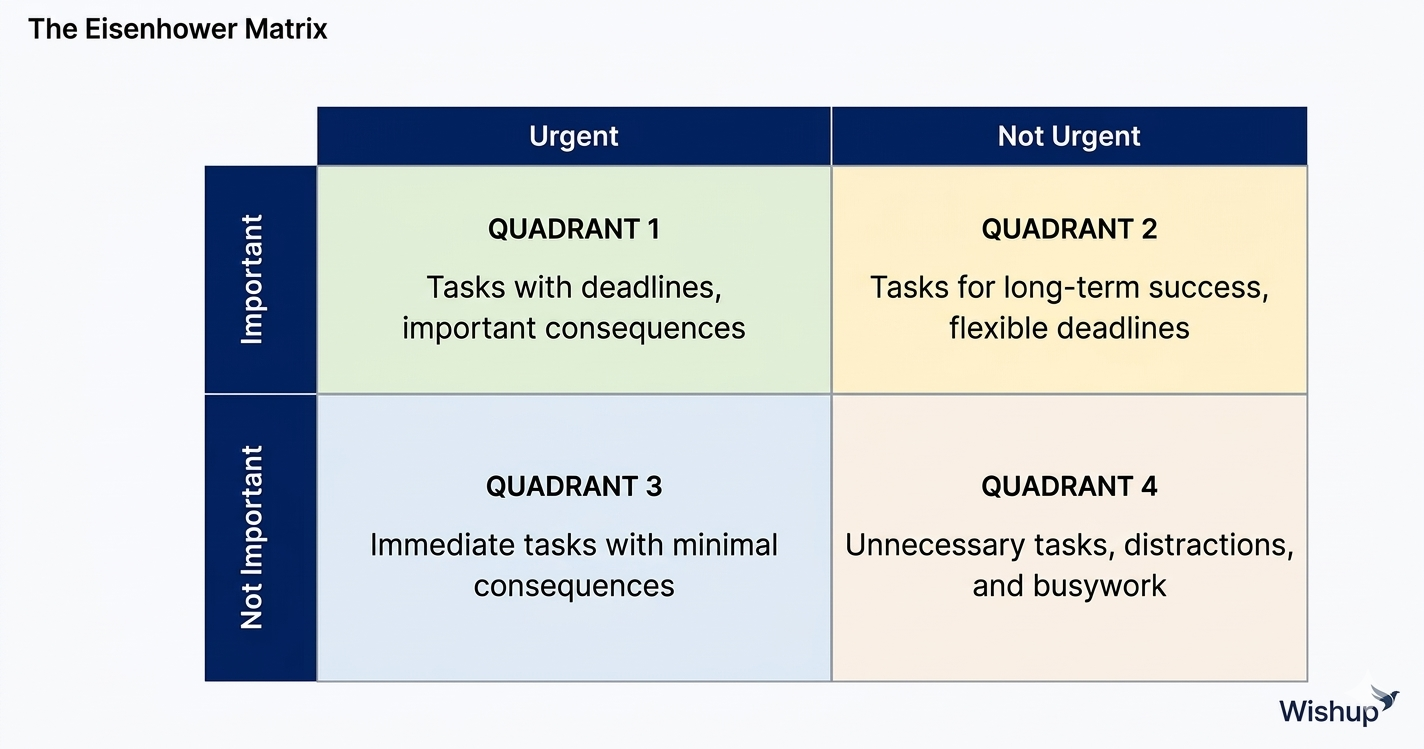
Use the Eisenhower matrix as a pre-check before the delegation decision tree. Anything in the "urgent but not important" quadrant, the bottom right, gets delegated immediately, regardless of how tempting it is to do it yourself. Anything "important but not urgent" gets systemised with an SOP so your VA can own it over time.
The Five Levels of Delegation for CEOs (And How to Actually Use Them)
Most CEOs either over-delegate (throwing things over a wall) or under-delegate (asking for constant check-ins). The five-level framework gives you a precise dial.
In practice: most CEOs only operate at Level 1 or 2. The goal isn't to jump straight to Level 5: it's to consciously move people up one level at a time as they prove themselves.
Before Level 1, If a task can be handled without any human involvement, data entry, appointment reminders, email routing, report generation, automate it with Zapier, Make.com, or n8n before bringing a VA into the equation. Automation is Level 0. Your VA manages and monitors the automation layer, not replaces it.
The 3-Step Delegation Handoff
Every delegation needs three things: the what, the why, and the 'done.' Skip any one of them, and watch it fall apart.
Step 1: Define the Outcome
Define the outcome; describe exactly what 'done' looks like, not how to get there. Not how to get there.
Step 2: Explain the Why
Give context before giving the task; context enables judgment; without it, they guess. Without it, they're just guessing.
Step 3: Set Check-In Points
Not daily check-ins. Just milestones.
| Category | Bad Delegation | Good Delegation |
|---|---|---|
| Outcome | "Handle the marketing stuff" | "Get me three campaign options with budgets by Thursday" |
| Why | None given | "We need to hit Q2 targets and we're currently 15% behind" |
| Check-ins | "Just let me know how it goes" | "Quick sync Tuesday. Final deck Thursday morning." |
Combine all three steps into a single task brief, a one-page document your VA receives before starting any new responsibility. A task brief includes:
- The outcome in one sentence,
- The why in one sentence,
- The tools required,
- The deadline, and
- The two check-in points.
Wishup VAs are trained to work from task briefs from day one, no lengthy onboarding required.
CEO Delegation Decision Matrix
Use this matrix before assigning any task. Run it top to bottom, stop at the first match.
Delegate it to a Wishup VA →
The Delegation Hangover (And How to Push Through It)
The first two weeks after delegating feel terrible. That's normal.
You'll want to take it back. You'll see mistakes. The output won't match your quality. Not yet, anyway.
Research shows managers spend 14% of their time redoing delegated tasks (Harvard Business Review). That stings. But here's what that stat doesn't tell you: that rework cost is a training investment, not a failure. If you keep taking stuff back, you'll be doing it forever.
Push through it. Here's how:
- Set a 'no-takebacks' rule. Two weeks minimum. No exceptions.
- Aim for 80% good enough. It doesn't need to be your quality. It needs to be done.
- Give feedback that builds capability, avoid corrections that just fix the output. Help them improve. Don't just fix it yourself.
- Remember: the first attempt is always the worst. The third time, they'll surprise you.
You're not lowering your standards. You're building someone else's capability. Those are very different things.
5 Delegation Mistakes That'll Cost a CEO
The biggest one? Delegating the task but keeping all the authority. You hand off the work, but still approve every tiny decision. That's not delegation. That's outsourcing your admin.
Mistake 1: Delegating tasks but not decisions
If they need your sign-off on every small call, you've added a middleman. You haven't freed up any time. Fix: define the decision boundaries before you hand anything over.
Mistake 2: Wrong person for the job
Skill mismatch kills delegation every time. You can't hand a complex financial analysis to someone who's never done one. Fix: match the task complexity to their proven track record.
Mistake 3: No clear 'done'
Define success before delegating, skip this and both you and your VA fail. You'll be disappointed. They'll be confused. Everyone loses. Fix: one sentence that describes exactly what the outcome looks like.
Mistake 4: Checking in too often
Daily check-ins aren't delegation. That's micromanaging with extra steps. It destroys their confidence and wastes your time. Fix: set two check-in points max and stick to them.
Mistake 5: Never checking in at all
That's not delegation; that's abdication. You've just thrown work over a wall. Fix: Schedule brief milestone reviews. Stay informed without hovering.
How to Know Your Virtual Resource is Ready for More?
They stop asking for permission and start asking for feedback. That's the shift. Watch for it.
Signs they're ready to move up a level:
- They bring solutions, not just problems
- They ask 'what do you think?' not 'what should I do?'
- They handle unexpected issues without panicking
- Their output quality is consistently above 80%
Red flags they're NOT ready yet:
- They need detailed instructions for every single task
- The same mistakes keep happening over and over
- They don't ask questions. That means they're guessing!
- They escalate everything straight back to you
Readiness isn't about tenure or titles. It's about behavior. Watch what they do when things get messy. That tells you everything.
How to Delegate to Virtual Assistants in Remote and Hybrid Teams?
Learning remote outsourcing of tasks works pretty much the same way. You just need better documentation.
Async communication matters more than you think. Written SOPs replace the verbal hand-offs you used to rely on. You need shared dashboards, not another status meeting nobody wants.
An SOP (Standard Operating Procedure) is the written version of your delegation handoff, the task brief made permanent.
Every recurring task your VA owns should have a one-page SOP within 30 days. Wishup clients who document SOPs in the first 30 days report 40% faster VA performance improvement than those who don't.
- Use Loom to give context without scheduling a call
- Drop everything into a shared project board so your team has visibility
- Weekly async updates beat daily standups every single time
The CEO's Weekly Delegation Check-In
The fastest way to find delegation opportunities is a weekly time audit — 30 minutes every Friday reviewing every task you touched that week against a single question: did this require my judgment, or did I just do it because it was faster?
Open your calendar and task list. Flag every task someone else could have owned, then track this for four weeks. Be brutally honest with yourself.
Then ask yourself one question: 'Did I do this because only I can? Or because I didn't trust anyone else?'
Track this for four weeks straight. You'll find 30-40% of your time goes to work you could've handed off. Gallup research shows CEOs spend 47% of their time on short-term issues, which is almost half their week buried in execution when you should be doing strategy.
The ROI of Getting Delegation Right by CEOs
Gallup research shows that high-delegating CEOs achieve 33% higher revenue. That's not a rounding error. That's a strategy.
The top CEO performers hit 1,751% average three-year growth, and delegation was a core driver. Meanwhile, 47% of CEO's time currently goes to issues under one year out. That's reactive, not strategic.
Make it personal. What would you do with 10 extra hours a week?
- Strategy sessions that actually move the needle
- Client relationships you've been neglecting
- Product thinking you keep pushing to 'next quarter'
- Or just sleeping more
All of those are better than formatting reports. Every single one.
The math on delegation is simple: your time has a dollar value, and the cost of bad delegation is expensive. So, do the math and act right.
Get Started with Delegation Today!
Delegation only works when the right tasks go to the right people, and that starts with having the right people in place. If you're a founder still doing work your team should be handling, the fastest fix isn't a better system.
It's better support. We match CEOs and founders with top 0.1% virtual assistant talent - all pre-vetted, remote-ready, and trained to take work off your plate from day one. Stop being the bottleneck.
Hire a Wishup VA →
Hire an Automation Expert VA →
See full pricing →
Frequently Asked Questions
1. What tasks should a CEO delegate first?
Recurring tasks are the highest-priority delegation targets, anything you do every week that doesn't require your specific expertise. Inbox management, scheduling, report formatting, vendor follow-ups, and data entry are the most common. If it repeats on a schedule and follows a process, delegate it on day one.
2. What is the best delegation framework for CEOs?
The clearest one: define the outcome, explain the why, and set two check-in points. That's it. Most delegation problems come from skipping one of those three steps. Everything else is noise.
3. What are the 5 levels of delegation?
Level 1 is 'do exactly this.' Level 2 is 'research and bring options.' Level 3 is 'decide and tell me.' Level 4 is 'decide and act, update me later.' Level 5 is 'full ownership, no update needed.' Match the level to their readiness, and move people up deliberately, not by default.
4. What should CEOs never delegate?
Vision, culture decisions, top-tier relationships, and true crisis calls. These define what the company is. No one else can own them for you. If you're not sure whether something qualifies, ask: 'If this goes wrong, does it change who we are?' If yes, keep it.
5. How do you avoid micromanaging after delegating?
Set two check-in points and only use those. Don't check in between milestones. If you trust them enough to delegate, trust them enough to work. The urge to check in is almost always about your anxiety, not their performance.
6. What is the 70% rule in delegation?
If someone can do the task 70% as well as you, delegate it. Your time is worth more on higher-value work. Waiting for 100% match means you delegate nothing. And here's the part people miss: with practice, they'll get to 90%, and occasionally surpass you entirely.
7. How do you delegate decisions, not just tasks?
Define the decision boundaries upfront. Tell them exactly what they can decide alone and what needs your input. Then step back and let them use it. The biggest mistake I see here is CEOs who delegate decisions verbally but then override them in the moment, which teaches their team that the delegation was never real.
8. How do you know if someone is ready for delegation?
They bring solutions without being asked. They handle surprises without escalating. Their output is consistently solid. Those three behaviors together mean they're ready for more responsibility. Tenure and title are almost irrelevant.
9. What's the biggest delegation mistake CEOs make?
Handing off the task but keeping all the decision-making authority. It creates a bottleneck with extra steps. Real delegation means real authority to act. I call this 'shadow ownership', and it's more common than any CEO wants to admit.
10. How long does it take to see results from delegation?
Expect two to four weeks of rough output. That's the learning curve. By the third or fourth cycle, quality improves significantly, and your time opens up noticeably. The CEOs I've worked with typically reclaim 8-12 hours per week within 60 days of committing to this framework.
11. What is the fastest first step to start delegating as a CEO?
Run a time audit for one week, log every task you touch and mark anything that doesn't require your unique judgment, key relationships, or creative vision.
Everything marked goes into a task brief and gets handed to a VA within 30 days. Wishup CEOs who do this exercise typically identify 8–12 hours/week of delegatable work in the first session.
Get 3 time-wasting business tasks automated — free.