Summary - TL;DR
- Distributed admin teams, outperform centralized in-house support on speed, cost, and coverage. Atlassian proved it. Amazon, IBM, and Google built GCCs around it.
- One such low-cost alternative is hiring EAs and VAs spread across time zones.
- They handle calendars, inboxes, CRM, board prep, travel, and vendor comms, freeing executives to actually lead.
- Three models work: Hub-and-Spoke, Department Pods, or Executive-Dedicated VAs. The right one depends on your structure
Wishup places pre-vetted, NDA-bound VAs with your team in 60 minutes.
1000 days! It took 1000 days for Atlassian to understand that distributed work is indeed considered a deliberate operating model. Instead of relying on constant office attendance, Atlassian used structured workflows, intentional in-person meetups, and a flexible workplace model to help teams perform at scale.
A distributed team model is a way of organizing work where team members operate from different locations instead of one central office, but still function as one coordinated team.
By fully distributing work across its global teams, 92% of Atlassians reported better work output, 27% higher connection from 3-4 annual in-person gatherings that lasted 4-5 months, and highly distributed teams with 4+ overlapping hours being most effective.
Atlassian, being a Fortune 1000 company, has taught us a clear lesson: when designed properly, distributed admin support is not just a cost-saving decision. It becomes a scalable way to improve execution, responsiveness, and operational continuity across the business. Therefore, in this blog, we will create a blueprint for you on:
- What a distributed team is,
- Why Fortune 1000 companies rely on distributed admin support,
- What the distributed admin team actually handle in terms of work,
- How Fortune 1000 companies have created three models to cater to their needs,
- Finally, how Wishup fits into all this.
What Is a Distributed Admin Team?
A distributed admin team is a business support function made up of executive assistants, administrative coordinators, operations support staff, and back-office specialists who work across locations, time zones, or delivery hubs while supporting the same leadership team or business unit.
In most Fortune 1000s, these teams are no longer limited to working on calendar management or travel booking.
Administrative professionals are required to handle complex project coordination, cross-functional communication, data preparation, and workflow support that directly affects how leaders make decisions and how fast teams execute.
Why Fortune 1000 Companies Rely on Distributed Admin Support?
A report revealed that Fortune 1000 organizations can avoid 22,000 hours in annual business and IT labor costs through automation and reduce helpdesk tickets by as much as 78,000 per year.
This reinforces a broader operational truth: when repetitive support work is systematized and distributed well, large companies reclaim a meaningful amount of time and reduce internal friction.
Let us go through why distributed administrative support matters for Fortune companies.
1. Scalability for High-Volume Tasks
It is no surprise that large enterprises mostly deal with massive, complex tasks. It may range from managing distribution lists with tens of thousands of members to processing huge volumes of data.
Such tasks require dedicated, distributed support to manage effectively.
2. Access to Specialized Global Talent
Rather than being limited to local talent markets, companies can tap into global talent pools to find highly skilled professionals for specific tasks, including IT outsourcing and specialized administrative support.
Many companies outsource, and many Fortune companies choose an offshoring model that suits their purpose the most.
3. Cost Efficiency and Reduced Overhead
Distributed teams allow companies to reduce costs associated with in-house staff, such as office space, benefits, and training, making high-level support more cost-effective.
Companies such as Amazon, IBM, Deloitte, and many others have GCC centers in India that have proven cost-effective for them.

4. Get On-the-clock Support
Distributed teams across different time zones allow for continuous operations. Take the support team from the Philippines as an example.
The country is 13 hours ahead of US Eastern and 16 hours ahead of US Pacific. Compared to this, India is 10.5 hours ahead of US Eastern and 13.5 hours ahead of US Pacific. Nearshoring countries like Latin America will have a time difference of 0 to 3 hours.
This global delivery model also enables a follow-the-sun approach, allowing administrative work to continue across time zones so support stays active beyond standard business hours and overall productivity improves.
5. Adaptability and Technology Adoption
Distributed support staff are often well-versed in digital tools (e.g., Salesforce, AI tools, or Active Directory management) that enhance security and streamline workflows across large organizations.
Moreover, NTT DATA and similar boards launched a new GCC Innovation Acceleration Program to help GCCs to scale in terms of digital transformation and AI revolution.
For large-scale corporations, distributed support is not just about cost savings; it is a strategic approach to building a more flexible, productive, and technologically adept organization. But what tasks can they really handle? Let’s find out.
What Work Distributed Admin Teams Actually Handle?
In Fortune 1000 environments, distributed admin teams typically handle the recurring coordination work that keeps executives, departments, and customer-facing teams moving without interruption.
Let’s go through the use cases of how Fortune 1000s use distributed teams:
1. Calendar and Scheduling
The teams handle cross-time-zone scheduling for C-suite leaders, board members, and external stakeholders. Apart from that, meeting prep, agenda coordination, and follow-up documentation fall under this criterion of tasks as well.
2. Inbox and Email Management
Triaging hundreds of emails a day is a dreadful task no one wants to do. Prioritizing what reaches the executive and requires drafting responses is something that cannot be left to the AI.
It needs human intervention. Additionally, a VA can flag anything time-sensitive. With such an exhaustive list of tasks getting completed, you fulfil the goal of inbox zero without the executive ever touching it.
3. Board and Executive Meeting Prep
Who doesn’t need help with compiling briefing documents, pulling reports, formatting decks, and coordinating pre-reads?
The executive assistant can easily do everything the executive needs to walk into the room prepared as part of the distributed admin team.
4. CRM Hygiene and Pipeline Admin
Decluttering the CRM would not only save you time but also give you knowledge on what to prioritize. Maintaining CRM hygiene includes a VA to update contact records, log calls, track follow-ups, and keep Salesforce or HubSpot clean.
The work that every sales leader knows matters, but nobody wants to do it manually, will be done by the distributed admin team member.
5. Vendor and Supplier Communication
Eschewing communication can disrupt the whole business flow in certain industries, where vendors and suppliers are an integral part.
Following up on contracts, coordinating timelines, managing vendor onboarding paperwork, and tracking deliverables. The operational glue that holds procurement together.
6. Research and Competitive Intelligence
A VA can perform market research, competitor monitoring, and industry briefings that will be delivered as a clean summary, not a raw data dump. The executive reads the insight, not the raw material.
7. Travel Coordination
The tasks would include end-to-end travel management, flights, hotels, transfers, itineraries, visa documentation, backup plans executed seamlessly across multiple executives, multiple trips, and multiple time zones.
8. Internal Communications and Coordination
Drafting internal announcements, managing meeting follow-ups, and coordinating across departments on behalf of leadership requires one to have a grasp on what the industry demands and how to integrate it within the workforce culture.
The invisible thread that keeps large teams aligned is something most VAs and EAs have mastered.
Learn about 100+ tasks you can delegate before hiring full-time.
None of these tasks requires an executive. All of them consume executive time when there's no one else to handle them. That's the gap distributed admin teams exist to close. But how do these tasks get distilled within the structured model? This is….
How Fortune 1000 Companies Actually Structure Distributed Admin Teams
The shift has already happened. The question now is: how are the biggest companies actually building these distributed admin structures?
Let’s go through the models.
Model A: The Hub-and-Spoke Model
This model requires one senior, in-house admin to sit at the center. They will run the strategy, institutional knowledge, and executive relationships.
Everything else, scheduling, inbox management, research, travel, and documentation, will get pushed out to a distributed layer of virtual assistants.
Because it separates thinking from doing. The hub sets the standard. The spokes execute it. No bottlenecks. No single points of failure. If one VA is unavailable, another picks it up without the executive ever noticing.
This is the model most C-suite teams gravitate toward when they first go distributed. It's the lowest-friction transition from a traditional setup.
Model B: Department-Level Distributed Admin Pods
Here, each business unit or department gets its own dedicated admin pod. The marketing team has its VA. The operations team has its VA. The finance team has its own.
Admin support that actually understands the context it's working in. A VA embedded in a marketing pod knows the campaign calendar, the agency contacts, and the brand guidelines. They're not starting from scratch every week.
Fortune 1000 companies that run this model report faster turnaround times and fewer communication errors, because the VA isn't context-switching between five different departments with completely different priorities.
Model C: Executive-Dedicated Virtual Assistants
This is exactly what it sounds like. Every VP, SVP, or C-suite leader gets their own dedicated virtual assistant and creates a framework.
Not a shared resource. The VA will be a single, accountable person who knows your preferences, priorities, and the working style.
Companies running this model treat their VA the same way they'd treat a chief of staff. The VA manages the calendar, preps the briefings, coordinates the travel, handles the communications, and proactively flags anything that shouldn't reach the executive's desk.
At Wishup, this is the model most enterprise-adjacent clients graduate into. Because when you give your best people great admin support, they stop wasting time and start actually leading.
Check out How Much Does an Executive Assistant Cost in 2026; a full breakdown of real costs vs. value.
However, apart from achieving tangible results, there’s more to what Wishup can do. Here’s….
How Wishup Fits Into the Fortune 1000 Admin Model
Here's the thing about enterprise-grade admin support: the bar is always set higher.
Data security and reliability become a non-negotiable factor. Accountability does not just translate into a Jira ticket, but something that builds trust and fosters connection. Wishup was built for exactly this.
1. Pre-vetted, trained, and tool-ready from day one.
Every Wishup VA clears a 10-stage hiring process that accepts 0.1% of applicants.
Before they're placed with a client, they complete a minimum 8-week training program across 15+ modules that include AI tools, no-code platforms, communication standards, and professional accountability.
You get someone who is operational on day one, not week six.
Read our blog on “Inside Our Rigorous 8 Weeks Program (And Why Only 0.1% Make the Cut)”.
2. Data security is non-negotiable.
Every Wishup VA signs an NDA before being assigned to a client.
The platform is built for environments where sensitive information, starting from financials, executive communications, vendor contracts, and strategic plans, passes through admin hands daily.
Enterprise teams don't have to choose between convenience and confidentiality. With Wishup, they get both.
3. Dedicated management, not a marketplace.
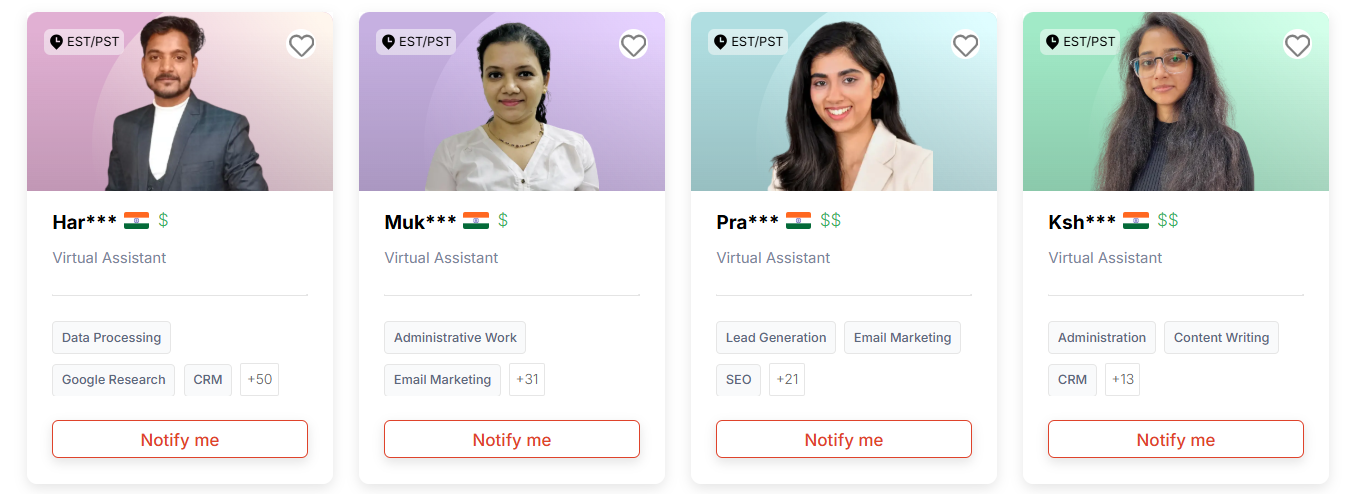
Wishup isn't a freelancer platform where you post a job and hope for the best. Every client gets a dedicated VA and a dedicated CSM, a Client Success Manager, whose job is to make sure the relationship works. If there's a performance issue, you don't raise a ticket. You make a call.
4. Tool proficiency across your entire stack.
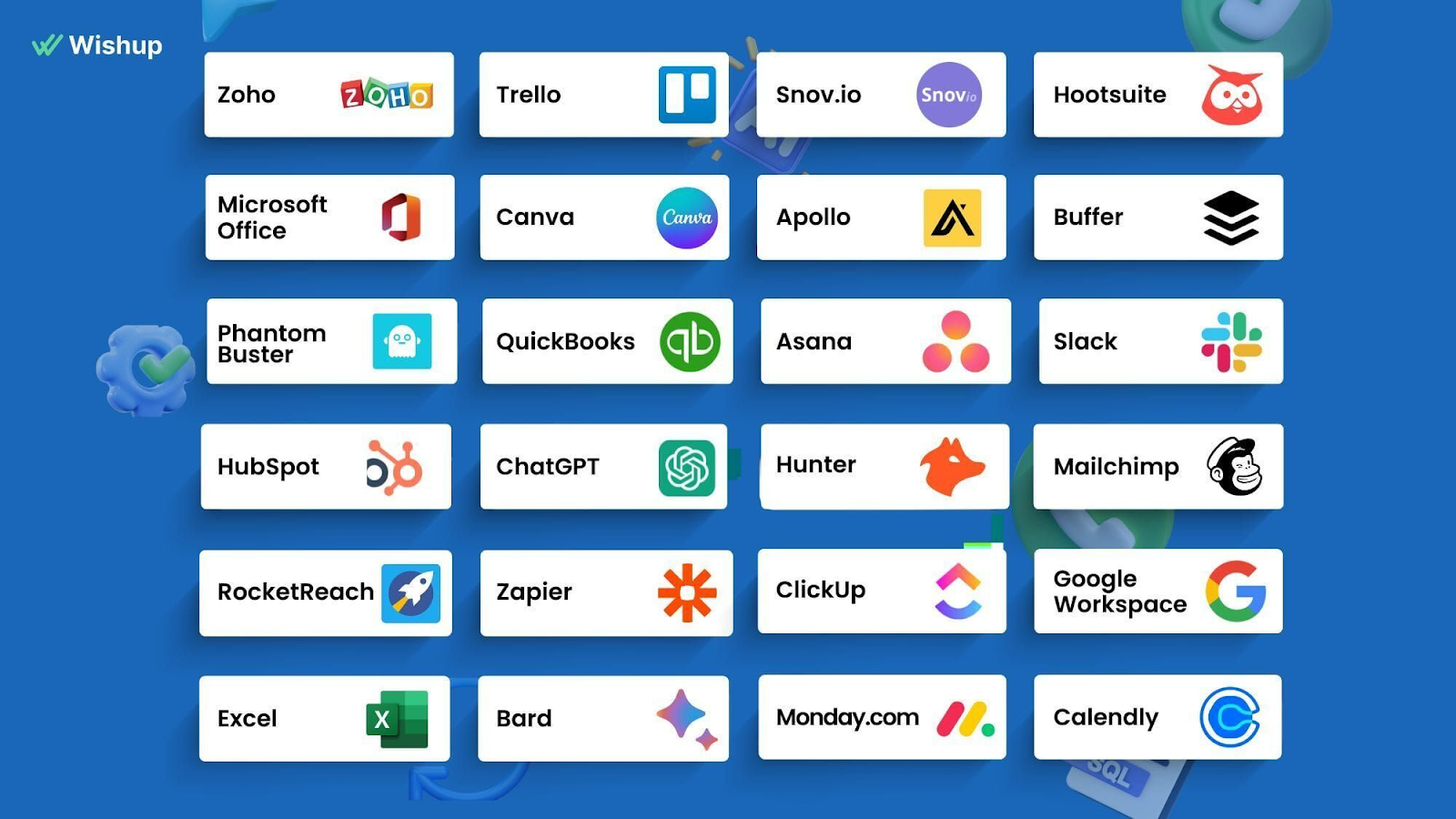
Salesforce. HubSpot. Notion. Asana. ClickUp. Google Workspace. Microsoft 365, you name it, our VAs have mastered it. Wishup VAs are trained on 200+ AI tools and 70+ no-code platforms to deal with issues at any time. They work inside your existing systems, not around them.
5. Onboarding in 60 minutes, not 60 days.
Most enterprise hires take months. A Wishup VA is matched, briefed, and operational in under an hour. For teams that need support now, not next quarter, that speed is a material advantage.
6. Flexible at enterprise scale.
One VA for a VP. A pod of three for a business unit. Dedicated support across the entire leadership team. Wishup scales to the structure you need, not the structure you're forced into.
What to Look for When Building a Distributed Admin Team
Whether you're working with Wishup or building your distributed admin model from scratch, the checklist is the same. Get these right, and the model works. Miss one, and you'll feel it.
1. Tool proficiency across your stack
Your VA should work inside your systems, not need to be trained on them from zero. Look for tool proficiency across the stack your business owns, along with some basic tools.
2. Async-first communication
If everything requires a live call to get done, your distributed model isn't actually distributed. Look for people who share information in a way others can read and act on later, without needing a live meeting or instant reply. That usually includes:
- Written updates
- Documented processes
- Recorded explanations
- Task comments
- Shared dashboards
- Clear handoff notes
3. SOP documentation from day one
Every recurring task needs a written process. If it's not documented, it's not transferable. Start documenting SOPs from day one.
In distributed teams, recurring work cannot depend on memory or informal handovers. If a process is not documented, it becomes difficult to delegate, standardize, or scale.
4. Data security protocols and NDAs
It is a non-negotiable. Every VA who touches sensitive information should be contractually bound before they start. Wishup ensures that all their VAs sign NDAs and maintain confidentiality, as well as protect data security protocols.
5. Time-zone coverage that matches executive schedules
The support structure should follow the executive's day, not the other way around. The support setup should be designed to match the executive’s schedule. Coordination, communication, and follow-ups happen when they are needed, not hours later.
6. A clear escalation path
The VA should know exactly what they own, what they flag, and who they contact when something needs a decision. A clear escalation path should be designed.
7. A human accountability layer
Managed VA services like Wishup include a dedicated manager. Freelancer marketplaces don't. Know which one you're buying.
8. Replacement coverage without disruption
If a VA is unavailable, what happens? The answer should not be "your executive manages their own inbox." If one assistant is unavailable, the workflow should continue smoothly through documented processes and replacement support.
You must check these eight things. Most enterprise teams check two or three before hiring, but all eight will indicate accountability, ownership, and intelligence. The ones that check all eight are the ones that make distributed admin work long-term.
Here's a 90-day framework for assessing remote operations partners built specifically for large enterprises.
Wrapping Up: Fortune 1000 Companies Already Know This. Now You Do Too.
The largest companies in the world didn't stumble into distributed admin teams. They moved there deliberately because the math was clear, the operational upside was undeniable, and in-house-only structures couldn't keep pace with how fast these organizations needed to move.
The distributed model isn't a workaround. It's the evolved operating standard.
And the good news? You don't need a Fortune 1000 budget or a Fortune 1000 team to operate like one.
With Wishup, you can have a pre-vetted, tool-trained, NDA-bound virtual assistant supporting your executive team in 60 minutes. Not next quarter. Not after a months-long hiring process. Today, learn the benefits of hiring a VA!