
Summary - TL;DR
- Offshore shared service models have evolved from cost-cutting tools into strategic global delivery frameworks.
- US enterprises in 2026 choose from four models, GCC, BOT, Hybrid, and VCC, based on control, budget, and speed.
- India leads destinations for talent depth; Latin America leads for time zone overlap.
- The right model depends on four questions: control needs, setup runway, function type, and internal leadership capacity.
Wishup gets you offshore-ready in 60 minutes: pre-vetted top 0.1% talent, fully managed, starting at $9.99/hr.
Offshore operations are no longer a fringe strategy for cost reduction. For many US enterprises, they have become a core part of how global operations are designed.
A 2024 Deloitte Global Outsourcing Survey of more than 500 business leaders found that nearly 80% of organizations plan to maintain or increase their third-party outsourcing investments in the coming years.
Among large corporations, the shift is even more pronounced. Today, over 60% of Fortune 500 companies operate offshore shared service centers to support finance, HR, IT, customer support, and operational workflows.
Read: Cost of Building Offshore Shared Services in India →
These numbers reflect a broader shift in how US enterprises view global operations.
The offshore shared service model that once focused primarily on labor cost reduction is evolving into something broader: a structured global delivery framework that provides access to skilled talent, operational agility, and round-the-clock execution capacity.
While cost efficiency still matters, 34% of leaders say it remains a primary driver; enterprises are increasingly building offshore capability for access to specialized skills, operational flexibility, and scalable talent pools.
This is why countries like India have become strategic hubs for offshore shared service models.
We'll walk you through
- The four offshore shared service models US enterprises are actively building,
- The destinations winning enterprise mandates in 2026, and
- How to choose the right model for where your organization is today.
- How Wishup fits into all this!
What Is an Offshore Shared Service Model and How Is It Different from Simple Outsourcing?
If you've used the terms "outsourcing," "offshoring," and "shared services" interchangeably, you're not alone, but in 2026, the distinctions matter more than ever, especially when you're making a decision that will shape how your enterprise delivers work for the next decade.
Here's a simple way to think about it:
Traditional outsourcing is transactional. You hand a vendor a function, say, payroll processing or IT helpdesk, and they run it with their people, their tools, and their processes. You buy an outcome. You own very little of what produces it.
Staff augmentation is additive. You bring in external talent, usually individual contributors, to plug gaps on existing teams. It's flexible, but it's not a model. It's a hiring workaround.
An offshore shared service model, on the other hand, is structural. You're either building or having someone build on your behalf a dedicated, integrated delivery function in another geography.
The talent is aligned with your culture. The workflows are designed around your systems. The intellectual property, the institutional knowledge, and the capability stay with your enterprise.
So what separates shared service models from everything else?
Ownership of capability, not just output.
Offshore shared service centers, whether fully owned, partner-managed, or hybrid, are now being treated as long-term strategic assets. The question in 2026 is no longer whether to build an offshore shared service model.
For most mid-to-large US enterprises, that decision has already been made. The real question is which model to build, and how.
Shared Services vs Outsourced Support: What US Enterprises Actually Choose in 2026 →
Key Drivers Behind the Shift Toward Outsourcing
The decision to build an offshore shared service model in 2026 is rarely driven by a single factor. For most US enterprise leaders, it's the convergence of several pressure points happening simultaneously. Here are the four forces accelerating the shift right now.
1. The US Talent Shortage Has Become a Structural Problem
According to ManpowerGroup's 2026 data, 71% of U.S employers face talent shortages and are experiencing significant hiring challenges. Finding good talent in the US is getting harder.
Skilled professionals in finance, IT, HR, and data are in short supply. When they do show up on the market, they're immediately picked up by larger companies offering salaries most enterprises simply can't match.
So what do smart companies do? They stop fishing in the same pond. Offshore shared service centers fix this permanently. You're not patching a gap. You're expanding your talent pool in a real, lasting way.
2. Digitisation and AI Are Changing What Offshore Teams Actually Do
The pressure to modernize the workforce sometimes outpaces the local talent supply. Offshore teams are no longer back-office order-takers. In 2026, outsourced professionals work as an extended unit of the internal team.
Enterprises aren’t just evaluating offshore partners solely on price; they are assessing their ability to deliver specialized talent, drive automation, manage risks, and enable digital transformation at scale.
A McKinsey research has shown that organisations with strong execution capabilities are able to achieve 1.3x higher revenue growth than their peers.
This goes on to show that what the employers are trying to achieve through offshore shared services models is continuous upgradation according to what the market demands.
3. Scaling Without Blowing Up Headcount Costs
U.S. Bureau of Labour Statistics revealed that over the year, total compensation has rose 3.4%, while wages and salaries rose 3.3%, and benefit costs rose up to 3.4%. In a volatile 2026 economy, fixed-cost domestic headcount is a liability.
An offshore model provides enterprises and SMBs the flexibility to scale up or down without the friction of traditional hiring and layoffs.
4. Geopolitical and Economic Pressure to Diversify Delivery
Single-location dependency, whether domestic or offshore, is increasingly seen as an operational risk. It is all about diversifying the outsourcing footprint to reduce risk and increase continuity.
Moreover, by distributing operations across multiple locations rather than relying on a single region allows business to to access high-quality global talent wherever it exists.
5. Strengthening Operation Stability by Offshoring
What each business demands is operational stability and a strategy to perfectly execute it without exceeding the cost. When the need for extra capacity arises, outsourcing allows such organizations to fill roles without bearing the extra cost.
This resourcing model supports stability and sustainability while the leaders can remain focused on what matters the most.
Together, these five drivers explain why offshore shared service model building has gone from a CFO-led cost initiative to a board-level strategic priority.
The Four Offshore Shared Service Models US Enterprises Are Using
Not all offshore shared service models are built the same. The right model for your enterprise depends on how much control you want, how fast you need to move, how much upfront investment you can absorb, and what your long-term ownership goals look like.
In 2026, US enterprises are primarily choosing from four operating models.
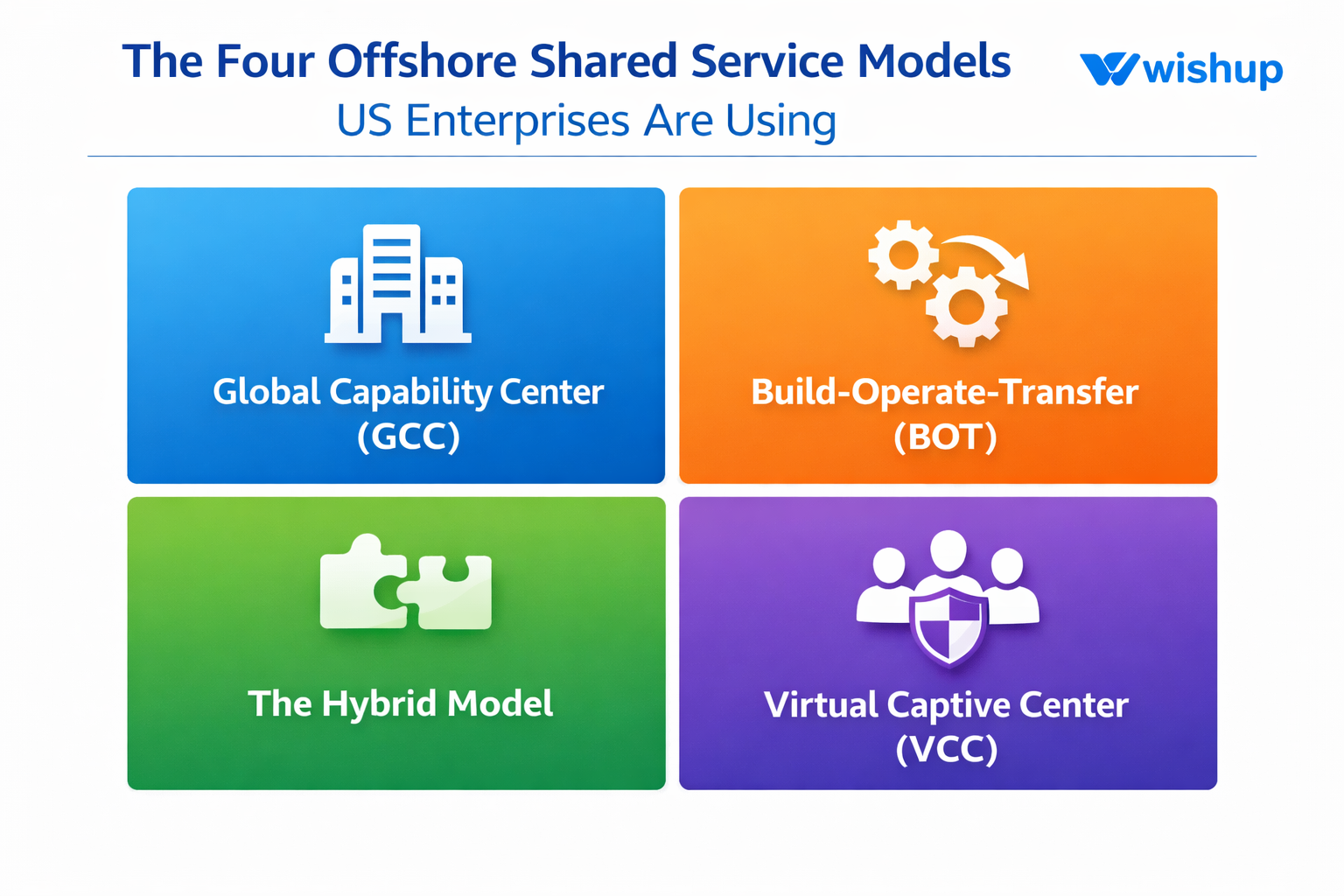
Here's what each one looks like in practice.
Model 1: Global Capability Center or GCC
A Global Capability Center, be it an offshore or nearshore subsidiary, is fully owned, funded, and operated by a parent company, rather than being outsourced to a third party.
It allows enterprises to maintain full control over management and governance with the goal of cutting through operational costs.
GCC, although clearly developed for the sake of cost saving in the early ‘10s, is now driving organization-wide innovation, digital transformation, and contributing directly to revenue growth.
Enterprises that have mature offshore experience, strong IP sensitivity, or functions like Finance and HR that require deep cultural and compliance alignment can consider establishing GCC.
Microsoft, Amazon, and Google can be considered as great examples of GCCs established in India’s prime locations.
Model 2: Build-Operate-Transfer or BOT
BOT refers to an outsourcing strategy where a third-party partner builds and operates an offshore subsidiary (e.g., IT, R&D center) for a set period before transferring full ownership and management to the client.
The build-operate-transfer or BOT model surged in the early ‘00s; it was in the mid-2010s, it recorded a significant boom in its adoption. This model allowed enterprises to enter new markets and geographies, primarily for labor arbitrage.
Although the favour fell out of favour once many giants in the field started creating their own delivery footprint. It is because of the ascension of digital transformation that renewed interest in BOT once again arisen.
The model runs in three phases:
- Build phase: The service provider sets up the offshore unit, including office infrastructure, legal compliance, talent hiring, and IT setup.
- Operate phase: The provider runs the offshore operation. It ensures smooth workflows, project execution, and talent management.
- Transfer phase: Complete ownership of the offshore unit is handed to the parent company.
Enterprises that want to enter a new offshore geography for the first time, or those that want captive-level control without the full upfront risk of building independently, can go for the BOT model.
Take GE, for example. It used the BOT approach to modernize its IT landscape
Model 3: The Hybrid Model
The hybrid model of offshoring combines in-house, local teams with external, offshore, or nearshore teams to balance cost savings with quality control.
In practical terms, it means the enterprise, SMBs own and executes high sensitivity functions, like financial reporting, data governance, or product engineering, while the vendor or partner manages all the supporting tasks like IT helpdesk, payroll processing, or customer operations.
The hybrid model comes with flexibility, so much so that the parent company can shift functions from partner-managed to internally owned as capabilities mature.
Enterprises managing a complex, multi-function delivery model, or those transitioning from pure outsourcing toward greater internal ownership over time, can try their hand at a hybrid model.
Take Amazon as an example. Amazon uses a hybrid approach involving on-site teams in Seattle for high-level decision-making and nearshore/offshore teams in India and Latin America for software development and customer support.
Model 4: Virtual Captive Center or VCC
This business model refers to a hybrid model of outsourcing that allows businesses to set up dedicated offshore teams that function as an extension of their in-house operations. It is considered to be the newest and up-and-coming model in this space that is practical for mid-size US enterprises.
It combines the control of a traditional captive center, fully owned by the company, with the flexibility and lower setup costs of outsourcing, often via a local partner handling infrastructure, HR, and admin.
Mid-size enterprises or those exploring offshore shared services for the first time, without the runway to immediately commit to a fully captive structure.
Decision Framework at A Glance
Why Businesses Will Hire More Offshore Staff
Numbers do not lie. The Outsourcing Services Market size is projected to be at $0.94 trillion in 2025, reach $1.02 trillion in 2026, and $1.35 trillion by 2031, with the CAGR expected to reach 5.77% from 2026 to 2031.
However, the case for building an offshore shared service model in 2026 goes well beyond labor cost arbitrage. The longer the model is in place and well-governed, the more value it delivers. Here are the five benefits that matter most.
1. Access to a Deep, Specialized Global Talent Pool
The domestic talent shortage is not a temporary problem. An offshore shared service model permanently expands the talent universe your enterprise can hire from.
It enables you to establish an integrated, branded team in a talent-rich region, while maintaining IP ownership, roadmap control, and operational standards under your jurisdiction.
You're accessing specialized expertise that simply doesn't exist at scale in your local market.
2. IP Protection and Control That Transactional Outsourcing Cannot Provide
One of the most persistent myths about offshore models is that they inherently increase IP risk. The opposite is true when the model is structured correctly.
An offshore shared service center operates under the same brand, rules, and policies as the parent company, giving the enterprise direct supervision over workflows, quality standards, and data governance.
Unlike traditional outsourcing, where a vendor controls the process and the people, a properly structured offshore shared service model keeps ownership of talent, processes, and output firmly with the enterprise.
Enterprise-grade security protocols, including ISO 27001 and SOC 2 compliance, GDPR and HIPAA adherence, signed IP protection agreements, data encryption, and regular security audits are now standard expectations in well-governed offshore centers, making IP protection as strong, or stronger, than many domestic setups.
3. Follow-the-Sun Operations and Faster Time to Market
Offshore models enable round-the-clock operations and faster project delivery by leveraging time zone differences for 24/7 support and continuous development cycles.
Digital Minds BPO For US enterprises with global customers, this isn't a nice-to-have; it's a service delivery expectation.
Functions like IT operations, customer support, financial reporting, and data processing that once required expensive domestic night shifts can now be handled by dedicated offshore teams operating within their standard working hours.
The result is a continuous delivery model that accelerates output without burning out your development team.
4. Freeing Your Core Team to Focus on What Matters Most
Perhaps the most underrated benefit of a well-built offshore shared service model is what it does to your onshore team.
When non-core, high-volume functions are handled by a structured offshore center, your domestic leadership and senior talent can redirect their energy toward strategy, innovation, and customer relationships.
You can say the right offshore shared service model doesn't just support your core business, it actively strengthens it.
Read: CEO Delegation Framework: The Honest Guide to Actually Letting Go.
Popular Offshore Destinations in 2026
Choosing where to build your offshore shared service center is as important as choosing which model to use. The right destination depends on the functions you're offshoring, the talent depth you need, your governance requirements, and how much time zone overlap matters to your teams. Here's where US enterprises are concentrating their offshore shared service investments in 2026.
1. India
India has become one of the top destinations for US enterprises for offshoring. The boom has been noticed due to India’s eagerness towards adaptability and acceptance of opportunities.
The most recent research has revealed that India's IT sector is experiencing significant growth driven by AI, GCC, and infrastructure expansion.
The total headcount in the Indian IT industry is estimated to reach approximately 5.95 million by the end of fiscal year 2026, with a net addition of 135,000 jobs.
Moreover, Global Capability Centres are considered a major driver. Let’s consider GCC’s ecosystem in India. Sources revealed that GCC is expected to touch $100 billion by 2030 and potentially employ 2.5 million professionals.
These centers are increasingly focused on high-end, strategic work such as engineering R&D, AI, and cybersecurity. Most major enterprise R&D centers are concentrated across Bengaluru, Chennai, Hyderabad, Pune, Mumbai, Delhi, and Kolkata. This stanfds evident of the fact that India's talent density is unmatched at scale.
--> Key cities: Bengaluru, Hyderabad, Pune, Chennai, Kolkata
2. Philippines
For US enterprises with significant customer-facing functions, the Philippines holds a position that no other offshore destination has managed to match.
The Philippines has 1.97M skilled workers, and has registered a 95%+ English proficiency, which allowed the workers there to bag customer-facing jobs with ease and professionalism that the West desires.
On top of strong English proficiency, the cultural alignment with American communication norms, and an established BPO infrastructure, make the Philippines the go-to destination for customer support, back-office operations, and shared service functions that require high-volume people engagement.
--> Key cities: Manila, Cebu, Davao
3. Eastern Europe
Eastern Europe excels in offshoring due to many reasons:
- Its skilled talent pools,
- Cost savings,
- Time-zone alignment with the US/EU,
- High English proficiency and
- EU regulatory compliance
All of this makes it ideal for IT, finance, and shared services. The country serves as a major technical hub, with Poland having 525,000+ ICT professionals; Ukraine has 300,000.
To add to it, 22,000 new ICT grads are annually produced in Ukraine alone, with the candidates having a strong background in AI, FinTech, and cybersecurity.
The IT outsourcing market recorded a whopping $5.34B by 2025; BPO revenue reached $4.44B in 2025; Europe's IT outsourcing $176.4B in 2024. All these numbers tell EU is ideal for mid-to-high complexity projects.
--> Key countries: Poland, Romania, Ukraine, Bulgaria
4. Latin America
Latin America is an up-and-coming and fastest-growing offshore destination for US enterprises that prioritize real-time collaboration alongside global talent access. There are many reasons why Latin America is considered to be a destination for offshoring,
- Time zone alignment
- Cultural and language compatibility
- Skilled bilingual workforce.
THE LATAM IT outsourcing market hit $70.85 billion in 2024 and is projected to reach $126.3 billion by 2030 with the 10.1% CAGR.
Colombia and Mexico have found success by offering expanding engineering and back-office talent pools while maintaining competitive wage structures, with Brazil's nearshore market growing quickly as well.
If you're evaluating partners for the long term, don't skip this: How to Evaluate a Remote Operations Partner for Large Enterprises.
--> Key countries: Mexico, Colombia, Brazil, Argentina
How to Choose Your Destination
How to Choose the Right Offshore Shared Service Model for Your Business?
You need to ask only four questions to choose the right offshore shared service model for your business.
1. How much control do you need from day one?
If your offshore functions involve sensitive IP, proprietary data, or compliance-heavy workflows, then you need a model that puts governance in your hands immediately. That points toward a Captive/GCC or a well-structured BOT with a clear transfer clause.
However, speed and flexibility are what you are expecting from day-one, a VCC or Hybrid model will give you operational momentum without the full upfront commitment.
2. What is your runway for setup and ramp-up?
Building a captive GCC takes 9 to 18 months from entity setup to full operational capacity. If your enterprise needs offshore delivery running within 60–90 days, a BOT or VCC model is a more realistic starting point.
3. Which functions are you offshoring first?
Not every function suits every model. High-volume, process-driven functions such as payroll, customer ops, and IT helpdesk can run comfortably under a VCC or hybrid structure.
But complex, IP-sensitive, or innovation-led functions such as data science, product engineering, and financial strategy typically warrant captive-level ownership from the outset.
4. Do you have the internal leadership to run an offshore center?
This is the question most enterprises skip and the one that causes the most expensive failures. A captive GCC without strong on-the-ground leadership in the offshore location is one of the most common and costly mistakes US enterprises make.
If that leadership doesn't exist internally today, a BOT model, where a partner provides operational leadership during the build phase, is a significantly lower-risk path.
A Quick Decision Framework
Building an offshore shared service model is a strategic undertaking: one that requires the right talent in place from the very first day of operations.
That is where Wishup.co comes in.
Wishup provides:
1. Rapid Access to Pre-Vetted Offshore Talent
Wishup removes the global talent sourcing and vetting burden.
- Only top 0.1% of applicants are selected through a multi-stage vetting process Wishup - USPs
- Assistants are aptitude-tested and communication-screened
- Talent is pre-trained in 120+ tools and AI workflows
This gives enterprises immediate access to skilled offshore operators without running their own recruitment engine.
2. Scalable Offshore Operations Without Fixed Headcount
One of the biggest advantages of offshore teams is the ability to scale operational capacity without increasing domestic payroll costs. Wishup allows enterprises to:
- Expand operational support without hiring full-time staff
- Scale teams up or down based on demand
- Reduce the burden of benefits, infrastructure, and HR management
This makes offshore support ideal for functions such as:
- Operations and administrative workflows
- CRM and data management
- Customer support coordination
- Research, reporting, and scheduling
3. Managed Workforce Support and Continuity
Managing offshore teams internally requires oversight across HR, payroll, training, and performance monitoring. Wishup provides managed workforce support so enterprises can focus on outcomes rather than administration. This includes:
- Dedicated workforce management support
- Performance monitoring and operational oversight
- Backup coverage and quick assistant replacement if needed
Wrapping Up
Offshore shared service models are no longer just a cost-cutting tactic. In 2026, they will have become a strategic way for US enterprises to access global talent, scale operations, and build resilient delivery structures.
Schedule a call with our experts now to bring the change!
FAQs
What is an offshore shared service model?
An offshore shared service model is a centralized operational structure where business functions such as finance, HR, IT support, and customer operations are delivered from an offshore location. Unlike traditional outsourcing, the enterprise retains control over workflows, processes, and systems while leveraging global talent to support operations.
How is offshore shared services different from staff augmentation?
Offshore staff augmentation involves hiring external professionals to temporarily support internal teams. An offshore shared service model, however, builds a structured delivery capability where teams operate as a long-term extension of the enterprise, managing defined functions and processes.
What functions are typically handled through offshore shared service centers?
Common functions include:
- Finance and accounting
- HR and payroll support
- IT helpdesk and technical support
- Customer operations
- Data management and reporting
- Research and operational support
Many enterprises also offshore advanced functions such as analytics, AI development, and engineering.
