
This breakdown looks at which industries use virtual assistants the most, what’s driving that demand, and what these patterns reveal about how businesses will operate going into 2026.
The 6 Industries Driving Nearly 80% of Virtual Assistant Demand
When you look at how Virtual Assistants are actually being used in 2025, one thing becomes very clear.
Most VA demand isn’t spread evenly across the economy.
It’s concentrated.
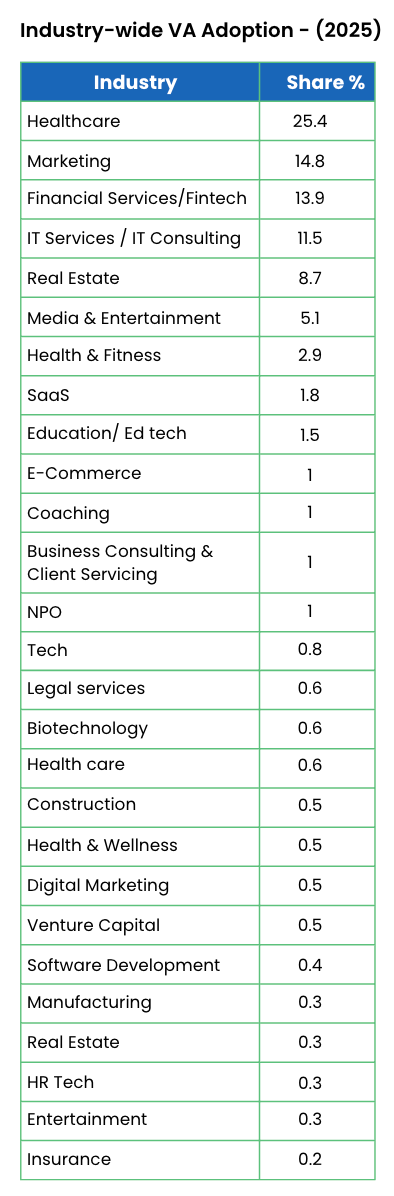
Just six industries account for nearly 80% of all VA usage. And that’s not random. These industries share one thing in common: too much operational work and not enough time.
Need Access to Full 2026 VA Report?
Get all the latest VA insights, trends, and AI predictions to stay ahead.
Let’s walk through them one by one—no jargon, just what’s really happening on the ground.
1. Healthcare (25.4%) — Where Admin Work Never Stops
Healthcare is the biggest user of Virtual Assistants by a wide margin. About one in four VAs works with a healthcare business.
And honestly, this makes total sense.
Doctors, clinics, and healthcare operators are drowning in admin:
- patient intake
- appointment scheduling
- insurance follow-ups
- medical records
- reports and documentation
- patient communication
Most clinicians didn’t sign up to do paperwork all day. But the paperwork keeps growing, and hiring in-house staff is expensive and slow.
So VAs step in and take over the repeatable, process-heavy work. Once a healthcare practice sets this up properly, it usually sticks. The VA becomes part of the workflow, not an experiment.
This category includes:
- independent doctors
- private practices
- telehealth companies
- healthtech startups
- rehab and wellness centers
Healthcare doesn’t just use VAs a lot. It uses them seriously.
2. Marketing (14.8%) — High Volume, Every Single Day
Marketing is the second-largest VA user, and the reason is simple: marketing never stops.
There’s always something to do:
- social media posts
- scheduling content
- Canva creatives
- email campaigns
- research
- influencer outreach
- reporting
- CRM updates
Even with AI tools, someone still needs to:
- prompt
- review
- format
- publish
- track results
That “someone” is often a VA.
Marketing teams don’t use VAs to replace strategy. They use them to keep execution moving. And because marketing work is repetitive and tool-based, VAs fit in easily.
This is why marketing VA demand has stayed strong—even as AI tools exploded.
3. Financial Services & Fintech (13.9%) — Built for Process
Finance is one of the most structured industries out there. That’s exactly why VAs work so well here.
VAs commonly support:
- bookkeeping
- reconciliations
- report preparation
- CRM maintenance
- lead qualification
- investor and client admin
- compliance documentation
What’s interesting about finance is that VA usage here is rarely temporary.
Once a finance team finds a VA who understands their systems and processes, they don’t let go. These relationships last.
This mirrors a bigger trend:
- fractional CFOs
- outsourced accounting
- remote finance teams
Finance doesn’t experiment with delegation. It operationalizes it.
4. IT Services & IT Consulting (11.5%) — Freeing High-Value Talent
IT teams don’t need help with coding. They need help with everything around it.
That’s where VAs come in.
In IT and consulting, VAs handle:
- documentation
- sprint coordination
- client reporting
- meeting management
- ticket triage
- proposals and research
- platform admin
- LinkedIn and brand ops
Every hour a senior developer or consultant spends on admin is expensive. VAs remove that drag.
This segment keeps growing because VAs today are digitally fluent. They can move across tools, dashboards, and platforms without hand-holding.
For IT teams, VAs are not support staff. They’re force multipliers.
5. Real Estate (8.7%) — Predictable Workflows, Daily Volume
Real estate has been using VAs for years, and it remains one of the most stable sectors for adoption.
Why? Because the workflows are clear and repetitive:
- listing management
- CRM updates
- lead follow-ups
- appointment setting
- document preparation
- MLS work
- property research
- client communication
Agents and brokers operate on speed and responsiveness. Missing a follow-up can mean losing a deal.
VAs make sure nothing slips—without adding full-time overhead.
That’s why real estate VA usage stays consistent year after year.
6. Media & Entertainment (5.1%) — Lean Teams, High Output
Media teams produce a lot of content, usually with very small teams.
This category includes:
- content creators
- YouTube and podcast teams
- production houses
- digital media agencies
- public figures
They rely on VAs for:
- research
- content prep
- guest outreach
- scheduling
- workflow coordination
- asset organization
Creative teams want to create. They don’t want to manage files, calendars, or inboxes.
VAs quietly run the backend so creators can stay focused on output.
What These 6 Industries Have in Common?
They’re not the biggest industries.
They’re the busiest.
They all deal with:
- constant documentation
- daily customer interaction
- repeatable workflows
- high opportunity cost of founder or senior time
That’s why nearly 80% of VA demand comes from just these six sectors.
Why Healthcare, Marketing, and Finance Dominate VA Usage
If you zoom out, healthcare, marketing, and finance look very different on the surface.
One saves lives.
One drives growth.
One manages money.
But operationally? They’re surprisingly similar. And that’s why they dominate VA usage.
These three industries sit at the intersection of heavy documentation, nonstop workflows, and low tolerance for mistakes.
Let’s break that down.
1. Documentation Is Constant (and Non-Negotiable)
In all three industries, work isn’t “done” unless it’s recorded.
- In healthcare, every patient interaction creates forms, notes, records, and follow-ups.
- In marketing, every campaign needs briefs, assets, schedules, approvals, reports, and dashboards.
- In finance, nothing moves without logs, reports, reconciliations, and audit-ready documentation.
This kind of work:
- can’t be skipped
- can’t be rushed
- can’t be messy
And it eats time.
VAs thrive here because documentation work is:
- repeatable
- process-driven
- easy to standardize once set up
That’s why these industries delegate early—and keep delegating.
2. The Work Never Comes in “Batches”
These industries don’t have calm weeks.
Healthcare doesn’t pause intake.
Marketing doesn’t stop publishing.
Finance doesn’t stop reporting.
The work flows in every single day.
That’s important, because VAs work best when:
- tasks are ongoing
- workflows are continuous
- there’s always a next item in the queue
You don’t hire a VA in these industries to help “once in a while.”
You hire them because the workload never clears on its own.

3. Senior Time Is Too Expensive to Waste
This is the biggest reason these three dominate.
In healthcare:
- a doctor’s time is the most expensive resource in the system
In marketing:
- strategists and founders shouldn’t be stuck scheduling posts or pulling reports
In finance:
- CFOs and founders shouldn’t be reconciling transactions or updating CRMs
Every hour spent on admin is an hour not spent on:
- patient care
- revenue growth
- financial strategy
VAs remove that drag. That’s why adoption here isn’t optional—it’s logical.
4. These Industries Are Built on Trust
This is critical.
Healthcare handles patient data.
Finance handles money and compliance.
Marketing handles brand reputation and customer communication.
These are trust-heavy workflows.
That’s why these industries don’t rely on random freelancers for long. They prefer:
- trained VAs
- managed processes
- clear SOPs
- accountability
Once trust is established, the VA becomes part of the operation—not a helper on the side.
This also explains why churn is low in these sectors. When a VA works, the relationship sticks.
5. They’ve Already Embraced Hybrid Work
All three industries were pushed into remote or hybrid models early—and stayed there.
- Telehealth normalized remote healthcare ops
- Marketing teams went distributed first
- Finance adopted cloud tools and remote stacks years ago
So adding a VA doesn’t feel like a culture shift.
It feels like an extension of how they already work.
That’s a big reason adoption is faster and smoother here than in traditional industries.
The Long Tail Effect: How 40+ Industries Are Quietly Adopting VAs
After the top industries, the data doesn’t drop off.
It spreads out.
Roughly 20% of VA demand comes from more than 40 smaller industries, each contributing a small share on its own—but together telling a very important story.
This is what market maturity looks like.
VA Adoption Is No Longer a “Startup Thing”
A few years ago, virtual assistants were mostly associated with:
- startups
- solopreneurs
- digital businesses
That’s no longer true.
Today, we see VA adoption across industries like:
- manufacturing
- construction
- insurance
- legal services
- logistics
- education
- ecommerce
- SaaS
- coaching and consulting
- nonprofits
- design and creative services
None of these dominate individually. But their presence itself is the signal.
When traditional sectors start showing up consistently—even at small volumes—it means the model is working beyond early adopters.
What These Long-Tail Industries Have in Common
These industries don’t look alike, but the way they use VAs is very similar.
They delegate:
- documentation
- coordination
- follow-ups
- data entry
- CRM updates
- research
- reporting
- inbox and calendar management
In other words, the operational layer.
They’re not outsourcing core expertise.
They’re outsourcing everything that slows the business down.
This is a key shift: VAs are no longer seen as “assistants.”
They’re seen as workflow stabilizers.
Service Businesses Adopt Faster Than Product Businesses
Another clear pattern shows up in the long tail.
Service-heavy businesses adopt VAs much faster than product-heavy ones.
Why?
Because service businesses:
- talk to customers constantly
- deal with scheduling and coordination
- generate paperwork and communication every day
Whether it’s a law firm, coaching practice, insurance agency, or consulting shop—the work is repetitive and people-driven.
That makes it perfect for delegation.
New-Age Industries Use VAs as Ops Anchors
Interestingly, many newer industries appear in the long tail too:
- SaaS
- AI startups
- healthtech
- fintech
- creator-led businesses
These companies move fast and stay lean. They don’t want bloated teams.
So instead of hiring early, they use VAs to:
- keep operations organized
- manage tools and dashboards
- handle internal coordination
- support founders directly
In these setups, the VA often becomes the central point of operational continuity.
Even Hyper-Niche Businesses Are Showing Up
One of the strongest signals of mainstreaming is diversity.
We now see VA adoption in industries like:
- pet care
- philanthropy
- jewelry retail
- fitness studios
- personal brands
These aren’t industries chasing trends.
They’re responding to operational pressure.
When even niche businesses find value in VAs, the category is no longer experimental.
What the Long Tail Really Tells Us
This spread across 40+ industries tells us three important things:
- VA adoption has crossed the niche threshold
It’s no longer limited to tech or digital-first companies. - The VA role has stabilized
Businesses now know what to delegate and how to manage it. - Virtual Assistants have become an operational layer
Not a role. Not a shortcut. A layer that sits between leadership and execution.
Once adoption reaches this level of diversity, it usually doesn’t reverse. It becomes part of how modern businesses operate.
Why U.S. Businesses Lead Global VA Adoption (And What That Means for 2026)
If you step back and look at where most virtual assistant demand comes from, the answer is very clear: the United States is far ahead of every other market.
This didn’t happen overnight, and it’s not because U.S. businesses are chasing a trend. It’s because the way American companies operate has been moving toward outsourcing and remote support for a long time.
For decades, U.S. businesses have relied on external teams for IT, customer support, finance, and back-office work. Outsourcing is already built into how companies scale. So when managed virtual assistants became widely available, they didn’t feel unfamiliar. They felt like the next logical step—simpler than hiring full-time, faster than building internal teams, and far more flexible.
Another big reason is how permanent remote work has become in the U.S. After 2020, many teams didn’t fully return to offices. They adjusted their processes, tools, and expectations. Working with someone who isn’t physically present is no longer a big shift. It’s normal. Because of that, adding a virtual assistant doesn’t require cultural change. It just extends an existing way of working.
There’s also the structure of the U.S. business landscape itself. The country has a massive number of small businesses, startups, consultants, and founder-led companies. These businesses feel operational pressure very early. Founders are juggling sales, delivery, customer support, marketing, and admin all at once. That strain forces delegation sooner rather than later. Virtual assistants become a practical solution to regain time before burnout or slow growth sets in.
The maturity of global outsourcing ecosystems also plays a big role. Countries like India and the Philippines have spent decades working with U.S. companies. That means better communication, stronger process discipline, and familiarity with U.S. tools and business expectations. For American businesses, this reduces friction. Onboarding is faster, workflows settle quickly, and the VA becomes productive sooner. That smooth experience encourages repeat adoption and long-term use.
When you compare this with other regions like the UK, Australia, Canada, or parts of Europe, the contrast is noticeable. These markets show interest in virtual assistants, but adoption moves slower. Remote work has been more uneven, outsourcing is less deeply embedded, and small businesses tend to delegate later. The value is understood, but the urgency isn’t the same.
Looking ahead to 2026, this gap matters. U.S. businesses are not just early adopters—they’re shaping how the VA model evolves. As global demand increases, competition for experienced virtual assistants will rise. Teams that have already built strong delegation systems will be ahead, while others will be trying to catch up.
The bigger takeaway is simple. For U.S. companies, virtual assistants are no longer a cost-saving experiment. They are becoming part of core operations—a way to stay fast, flexible, and focused in an increasingly competitive market. And the businesses that adopt this mindset earlier are the ones that will carry the advantage forward.
Why U.S. Businesses Lead Global VA Adoption (And What That Means for 2026)
If you’re running a growing business, the real question isn’t whether virtual assistants work. The data already answers that. The question is how much time and money is being lost by keeping repeatable work on your plate.
Next step:
Use the VA ROI Calculator to see what delegation could actually return for your business. It shows how much founder time you can reclaim and what that time is worth—based on how you work today.
Most founders are surprised by the number. That clarity usually makes the decision obvious.

VA ROI Calculator
Take control of where your time and money go.
See exactly what admin work costs you — and what a VA could save.
🚀 Meet Wishup in 30 Seconds
- ✅ 10+ years in the industry
- ✅ 1,500+ founders served across 50+ industries
- ✅ 200+ skill areas, 70+ no-code tools, 50+ AI tools
- ✅ Clients from Harvard and Y Combinator-backed startups
- ✅ Onboards trained VAs in just 60 minutes
- ✅ 98.8% client satisfaction | 99% on-time delivery
- ✅ Top 0.1% talent only – pre-vetted & ready to start
- ✅ 6-step vetting process (aptitude, cognitive, English, and more)
- ✅ Flexible plans starting at $9.99/hr — no long-term contracts
- ✅ 7-day money-back guarantee
- ✅ Lifetime satisfaction guarantee

Neelesh Rangwani · Co-founder at Wishup
With 10+ years in the virtual assistant space, Neelesh has helped 1000+ US and global founders build efficient remote teams by matching them with top 0.1% virtual assistant talent. He writes about virtual assistants, hiring frameworks, remote productivity, and scaling ops.
More posts by Neelesh → · Connect on LinkedIn