

TL;DR
- A car dealership's books span five profit centers — new and used sales, F&I, service, and parts — each on its own schedule, with floor plan financing accruing interest underneath all of it.
- Clean bookkeeping means monthly categorization, bank reconciliation, and P&L review, not a year-end scramble.
- Automation helps with high-volume, standardized transactions; it breaks down for manual overrides and low-volume dealerships.
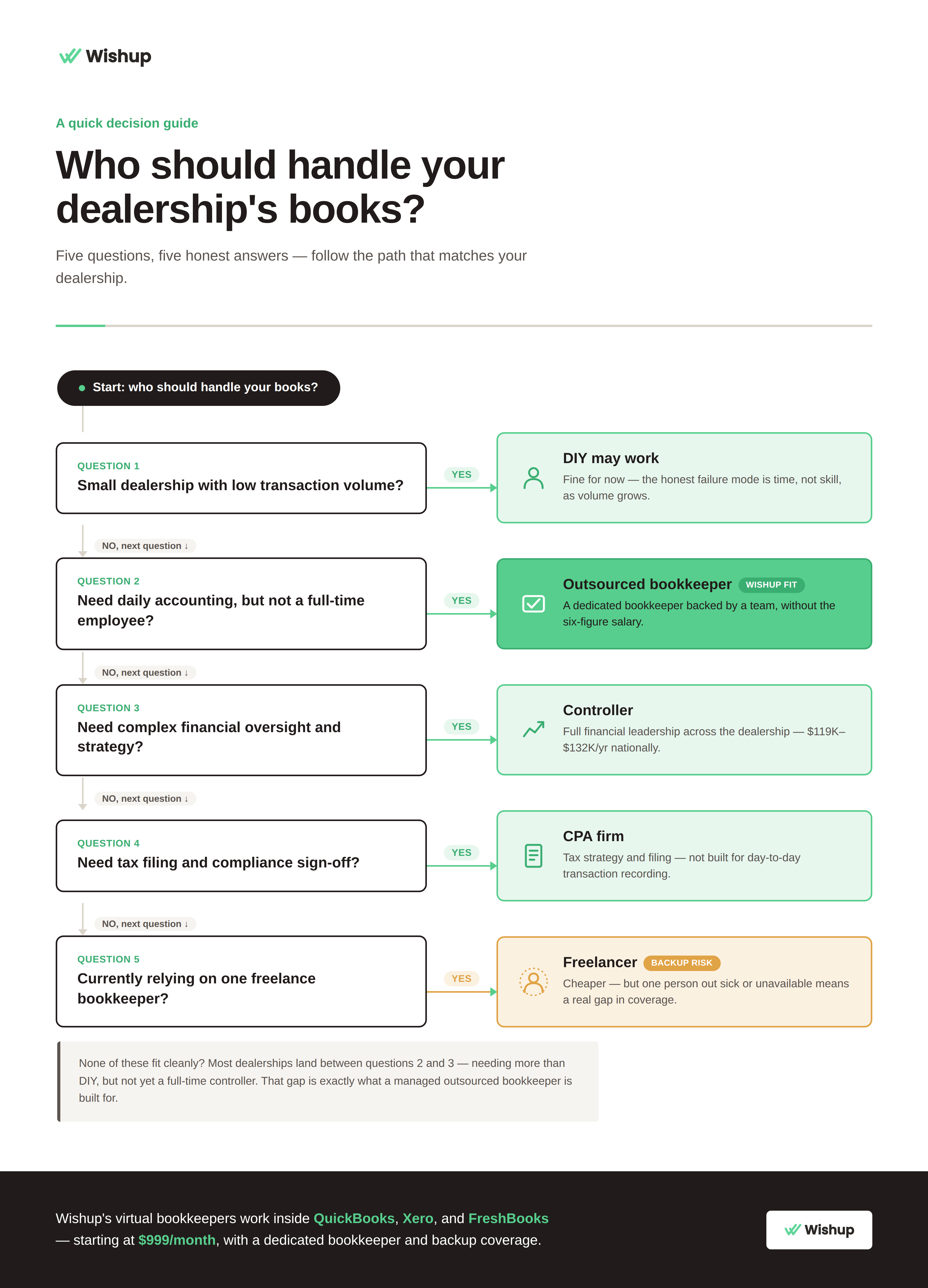
- Options for handling it: DIY (fine only at very low volume), in-house hire (Dealership Accountant ~$73K/yr, Controller $119K–$132K/yr), a CPA firm (tax and compliance, not day-to-day recording), a freelance bookkeeper (cheap but no backup), or a managed outsourced bookkeeper like Wishup (from $999/month).
- A dedicated bookkeeper doesn't file taxes or replace a controller — it keeps the books clean enough that whoever does those jobs works faster.
- Independent and BHPH dealerships have distinct accounting needs (receivables, delinquency tracking) that differ from franchise dealership books.
A car dealership doesn't have one set of books. It has five or six, all pretending to be one: new vehicle sales, used, service, parts, and F&I income (commissions, reserves, chargebacks), each moving on its own schedule. Underneath it all sits floor plan financing, accruing interest on inventory that hasn't sold yet. A single sale can touch the sales desk, F&I, accounting, and the factory before it's actually closed in the books.
Most explanations of "car dealership accounting" stop at "inventory, financing, and tax compliance," true, but vague enough to describe any capital-intensive business. What actually makes it different is how easily one profit center's numbers bleed into another's if nobody's watching closely.
This guide covers how it works month to month, what makes a dealership's chart of accounts different, and who should handle it: DIY, in-house, or a virtual assistant for bookkeeping.

What Is Car Dealership Accounting? The Five Profit Centers Behind Every Sale
Every dealership, franchise, or independent is really running several small businesses under one roof:
- New vehicle sales: Pricing, factory holdbacks, incentive money
- Used vehicle sales: Acquisition cost, reconditioning, depreciation
- F&I: Financing commissions, extended warranty income, insurance products, chargebacks when a customer refinances or pays off early
- Service: Labor, parts consumed, warranty claim reimbursement from manufacturers
- Parts: Inventory turnover, shrinkage, obsolete stock
Each one generates its own paper trail. A car sale isn't done accounting-wise until the finance contract funds, the factory holdback posts, and any F&I products attached to the deal are recorded correctly, sometimes days or weeks after the customer drove off the lot. If those pieces don't get reconciled against each other, a dealership can look profitable on the sales floor while quietly leaking money in F&I chargebacks or unreconciled contracts in transit.
This is also why generic small-business bookkeeping advice doesn't transfer cleanly to a dealership. A Wishup bookkeeper, Ritika, who's worked with an auto resale and repair business, put it simply when describing how she learns any new client's numbers: you can't categorize expenses correctly until you understand what a business actually buys and why. A used car lot has reconditioning costs, auction fees, and floor plan interest. If its books suddenly show an expense that looks like it belongs to the service department- a bulk parts order, say- that's not a data entry quirk to shrug off. It's a flag. Either a transaction was miscategorized, or there's a business reason that needs to be verified directly with the client. The skill isn't recording numbers; it's knowing what shouldn't be there.
This is also why a car dealership chart of accounts looks different from a standard one: separate groupings per profit center, plus liability accounts for floor plan financing and contracts in transit. Lump it all into one sales account and department-level P&Ls stop meaning anything.
Read more: How to Hire a Bookkeeper for Your Small Business
Floor Plan Financing: What It Is and Why Dealership Bookkeepers Get It Wrong
Floor plan financing is a revolving line of credit used to buy inventory. Dealerships don't pay cash for the cars on their lot. However, they borrow against a credit line, and interest accrues on every unit until it sells. That interest has to be separated from the principal and tracked as its own expense line, and the loan balance has to be reconciled against the actual physical inventory on the lot.
Get this wrong, and two things happen. First, the cost of goods sold gets distorted, because floor plan interest is an operating expense, not part of the vehicle's cost basis. Second, this is the one that causes real damage: a mismatch between the floor plan balance and the actual inventory count ("out of trust" units) is one of the fastest ways to trigger a lender audit or a manufacturer compliance review.
What 1200+ Clients want you to know
What Happens Every Month in Car Dealership Bookkeeping
Most articles on this topic hand you a generic monthly checklist. Here's what the process actually looks like when someone is doing it properly, based on how Wishup's bookkeeping team runs it for clients:
- Categorization first: Every transaction from the bank feed gets sorted by nature. It includes vehicle purchase, parts, payroll, floor plan interest, etc. Anything that doesn't match a known pattern goes on a query sheet and gets sent to the client directly, rather than guessed at. That single habit, asking instead of assuming, is what prevents the kind of miscategorization that quietly distorts a P&L for months.
- Bank reconciliation, every month, not just at year-end: The software's ending balance gets checked against the actual bank statement. If there's a mismatch, whether it's five dollars or five thousand, then the fix isn't guesswork. On a long statement, the fastest way to isolate the problem is to total the deposits and total the withdrawals separately and see which side is off. That narrows down whether you're chasing a missing transaction or a duplicate one (a transaction that was posted on both a Sunday and the following Monday, for instance) in a fraction of the time it takes to scan line by line.
- Profit and loss review, month over month: This is where anomalies get caught before they compound. If a repair-and-maintenance line jumps from $1,000 to $5,000 in one month, that gets investigated and pulled apart in the general ledger, traced back to the actual transactions. Sometimes it's legitimate (something broke at the dealership). Sometimes it's a transaction that got booked to the wrong account entirely.
- Year-end, the balance sheet gets finalized: Depreciation entries, journal adjustments, and a final check across every account. Because reconciliation happened monthly all year, this isn't a scramble. It's a formality.
Do this consistently, and a dealership's books stay clean without a year-end fire drill. Skip it, and errors from March are still sitting there, uncorrected, in November.

Where Automation Helps in Dealership Accounting and Where It Doesn't
Accounting-software vendors will tell you automation solves most of this. It solves some of it. It doesn't solve the parts that make dealership accounting genuinely hard.
Automated categorization rules work fine for repetitive, standardized transactions. They break down fast for anything with a manual override built into the business itself. One real example from a Wishup bookkeeper's client roster: an invoicing system tied to a piece of software that reports a device count, where company policy requires that count to show a minimum of 10 regardless of what's actually connected. That's a manual adjustment every time, not something a rules engine can be trusted to handle correctly without a human checking it.
There's also a volume threshold where automation stops making sense. A dealership or small shop running 20–30 transactions a month doesn't need, and often doesn't want to pay for heavy automation. At that volume, a person doing it directly is both cheaper and, frankly, more trustworthy to the business owner than a black-box tool would be. Automation earns its keep at high transaction volume with standardized inputs. Below that, it's often solving a problem the dealership doesn't have.
Who Should Handle Your Dealership Bookkeeping?
This is the question that matters more than any checklist, and it's the one most guides avoid answering directly because it means picking a side.
- Doing it yourself: Fine for a very small operation with light transaction volume. The honest failure mode isn't incompetence; it's time. Running a dealership means the incentive is always to chase the next sale, not update QuickBooks. Invoices go unfollowed, declining account balances go unnoticed until they're a problem, and reconciliation happens "when there's time," which in a busy month means it doesn't happen at all.
- Hiring in-house: This is where the real cost of dealership accounting becomes visible, and it's higher than most owners expect going in. A Dealership Accountant averages $73,158 a year, with most roles falling between $65,780 and $78,545, according to Salary.com's compensation data. A Dealership Controller, the role responsible for full financial oversight, compliance, and reporting to ownership, averages $131,831 a year on Salary.com and $119,497 on ZipRecruiter, with top earners clearing $154,000 to $175,000 depending on the market. That's before benefits, payroll taxes, and the cost of the position sitting empty during a hiring search. It's also worth knowing that dealership controllers are genuinely hard to find right now, industry commentary has flagged a shrinking pool of experienced candidates for the role, which stretches hiring timelines further.
- A CPA firm: Necessary for tax filing, compliance sign-off, and year-end strategy. Not built for daily transaction recording, and billed accordingly. CPA firms are priced for advisory and compliance work, not for categorizing Tuesday's parts invoice.
- A freelance bookkeeper: Cheaper than the above, typically $15–30 an hour. The trade-off shows up in consistency. One Wishup client, an IT services company, described their prior experience with freelance bookkeepers directly: there was always some hand-holding or chasing involved. A single freelancer with no backup means a gap every time they're sick, on leave, or simply move on.
- A managed outsourced bookkeeping service: This is the gap in the middle: a dedicated bookkeeper handling daily recording, transaction categorization, bank and card reconciliation, AP/AR follow-up, and monthly reporting consistently, without the six-figure salary or the freelancer's single point of failure. A Wishup bookkeeper working with a dealership would spend the month keeping each profit center's books current, flagging anomalies before they compound, and preparing clean reports for whoever needs them: ownership, a lender, or an outside CPA. The value shows up as much in what gets caught early as in what gets recorded on time.
In practice, that's the difference between a dealership accountant on payroll and a dealership bookkeeper who's already done car dealership bookkeeping elsewhere and skips the learning curve.
Wishup's virtual bookkeeping service runs on this model: a dedicated bookkeeper backed by an account manager and a review layer, working inside QuickBooks, Xero, or FreshBooks, starting at $999 a month. For comparison, that sits well below the $45,000–$65,000-plus-benefits range of a general in-house bookkeeper, and far below dealership-specific accountant or controller salaries, while still being a managed, backed-up service rather than a single freelancer you're hoping doesn't disappear mid-month.
What Clean Dealership Books Actually Prevent
The value shows up less in what gets built and more in what stops going wrong.
A recurring pattern across Wishup's client reviews is what happens at tax time: the external accountant notices. Multiple business owners, independently, have reported their CPA commenting on how much cleaner the books looked at filing time, or needing fewer corrections than in prior years. That's a useful signal precisely because it's not Wishup saying it. It's the professional whose job is to catch errors, saying there weren't as many to catch.
The other recurring theme is what one real estate broker client described bluntly: it gave them their weekends back. Over six hours a week reclaimed, and late client payments that used to happen "several times a month" dropped to almost none, once someone was consistently chasing invoices and flagging unfamiliar charges before they became a problem. Another client, comparing the experience directly to past freelance bookkeepers, pointed to the difference between a one-person dependency and a managed process: no chasing, no hand-holding, work that continued even when one person was unavailable.
None of this is dramatic. That's the point. Clean dealership books are supposed to be boring; the interesting part is what stops happening: no year-end scramble, no surprise chargeback nobody caught, no floor plan balance that mysteriously doesn't match the lot.
Accounting for Independent and Buy-Here-Pay-Here (BHPH) Dealerships
Most accounting content aimed at "car dealerships" is quietly written for franchise stores. Independent lots and buy-here-pay-here (BHPH) dealers in particular deal with a different set of books entirely.
BHPH dealerships finance their own sales and collect payments directly from customers over time, which means their accounting looks less like a retailer's and more like a lender's. Receivables aging, delinquency tracking, and repossession accounting all become core, recurring work rather than occasional edge cases. A bookkeeper who's only ever worked franchise dealership books, with their factory holdbacks and manufacturer warranty claims, isn't automatically equipped for a portfolio of customer notes receivable. It's a genuinely distinct skill set, and it's worth asking directly whether a bookkeeping provider has handled it before hiring one.

FAQs
Is car dealership accounting different from regular small business accounting?
Yes, mainly because of floor plan financing, multi-department profit centers (sales, F&I, service, parts) that all need to reconcile against each other, and inventory accounting for high-value, individually financed units. The core bookkeeping skills are the same; what changes is the number of moving parts inside a single transaction.
Can a bookkeeper or virtual assistant file my dealership's taxes?
No. Bookkeeping and tax filing are different functions, and a bookkeeper's job, even a highly experienced one, is to keep records accurate and organized so that a CPA or tax preparer can file correctly and efficiently. Be cautious of any provider that blurs this line.
How much does it cost to outsource dealership bookkeeping versus hiring in-house?
A managed outsourced bookkeeper typically runs $999 a month and up. A general in-house bookkeeper costs roughly $45,000–$65,000 a year plus benefits; a dedicated Dealership Accountant role averages closer to $73,000, and a Dealership Controller averages $119,000–$132,000 nationally. A freelance bookkeeper runs $15–30 an hour but without built-in backup coverage.
What's the difference between a dealership bookkeeper and a dealership controller?
A bookkeeper handles the day-to-day: recording transactions, reconciling accounts, tracking AP/AR, producing basic reports. A controller owns the full financial function, compliance, strategic reporting to ownership, and oversight of the accounting team. Clean bookkeeping makes a controller's (or a CPA's) job faster; it doesn't replace the need for one in complex, multi-rooftop operations.
Can I use QuickBooks or Xero for a car dealership?
Yes, for the general ledger, reconciliation, and reporting layer, most independent and small dealerships run on QuickBooks or Xero rather than a full dealership management system (DMS) like CDK or Reynolds & Reynolds. The friction point is usually getting deal data to flow cleanly from the DMS (where the actual sale is processed) into the accounting software, which is exactly the kind of manual reconciliation work a dedicated bookkeeper handles.
What's the best car dealership accounting software for a small dealership?
General software, QuickBooks or Xero, usually beats a full DMS-integrated system below a certain size. Purpose-built dealership software earns its cost once you're running a full DMS like CDK or Reynolds & Reynolds; before that, the bookkeeper matters more than the tool.
If you're weighing whether to keep doing your dealership's books yourself, hire in-house, or hand it to a CPA firm by default, it's worth being clear-eyed about what each option actually costs and covers. A managed bookkeeper won't file your taxes or replace a controller on a multi-rooftop operation, but for the day-to-day recording, reconciliation, and reporting that most independent dealerships actually struggle to stay on top of, it's often the option nobody considers until the books are already a mess.
Wishup's virtual bookkeepers work inside QuickBooks, Xero, and FreshBooks, starting at $999/month, with a dedicated bookkeeper, an account manager, and backup coverage so work doesn't stall when one person is out. If you want to see what that looks like for your dealership specifically, get a free consultation and talk through your transaction volume and current setup.
