
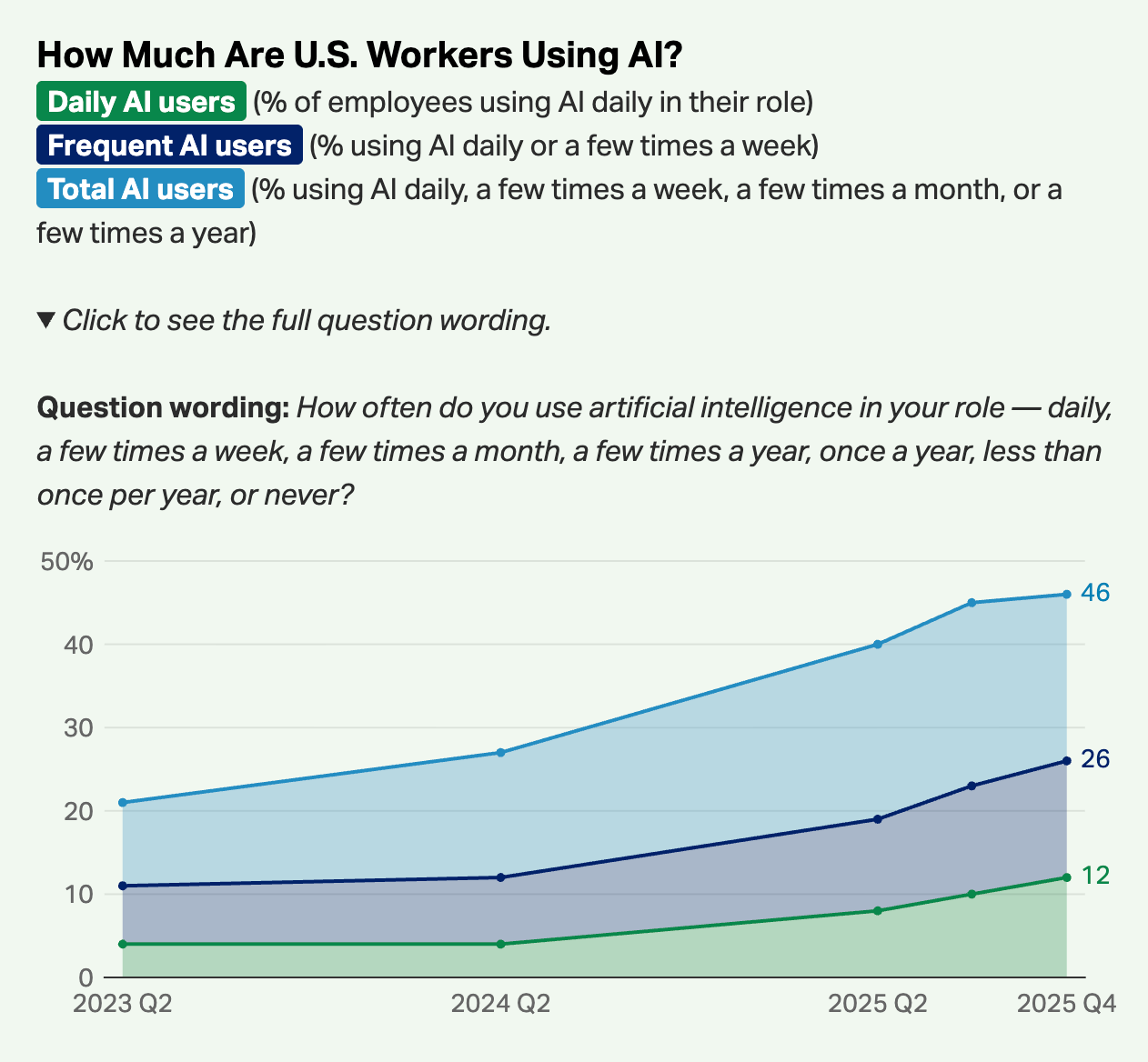
Here's the truth: 48% of US workers already use AI at work.
But most of them are doing it wrong. They're automating tasks that need a human touch. Or paying VAs $15-30/hr to do robot work. I say this confidently because I speak with US founders every week during VA onboarding calls, and many of our existing clients reach out asking how to integrate AI with their VAs effectively.
Automate repetitive, rule-based tasks using AI, data entry, email sorting, calendar scheduling, transcription, and report generation.
Delegate judgment-based, relationship-dependent tasks to a human VA, client communication, complex research, crisis management, creative problem solving, and sensitive HR work.
Get this split right and save $1,868/month versus using a VA for everything.
Most businesses waste money on one side, automating tasks that need human judgment, or paying VAs to do work AI handles for $20/month
Hiring a VA at $9/hour to copy-paste data costs $180/month. Zapier handles it for $20/month. Or you built a chatbot that can't read the room.
It is not about whether you should use AI or hire a VA. It's "which tasks go where?"
Get this right, and you'll save thousands monthly. Get it wrong, and you'll struggle scaling your business while burning cash.
How Do I Know If a Task Should Be Automated or Delegated?
If it follows a script, automate it. If it needs judgment, delegate it. That's it.
- If you can write every step down, AI can handle it.
- If it requires reading between the lines, you need a human.
Can you write every step of this task in a numbered list, where each step has exactly one right answer? If yes, automate it with Zapier, Make.com, or n8n. If any step requires you to write "it depends", delegate it to a human VA.
Human judgment is the deciding variable. Any task where the right answer changes based on context, relationship history, emotional tone, or unstated intent requires a human VA, not automation. This is the line AI cannot cross in 2026.
Here's where it gets tricky, though. Some tasks look scriptable but aren't. Email replies seem perfect for automation. You get the same questions constantly. But a refund request might come from someone furious. Or just curious. AI can't catch that tone difference. It'll send the same chipper response either way.
Same with scheduling. Tools like Calendly work great until someone emails saying, "I need to move my meeting because my mom's in the hospital." An AI will offer three alternative time slots. A VA will say, "I'm so sorry, whenever works for you."
The messy middle is real. Tasks that are 80% routine and 20% judgment.
Automating the 80% that is routine while losing the 20% that requires judgment costs you clients. Delegate the full task to a VA
What Tasks Should I Automate Using AI?
Your VA uses ChatGPT to draft first versions of emails, blog outlines, and social captions, then reviews, edits for tone, and sends. This is the correct human-in-the-loop model. Here are 7 specific task types to automate, with the exact tools:
1. Email sorting and filtering
Gmail filters and SaneBox route emails based on keywords and sender patterns. You'll never manually file a newsletter again. Set up rules like "any email from ABC client goes to Priority" and forget about it.
2. Calendar scheduling
Calendly and Motion eliminate the back-and-forth. Someone picks a time, it goes on your calendar, and they get a confirmation. Works perfectly for standard meetings with strangers. A podcast interview or sales call with a new lead? Automate it.
3. Data entry and extraction
Zapier and Make pull data from one system and push it to another. You get a Stripe payment? It creates a Google Sheet row, updates your CRM, and sends a Slack notification.
4. Transcription
Otter.ai and Fireflies join your Zoom calls and spit out transcripts. They catch 95% of words correctly. Perfect for meetings you need to reference later. Not perfect for legal depositions where one wrong word matters.
5. Basic customer service
Chatbots on Intercom handle "Where's my order?" and "How do I reset my password?" questions. They pull from your knowledge base and respond instantly. The second someone asks something off-script, they hand it to a human. This cuts customer service costs by 25% if you set it up right.
6. Social media scheduling
Buffer and Hootsuite post your content at optimal times across platforms. You batch-create posts on Sunday, schedule them for the week, and you're done. They can't write the posts, though. AI-generated social content will only be more noise to the existing noise.
7. Report generation
Tools like Databox pull metrics from Google Analytics, your CRM, and ad platforms into one dashboard. No more manual spreadsheet updates. You check one place every Monday and see exactly what's working.
What Can a Virtual Assistant Do That AI Can’t?
Humans win when the stakes are personal or messy. AI can draft emails. But it can't read a client's mood from their terse two-word reply. It can't decide if now's the time to go hard or back off.
- Relationship management is pure human territory. Your VA knows Client A needs three follow-ups before responding. They remember Client B's kid just started college. They adjust tone based on who's stressed and who's chatty. AI treats everyone like a template, and people notice.
Emotional intelligence, reading a client's mood from their word choice, adjusting communication style in real time, and knowing when to push and when to back off, is the single capability that separates a human VA from any AI tool available in 2026. - Complex research needs judgment calls. You ask your VA to find podcast sponsorship opportunities for your SaaS. They don't just pull a list of tech podcasts. They check listener size, audience fit, and whether the host actually reads ads or phones it in. AI gives you data. Humans give you the "yeah, but" layer of screening.
- Crisis management fails with AI. Your payment processor goes down during a launch. Your VA jumps on live chat, escalates to their manager, finds a backup option, and updates your customers. AI would've sent a canned "we're looking into it" response while your revenue tanks.
- Creative problem solving requires context. Your VA books you a flight to Austin. Then SXSW gets announced for those dates. They switch your hotel to downtown without being asked because they know why you're going. AI books the cheapest option and calls it done.
- Reading between the lines matters. When a client emails "no rush on this," your VA knows Client X means it, but Client Y is being passive-aggressive. They prioritize accordingly. AI reads words. Humans read subtext. That's the huge gap.
- Sensitive HR stuff needs a human. Employee conflicts, firing someone, salary negotiations - you can't automate empathy. Your VA handles the scheduling, preps the talking points, and follows up with the paperwork. AI can't comfort a crying team member or de-escalate tension. Not yet anyway.
How Do the Costs of AI and VAs Really Compare?
The numbers tell you why everyone's confused about this. An AI stack costs about $52/month. A human VA costs $300-1,200/month. But here's what nobody mentions — you need both.
Your AI setup looks like this. ChatGPT Plus at $20/month for drafting and research. Zapier is at $19.99/month for connecting your tools. Calendly is at $12/month for scheduling. Total: $52/month. That handles your repetitive volume work.
The cost of a human virtual assistant from the best companies ranges between $15-30/hour, depending on experience and location. For 20 hours a week (part-time), you're paying $300-600/month at the low end. For 40 hours weekly, you're at $1,200-2,400/month.
See full pricing →
That's where the judgment calls happen.
But here's the real math. AI can automate 60-70% of workers' current tasks. So, your VA handles client relationships, research with nuance, and anything that might blow up if done wrong.
Also, you can depute your VA to oversee anything that's automated by AI - like email sorting, calendar management, basic data entry, and social media posting
Example ROI breakdown.
You’ve got 160 hours of admin work monthly (basically a full-time load).
AI handles 60% of the repetitive tasks. That’s 96 hours automated for about $52/month in tools.
Your VA takes care of the remaining 64 hours that require judgment and context.
At $20/hour, that’s $1,280/month.
So, your total monthly cost?
$1,332.
Now compare that to hiring a VA for the full 160 hours at $20/hour.
That’s $3,200/month.
You just saved $1,868 every single month (that's over $22,000 per year) while actually improving quality because your VA isn’t stuck doing robotic tasks.
- AI tools handle 96 hours of repetitive work: $52/month
- Wishup VA handles 64 hours of judgment work: $1,299/month
- Total: $1,351/month
- Versus a full VA for 160 hours: approximately $3,200/month at market rates
- Monthly saving: $1,849, over $22,000/year
That’s the leverage layer most businesses miss.
The 25% reduction in customer service costs via AI comes from this exact model. AI handles FAQs and routing. Humans handle the angry customers and edge cases. You don't choose AI or VAs. You layer them.
How Do I Combine AI and a Virtual Assistant the Right Way?
The best setup treats AI as your VA's assistant, not their replacement.
AI does volume. Humans do value. You stay out of both until something needs your actual expertise.
Here's how it works in practice. AI (ChatGPT or Claude) monitors your inbox and sorts messages into categories. It drafts responses to routine questions.
Your VA reviews those drafts every morning, edits for tone, catches anything that needs escalation, and sends them. You only see the 3-4 emails weekly that actually need your brain. This is what the 48% of people already using AI at work are figuring out.
Workflow example one
Podcast guest outreach. AI generates a list of 50 podcasts in your niche with host emails. Your VA filters it down to 15 that actually match your expertise and audience size. AI drafts personalized pitches using your bio and talking points.
Your VA personalizes each one with a specific episode reference or compliment. You approve the final 15 in ten minutes. Send.
Workflow example two
Content repurposing. You record a 30-minute strategy video. AI (Descript or Otter) transcribes it. ChatGPT pulls out five key quotes and drafts three LinkedIn posts.
Your VA rewrites them in your actual voice, adds relevant hashtags, finds or creates graphics, and schedules them via Buffer. You review nothing unless engagement tanks. The 40% productivity improvement from AI comes from this kind of multiplication.
Workflow example three
For document-heavy workflows, your VA uses Claude, analysing long contracts, summarising 50-page reports, and drafting structured briefing documents from raw research, then applies human judgment to the outputs before delivery.
How Do I Quickly Decide Whether to Automate or Delegate a Task?
Ask these questions:
Is it repetitive and rule-based?
Automate it.
Data entry, scheduling posts, sending order confirmations - if you can write clear steps, AI handles it. No judgment calls needed.
High-volume, low-judgment tasks, email routing, CRM updates, Slack notifications from form submissions, go to Zapier or Make.com. Your VA monitors these automations, catches failures, and adjusts triggers when business rules change.
Is it emotionally charged or relationship-dependent?
Delegate to a human VA. Angry customer emails, client negotiations, sensitive feedback - humans read subtext. AI doesn't understand when someone's actually furious behind polite words.
Client communication, including initial outreach responses, contract negotiation follow-ups, conflict de-escalation, and relationship maintenance, goes to your human VA every time. One AI misstep in client communication can cost a $50K annual relationship.
Is it sensitive or confidential data?
Probably needs a human with proper security training. Client SSNs, medical records, and financial statements - one data leak costs you everything. If you must use AI, use enterprise versions with data protection agreements.
Is it high-volume with no judgment required?
Sorting 500 emails by category? You know what to do. Don't get burned out.
Is a relationship at stake if it goes wrong?
Human does it. Client onboarding calls, contract negotiations, apology emails. Relationships are too valuable to risk. One AI screwup costs you a $50K annual client.
Is it a first draft a human will review?
AI writes it, human polishes it. Blog outlines, email templates, social media captions - let AI generate, you edit. You get speed without the risk of sending garbage.
How Should Different Industries Use AI and Virtual Assistants?
E-commerce works best with AI handling order tracking and inventory alerts. Automate the "Where's my package?" responses. But delegate customer complaints to humans. Someone saying your product broke needs empathy, not a bot.
Real estate agents should automate lead capture and first-touch emails. Zapier pulls leads from Zillow into your CRM instantly. But delegate the follow-up calls and property tours. Nobody buys a $400K house from a robot.
Healthcare providers need to be paranoid about HIPAA. Don't paste patient info into ChatGPT or free AI tools. Use HIPAA-compliant platforms like DAX Copilot for clinical notes. Automate appointment reminders, but keep patient communication with trained staff.
Legal practices can use AI for document review and legal research (tools like Harvey AI or CoCounsel). It finds clauses in contracts faster than junior associates. But keep client communication human. Clients paying $400/hour want to talk to their actual lawyer.
Startups should go AI-heavy early when cash is tight. A $20/month ChatGPT Plus subscription beats a $2,400/month VA. Automate everything you can. Social posts, email sequences, and data entry. Add human VAs as you scale and need judgment calls. You'll save $14,000+ yearly until you can afford real help.
FAQs About AI vs. Virtual Assistants
1. Can AI fully replace a virtual assistant?
No. AI handles repetitive tasks - data entry, scheduling, email sorting. It can't read a room or handle nuanced client conversations. You still need a human for anything that requires judgment or empathy.
2. What tasks should I automate with AI first?
Start with data entry, appointment scheduling, and email filtering. These are high-volume, low-judgment tasks.
3. How much does an AI tool stack cost vs. a human VA?
ChatGPT Plus costs $20/month, Zapier runs $19.99/month, and Make starts at $9/month. That's under $50 total. A human VA costs $15-30/hour for part-time work. AI wins on price for simple tasks.
4. What's the biggest risk of over-automating?
You lose the human touch. Automated responses feel robotic, and customers notice. If you automate client communication too much, you'll damage relationships faster than you save time.
5. Should small businesses use AI or hire a VA?
Start with AI for repetitive admin work. Hire a VA when you need someone to manage client relationships or handle complex projects. Most small businesses do best with both. AI handles the grunt work, the VA does everything else.
6. What AI tools work best alongside a virtual assistant?
Zapier connects your apps and automates workflows. ChatGPT drafts emails and content. Calendly handles scheduling without back-and-forth. Your VA uses these tools to work faster. So, you're not replacing them, you're upgrading their toolkit.
7. How do I know if a task needs human judgment?
Ask yourself: does this require reading context or understanding emotion? If yes, it needs a human. AI can't handle upset clients, negotiate deals, or pick up on subtle cues in a conversation.
8. Can AI handle customer service on its own?
For basic FAQs and simple requests, yes. For anything complex or emotional, no way. Use it for first-level support only and then escalate to humans.
9. Will AI make virtual assistants obsolete?
Not even close. AI makes VAs more valuable. VAs can offload boring tasks to bots and focus on high-level work.
10. What's the best way to start with a hybrid AI + VA setup?
Pick three repetitive tasks and automate them with AI first. Then hire a VA to handle everything that requires thinking like client communication, project management, problem-solving. Train your VA to use the AI tools you've set up.
11. What's the difference between using ChatGPT, Claude, Zapier, and a human VA?
ChatGPT and Claude generate first drafts, summarise documents, and answer questions, but require human review before anything goes to a client. Zapier, Make.com, and n8n connect your apps and automate data flows between tools without human involvement. Your human VA does everything that requires context, judgment, emotional intelligence, or relationship management, and also supervises the AI and automation outputs to catch errors before they reach your clients. All four work together, not against each other.
What’s the Final Verdict on AI vs Virtual Assistants?
AI and virtual assistants aren't competing. They're complementary. AI crushes repetitive, high-volume tasks. Your VA handles everything that requires judgment, relationship-building, or creative thinking.
The businesses winning right now? They're using both. AI handles data entry, scheduling, and email triage for under $50/month. The VA takes that saved time and focuses on client relationships, strategic projects, and putting out fires. You get without sacrificing the human connection.
AI and virtual assistants are not competing, they are complementary layers in a single operational system. Start thinking about AI plus virtual assistants.
Hire a Wishup Virtual Assistant →
Hire an Automation Expert VA →
See full pricing →
