
If you are an eCommerce brand owner trying to build a robust customer support system without the overhead of a full in-house team, this guide is written for you.
Table of Contents
- What is eCommerce Customer Service Outsourcing?
- The Evolution of eCommerce Customer Service Outsourcing
- The Numbers That Matter in 2026
- When Do You Need to Outsource Customer Support?
- Why eCommerce Stores Outsource Customer Service
- Benefits of eCommerce Customer Service Outsourcing
- What Can Be Outsourced?
- eCommerce Customer Service Outsourcing Models: Choosing the Right Structure
- How to Choose the Right eCommerce Customer Service Outsourcing
- Hidden eCommerce Customer Service Outsourcing Risks Most Guides Don't Talk About
- How to Transition Without Losing Brand Voice
- Essential eCommerce Customer Service KPIs to Track
- How Wishup's eCommerce Virtual Assistants Help Online Stores Scale
- How Wishup eCommerce VAs Help Online Stores Scale
- What Sets Wishup Apart for eCommerce Support Outsourcing
- Summary: When to Outsource, When Not To
What is eCommerce Customer Service Outsourcing?
In simple words, eCommerce customer service outsourcing is done when an online store hires a third-party team to handle its customer support. It includes Emails, live chats, phone calls, social DMs, order disputes, and refund requests.
The outside team works under the store's name by following its policies, and communicates in the brand tone. There is no visible difference to the customers.
The Evolution of eCommerce Customer Service Outsourcing
The concept of eCommerce customer service outsourcing is not new. Big retail chains have been doing it for decades. What has changed is access. Today, a Shopify store doing $500K a year has the same outsourcing options that were once reserved for brands doing $50 million. The tools are better, the providers are more specialized, and the cost of entry is lower than before.
The nature of work also changed. Early outsourcing meant a call center reading from a script. But the best providers are not doing it anymore. A strong outsourcing partner gets embedded in the store's tech stack, trained on its catalog, and held accountable to real performance numbers. They are less of a vendor and more of an operational extension.
The Numbers That Matter in 2026
When Do You Need to Outsource Customer Support?
A lot of business owners assume eCommerce Customer Service Outsourcing is a shortcut. Something you do when you want to spend less and care less. That assumption is worth pushing back on.
So when does it actually make sense?
The most common trigger is simple: the team can not keep up. Tickets pile up, response times stretch, and the two people handling support are also doing three other jobs. At that point, onboarding eCommerce Customer Service Outsourcing team help is not cutting corners. It is the practical move.
But volume is not the only reason. Some businesses witness seasonal hikes where demand increases for a few weeks. Others get more complex requests where the existing expertise is not enough to handle them. And some faces rapid growth and the necessity of building a support team in-house and processes from scratch. This eats up a lot of budget and time that can be spent elsewhere.
If any of those situations sound familiar, outsourcing is worth a serious look. Not because it is the easy way out, but because getting customer support right matters too much to let it run at half capacity.
Why eCommerce Stores Outsource Customer Service
People always combine outsourcing eCommerce customer service with cost savings. But it has myriad benefits other than that.
For example, the marketing team runs a flash sale. Orders jump four times overnight. A small support team is now sitting with 3,000 tickets. The results: response times stretch past 24 hours, and negative reviews start piling up. The product is fine. The sale worked. But the customer experience around it fell apart.
The entire operational team is built in a headcount that works for normal order volume, not peak volume. Hiring and training an in-house support team take months. Budget gets consumed fast.
Here is how eCommerce Customer Service Outsourcing changes the structure of that problem:
- Seasonal elasticity: Volume surges for Black Friday, then drops in February. Outsourced teams scale with demand. There is no carrying cost during slow months and no scramble when volume spikes.
- Time zone coverage: A store selling globally cannot be served by a team that clocks out at 6 pm Eastern. Outsourced teams in different time zones handle coverage without anyone working overnight shifts.
- Platform expertise: An experienced eCommerce outsourcing firms already have assistants trained for various platforms such as Shopify, Gorgias, Zendesk, and Magento. This significantly reduces the onboarding time compared to hiring a new person.
- Multilingual reach. Expanding into Europe or Southeast Asia means customers who want to be served in their own language. Building that in-house is expensive and slow. Outsourced providers often have it ready.
Benefits of eCommerce Customer Service Outsourcing
Check these eCommerce customer service outsourcing benefits:
1. Lower Costs, Same Output
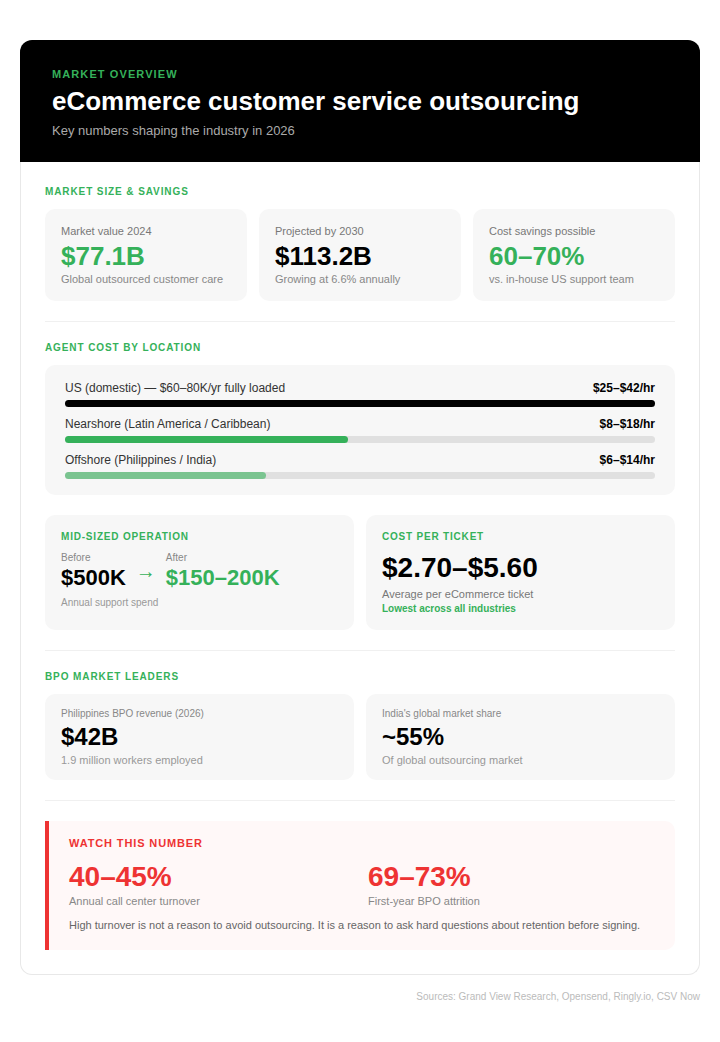
Running an in-house support team in the US costs $60,000-$100,000 per assistant per year. This includes salary, benefits, training, and overhead. An offshore outsourced assistant does the same work for $10,000-$18,000 per year. For a five-person team, that difference is somewhere between $250,000 and $400,000 annually. This budget can be utilised effectively on inventory, marketing, or product development.
Wishup's team will match the right eCommerce VA structure to your store size, order volume, and operational needs - so you only pay for exactly what your business requires.
→ Book a Free Pricing Consultation with Wishup
2. Support That Runs Around the Clock
Customers shop at odd hours. Someone in California checking on an order at midnight is not thinking about business hours. Outsourced teams working across time zones handle those gaps without overnight shifts or premium pay rates for the internal team.
3. Faster Agent Readiness
A new in-house hire typically takes 8-12 weeks to handle tickets independently. A specialized eCommerce assistant from a well-experienced firm already knows the most common workflows, from return processing to payment disputes. That gets cut to 2-4 weeks. Wishup’s eCommerce virtual assistants are experienced and can start in 60 minutes. Our eCommerce virtual assistants have hands-on experience in tools such as Shopify, Amazon Seller Centre, Klaviyo, Hubspot, WooCommerce, etc. This eliminates the burden of training.
4. More Consistent Quality
Consistency is harder to maintain in-house than most people expect. Small support teams rarely have bandwidth for formal quality reviews. Good eCommerce customers supporting an outsourcing firm run structured QA programs, score agents regularly, and retrain based on what they find. That produces a more stable support experience over time.
5. Leadership Gets Time Back
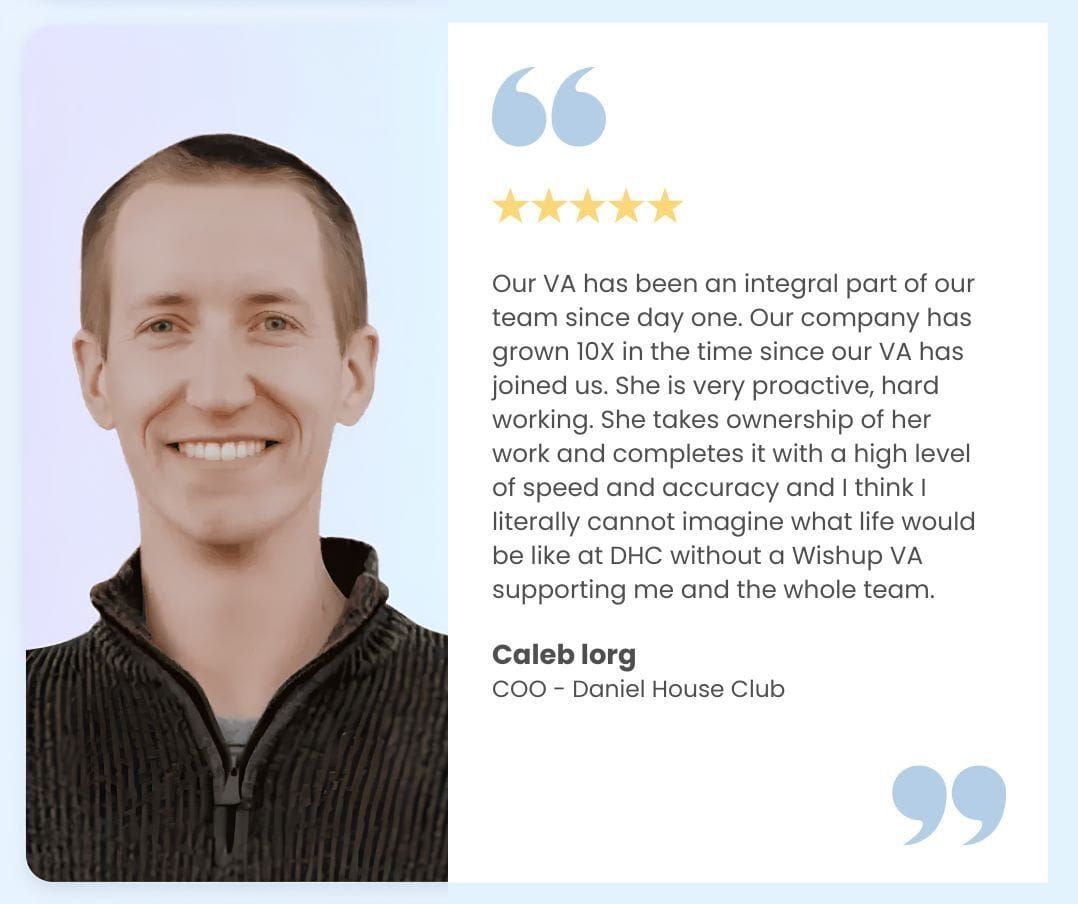
Every hour a founder or operations lead spends on support escalations is time away from higher-leverage work. At Daniel House Club, an eCommerce platform for interior designers, the COO was running catalog operations alongside finance responsibilities. Once that function was handed to Wishup’s eCommerce VA team. The catalog has been updated and streamlined, and the whole process around it. They scaled 10x during the period outsourced support was in place.
6. Boost Brand Image
Customer service outsourcing can improve the customer support quality and brand image by displaying that the brand cares about the customer experience and satisfaction. While addressing the customer issues immediately brings loyalty and trust, it also significantly boosts customer retention. Our eCommerce VAs have noticed tremendous growth once they streamlined the customer experience.
What Can Be Outsourced?
Functions most stores outsource:
- Order status inquiries. "Where is my order?" is still the single most common ticket type in eCommerce.
- Catalog management; real-time update.
- Return and exchange processing
- Refund requests and payment dispute resolution
- Live chat on product and checkout pages
- Email ticket management
- Social media DMs and comment responses
- Subscription management, pausing, canceling, and upgrading
- Pre-sales questions and product recommendations
- Cart abandonment follow-ups
- Review and reputation management
Functions most stores keep in-house:
- High-value escalations that need brand authority
- Crisis communications and product recalls
- VIP customer relationships
- Feedback loops that feed product and operations decisions
ECommerce Customer Service Outsourcing Models: Choosing the Right Structure
How to Choose the Right eCommerce Customer Service Outsourcing
Most of the time, an eCommerce brand makes a decision by looking at the price deck or through a sales call. The end result: within 6 months of span, the brand starts searching for a replacement.
A better process looks like this:
Step 1:
Know your current numbers: Aggressively verify the ticket volume, average handle time, first response time and CSAT. A baseline helps to track the improvement and identify the gaps.
Step 2:
Write down what is non-negotiable: Figure out the non-negotiable attributes. It includes data security certification, platform compatibility, language coverage, escalation protocol, etc. These attributes should take a major role while taking a conversation forward with the shortlisted outsourcing firms.
Step 3:
Run a paid pilot: Reputable providers offer a pilot phase, usually 4-8 weeks. This is the real vetting period. Closely watch how edge cases get handled, not just routine queries. On the other hand, industry experts like Wishup have immediate replacements based on the client's request. This helps the eCommerce brands to get the best service without any procedural delays.
Step 4:
Research independently: Do not rely on provider-supplied references. Check Clutch, G2, and Trustpilot. Look for complaint patterns, not just positive reviews.
Step 6:
Tie the contract to outcomes: Any agreement that pays per hour with no CSAT or resolution rate benchmarks attached is an agreement with no accountability. Negotiate for performance metrics before signing.
Hidden eCommerce Customer Service Outsourcing Risks Most Guides Don't Talk About
1. Agents Who Can't Actually Access Anything
If the outsourced team cannot pull up live order data, inventory status, or fulfillment details in real time, they are flying blind. "Where is my order?" is the top eCommerce query. An e-commerce virtual assistant who has to email an internal ops team to answer it is not providing support. Verify exactly what systems the partner will have access to before committing.
2. The Turnover Cycle
First-year attrition in BPO runs 69-73%. The agent who sat through onboarding is statistically likely to be gone within 12 months. Some providers use this as a revenue model, cycling through agents while billing the same onboarding fees repeatedly. Ask specifically about average agent tenure and how the provider handles continuity when agents leave. Wishup has eCommerce virtual assistants who have been working with eCommerce brands for 3+ years consistently and delivering the best.
3. Leaving With Nothing
Some companies’ contracts are structured so the provider retains ownership of the knowledge base, AI training data, and process documentation. When the client leaves, they start from scratch. Any contract should explicitly confirm that all documentation and customer interaction data belong to the client, not the provider.
4. Friendly Fraud and Social Engineering
Fraudsters increasingly target outsourced support teams because manipulating a person is often easier than breaking through a security system. An agent who is not properly trained can authorize a high-value refund to a scammer without realizing it. To avoid such incidents while outsourcing eCommerce Customer Service, it is important to check the background of the companies and the agent’s experience.
5. AI Claims That Don't Hold Up
A growing pattern in 2026 is providers pitching "Agentic AI" to reduce agent headcount while actually delivering a worse customer experience. Forrester has flagged over-automation of complex or emotionally charged tickets as a serious satisfaction risk. If a provider says their AI resolves 90% of tickets from day one, ask for CSAT data from existing clients. Not a case study PDF. Actual current client references.
How to Transition Without Losing Brand Voice
The biggest concern brands raise about outsourcing is that the support team will stop sounding like them. It is a fair concern. It is also one that can be avoided with the right preparation.
- Write the brand voice guide first, before onboarding starts: This should not be a marketing document repurposed for support. It needs to be built specifically for customer interactions. Tone descriptors, phrases to avoid, escalation language, and real examples of tickets handled well and handled poorly. Agents need concrete examples, not abstract guidelines.
- Build a knowledge base that does not depend on a person to maintain: Whatever documentation tool the team already uses works here. The goal is a single place where agents can find answers without having to ask someone every time. If the outsourced team has to ask the internal team for basic product information regularly, the knowledge base has gaps that need to be filled. The goal is for the customer service agent to self-serve 80% of product questions from documentation.
- Start with one channel: Trying to migrate email, chat, phone, and social all at once harms the process. Start with email. For the initial one month, run the outsourced team in parallel with the in-house team. Compare quality scores side by side. Fix the gaps before adding channels. Eventually, hand over more tasks to the outsourced teams.
- Lock in KPI targets before the contract is signed: First Response Time, CSAT, Resolution Rate, Escalation Rate, and Average Handle Time should all have defined ranges in the agreement. If the provider resists putting performance targets in writing, that is worth taking seriously.
- Meet weekly for the first three months, not monthly: The first 90 days will surface scenarios that documentation did not anticipate. Catching and closing those gaps quickly determines how fast the partnership reaches a stable, high-quality state.
Essential eCommerce Customer Service KPIs to Track
| KPI | Industry benchmark | Target |
|---|---|---|
|
First response time FRT
|
Under 1 hour (chat)
12 hours (email)
|
Under 45 min (chat)
4–6 hours (email)
|
|
Customer satisfaction CSAT
|
80–85% |
85%+ |
|
First contact resolution FCR
|
65–75% |
75%+ |
|
Average handle time AHT
|
6 minutes |
Varies by ticket type |
|
Escalation rate
|
15–20% |
Under 10% |
|
Ticket backlog
|
0 at end of day |
Near zero |
|
Resolution rate
|
90% |
95%+ |
Review these monthly at a minimum. When a metric drifts consistently outside its target range, that is a conversation to have with the provider. High escalation rates often point to knowledge base gaps. Low first contact resolution usually means agents do not have enough product authority to resolve tickets on the spot. Both are fixable with the right partner.
How Wishup eCommerce VAs Help Online Stores Scale
Most outsourcing conversations focus on customer support tickets. Wishup's eCommerce virtual assistants cover a lot more ground than that.
From the moment an order is placed to the moment it lands at a customer's door, there are dozens of small operational tasks that eat up time without anyone noticing. Inventory updates, vendor follow-ups, return processing, catalog edits, financial reconciliation. None of it is glamorous. All of it has to get done. Wishup VAs handle exactly this kind of work.
| Area of support | What Wishup VAs handle | Business impact |
|---|---|---|
|
Order & inventory management
|
|
Faster operations and fewer fulfillment errors
|
|
Product & catalog management
|
|
Accurate listings and improved discoverability
|
|
Customer communication
|
|
Faster response times and better satisfaction
|
|
Vendor & supply chain
|
|
Reduced delays and smoother backend workflows
|
|
Financial operations
|
|
Better financial visibility and fewer gaps
|
|
Logistics & shipping
|
|
Streamlined dispatch and proactive delivery updates
|
|
Market research
|
|
Better market positioning and faster decisions
|
What Sets Wishup Apart for eCommerce Support Outsourcing
| Unique value proposition | Details |
|---|---|
|
Highly selective hiring
|
Top 0.1%
Only 0.1% of applicants are selected through a rigorous 6-step screening process.
|
|
Structured training
|
8 weeks
Trained across 120+ tools including AI and no-code platforms.
|
|
3-layer support model
|
3 layers
Every client gets a VA, VA Manager, and Customer Success Manager.
|
|
Experienced talent
|
3+ years
All VAs come with a minimum of 3 years of professional experience.
|
|
Fast onboarding
|
60 mins
Get matched, onboarded, and started in approximately 60 minutes.
|
|
Quick response time
|
5 mins
Guaranteed 5-minute response time during your business hours.
|
|
Easy replacement process
|
Zero hassle
Fast VA replacement with minimal disruption to your operations.
|
|
High retention
|
4 yr avg
Average VA retention of 4 years ensures continuity and consistency.
|
Summary: When to Outsource, When Not To
Outsource when:
- Ticket volume is outpacing the current team's capacity
- SLA targets are being missed regularly
- Coverage gaps exist outside standard business hours
- Recruiting and training costs are cutting into growth budget
- Specialized eCommerce tooling is needed without owning it outright
Hold off if:
- The support function requires institutional knowledge that takes more than three months to transfer
- The business operates under regulations with strict data residency requirements
- Monthly ticket volume is under 200. The unit economics do not support it yet.
Outsource in stages if:
- The goal is to test the model on one channel before going all in
- The business is growing fast and needs to relieve pressure while building a longer-term support structure
The market in 2026 has a credible solution for nearly every eCommerce size and model. The decision is no longer whether to outsource. It is about choosing the right partner, tracking the right numbers, and building the integration deeply enough to make it last.
