

Knowing how to pay freelancers and distributed teams sounds simple until you are actually doing it across five countries, three currencies, and two payment platforms that hate each other. Then it becomes one of the bigger time sinks in your week.
And the cost of getting it slightly wrong adds up quietly: the average US small business is owed $17,500 in unpaid invoices at any given moment. Some of that backlog is your clients owing you. Some of it is the mirror image, where your own payments to the people doing your work slip late because the process is a mess.
If you run a lean operation with a virtual assistant in Manila, a designer in Lisbon, and a couple of contractors who appear when you need them, you already know the feeling. Paying everyone correctly, on time, in the right currency, without losing a chunk to fees, is real work.
Why paying a distributed team is harder than it looks
A single domestic freelancer is easy. You agree a rate, they invoice, you pay. Done. Stretch that across borders and small frictions start multiplying.
Your VA in one country wants payment in their local currency. Your contractor in another only takes a specific platform. A third prefers a bank transfer that takes four days and shaves off a conversion fee on the way. None of these are dramatic on their own. Together, on a recurring monthly cycle, they turn into a chore you quietly dread.
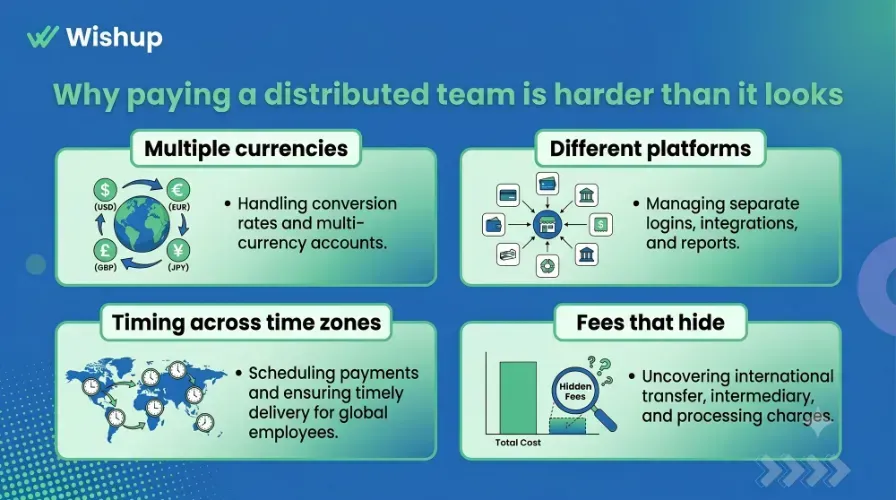
Here is what actually makes it messy:
- Multiple currencies. Every conversion costs something, and the spread is rarely in your favour.
- Different platforms. One person uses one tool, another refuses it, and you end up maintaining three payout methods.
- Timing across time zones. A payment sent Friday afternoon your time can sit over a weekend that does not line up with theirs.
- Fees that hide. Transfer fees, conversion margins, and receiving fees nibble at both ends of every payment.
Stack those on top of a growing roster and the admin scales faster than the team does.
Why do late payments matter more than you think?
It is tempting to treat a payment that lands a few days late as harmless. It rarely is. For the freelancer or VA on the other end, your invoice is their income, and a delay can mean a missed personal bill, not just an awkward email.
There is a relationship cost too. The best freelancers have options. If paying you means chasing invoices and waiting two extra weeks every month, they will quietly prioritise the clients who pay cleanly and put you at the back of the queue. Reliable payment is one of the cheapest loyalty tools you have, and most businesses underuse it.
So the goal is not just "pay people." It is pay them predictably, in a way that does not cost you a morning of admin each cycle.
Should you pay your VA as a contractor or an employee?
Before you optimize how you pay people, get clear on what they are. This trips up more small businesses than almost anything else, and it is worth settling early because it shapes everything downstream.
If you are weighing the trade-offs in detail, Wishup's breakdown of virtual assistant vs employee costs is a useful starting point.
When is someone genuinely a contractor?
A freelancer or VA you use occasionally, who works for other clients and sets their own hours, is usually a contractor. Fine. That arrangement is light, flexible, and perfectly legitimate.
When does a contractor quietly become an employee?
Here is the trap. If someone works full time on your core operations, follows your schedule, and has done so for a year, the law in their country may treat them as an employee no matter what your contract says. That distinction changes how you are supposed to pay them, what you owe in taxes, and what benefits they are entitled to.
You do not need to become an employment lawyer. You do need to ask the question honestly for each long-term person, because guessing wrong here is the expensive kind of mistake, with backdated taxes and penalties attached.
What are the best ways to actually move the money?
There is no single best method. There is a best method for your situation. Here are the common routes and where each one fits.
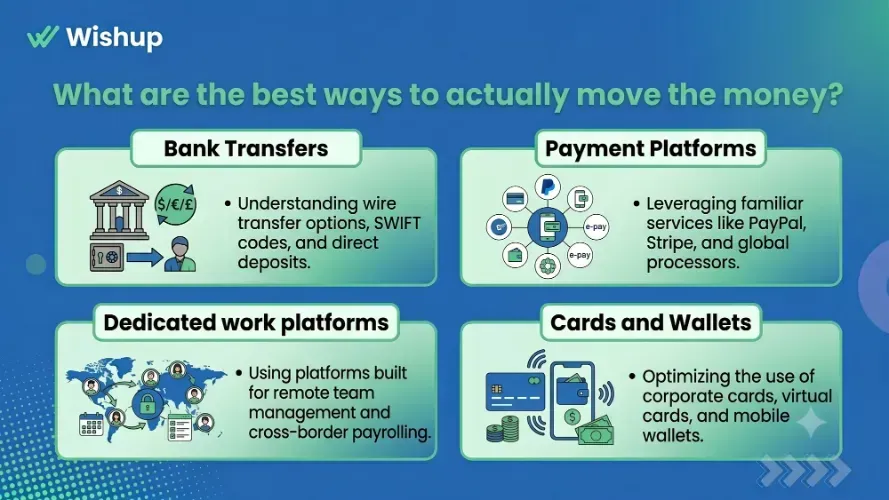
Bank transfers
The old reliable. Direct, widely accepted, and fine for a small number of stable relationships. The downside shows up internationally: slow settlement, weak exchange rates, and fees on both sides. Workable for one or two people, painful at scale.
Payment platforms
Tools like PayPal or Wise speed things up and handle currency conversion more gracefully than a bank. They are convenient, but fees vary, and not every contractor in every country can receive from every platform. You often end up running more than one.
Dedicated work payment platforms
For teams that have outgrown the patchwork, platforms built specifically for paying distributed workers pull everything into one place. The better ones offer Work payments services such as Native Teams that combine multi-currency payouts, invoicing, and tax handling in a single system, which cuts down the manual juggling between tools.
The trade-off is that you adopt a new system, but for anyone paying more than a handful of people across borders, the time saved usually justifies it.
Cards and wallets
Virtual or physical cards and multi-currency wallets suit on-demand and gig-style payments where you need flexibility and speed more than structure. Useful as a supplement, less so as your whole system.
How do you build a payment setup that scales?
You do not need anything elaborate. You need consistency. A setup that holds up as you grow tends to share a few traits.
Pay on a fixed schedule everyone knows in advance, so nobody has to chase you. Keep documentation in one place: contracts, invoices, and proof of payment, all findable. Decide each person's classification before they start, not after a problem appears. And pick a payment method that matches your volume rather than defaulting to whatever you used for your first hire.
The boring version of this works better than the clever version. Predictability is the whole point. And if part of the problem is simply that there are too many tasks and too few hours to manage any of this well, that is often the signal to bring in dedicated support. Many founders reach the point where they hire a virtual assistant specifically to own invoicing, payment scheduling, and the admin around it.
Conclusion
Paying a distributed team well is less about finding one perfect tool and more about removing friction before it compounds. The currencies, platforms, fees, and timing differences are all manageable individually. They only become a problem when you let them pile up unaddressed across a growing roster.
Start with clarity on who each person is, settle on a payment method that fits your actual volume, and pay on a schedule people can count on. Do that and payments stop being the thing you dread each month. They become routine, your team trusts that money arrives when it should, and you get your time back for the work that actually grows the business.
Frequently Asked Questions
How do I pay freelancers and distributed teams in different countries?
You pay them through whichever method balances speed, cost, and reach for the countries involved, usually bank transfers, payment platforms like Wise or PayPal, or a dedicated work payment platform.
The right choice depends on how many people you pay and how many currencies are in play, since fees and settlement times differ sharply between methods.
What is the cheapest way to pay international freelancers?
There is no single cheapest option, because cost depends on currency, destination, and amount.
Dedicated multi-currency platforms often beat traditional bank transfers on exchange rates and fees for regular international payments, while a plain bank transfer can be fine for an occasional one-off.
Should I pay my virtual assistant as a contractor or an employee?
It depends on the working relationship, not just your preference.
If your VA works full time on your core operations under your direction over a long period, the law in their country may classify them as an employee, which changes your tax and benefit obligations. The wider cost picture, covered in this guide on how much a virtual assistant costs, is worth reviewing before you decide.
How can I make sure freelancers get paid on time?
Set a fixed payment schedule, keep invoices and contracts organised in one place, and use a payment method fast enough for the countries you work with.
Consistent, predictable payment also protects your relationships, since reliable freelancers tend to prioritise the clients who never make them chase.
What is the most common payment mistake small businesses make?
Letting the process stay ad hoc as the team grows.
A method that worked for one freelancer turns into a tangle of platforms, currencies, and missed timing once you are paying ten people, which is why deciding on a consistent system early saves real money and time later.
