
You hired a virtual assistant to save time. Instead, you spend it rechecking their work, re-explaining the same tasks, and wondering whether delegating was worth it at all.
The problem is rarely the person. It is almost always the process behind how they were hired and trained.
At other VA companies, anyone can create a profile and start taking work. There is no standardized vetting, no training provided by the platform, and no quality benchmark. You do the screening, the interviewing, and the training yourself.
Even matching is personalized, and the service is premium, but it is built primarily for C-suite executives and comes with a price point that puts it out of reach for most growing businesses.
Most virtual assistant companies sit somewhere in between: fast to place, light on training, and heavy on promises.
At Wishup, we built something different. Our virtual assistant training program runs a minimum of 8 weeks, covers 15-plus modules, and requires a score of 90 percent or higher on every single assessment. Before a VA even reaches training, they have cleared a 10-stage hiring process that accepts just 0.1% of all applicants.
Still don’t believe us? This blog takes you behind the scenes of exactly how Wishup.co trains virtual assistants.
Let’s start from the beginning: How we recruit.
The Hiring Filter: Why 99.9% Applicants Never Make It to Training
Before a single training session begins, every Wishup virtual assistant has already cleared one of the most rigorous hiring filters in the virtual assistant industry.
In the last six months, we received 1,79,110 applications and hired 179. Each candidate goes through a rigorous 10-stage hiring funnel. Each stage systematically filters out candidates who do not meet our standards.
Here is what that filter actually looks like.
Here is What Our 10-Stage Hiring Funnel Contains
We do not just post a job and interview the first few promising candidates. Every applicant moves through a structured sequence designed to test skill, judgment, and character at every step.
- Online aptitude test: This is the first and largest filter. Thousands of applicants are assessed on raw problem-solving ability and logical thinking before a human ever reviews their profile.
- English proficiency test: Clear, professional written communication is the baseline for any client-facing role. Candidates who cannot meet that standard here do not move forward.
- Assignment stage: This is where theory meets reality. Candidates are given tasks modeled on actual client situations at Wishup. We are not testing what they know. We are testing how they think.
- Resume screening: Reviewed after assessments, once the volume is manageable. We look for relevant experience, stability, and growth, and flag anything that does not add up.
- Interview: This process is conducted by existing Wishup VAs, not just HR. The people interviewing candidates know exactly what the job demands daily, and they probe accordingly.
- Selection decision: Every candidate is scored against an internal rubric that weighs skill, communication, personality, and overall client-readiness, not gut feel.
- Reference check: We contact previous employers directly. Faked experience, salary gaps, and performance issues all surface here, and they are automatic disqualifiers.
- Offer negotiation: Expectations on both sides are aligned openly before anything is signed.
- Logistics check: Home setup, internet reliability, and equipment are confirmed. Remote work only works when the infrastructure behind it does too.
- Joining confirmation and onboarding: Once everything checks out, the candidate is handed off to the training team. The real work begins here.
The assignments are not textbook exercises. They are built to simulate the real situations our clients deal with every day.
For inbox and calendar management, trainees receive an actual client case study. They must understand the business, map out the team structure, identify active projects, and then manage a live dummy inbox and calendar as though the client were real and waiting.
We provide no templates, no step-by-step guides, and only important information to work through the test. For social media, trainees are handed a fictional company in a specific industry and asked to produce a complete content package from scratch: short-form videos, a logo, posters, and supporting copy.
For email marketing, they are given a campaign brief including target audience, industry context, and objective, and are expected to build a full campaign. They are evaluated not just on correctness but on creativity and whether the output would actually work in the real world.
Candidates who clear these assignments with strong scores move forward in the hiring process. Those who do not, do not. It is that straightforward.
Although our screening process is thorough, many candidates are disqualified for specific reasons.
Why So Many Get Rejected
Rejection happens at multiple points across the funnel, and the reasons fall into two clear categories.
- Skill-based rejections
- Personality-based rejections
Skill-based rejections include weak written English, poor aptitude scores, low assignment quality, incorrect or incomplete task submissions, and gaps or errors in the resume.
Personality-based rejections include a lack of ownership, poor conflict resolution instincts, absence of a service mindset, low energy or warmth in the interview, and signals of short-term thinking, etc.
As Nimish Jain, our recruiter, puts it: "We dig deeper into past experiences. We want to know how they handled a problem outside the SOP, something that required real judgment, not just following instructions."
Candidates who make it through the interview face a reference check, offer negotiation, and a logistics review to confirm their home setup before onboarding begins. The offer-to-join rate sits at 75%.
Why Passing Ten Screening Stages Still Isn’t Enough
Even candidates who clear all ten stages must meet five non-negotiable baselines to be considered client-ready enough to enter training.
- Strong communication skills, both written and spoken
- Task quality that enables them to be tech-savvy, attentive to detail, and adaptable.
- A genuine service attitude, the willingness to go beyond instructions when the situation calls for it
- High ownership, the ability to work independently, and take full accountability for outcomes
- Strong aptitude and the capacity to think clearly under pressure
There is one more requirement that applies to every single hire: A minimum of two years of prior corporate experience. No freshers, no exceptions! Most of our strongest performers have five to ten years of experience.
That experience is not a formality on the resume; it is what determines whether someone can operate with the professional maturity a client-facing role demands from day one. Once the virtual assistant is hired and onboarded, they are passed to the training session.
The Training Program: How Only 0.35% Become Client-Ready
Once a candidate is onboarded, they enter a minimum of 8 weeks of training program built around one principle.
As Shay Nuggu, our Senior Training Manager, puts it: "Everything begins with understanding the client’s needs and pairing them with a VA set up to succeed."
That philosophy shapes every session, every assignment, and every standard within the program.
The training itself rests on four pillars:
→ Structural integrity,
→ Discipline,
→ Standards, and
→ Intent.
Nothing is taught randomly. We have 15 modules, and every module has a purpose, every assessment has a benchmark, and every trainee is held to the same bar regardless of their background or prior experience. No exception is made when it comes to preparing the candidate into “the crème de la crème” in the VA industry.
Day 1: Induction
The first day is not about tools or tasks. It is about expectations. Trainees are walked through Wishup's rules, policies, and professional standards.
Days 2 and 3: The Foundation
The first sessions after induction focus on two things:
- AI tools and prompt engineering,
- Research methodology.
Trainees first learn how to conduct manual research, then how to layer AI into that process intelligently. This sequencing is intentional. Understanding the fundamentals first means trainees use AI as a tool, not a crutch.
Two dedicated AI sessions run through the core program.
--> The first covers prompt engineering: how to write effective prompts and apply AI tools to real client scenarios.
--> The second, introduced around day seven, focuses on automation and workflow thinking using tools like Zapier.
Beyond these sessions, AI is integrated into almost every module, from email writing and social media to lead research and data management. By deployment, every Wishup VA is expected to be approximately 75% equipped in practical AI usage.
The remaining 25%, including AI agents and more advanced automation, continues to develop after placement. The curriculum itself is reviewed regularly and updated based on client demand and market shifts, so what trainees learn stays relevant to what clients actually need.
By the end of these early sessions, VAs have also completed their first live test on research, giving trainers an early read on how each assistant thinks and works independently.
Week 1 to Week 4: Building the Foundation, One Module at A Time
The program moves into its core modules. Inbox and calendar management come early because, as Jatin Kelkar, our Training Manager of VAs, notes, these are the backbone of any executive support role. A VA who cannot manage an inbox and a calendar confidently cannot be trusted with much else.
Over the following weeks, trainees work through a structured curriculum covering the skills most in demand across Wishup's client base. This includes:
1. Inbox management
2. Calendar management
3. Research methodology
4. Business email writing,
5. Travel planning,
6. Data management,
7. Project management,
8. CRM and sales support,
9. Social media management,
10. Photo and video editing,
11. Email marketing,
12. Bookkeeping basics,
13. Automation,
14. Lead generation,
15. AI tools and prompt engineering
Each module is followed by an assignment, a live test, or both. Every assessment is scored against a 90% benchmark. Fall below it, and you get one opportunity to rework your submission based on feedback.
Consistent underperformance across modules is not managed with extra support or retesting. It results in removal from the program.
But simulating real client work goes beyond task execution. How a VA communicates under pressure matters just as much as what they deliver. That is why we have set up mock calls across the modules to set high communication standards.
From here, virtual assistants move into the heart of the training program. Inbox and calendar management come first because, as Jatin Kelkar, our Training Manager, explains, these are the foundation of any executive support role.
A VA who cannot manage an inbox and a calendar with confidence cannot be trusted with the broader responsibilities a client will eventually hand over.
Over the following weeks, the curriculum expands progressively. Virtual assistants are trained on business email writing, travel planning, data management, project management, CRM and sales support, social media management, photo and video editing, email marketing, bookkeeping basics, automation using tools like Zapier, and lead generation.
Each module builds on the last, and each one is followed by an assignment, a live test, or both.
Throughout this period, mock calls are woven into the training at regular intervals. Three mock calls are conducted across the full program, each scored out of five.
A virtual assistant must score four or above to progress. These are not casual conversations. They assess how a VA communicates under pressure, how clearly they think on the spot, and how confidently they can represent themselves and a client's business in a live scenario.
Written communication is reinforced in parallel through inbox management sessions, business email writing, and Slack etiquette, ensuring that VAs are just as strong on paper as they are on a call.
Every assessment across every module is scored against a 90 percent benchmark. Fall below it, and a virtual assistant gets one opportunity to rework their submission using trainer feedback.
Consistent underperformance is not managed with additional support or extra attempts. It results in removal from the program. The bar does not move.
Graduation and Deployment
Trainees who clear all module benchmarks, pass their mock calls, and demonstrate consistent ownership, proactiveness, and professional accountability throughout the program receive a Certificate of Graduation. Only then are they considered client-ready and eligible for placement.
As Shay puts it: "No amount of technical skill can compensate if accountability, communication clarity, and an ownership mindset are missing."
That is the standard every Wishup VA is held to before they ever work with a client. But what happens once they are deployed? Let’s unveil.

Wishup’s Support Doesn’t Stop at Deployment
Training does not end at graduation. Neither does Wishup's responsibility to the client.
The first 90 days after a virtual assistant is placed with a client are the most critical. A new VA, regardless of how well they performed in training, is entering a live business environment for the first time.
There are new tools, new communication styles, new expectations, and a real person on the other end whose time and trust are on the line. Wishup accounts for that reality with a structured buffer that protects both the client and the VA during this transition period.
That Is Why We Have A 90-Day Manager Buffer
For the first 90 days of every new placement, a dedicated VA Manager acts as an invisible layer of quality control between the virtual assistant and the client. No task goes to the client without the manager reviewing it first.
No communication is sent without approval. Every deliverable passes through an additional checkpoint before it reaches the person who hired us.
This is not a sign of distrust in the VA. It is a deliberate system designed to catch gaps early, course-correct quickly, and ensure that what the client receives consistently reflects the standard they were promised.
As Shay explains: "Structured check-ins and client satisfaction tracking in the early stage ensure stability and alignment before the VA moves to full independence."
If a manager develops confidence in a virtual assistant's output earlier than the 90-day mark, supervision is reduced accordingly. The timeline is a ceiling, not a fixed rule. What matters is that the client never bears the cost of a VA still finding their footing.
To ‘Align’ Them, We Provide Training That Evolves With Client Needs
The curriculum that trained your virtual assistant today will not be the same curriculum training VAs six months from now. Wishup runs a continuous feedback loop between client outcomes and training content.
VA Managers surface patterns from active accounts. Category Managers analyze what skills clients are requesting most and where gaps are appearing. The training team conducts root cause analysis on underperformance and uses that data to update modules, retire tools that are no longer relevant, and introduce skills that the market is actively asking for.
The result is a virtual assistant who was trained on what clients need right now, supported by a system that keeps pace with what they will need next.
Every Wishup VA Is the Result of a Process Most Companies Never Bother to Build
Most virtual assistant companies will tell you they hire the best. Very few can show you what that actually means.
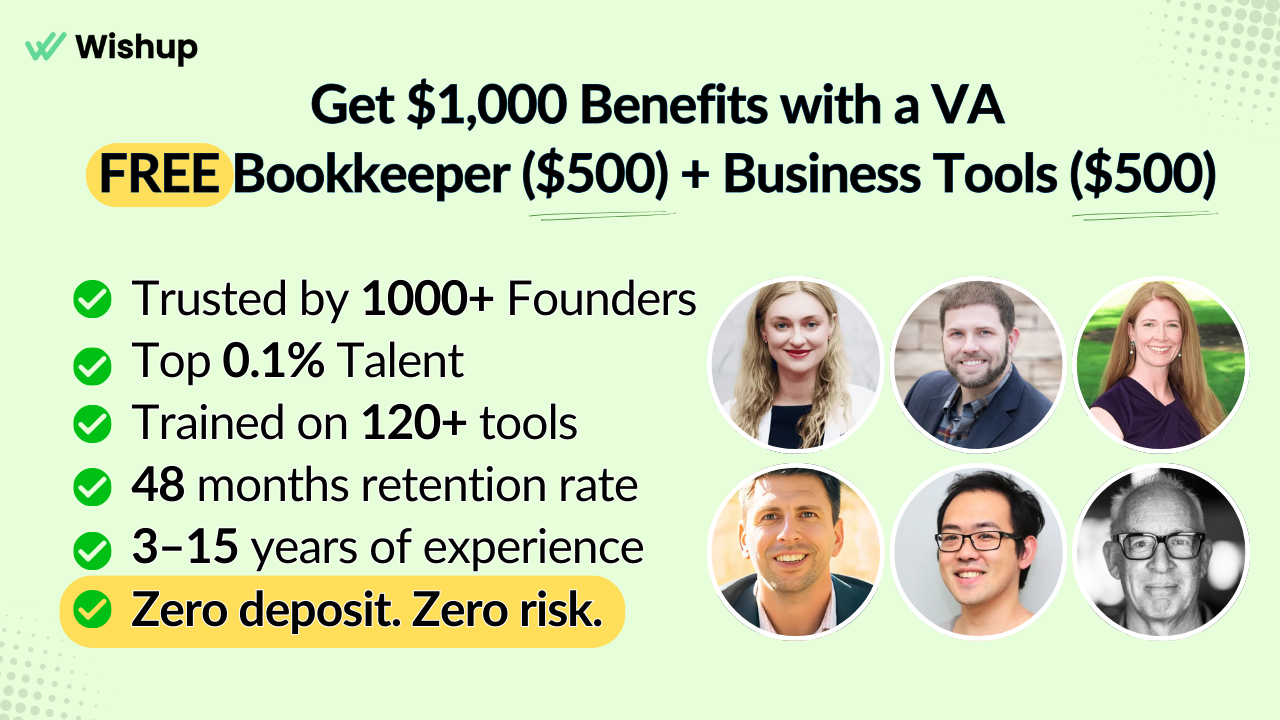
At Wishup, the standard is not a claim. It is a process. It starts with a hiring filter that accepts 0.35 percent of all applicants, moves through a 10-stage screening process that tests skill, judgment, and character at every step, and continues into a 8 weeks training program where virtual assistants must score 90 percent or higher on every module, pass three mock calls, and demonstrate the ownership and accountability that no tool or template can teach.
By the time a Wishup VA is assigned to your business, they have already proven themselves in conditions designed to replicate the real thing. And for the first 90 days after placement, a dedicated manager ensures that the standard you were promised is the standard you actually receive.
If you have been burned by a VA who needed constant hand-holding, or a platform that left the vetting entirely up to you, this is what the alternative looks like.
