
Summary - TL;DR
- HVAC business automation primarily focuses on seven operational areas: billing and invoicing, dispatch coordination, customer scheduling, estimate conversion, service agreement management, payroll processing, and reporting.
- The leading HVAC automation platforms in 2026 include ServiceTitan, BuildOps, FreshBooks, QuickBooks, and HouseCallPro, each serving a different layer of field service operations.
- Software implementations and migrations often reveal operational bottlenecks rather than eliminate them. A trained virtual assistant team is typically required to manage and optimize the new workflows.
- The most common automation mistake is relying solely on software. Critical functions such as portal billing, dispatch decisions, payroll reconciliation, and customer communication still require human oversight and judgment.
- Wishup's HVAC deployment model operates with 8 virtual assistants across dispatch, finance, HR, administration, and business intelligence functions, supporting multiple customer portals and field operations workflows.
- Wishup pricing starts at $1,299/month for a part-time Prime VA and scales to $5,400/month for a full-time US-based VA, compared to the $60K–$85K annual cost of a full-time in-house administrator.
The best HVAC automation strategy combines software with trained operators. Technology handles the workflow, while skilled virtual assistants ensure jobs are dispatched, invoices are paid, payroll is accurate, and customers stay informed.
HVAC businesses that do not automate billing, dispatch, and scheduling lose 30 or more hours per week to administrative work that generates zero revenue.
The gap between a contractor who scales and one who stalls is not usually the size of their technician crew. It is how much of the owner's week gets consumed by tasks that a trained virtual assistant or a piece of software could execute more reliably, at a fraction of the cost.
Hire an HVAC virtual assistant from Wishup and get started in 60 minutes.
This guide covers:
- The 7 core areas HVAC businesses automate first,
- The 5 tools that power most of those workflows,
- The real operational challenges contractors face when they try to automate (and why most implementations fail), and
- The exact workflow Wishup's virtual assistant use inside a live HVAC operation today.

Whether you run a 5-van residential service company or a 30-technician commercial contractor, the automation opportunities in this guide apply to your back office right now.
7 Key Areas to Automate in an HVAC Business
HVAC business automation covers 7 operational areas: dispatch coordination, billing and invoicing, scheduling, customer follow-ups, job costing, payroll admin, and reporting.
1. Billing and Invoice Management
Billing is the single most critical automation target in any HVAC back office. Invoices that bounce between billers and account managers, get rejected by customer portals, or miss submission deadlines directly delay cash flow by days or weeks.
In Wishup's $18,000 MRR HVAC deployment, the client described their billing problem in plain terms: "the billing goes to the customer account manager, then it goes back to the billers, then it goes back to the customer account manager, and it just keeps going back and forth."
The BuildOps migration surfaced this bottleneck rather than fixing it. It required a dedicated virtual assistant billing team, who know automation and how to use the tool.
→ Creating invoices from completed work orders inside BuildOps, ServiceTitan, or HouseCallPro.
→ Submitting invoices through customer portals, including Corrigo, ServiceChannel, Verisae, and Publix Portal.
→ Tracking rejections, flagging purge-risk jobs, and resubmitting with corrected documentation.
→ Converting estimates and approved proposals into invoices.
→ Processing ACH payments and maintaining collection trackers for past-due accounts
2. Dispatch Coordination
Dispatch is the operational core of every HVAC business. Misassigned technicians, uncovered service calls, and delayed portal updates cost service revenue and customer relationships simultaneously.
From the real-world deployment data in Wishup's 8-virtual assistant HVAC operation, dispatch workflows span 7 sub-functions: service call creation, technician assignment, subcontractor tracking, portal posting (Corrigo, PFS, Verisae, ServiceChannel), emergency re-routing, GPS reconciliation, and job completion monitoring.
→ Creating and assigning service calls in BuildOps or ServiceTitan from Slack channels, emails, and portal notifications.
→ Posting jobs to customer portals and monitoring arrival alerts, overdue notifications, and recall alerts.
→ Moving labor hours between jobs at the end of the shift.
→ Tracking technician check-in/check-out via GPS and flagging incomplete job notes.
→ Managing on-call schedules, technician vacations, and backup dispatcher coverage.
3. Customer Scheduling and Appointment Management
HVAC businesses using automated scheduling reduce no-show rates and eliminate the 2 to 3 hours per day technicians and coordinators spend confirming appointments by phone.
Scheduling automation tools like HouseCallPro and ServiceTitan connect booking, reminders, and technician dispatch into a single flow. Customers receive automated confirmation texts, 24-hour reminders, and technician-on-the-way notifications, all without a coordinator picking up the phone.
→ Online booking pages connected directly to the dispatch board.
→ Automated confirmation and reminder messages at 24 hours and 2 hours before appointments.
→ Real-time technician tracking shared with customers via SMS.
→ Seasonal maintenance reminders sent to customers based on service agreement dates.
→ Follow-up surveys are triggered automatically at job completion
4. Estimates and Quote Conversion
HVAC contractors who automate estimate follow-ups close 30 to 40% more open proposals simply by removing the delay between estimate delivery and follow-up contact.
Manual quote workflows in most small HVAC businesses look like this: a technician generates a quote in the field, it sits in the system, someone manually follows up 3 to 5 days later if they remember, and a significant portion of estimates expire without a response.
→ Sending estimates to customers automatically on job completion via email and SMS.
→ Triggering follow-up sequences at 24 hours, 48 hours, and 7 days for unaccepted estimates.
→ Converting approved proposals into work orders and invoices with one action inside the FSM software.
→ Tracking quote approval status by salesperson and generating weekly status reports.
→ Updating NTE increases in customer portals when scope changes are approved
5. Service Agreement and Maintenance Scheduling
Manual agreement management means tracking expiry dates in spreadsheets, calling customers individually for renewals, and scheduling seasonal visits without a systematic trigger. All three of those tasks can be automated with modern FSM software and a virtual assistant who maintains the agreement database.
→ Automated expiry notifications sent to customers 60, 30, and 7 days before agreement end.
→ Seasonal maintenance job creation triggered by agreement schedules inside BuildOps or ServiceTitan.
→ Renewal quote generation and sending without dispatcher involvement.
→ Tracking agreement status across all accounts and reporting coverage gaps weekly.
→ Creating and updating service agreement records when scope or pricing changes
6. Payroll and Timesheet Processing
In a technician-heavy operation with 20 or more field staff, weekly timesheet reconciliation against GPS data, job records, and payroll system inputs takes 4 to 6 hours without automation.
In Wishup's live HVAC deployment, a dedicated payroll virtual assistant pulls BuildOps labor hour reports, reconciles them against ADP timecards, flags discrepancies, and sends weekly timesheet reminders, as a standalone function.
→ Pulling labor hour reports from BuildOps or ServiceTitan by job and technician.
→ Cross-referencing FSM labor data against ADP or payroll system entries.
→ Flagging technicians with missing time entries and sending automated reminders.
→ Tracking overtime, PTO, and unpaid leave entries inside the dispatch system.
→ Generating weekly payroll summaries for the finance team before processing
7. Reporting and Business Intelligence
Most FSM platforms generate data. They do not generate structured reports that a business owner can act on. Turning raw BuildOps or ServiceTitan data into a dispatch performance dashboard, a technician productivity scorecard, or a monthly revenue forecast requires a person who can pull, clean, and structure that data consistently.
→ Weekly job completion reports pulled from FSM dashboards and distributed to operations leadership.
→ Technician productivity reports segmented by job type, customer, and trade.
→ Billing and dispatch performance dashboards maintained and updated inside BuildOps.
→ ServiceChannel IVR time reconciliation reports.
→ Data quality audits identifying missing or incorrect job, customer, and asset records.
Best HVAC Business Automation Tools and Software in 2026
The 5 HVAC business automation platforms used most widely in 2026 are ServiceTitan, BuildOps, FreshBooks, QuickBooks, and HouseCallPro. Each platform automates a distinct layer of HVAC operations, from dispatch and invoicing to bookkeeping and customer communication.
1. ServiceTitan
ServiceTitan is the most comprehensive HVAC field service management platform available in 2026. It covers dispatch, scheduling, invoicing, CRM, service agreements, and reporting inside a single system.
What it is best for: ServiceTitan is purpose-built for residential and commercial HVAC contractors who need to manage the full job lifecycle from first call to final payment in one platform. It is the dominant FSM platform in the residential HVAC space and is widely used by commercial contractors as well.
What ServiceTitan automates for HVAC businesses:
- Dispatch board management with drag-and-drop technician scheduling and real-time job status updates
- Automated customer notifications at every job stage: booking confirmation, technician dispatch, arrival, and job completion
- Estimate creation and follow-up sequences with automated texts and emails to unaccepted proposals
- Invoice generation from completed work orders with direct payment processing integration
- Service agreement tracking, renewal reminders, and seasonal maintenance scheduling
- Reporting and analytics dashboards covering technician performance, revenue per job, and campaign ROI
ServiceTitan Cost:
Contact their sales team for customized pricing!
Rating:
- G2: 4.5 / 5
- Capterra: 4.3 / 5
2. BuildOps
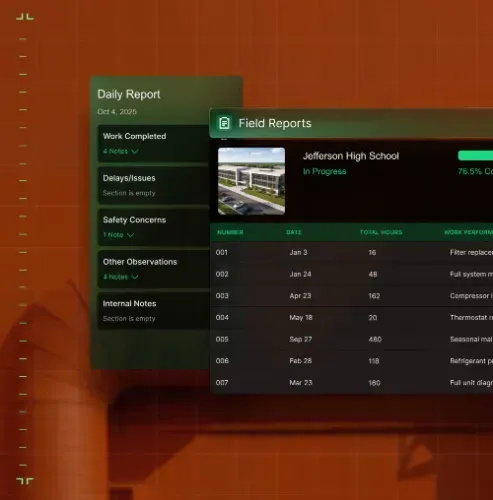
BuildOps is the leading FSM platform purpose-built for commercial HVAC, mechanical, electrical, plumbing, refrigeration, and fire safety contractors. It covers dispatch, invoicing, project management, customer portals, purchasing, and service agreements within a single system.
What BuildOps automates for HVAC businesses:
- Commercial dispatch board with real-time technician assignment, job status tracking, and subcontractor coordination
- Estimate-to-invoice conversion with portal submission workflows for Corrigo, ServiceChannel, Verisae, and customer-specific portals
- Purchase order creation and vendor invoice matching, including refrigerant documentation tracking
- Service agreement creation, scheduling, and PM invoice processing
- Customer portal management with automated notification monitoring for arrival alerts, overdue warnings, and recall alerts
- Business intelligence dashboards with job completion, technician productivity, and billing performance reporting
BuildOps Cost: Book a demo with them to get a quote!
Rating:
- G2: 4.2 / 5
- Capterra: 4.4 / 5
3. FreshBooks
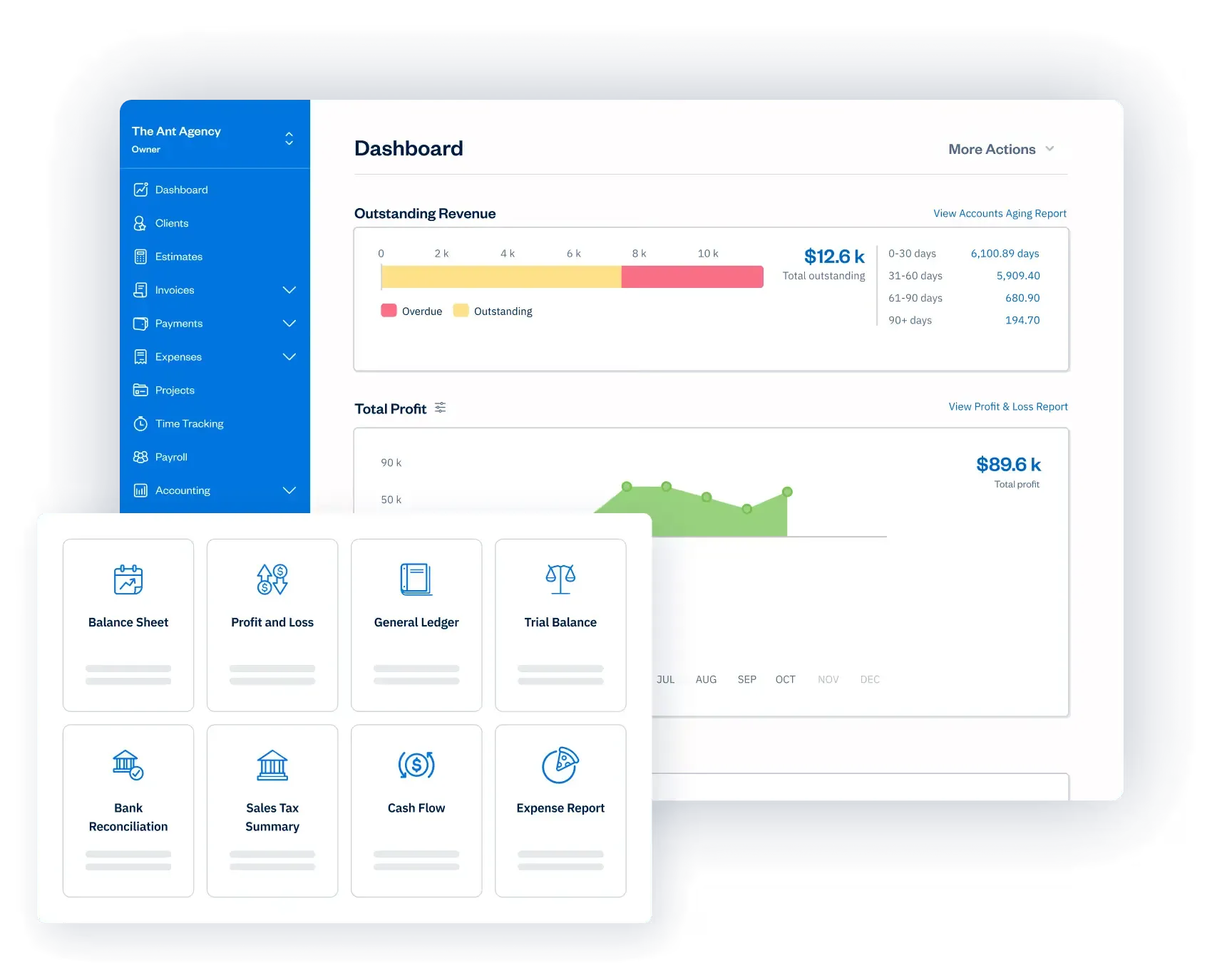
FreshBooks is cloud-based accounting and invoicing software. It automates billing, expense tracking, payment follow-ups, and financial reporting for HVAC businesses with annual revenue under $3M.
What FreshBooks automates for HVAC businesses:
- Recurring invoice creation and automated payment reminders at 7, 14, and 30 days past due
- Expense categorization and receipt scanning to reduce manual data entry
- Time tracking integration with project records for accurate job costing
- Automated bank reconciliation pulling transactions from connected accounts
- Financial reporting, including profit and loss statements, cash flow summaries, and tax-ready expense reports
FreshBooks Cost:
FreshBooks pricing starts at $2.30/month (Lite plan, up to 5 clients) and scales to $7/month (Premium plan, unlimited clients) in 2026.
Ratings:
- G2: 4.5 / 5
- Capterra: 4.5 / 5
4. QuickBooks
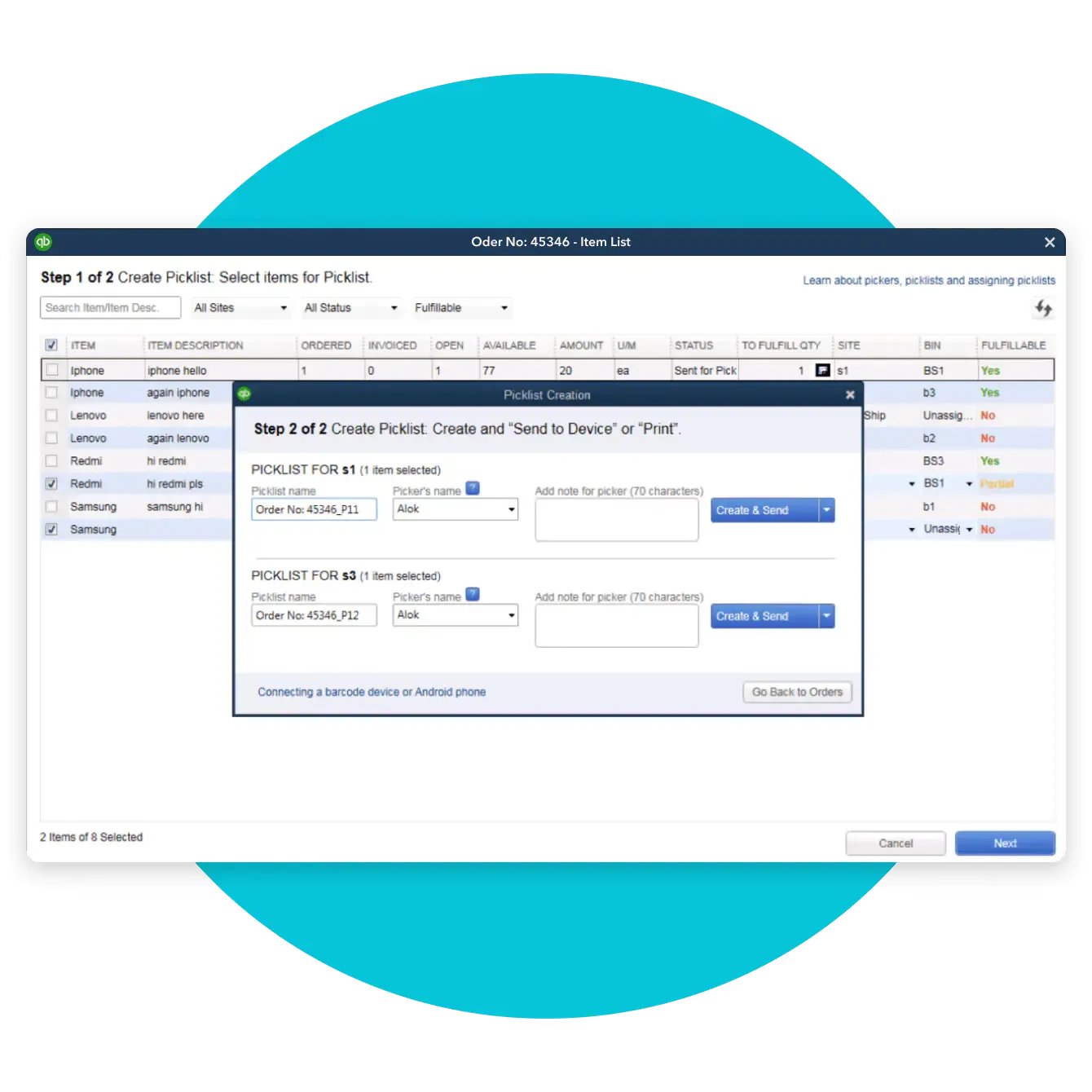
QuickBooks is the most widely used accounting platform for HVAC businesses in 2026. It covers invoicing, payroll, expense management, tax preparation, job costing, and financial reporting within a single ecosystem.
Most HVAC contractors use QuickBooks Online as their accounting backbone regardless of which FSM platform they run for dispatch and billing.
It integrates with ServiceTitan, HouseCallPro, and other FSM tools, making it the connective tissue between field operations and financial records.
What QuickBooks automates for HVAC businesses:
- Payroll processing with automated tax calculation, direct deposit, and year-end W-2 generation (QuickBooks Payroll add-on)
- Invoice creation, recurring billing, and automated payment reminders
- Expense tracking with bank feed integration and AI-powered categorization
- Job costing reports showing labor, materials, and overhead by project
- Sales tax calculation and filing in supported states
- Integration with 750+ apps including ServiceTitan, HouseCallPro, and Zapier
QuickBooks Cost:
QuickBooks Online pricing in 2026 starts at $19/month (Simple Start) and scales to $137/month (Advanced plan) for larger HVAC operations.
Rating:
- G2: 4.4 / 5
- Capterra: 4.3 / 5
5. HouseCallPro
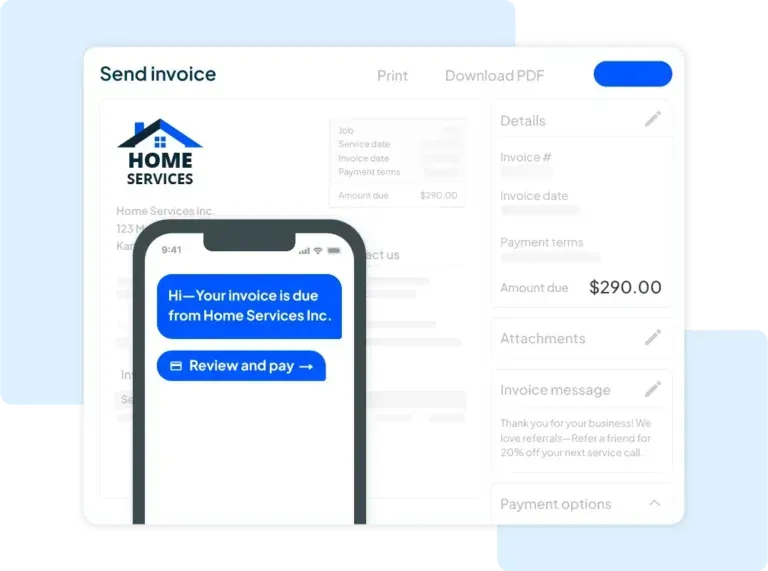
HouseCallPro is a field service management and customer communication platform built for residential HVAC businesses. It covers online booking, automated scheduling, dispatch, invoicing, and customer follow-ups in a single mobile-first platform.
What HouseCallPro automates for HVAC businesses:
- Online booking with real-time availability connected directly to the dispatch calendar
- Automated appointment confirmations, reminders, and technician-on-the-way notifications via text and email
- Digital invoicing with card-on-file payments and automated follow-ups on unpaid invoices
- Review request automation triggered at job completion with direct links to Google reviews
- Postcard and email marketing campaigns for seasonal tune-up promotions and service agreement renewals
- Reporting dashboards covering revenue, job count, technician performance, and conversion rates
HouseCallPro Cost:
HouseCallPro pricing starts at $59/month (Basic, 1 user) and scales to $299/month (Grow plan) for teams of up to 5 users in 2026.
Ratings:
- G2: 4.3 / 5
- Capterra: 4.7 / 5
HVAC Automation Tool Comparison at a Glance:
The Challenges of HVAC Business Automation and How Wishup's Virtual Assistant Resolve Them
HVAC business automation fails in 4 ways: software adoption without trained operators, billing bottlenecks that survive platform migrations, portal rejection loops, change management gaps, and the absence of accountability infrastructure.
Challenge 1: The Software Migration Exposes Problems It Cannot Solve
When a commercial HVAC contractor migrated from their previous FSM platform to BuildOps, the billing workflow collapsed almost immediately.
Invoices began bouncing between billers and account managers in an approval loop that had no defined ownership, no turnaround time, and no accountability for first-pass accuracy.
In the live deployment drawn from the task data, 9 finance virtual assistants cover distinct functions: invoice creation, portal submission, Whole Foods and Publix billing tracks, accounts payable management, quote coordination, and collections.
Each virtual assistant owns a specific function with defined inputs and outputs. This eliminates the approval loop.
Challenge 2: Customer Portal Billing Requires Human Judgment, Not Just Software
Portal-based billing is where most commercial HVAC cash flow delays originate. Each portal has different submission requirements, different rejection criteria, and different SLA windows.
An invoice submitted without the correct refrigerant documentation, with a line item that exceeds the NTE threshold, or with a mismatched PO number is rejected instantly and requeued. What happens in turn is that it adds days or weeks to the payment cycle.
Competing virtual assistant companies that evaluated the same commercial HVAC client dismissed this complexity with generic assurances.
Across the finance team, Wishup's virtual assistants handle
- Corrigo job completion verification before billing opens,
- Corrigo portal invoice submission with documentation attached,
- ServiceChannel workflow management,
- Verisae submission and compliance tracking,
- Publix portal work order completion, purge-risk job monitoring, and rejected invoice revision and resubmission.
All of this is worked upon as distinct daily functions with named virtual assistant ownership.
Challenge 3: Billing Accuracy on First Pass Requires Dedicated Ownership
In the live HVAC deployment, one of the core operational problems is that no single person owns billing accuracy from estimate review to final invoice submission.
Account managers were reviewing invoices not because it was their function, but because the biller was not catching errors before submission. The result was an endless review loop that slowed billing cycles for every job.
In the live 9-virtual assistant finance deployment, the quote coordinator reviews line items and pricing on estimates. Before they are converted to invoices, associates approve quotes with jobs, update NTE increases, and track quote approval status by salesperson.
The billing virtual assistants then convert approved estimates into invoices with documentation attached, split billable versus non-billable line items on mixed-scope jobs, and submit through the correct portal.
This structure gives billing accuracy a defined owner at every stage, rather than distributing accountability across roles that were never designed for it. The account manager review loop is eliminated because the finance virtual assistants catch errors before the invoice is created, not after.
Challenge 4: Dispatch Complexity Scales Faster Than Internal Capacity
Commercial dispatch is a 7 distinct functions operated in parallel: primary dispatch, backup dispatch, after-hours coverage, Whole Foods-specific coordination, weekend coverage across 2 virtual assistants, and GPS/payroll reconciliation.
A single dispatcher cannot cover all 7 functions reliably, and most HVAC businesses try to make one person do exactly that until something breaks.
In the live 8-virtual assistant dispatch deployment, each virtual assistant owns a defined coverage window and set of responsibilities.
- The primary dispatcher manages the full service call lifecycle during business hours. Backup dispatch handles collections and payroll support.
- After-hours and weekend dispatchers cover portal monitoring, technician follow-ups, and emergency job creation.
- The GPS and payroll virtual assistant reconcile BuildOps labor hours against ADP timecards weekly.
For HVAC businesses earlier in the automation journey, a single virtual assistant trained across dispatch coordination and basic billing can absorb the highest-impact functions before a multi-virtual assistant team structure becomes necessary.

How to automate technician scheduling and dispatch?
Automate technician scheduling and dispatch by connecting your FSM platform's dispatch board to automated job assignment, GPS check-in, and portal posting, then having a virtual assistant own the exceptions.
In BuildOps or ServiceTitan, service calls auto-create from Slack, email, and portal notifications, jobs post to customer portals automatically, and GPS tracks technician check-in.
The virtual assistant handles emergency re-routing, subcontractor tracking, and incomplete job notes, the judgment calls software cannot make.
Why Choose Wishup's Virtual Assistants for HVAC Business Automation
Wishup is the only managed virtual assistant service with a documented live deployment inside a commercial HVAC operation running BuildOps, ServiceTitan-adjacent workflows, and multi-portal billing across a 30-technician contractor.
Here is why Wishup is worth your grain of salt.
1. FSM Workflow Fluency, Not Just Tool Exposure
Wishup's virtual assistants have worked inside ServiceTitan, Service Fusion, and Jobber, the sibling platforms to BuildOps in the commercial FSM category. They understand PO-driven billing, portal submission logic, dispatch board operations, and the estimate-to-invoice workflow that commercial HVAC accounts require.
2. 0.1% Selection Rate Across 51,119 Applicants in 6 Months
179 virtual assistants were hired from 179,119 applicants over 6 months, a selection rate of 0.1%, approximately 1 hire per 179 applicants.
Every Wishup's virtual assistants clears a multi-stage vetting process: written English assessment, aptitude test, real-world scenario assignment based on live client situations, structured interview conducted by senior Wishup VAs, reference check against prior employers, and salary and logistics confirmation before onboarding.
Minimum entry requirement is 2 years of corporate experience. The typical Wishup's virtual assistant has 5 to 10 years. No freshers are hired. That experience depth is what makes FSM workflow transfer possible inside a 10-day onboarding window.
3. Full-Time Employees on Wishup Payroll, Not Freelancers
Every Wishup's virtual assistant is on Wishup's payroll with a formal employment structure. This is operationally significant in 3 ways.
- First, it enforces a mandatory 2-week notice period before any virtual assistant exits a client engagement.
- Second, it enables unlimited virtual assistant replacement via a single email or text to the assigned Customer Success Manager.
- Third, it enforces Wishup's Time Doctor utilization tracking across all deployed virtual assistants.
HVAC clients can see daily productivity, task completion, and login time without managing the virtual assistant directly.
4. 90-Day Supervised Deployment for Quality Assurance
For the first 90 days post-deployment, Wishup's Manager for virtual assistants reviews all task outputs and client-facing communications before they reach the client's billing system, customer portals, or end customers.
After 90 days, supervision is reduced based on demonstrated performance. Virtual assistants with consistently high task quality scores and positive client feedback move to independent ownership faster. Virtual assistants with recurring errors receive additional manager oversight until performance stabilizes.
6. Dedicated CSM With Bi-Weekly Check-Ins
Every Wishup client has a named Customer Success Manager who attends bi-weekly operational check-ins, handles replacement requests, escalates task quality issues, and adjusts virtual assistant scope as the HVAC business's needs change.
How Wishup Virtual Assistants Create a Workflow Through Automation That Works Best for Your HVAC Business
HVAC business automation workflow by function
Select any task card to see what a Wishup VA does at that step.
The workflow above is not a template. It is a live operating model drawn from a real commercial HVAC deployment.
Every card in the four departments above, dispatch, billing, payroll, and reporting, maps to a named virtual assistant role that ran inside an actual HVAC operation.
The task list comes from 10 years of VA deployments inside HVAC contractor companies. Click any card to see what Wishup's virtual assistant owns at that step and which tool they use to do it.
Here is how this workflow gets built for your business.
Step 1: Identify your highest-cost bottleneck first.
For most HVAC businesses, it is billing. Invoices that sit in an approval loop, get rejected by portals, or go out with wrong line items cost cash flow faster than any other back-office failure. That is where the first virtual assistant deployment almost always starts.
Step 2: Assign ownership, not just software.
BuildOps, ServiceTitan, and HouseCallPro can all surface the problem. None of them fix it without a person who owns the output at each stage.
A virtual assistant with clear scope, defined inputs, and a daily completion standard does what software alone cannot.
Step 3: Build out departments as volume grows.
The workflow above shows a mature deployment. Most HVAC businesses start with one or two virtual assistants covering billing and dispatch basics, then expand into payroll, HR admin, and BI reporting as the operation scales. Wishup structures the expansion based on your actual work volume, not a predefined package.
Step 4: Let the first 90 days be supervised.
Every Wishup's virtual assistant works under manager review for the first 90 days. Nothing goes to your portals, your customers, or your billing system without a second set of eyes.
That window is when errors get caught and workflows get tightened, before they become cash flow events.
The workflow is built around your FSM platform, your portal configuration, and your team structure. It is not a plug-in. It is a custom operating layer that a Wishup team configures, trains virtual assistants on, and monitors from day one.
How to Hire Wishup's Virtual Assistant for Your HVAC Business?
Getting started takes one conversation and about 60 minutes. Here is what the process looks like:
1. Book a free consultation.
Tell the Wishup team where your operations are breaking down. Billing backlog, dispatch coverage gaps, portal rejections, payroll errors, wherever the most hours are going, that is the starting point. The consultation is diagnostic, not a sales pitch.
2. Get matched with the right virtual assistant profile.
Wishup matches you based on your FSM platform, your back-office complexity, and the specific functions you need covered first. A commercial contractor running BuildOps with portal billing needs a different virtual assistant profile than a residential company on HouseCallPro. The match reflects that.
3. Onboard in 60 minutes.
Your virtual assistant is introduced, given access to your systems, and starts the 10-day unpaid BuildOps or FSM-specific training on your workflows before going live. No lengthy hiring cycle. No trial-and-error ramp-up on your billing cycle.
Schedule a free consultation with Wishup and get your HVAC back office running cleanly.
How Much Does HVAC Business Automation Cost?
Hiring a full-time HVAC back-office admin costs $45,000 to $65,000 per year in salary alone, before benefits, equipment, and office overhead. A Wishup HVAC virtual assistant starts at $1,299 per month with onboarding, a virtual assistant's Manager, and a replacement guarantee included.
Wishup offers three virtual assistant plans: Prime, Elite, and US-based virtual assistant.
- The Prime virtual assistant plan costs $1,999 per month for full-time and $1,299 per month for part-time.
- The Elite virtual assistant plan costs $2,999 per month for full-time and $1,999 per month for part-time.
- The US-based virtual assistant plan costs $5,400 per month for full-time and $3,000 per month for part-time.
Most HVAC businesses start with a part-time Prime virtual assistant covering their single highest-cost bottleneck, typically billing or dispatch. As volume grows, they expand to full-time or add a second virtual assistant for a different department. The cost scales with your actual need, not a fixed package.
Annual cost comparison:
The savings compound with every virtual assistant added. A 3-virtual assistant deployment covering dispatch, billing, and payroll costs less annually than a single mid-range in-house admin hire.
FAQs on HVAC Automation
How can AI help in the HVAC business?
AI helps HVAC businesses in 4 direct ways.
- First, it automates customer communication, sending booking confirmations, appointment reminders, and follow-up surveys without staff involvement.
- Second, it powers predictive scheduling inside platforms like ServiceTitan and BuildOps, flagging technician availability gaps before they create coverage failures.
- Third, AI-assisted invoice review catches line-item errors and NTE mismatches before portal submission.
- Fourth, AI tools like Zapier and AppScript automate recurring data transfers between FSM platforms, accounting software, and payroll systems, eliminating manual re-entry.
Wishup's virtual assistants are trained in AI tools and prompt engineering and deploy these capabilities inside your existing tech stack.
How to automate an HVAC business?
Automate an HVAC business in 4 steps. Start with your FSM platform: BuildOps, ServiceTitan, or HouseCallPro handle dispatch, scheduling, invoicing, and portal management in one system.
Layer accounting automation on top using QuickBooks or FreshBooks for payroll, job costing, and expense tracking. Add customer communication automation for booking, reminders, and follow-ups.
Finally, deploy a trained virtual assistant to operate these tools daily, because software alone does not eliminate the human judgment required for portal billing, dispatch decisions, and payroll reconciliation. The virtual assistant is what turns software investment into operational output.
What is the best software for a small HVAC business?
HouseCallPro is the best software for small HVAC businesses with 2 to 10 technicians, starting at $65/month with strong scheduling, customer communication, and invoicing tools built in.
- ServiceTitan is the better choice for residential businesses with over 10 technicians that need deeper reporting, CRM, and marketing automation.
- BuildOps is purpose-built for commercial HVAC contractors managing portal-based billing, multi-site dispatch, and PO-driven workflows.
- QuickBooks handles accounting and payroll across all three.
The right stack for most small HVAC businesses is one FSM platform plus QuickBooks, operated by a trained virtual assistant who keeps both systems accurate and current.
What is a realistic estimate follow-up ROI for a $3M HVAC company using AI?
For a $3M HVAC company, automated estimate follow-up realistically recovers $90,000 to $150,000 a year in closed proposals that would otherwise expire unanswered.
Here is the math: a $3M contractor typically has 25 to 35% of revenue sitting in open estimates at any time, roughly $750,000 to $1,000,000 annually. HVAC contractors who automate estimate follow-up close 30 to 40% more of those open proposals, simply by removing the delay between estimate delivery and follow-up.
Even at the conservative end, recovering an extra 10 to 15% of a $750,000 open-estimate pool is $75,000 to $110,000 a year, against a virtual assistant cost of roughly $16,000 to $24,000.
HouseCall Pro vs FreshBooks for HVAC: Which do you need?
HouseCall Pro and FreshBooks solve different problems for an HVAC business: HouseCall Pro is field service management (booking, dispatch, scheduling, customer communication), while FreshBooks is accounting and invoicing (billing, expenses, payment follow-up, financial reporting).
Most residential HVAC businesses need both, HouseCall Pro to run the field operation and FreshBooks or QuickBooks to run the books, connected so job data flows into billing.
The comparison is not either-or: it is which FSM platform (HouseCall Pro for residential, BuildOps for commercial) pairs with which accounting tool (FreshBooks under $3M revenue, QuickBooks above). A virtual assistant keeps both systems accurate and reconciled so the data matches.
What is the best AI for HVAC job costing and proposal generation?
For job costing and proposal generation, the strongest stack pairs an FSM platform (BuildOps or ServiceTitan) that generates the cost and proposal data with AI-assisted review that catches line-item and NTE errors before submission. A virtual assistant trained in these tools builds the proposals, applies job-costing logic, and runs follow-up, since the AI generates but does not close.
Which payment platform is best for independent HVAC contractors?
Independent HVAC contractors are best served by the payment processing built into their FSM or accounting tool, HouseCall Pro and ServiceTitan for card-on-file and job-linked payments, QuickBooks or FreshBooks for ACH and recurring billing, so payments reconcile automatically against invoices rather than needing manual matching.
