
Summary - TL;DR
- What does offshore shared services in India cost? Companies save 30–70% on total costs by offshoring to India. Loaded FTE costs run $8,000–$15,000/year vs. $60,000–$120,000 in the US. Tier 2 cities like Kochi and Indore are 20–30% cheaper than Bangalore or Mumbai.
- Why India? #1 on Kearney's Global Services Location Index. 100M+ English speakers, mature BPO ecosystem, 24/7 time zone coverage.
- Watch out for: Hidden costs, management overhead, attrition, and underutilization can quietly add 15–30% back.
The smarter route: Wishup gives you pre-vetted, top 0.1% Indian talent, trained, managed, and ready in 60 minutes, starting at $9.99/hr, no long-term contracts. You get the India cost advantage without the operational complexity.
Offshore shared services in India keep showing up at the top of the shortlist for one reason: you get real capability at a cost base that’s hard to match. Kearney’s Global Services Location Index ranks India in the top spot, with the index built on financial attractiveness and people skills/availability, among other factors.
And it’s not just theory. Deloitte has called India the most preferred location for global shared services, pointing to the scale of GCCs and the depth of the talent market already operating there.
That momentum is also reflected on the demand side. Surveys and industry summaries consistently show that two-thirds of U.S. companies outsource at least one function or department, which is why “offshore” is no longer a niche strategy reserved for mega-enterprises.
But here’s the part most blogs skip:
- The cost of building offshore shared services in India is not just about salaries.
- Your real number is shaped by decisions around city tier, hiring model (captive vs partner), infrastructure, utilization rates, management layers, wage inflation, and how well your team is structured from day one.
Get these wrong, and the “low-cost centre” quickly turns into a high-friction operation that quietly eats into margins through underutilization, rework, and management overhead.
This guide breaks the cost down practically:
- What drives the cost of offshoring to India
- How much companies actually save (and where savings get diluted)
- The hidden costs most teams discover too late
- And how to structure an Indian offshore team with Wishup so that net savings stay in the 30–50% range instead of eroding after month one
If you’re evaluating offshore shared services in India, this will help you look beyond headline wage arbitrage and understand the real operating cost.

Why India?
A law journal article by George and Gaut showcases India as an emerging and dominant offshore outsourcing destination from the late 1980s onward. The outsourcing boom took place due to many reasons.
1. Workforce Advantages
India offers a vast, young, and highly educated talent pool. Nearly 70% of its population is under 35, providing an almost unlimited supply of potential workers.
Crucially, India ranks among the top three English-speaking nations globally. This makes communication with Western clients seamless.
2. Cost Economics
The cost of living in India is roughly one-fifth that of the U.S. This fact alone translates to lower labour costs. Take an Indian accountant, for example.
He earns around $5,000 annually compared to his U.S-based counterpart, who earns $41,000. This wage arbitrage remains one of the single most compelling reasons companies continue to build an Indian offshore team to work there.
3. Cultural and Historical Compatibility
Seven centuries ago, the British colony left India with a common law legal system, English as a professional language, and familiarity with Western business culture.
Moreover, Indian professionals who worked on Y2K projects or on temporary visas in Silicon Valley brought direct experience of American working styles back home. This only deepened that compatibility.
4. Established Industry Ecosystem
India has a mature, deeply embedded outsourcing industry with globally recognised firms like Infosys, Wipro, Tata Consultancy Services, and MphasiS.
This ecosystem means clients benefit from proven processes, established governance frameworks, and a competitive supplier market that drives quality upward.
Let’s see statistically why India is considered to be the preferred choice to establish offshore shared services.
→ A PwC study has stated that India is considered to be a mature global sourcing destination that offers a wide range of options. Take the IT / ITeS industry as an example that has a strong and established customer footprint in North America nd Europe.
→ The same PwC study revealed that emerging tier 2 cities for BPO destinations, such as Kochi or Indore, offer a 20-30% cost advantage compared to tier 1 Bangalore or Mumbai.
→ At the time of reporting, India hosted over 825 captive centres employing around 530,000 people, generating a market size of USD 15.5 billion.
→ Notably, 76% of these captives were headquartered in North America.
→ Bangalore was the dominant location, housing 44% of all captive talent, followed by Delhi NCR and Mumbai/Pune. Major global firms with captives in India included IBM, Microsoft, JP Morgan, HSBC, Amazon, Goldman Sachs, and many others.
→ The cost of offshoring to India, including entry-level salaries in emerging tier-2 cities like Kochi and Indore, was as low as USD 3,000 per annum, with loaded costs per FTE as low as USD 8,000.
→ India had over 100 million English speakers. It is the second largest pool in the world after the US.
→ Top 6 out of 10 outsourcing destinations in India, according to a study, are Bangalore, Mumbai, Pune, Hyderabad, Chennai, and Delhi.
All of these factors have contributed to rapid growth. Moreover, the domestic BPO market registers USD 3 billion in revenues.
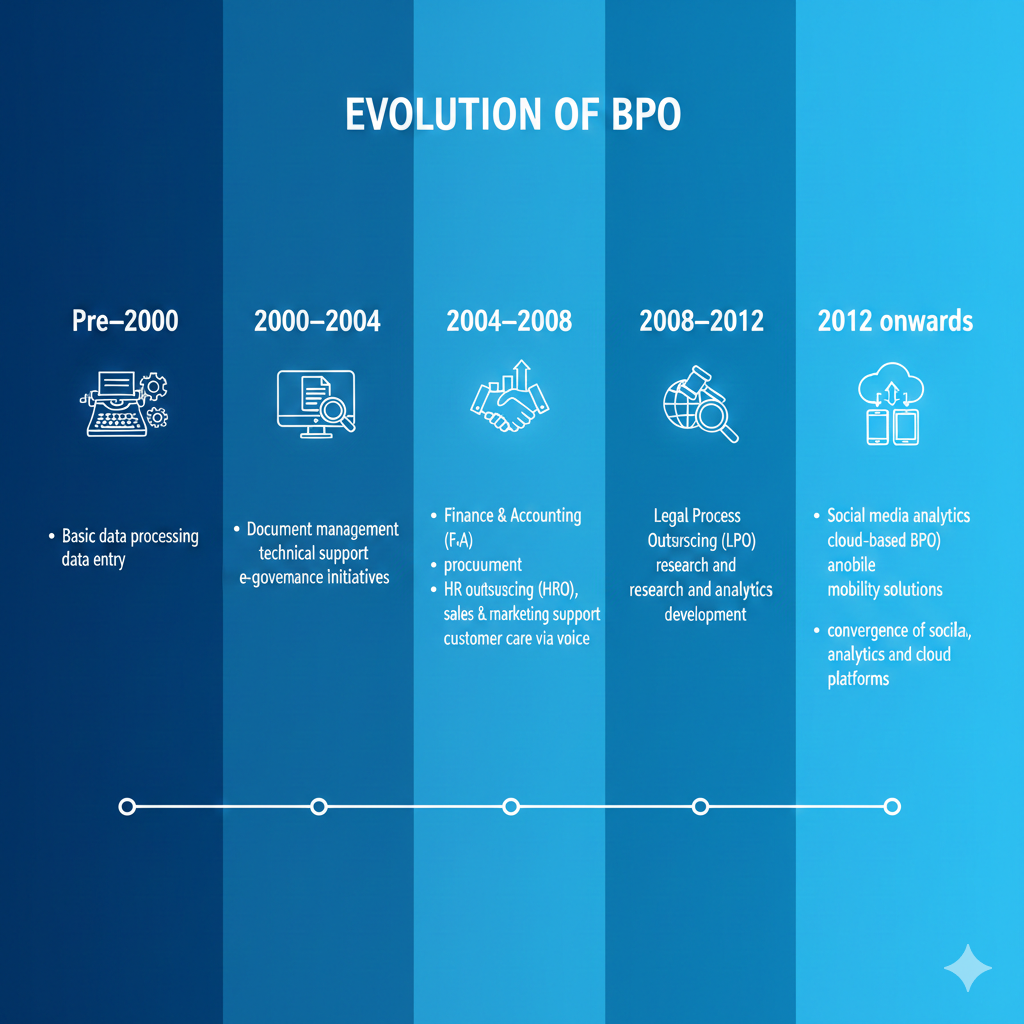
The report traced the evolution of BPO offerings across distinct phases. BPO captives formed a significant part of India's captive landscape.
Moreover, the report also noted that BPO captives accounted for almost 50% of India's total knowledge-based services. However, there are major reasons why offshore shared services in India are beneficial to you.
Read “A Guide to Understanding Back Office Support Services” carefully.
How do offshore shared services in India benefit you?
Offshoring to India reduces the burden of maintaining, managing, and extending a new set of benefits to a larger workforce, which are mentioned below:
1. Cost reduction
The cost of offshoring to India is highlighted as the major benefit. Beyond the wage point, outsourcing the talent removes additional overhead burdens like taxes, benefits packages, equipment, and insurance that come with full-time employees.
Another major point to be noted is the conversion of fixed costs into variable ones. It gives the companies that outsource far greater financial flexibility.
2. Access to Specialised Talent
Outsourcing has been known to many to be the agent that connects a business with a global pool of skilled professionals with domain expertise. India's talent pool includes over 100 million English speakers, 3 million IT employees, and over 200,000 engineering graduates entering the industry annually.
With such a wide network of people coming from backgrounds in engineering, finance, law, medicine, and more, it becomes accessible to hire people with niche expertise without the cost of maintenance.
3. Focus on Core Business
Companies can delegate peripheral, non-essential functions to external providers. This, in turn, can help companies redirect internal resources and leadership attention toward their core competencies and growth strategies.
4. Round-the-Clock Productivity via Time Zone Advantage
There is a significant time zone difference between India, the US, and Europe. As a result, it enables the third-party providers to have continuous, 24-hour work cycles. This is a great way to analyse the cost of offshoring to India.
For example, an American firm can use its in-house team during normal hours and hand off to an Indian team overnight, and review progress each morning.
5. Scalability and Flexibility
If you need to scale your workforce up or down based on requirements, offshore shared services is the way to go. Moreover, there is close to no risk associated with hiring and redundancy cycles.
This is particularly valuable during peak and off-peak business periods. Service providers can adjust support levels on an as-needed basis. This protects companies from the risks of being overstaffed during slow periods or understaffed during busy ones.
6. Reduced Start-Up Costs
Because outsourcing providers already have the infrastructure, processes, and frameworks in place, start-ups can avoid the significant upfront investment typically required to build new capabilities from scratch. This also reduces the time needed to get new functions operational.

How much can companies really save by outsourcing to India?
Companies can typically save 35-70% on total costs by outsourcing to India compared to in-house operations in the US, UK, or Europe, driven mainly by lower labour rates and reduced overheads. Savings vary by industry, role complexity, and model.
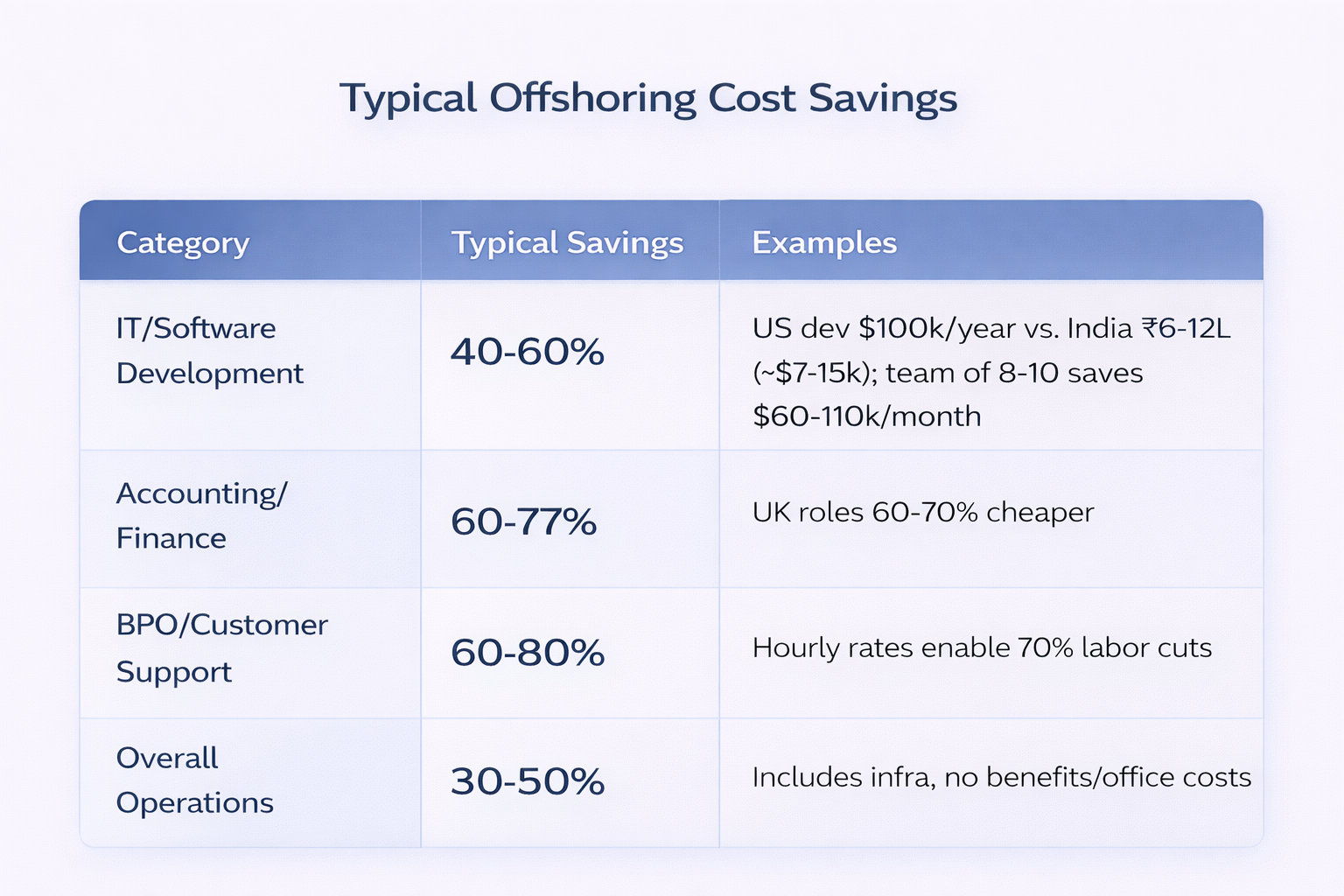
For example, the cost of offshoring customer support to India remains significantly lower than maintaining an in-house US team, especially for email, chat, and blended voice operations.
Even after factoring in supervision, QA layers, and tooling, companies often achieve 40–60% net savings compared to domestic support teams.
When you calculate the cost of building offshore shared services in India, salary is only one component.
- You also need to factor in recruitment and onboarding time, laptops and secure tool access, payroll and statutory compliance, management oversight, training and ramp-up periods, and expected attrition replacement.
- Infrastructure costs, whether physical office space or a remote setup,
- Along with software licenses, cybersecurity controls, and quality supervision layers, all of which add to the true operating cost.
Ignoring these line items can make the cost of offshoring look lower on paper than it is in practice. Let’s discuss the average offshoring rate globally.
Average offshoring rate globally
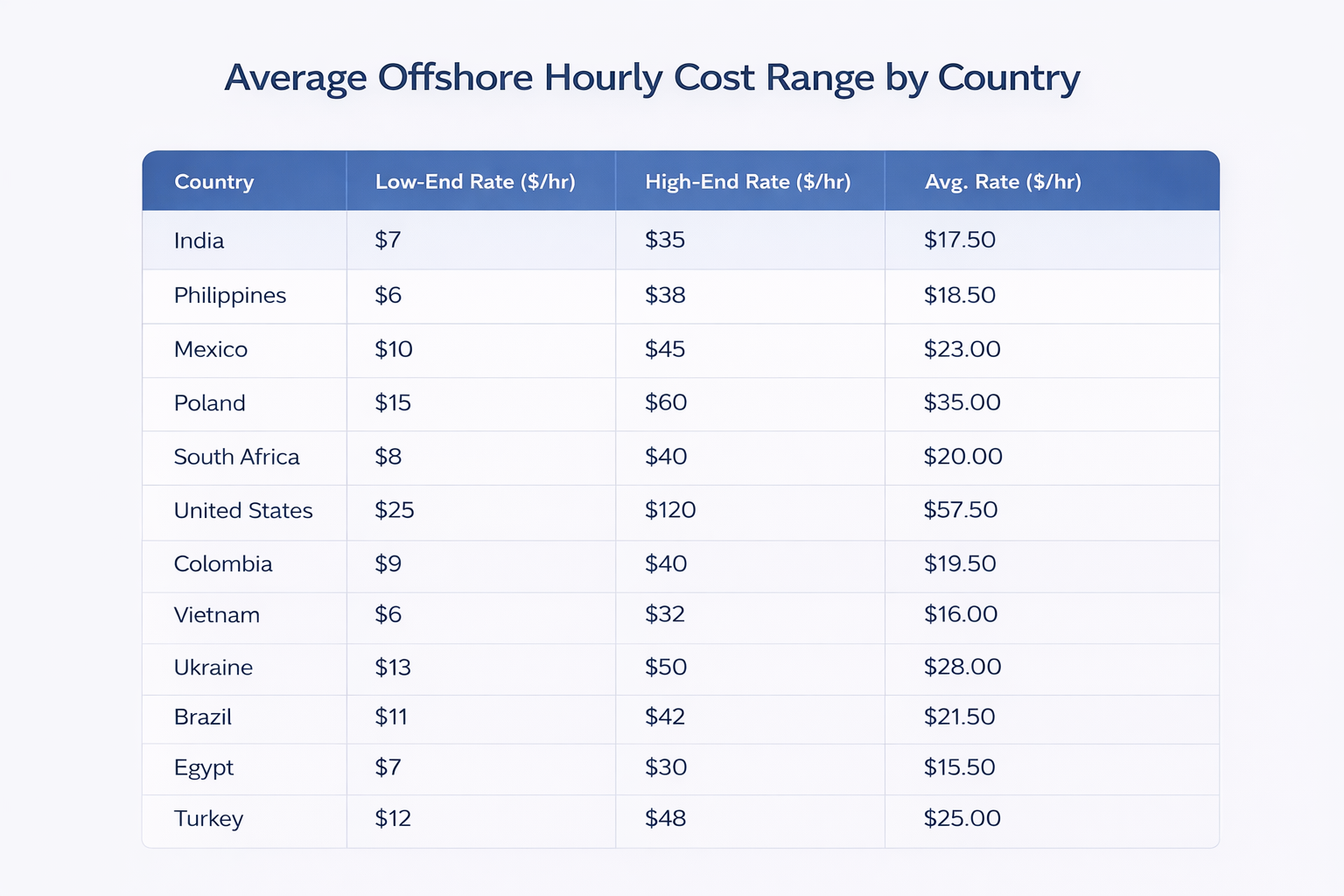
The cost of offshore shared services globally ranges from $6/hr in Southeast Asia to over $100/hour in North America. In practice, India and the Philippines continue to lead the race in terms of cost to offshoring and scalable talent pools.
Next, we’ll break this down country by country, with a clear view of hourly rates and role-wise costs so you can compare like-for-like.
1. Hourly rate comparison globally
The hourly rate comparison globally of the major players in the offshoring industry varies. Rates change continuously and rapidly based on the size of the service provider, work complexity, and the involved industry.
2. Cost by role
Understanding the cost of offshoring to India (and how it compares to other countries) is what helps you spot the real value, not just the cheapest rate.
Different markets are optimized for different kinds of work. Some are a strong fit for customer-facing roles, while others shine in technical or creative execution. India is one of the rare destinations that performs well across multiple functions, which is why it keeps showing up on offshoring shortlists.
That said, places like Mexico and Colombia can be especially attractive when bilingual communication is a priority, because they offer strong language alignment and timezone overlap for support and coordination roles. Let’s see what the cost of offshoring globally is based on roles.
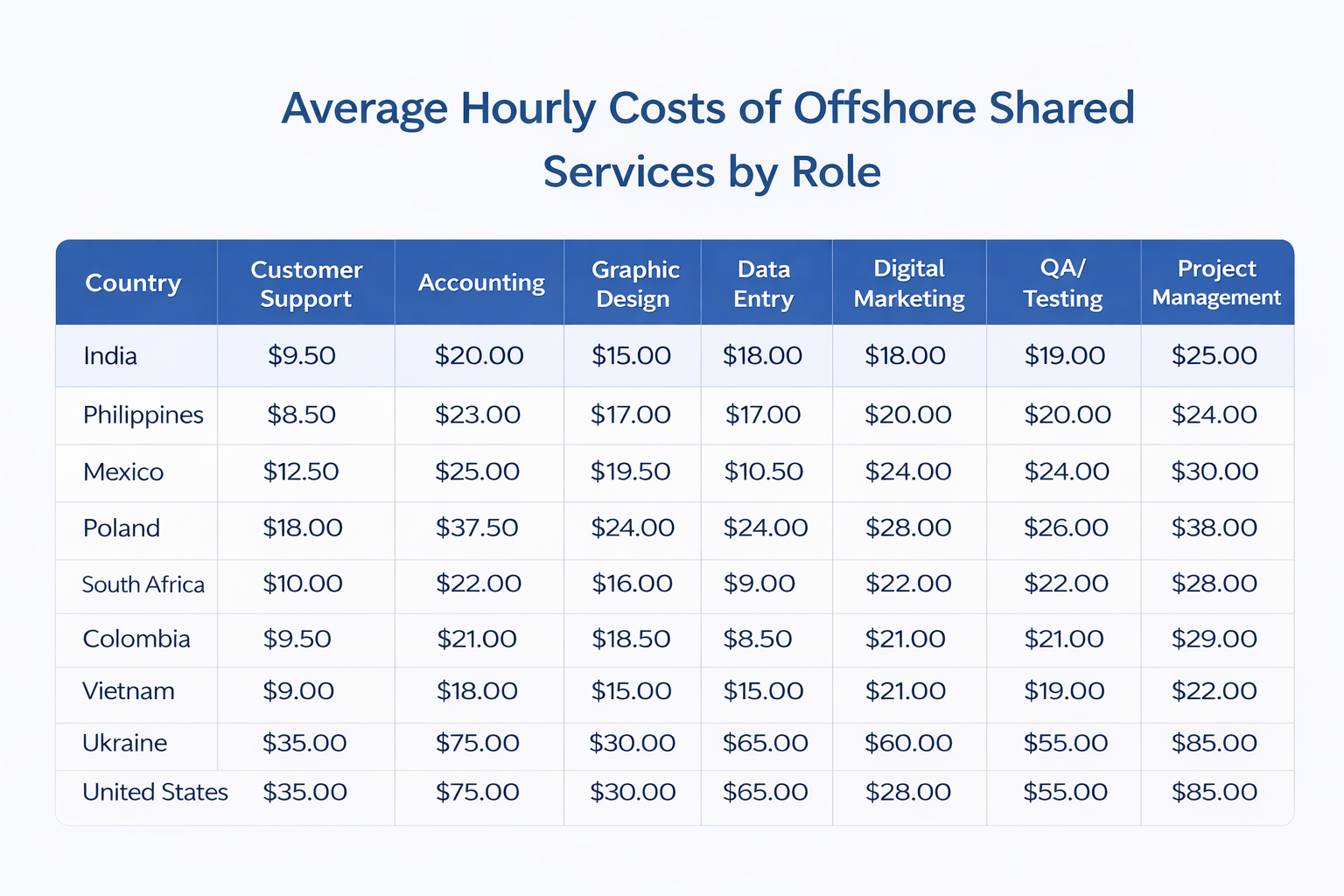
For instance, when comparing roles like voice agents, chat support, and email handling, the cost of offshoring customer support varies based on coverage hours, supervision layers, and compliance needs.
However, even with QA and team lead layers included, India continues to offer a significantly lower blended cost compared to US or UK-based support teams.
Key Factors That Affect Outsourcing Rates in India
It is significant to understand the behind-the-scenes factors to pick an outsourcing partner who not only fits your budget but serves your business needs as well. According to PwC, several structural and market factors influence the cost of outsourcing to India, which we break down below.
1. Employee Utilization to the Fullest:
India improves efficiency by building teams that are cross-trained instead of siloed. That means people can step into multiple roles when needed, keeping work moving instead of creating bottlenecks.
Many providers also run night shifts to align with US and global time zones, ensuring real-time collaboration without delays.
Another advantage is a structured team model. Instead of flat teams where everyone operates at the same level and some sit underutilized, there is a healthy mix of junior and senior talent. Entry-level professionals handle routine tasks while senior team members focus on higher-value work.
This model increases billable utilization from roughly 65–75% to 85% or more. As a result, the cost per employee drops by 15–25% without compromising productivity.
2. Location Tier
Tier 1 cities like Bangalore, Hyderabad or Mumbai remain cheaper than global peers. But if compared nationally, it is costlier than Tier 2/3 cities. For example, Kochi and Indore offer 20-30% lower costs via reduced real estate and wages.
3. Labor Costs and Wage Inflation
The primary advantage still comes from salary arbitrage. Mid-level roles in India often cost 30 to 50% less than global benchmarks. For example, a mid-level IT professional earning ₹8 to 15 lakh per year is significantly more cost-effective compared to a similar role in the US earning $80,000 to $120,000 annually.
That said, wage inflation is real. In major metro cities, salaries can increase by 10 to 15% each year, which gradually tightens margins. To offset this, many organizations expand hiring into Tier 2 cities where salary growth is more stable.
At the same time, stronger productivity systems, cross-training, and better utilization models help preserve overall cost efficiency.
4. Infrastructure and Overhead
Cost efficiency is not just about wages. Infrastructure plays a critical role. High seat utilization, typically targeting 1.2 to 1.5x occupancy, ensures that physical space and resources are not underused. Energy-efficient facilities and optimized telecom infrastructure further improve operational economics.
India’s improving power reliability and bandwidth availability also reduce downtime and related losses. In many cases, this lowers infrastructure-related costs by 10 to 15% compared to competing locations.
However, companies must account for upfront setup investments, especially for compliance-heavy structures like Global Capability Centres (GCCs), which can increase initial capital expenditure before long-term efficiencies are realised.
Nonetheless, there are some hidden costs associated with offshoring to India which you must know.
The Hidden Cost of Offshore Shared Services in India
Offshoring to India has a hidden cost that can add up to 15-30%. Although considered an operational inefficiency, it is in no way a structural failure. With contingency, it can easily be corrected.
These hidden costs typically arise when companies focus solely on salary arbitrage and ignore how teams are structured, utilised, and managed.
1. Suboptimal Infrastructure Utilization
When seats, facilities, or shared services capacity is underused, fixed overhead is spread across fewer billable hours. This weakens the expected savings, especially in Tier 1 cities where real estate premiums are higher.
Expand hiring into Tier 2 and Tier 3 cities. This is often 20–30% cheaper than major metros in India and can solve this issue.
2. Employee Pyramid Imbalances
If teams rely too heavily on senior staff without expanding the junior layer, the blended cost per employee rises. A flat hierarchy increases average labour cost and limits scalability.
Design stronger staffing pyramids with a wider junior base so that the labour cost stays under budget.
3. Shift & Training Inefficiencies
Poor cross-training and rigid shift structures reduce billable utilization. When employees cannot flex across roles or time zones, idle time increases. That idle time becomes an indirect cost.
Improving process discipline and cross-skilling.
In practice, these hidden costs show up as lost utilization, rework, and added management overhead. A managed model like Wishup is designed to reduce those drains early.

How Wishup Eliminates the Biggest Hidden Costs of Outsourcing
Instead of just offering labour arbitrage, Wishup focuses on operational efficiency from day one. Wondering how? It:
1. Dissolves Communication & Time Zone Gaps
Wishup provides:
- VAs aligned to US and EU business hours
- 5-minute turnaround time during working hours
- Daily updates and structured communication workflows
- In-app time tracking and visibility
Because VAs operate in your working window, work moves in real time instead of overnight batches. That removes the 7–8 hours per week often lost to coordination inefficiencies.
2. Maintains Quality Control & Rework
Poorly vetted talent increases QA cycles, rework, and ramp-up time, which can be a concern for many. However, we provide you with:
- Top 0.1% pre-vetted talent
- 6-step stringent vetting process
- 8-week mandatory AI & communications training
- VAs trained in 120+ AI tools and 70+ no-code tools
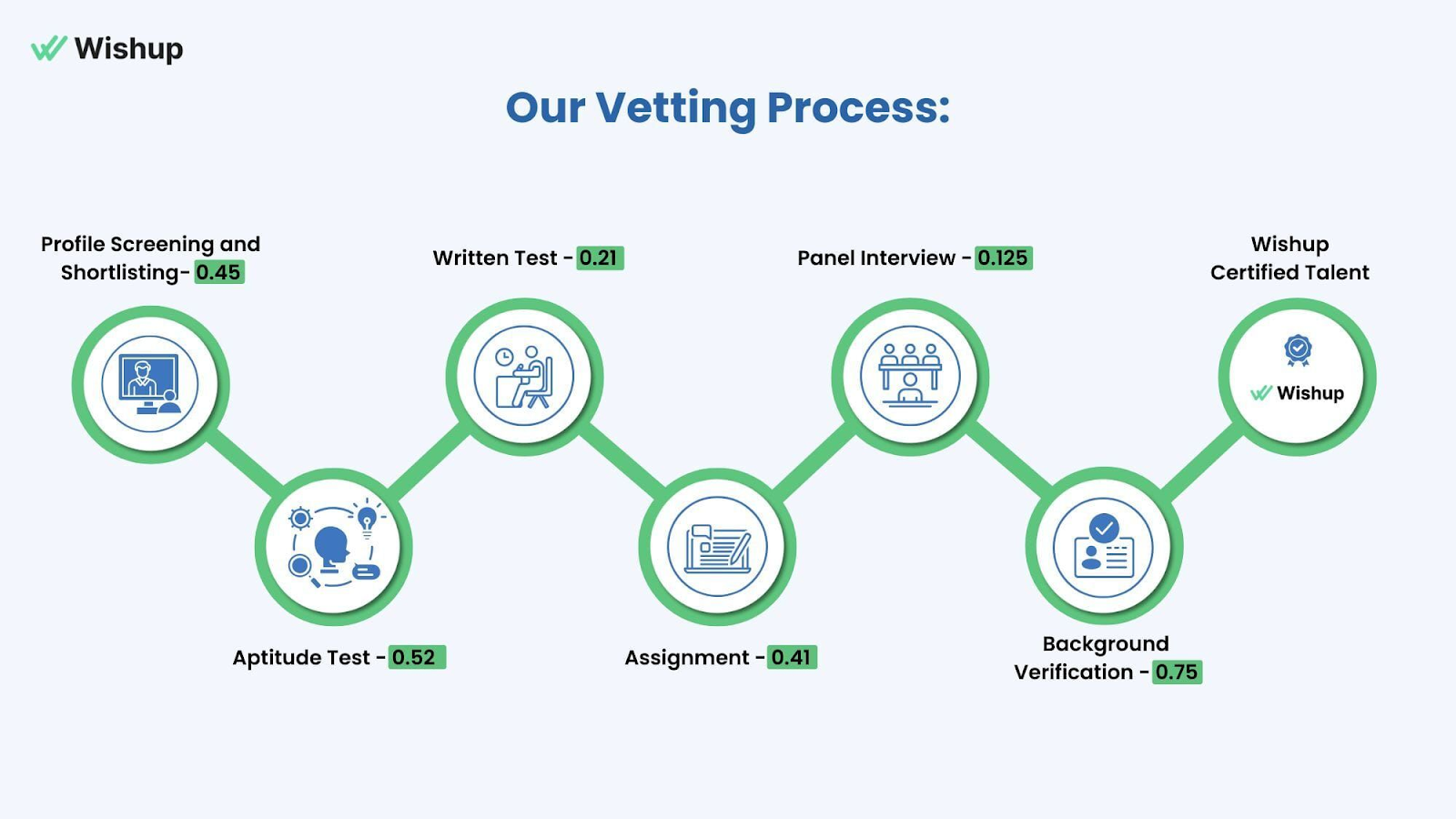
Instead of hiring raw offshore labor, you get trained operators who understand structured workflows, automation, and US-specific business expectations.
3. Mastered Management Overhead
Hidden costs often come from client-side project managers, oversight layers, compliance handling, and vendor coordination. We provide:
- Dedicated VCA Manager + Client Success Manager
- Free replacement within 24 hours
- Built-in workforce management app
- Month-to-month flexibility with no rigid contracts
Wishup handles hiring, HR, payroll, performance tracking, and continuity. You do not need to build your own management layer to supervise offshore execution. This removes the 15 to 20% coordination overhead that many companies underestimate.

Wrapping Up
Building offshore shared services in India can absolutely deliver 30–50% net savings, sometimes more. But those savings don’t come automatically from lower salaries alone.
They come from structure.
- From choosing the right city tier.
- From designing the right staffing pyramid.
- From maintaining high utilization.
- From controlling management overhead.
- From preventing rework and communication delays before they scale.
If your goal is to capture the cost advantage of India without absorbing the hidden complexity, it may be worth exploring Wishup first. Schedule a call with us and see what your offshore cost structure could actually look like.
🚀 Meet Wishup.co in 30 Seconds
Wishup.co is a US-based (Delaware) virtual assistant company that offers remote virtual assistants to busy founders and executives worldwide. Our trained VAs handle everything from admin tasks to specialized work, helping you focus on what truly matters.
- ✅ 10+ years in the industry
- ✅ 1,500+ founders served across 50+ industries
- ✅ 200+ skill areas, 70+ no-code tools, 50+ AI tools
- ✅ Clients from Harvard and Y Combinator-backed startups
- ✅ Onboards trained VAs in just 60 minutes
- ✅ 98.8% client satisfaction | 99% on-time delivery
- ✅ Top 0.1% talent only – pre-vetted & ready to start
- ✅ 6-step vetting process (aptitude, cognitive, English, and more)
- ✅ Flexible plans starting at $9.99/hr — no long-term contracts
- ✅ 7-day money-back guarantee
- ✅ Lifetime satisfaction guarantee
FAQs
Is outsourcing to India worth it?
Yes, outsourcing to India is worth it for companies that structure it properly. Businesses typically save 30–50% on total operating costs compared to in-house teams in the US or Europe. However, the real value comes from access to skilled talent, scalability, and 24-hour productivity cycles.
Savings erode when utilization, communication, and team structure are poorly managed. When set up correctly, offshore shared services in India can deliver both cost efficiency and operational depth.
What is the cheapest country to outsource to?
The “cheapest” country depends on the role and complexity.
- For IT and knowledge work, India often offers one of the lowest blended cost-to-skill ratios.
- For customer support, the Philippines and India remain highly competitive.
- For bilingual Spanish-English roles, Mexico and Colombia can be cost-effective due to time zone alignment.
However, the lowest hourly rate does not always equal the lowest total cost. Hidden overhead, rework, management layers, and compliance costs can shift the real equation. The best choice balances cost, talent availability, and operational efficiency.
What is the top 1 outsourcing country?
India consistently ranks as the top outsourcing destination globally due to:
- Large English-speaking workforce
- Mature IT and BPO ecosystem
- Strong presence of Global Capability Centres (GCCs)
- Competitive cost structure
- Deep engineering and finance talent pools
Multiple global indexes, including location attractiveness rankings, regularly place India at or near the top for offshore shared services.
How to outsource work from the USA to India?
You have three main options:
1. Build your own captive (GCC): Set up an entity in India and hire directly. High control, high setup cost.
2. Partner with a BPO/EOR: A vendor hires and manages the team for you. Faster, but includes vendor margins.
3. Use a managed platform like Wishup: Hire pre-vetted talent without setting up infrastructure. Wishup handles hiring, payroll, and management, giving you faster deployment and predictable costs.
