

Summary - TL;DR
- What is a virtual receptionist? A real person who runs your front desk remotely: answers calls, routes requests, schedules appointments, and captures messages.
- Best when you’re missing calls, losing leads, or scheduling is stealing time.
- AI wins on instant pickup and volume. Humans win on nuance, empathy, and complex calls (hybrid often works best).
With Wishup, setup is mostly call flows + booking rules + escalation rules, then execution stays consistent.
Imagine you call a business to book an appointment.
Instead of a person, you get an automated voice: “Press 1. Press 2. Say your issue in a few words.” You try to explain what you actually need, but the system keeps forcing you into the wrong option. You hang up, call again, and now you’re annoyed before the service even starts.
AI is everywhere, but when a request has nuance, urgency, or emotion, people still want a human on the other end. In a 2019 survey of 1,000+ U.S. consumers, 86% said they prefer interacting with a human agent, and 71% said they’d be less likely to use a brand if human reps weren’t available.
In this guide, we’ll break down what a virtual receptionist does, how it compares to in-house reception and answering services, where and how AI fits, what benefits to expect, and how to set it up cleanly with Wishup.
What Is A Virtual Receptionist?
A virtual receptionist is a real, trained professional who handles your front-desk workflows remotely. These virtual receptionists act as an extension to your team with the goal that calls are handled consistently, and every caller feels heard.
Think of it as the front desk function, delivered remotely, with the same goal as a good in-office receptionist has. But how would you know which virtual receptionist services to go for in the time of need? Let’s find out.
What to Look for in a Virtual Receptionist Service
When searching for the right virtual receptionist provider, you will come across multiple providers with good claims; however, you may notice that those claims lack substance. Therefore, you must know the key features to look for in a virtual receptionist.
1. Basic Customer Service
First on our list is the ability to provide basic customer service, because knowing the basics of your business and how to keep customers engaged throughout the call, will keep them moving through the sales funnel.
2. Handing Calls with Customisations
A worthy virtual receptionist provider should urgently ensure that the receptionists can not only answer queries regarding your business but also customise how your calls are handled. If you have a customised method of taking the call, the receptionist needs to adapt to it naturally.
3. Appointment Booking and Scheduling
Any virtual receptionist provider worth their money should easily handle appointment booking as well as scheduling for you. A virtual receptionist should be able to book, take, reschedule, and cancel appointments on your behalf.
4. Setting Appointment Reminders
Missed appointments are like missed opportunities, so your virtual receptionists should be able to send out appointment reminders. A study has shown that appointment reminders can reduce up to 75% of no-shows.
5. Share Important Information Openly
Why wait for the message to be sent to the client when you can leave a voicemail directly to them with the important messages? One of the features of a good receptionist is to deliver your voicemail directly to your email address as soon as it is received. This will reduce any miscommunication and missed opportunities.
6. Provide Personalized Services
What sets a virtual receptionist apart from a good receptionist is their ability to perform personalized services. With corporate policies changing, what one would need is someone who can keep themselves up to date and meet you in the middle with flexibility.
What Does a Virtual Receptionist Do?
The virtual receptionists’ task would entail:
1. Managing Calls
This entails answering incoming calls professionally and capturing/routing requests correctly. In practice, their task might be to:
- Answer calls promptly and professionally
- Understand what the caller needs, then route it correctly (sales, support, scheduling, urgent)
- Capture the right details so you do not have to call back for basics
2. Scheduling and Coordinating Appointments
This covers booking /managing appointments and coordinating calendars with clients and internal team members. At length, this typically includes:
- Scheduling and managing appointments
- Keeping the calendar organized so it stays usable (not just “full”)
- Coordinating details with the right people so meetings actually happen as planned
3. Providing Admin Support
This generally covers helping with general admin tasks as needed, and can be personalized as per the demands of the client.

However, the easiest way to understand this role is by understanding the differences between virtual receptionists, traditional receptionists, and answering services.
Virtual Receptionist Vs Traditional Receptionists Vs Answering Services
A virtual receptionist might sound like a different role, but the day-to-day tasks can look similar. That “almost” matters. It’s where the differences between a virtual receptionist, a traditional receptionist, and an answering service actually show up.
A traditional receptionist works on-site to greet visitors and handle calls. Meanwhile, a virtual receptionist, although seemingly having similar tasks, operates remotely, handling phone calls, scheduling, and administrative tasks.
However, an answering service differentiates itself from both of these in terms that it only pertains to handling basic inquiries and taking messages. Let’s analyze in depth what the differences are between a virtual receptionist, a traditional receptionist, and an answering service.
Although all three roles sit at the “front desk,” the difference is in how much of the front desk they actually run. Now that we have discovered the difference between these three roles, let us know how AI fits into each role.
Is an AI Virtual Receptionist Better Than a Human Virtual Receptionist?
Although the term AI virtual receptionist and virtual receptionist is used interchangeably, there lies a difference. It is the difference of nuances. Although everyone claims that AI has taken over almost all kinds of jobs, it remains an undefeatable fact that all those jobs still require human interaction to ensure accuracy and compliance.
While both the AI virtual receptionist and the virtual receptionist have the core job of answering calls, it boils down to the nuances of how the matters are handled.
1. Advantages and Limitations:
A virtual receptionist, who works remotely, greets each caller in real time with scripted answers, maintaining guidelines. However, they have the ability to pause, show empathy, and convey the messages, nudge slightly, once detecting the subtle cues a caller might be giving off.
An AI receptionist can answer every call instantly, as it is software. A virtual receptionist, on the other hand, has a capacity limit. Let’s say, when multiple calls come in at once, callers may be placed on hold.
Nonetheless, it is the human touch for nuanced conversation that steals the show when compared to the automated call with an AI receptionist. While 42% of the CX leaders perceive generative AI influencing voice-based interactions in the customer service region in the next two years, the rest feel differently.
2. AI Might Influence CX, But Can’t Replace Humans:
It is because of how the differences lend themselves to cultural build-up as well. A virtual receptionist builds familiarity over time, which improves retention and loyalty. The call with an AI receptionist can feel impersonal. After all, only 47% of consumers have claimed that AI agents can be empathetic.
3. ROI Impact:
Virtual receptionists can conversationally convert leads by maintaining the branding of the business, while tools like an ai video maker can further help companies create branded customer-facing content that strengthens engagement. Teams that want to extend that same responsiveness across chat and messaging channels use Text.com to keep every customer conversation on brand and revenue-focused. Not only that, but the capability to handle complex situations exceptionally comes naturally to a virtual receptionist.
However, an AI receptionist can only take information; objection-handling and consultative selling is limited because they lack the negotiation style-technique. This stands to be the case because Zendesk revealed that 63% of consumers are concerned about potential bias and discrimination in AI algorithms and their ability to make decisions.
An Informative Use Case-Based Table, Depending on What Your Business Demands
With PwC revealing that 3 in 4 CEOs are concerned about the level of transparency in the AI market, a virtual receptionist seems like a good option. However, to help you make an informed decision, the following is a list that covers which type of receptionist your business needs the most.
While you may think that, scalability and cost-wise, an AI receptionist will be a better choice, because it is software. But with the correct service in place, you can get a receptionist who will fulfill most of your business needs.
Zendesk notes that 65% of agents say more training would help them do their job better. That’s why a managed virtual receptionist setup can feel lighter than hiring from scratch: the training and call-handling standards are already built in, so you’re not reinventing scripts, etiquette, and escalation rules.
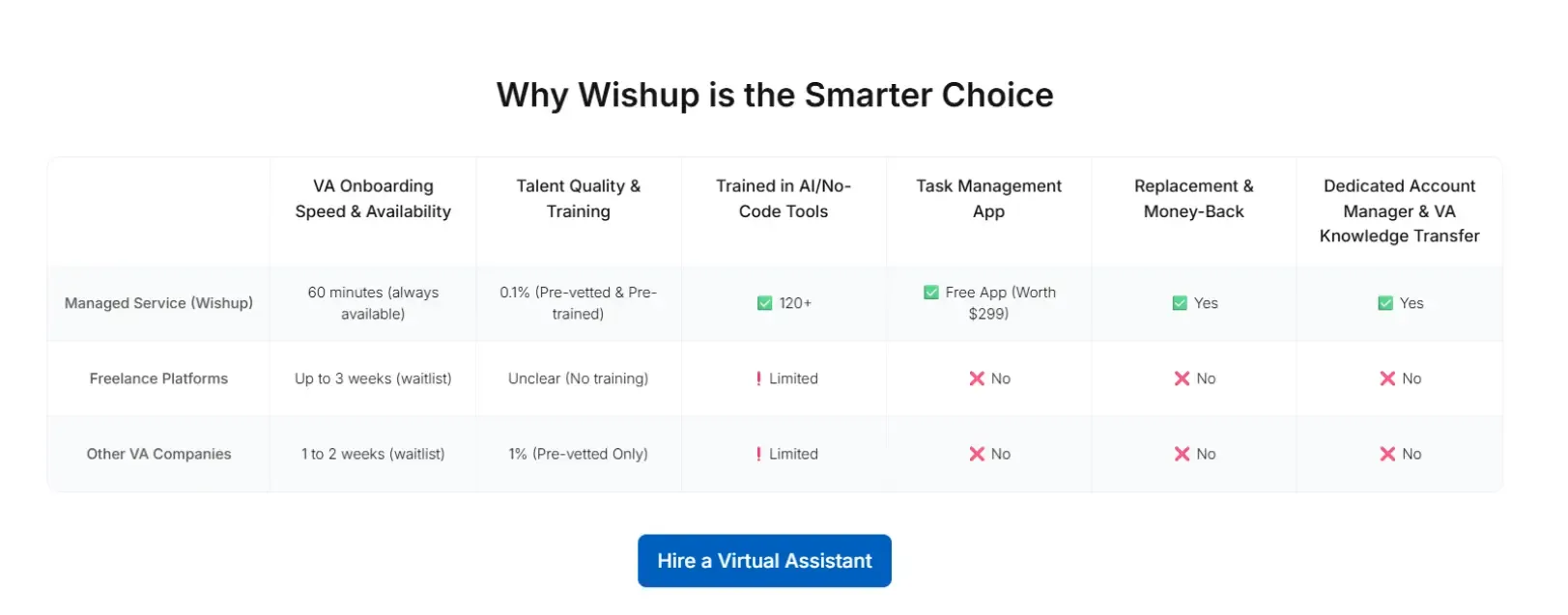
With Wishup, you’re essentially getting reception support that’s vetted and trained upfront, and you focus on the specifics of your business instead of basic enablement.

What Are the Benefits of Hiring a Virtual Receptionist?
A good virtual receptionist brings more than call answering. They bring front-desk experience, calm communication, and the ability to handle the small but constant requests that usually pull your team away from higher-value work.
If your goal is to stay responsive, create a more consistent customer experience, and keep your operations running smoothly as you grow, Wishup’s virtual receptionist can help. Here are the key benefits.
1. Focused, Experienced Communication Skills
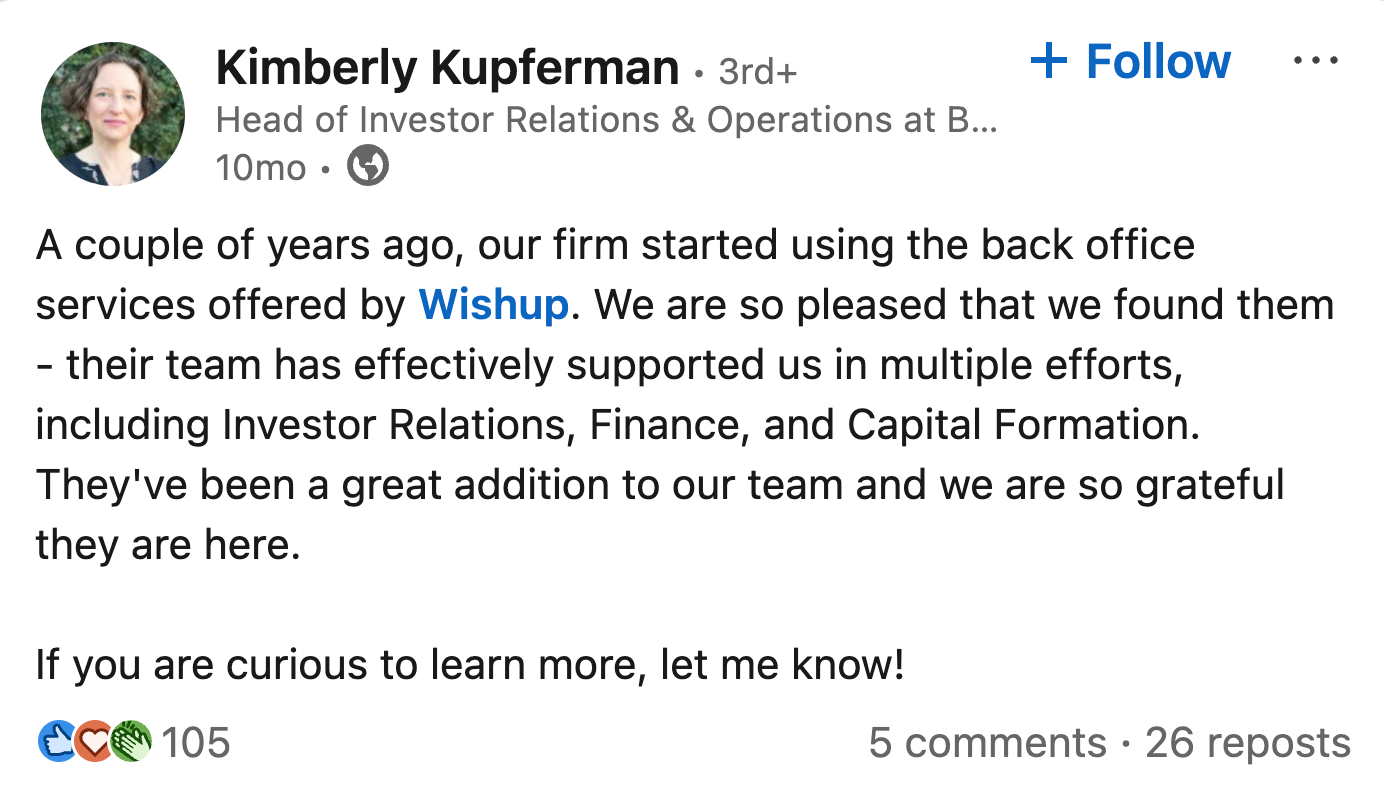
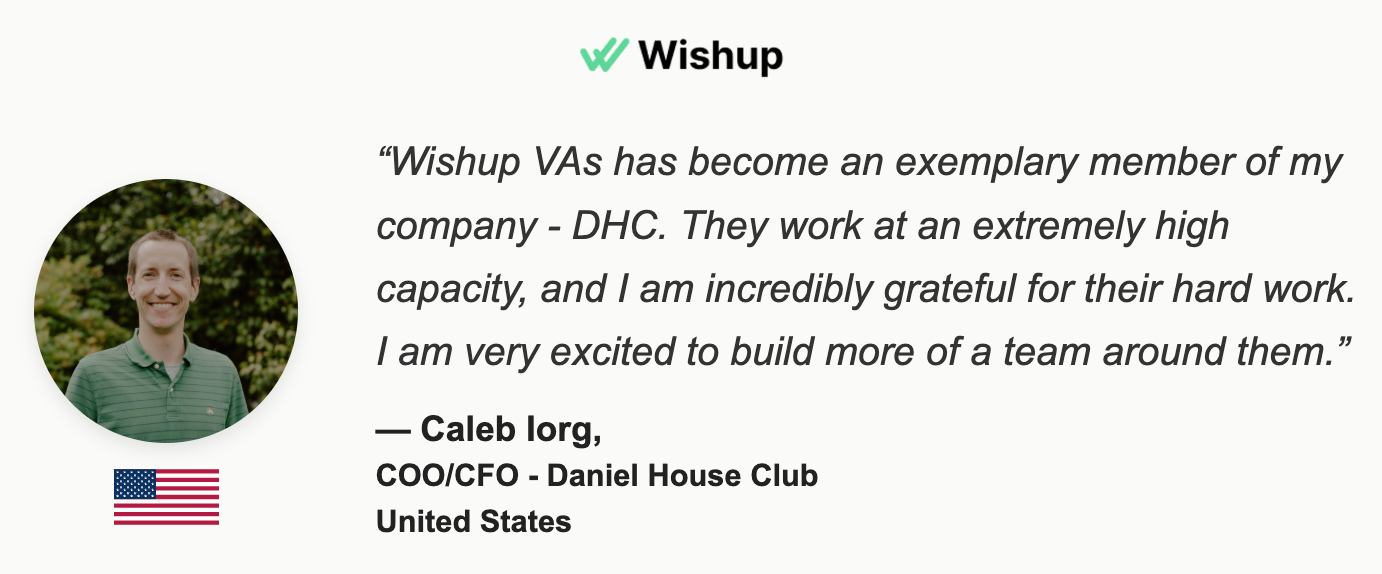
When you use a virtual receptionist service like Wishup, you get access to a network of dedicated, properly pre-vetted talents who already have experience in customer service.
There’s no need to spend time on training because they are already trained and equipped with the skills to work with multiple tools. The only thing that you have to do is equip them with what your business demands, teach the nuances you expect, and be done.
2. Prompt Call Handling
Who wouldn’t want the customer calls to get handled without an escalation? Wishup’s virtual receptionists are trained to handle the incoming calls courteously. Moreover, no calls are missed or go to voicemail, as a moment’s delay could lead to dissatisfaction among customers.
3. Coordination, Appointment Scheduling, and More!
The pre-vetted virtual receptionists are not only known for their promptness, but also for their proactiveness as well. From appointment scheduling and coordination to calendar management and organization, a virtual receptionist can do a lot.
Their tasks in this realm pertain to keeping bookings smooth and your schedule structured. Moreover, they look after the ‘end-to-end’ coordination, not just “slot booking”.
4. Get Administrative Support
Get administrative support as needed on top of the traditional receptionist tasks. You may get help with front-desk-adjacent admin work beyond calls and scheduling.
Moreover, if any issues arise, there are clear, pre-defined escalation protocols for urgent matters set in place. These predefined protocols help the receptionists get in touch with the correct POC so that urgent issues get immediate attention.

Implementation and Setup with Wishup
A virtual receptionist only works if the “front desk rules” are clear. Wishup’s implementation and set-up process keeps the scope tight. On top of that, it then adds guardrails so the work doesn’t turn messy.
Step 1: Start with a Quick Call and Align on What You Want Covered
Reach out to Wishup’s customer success team to get aligned on what services you want covered for yourself. However, before the call, decide:
- Your coverage hours (peak hours only vs full workday)
- Your primary outcomes (book appointments, capture leads, reduce missed calls)
- The “must-handle” buckets: call handling, appointment scheduling, and admin support
Step 2: Choose the Receptionist Profile You Want
The second step requires you to choose from our pre-vetted, trained, and seasoned virtual receptionists. Get access to a visible talent bench, where you can choose from Wishup’s listed profiles for virtual receptionist services. Wishup’s vetting process has a stringent six-step process.
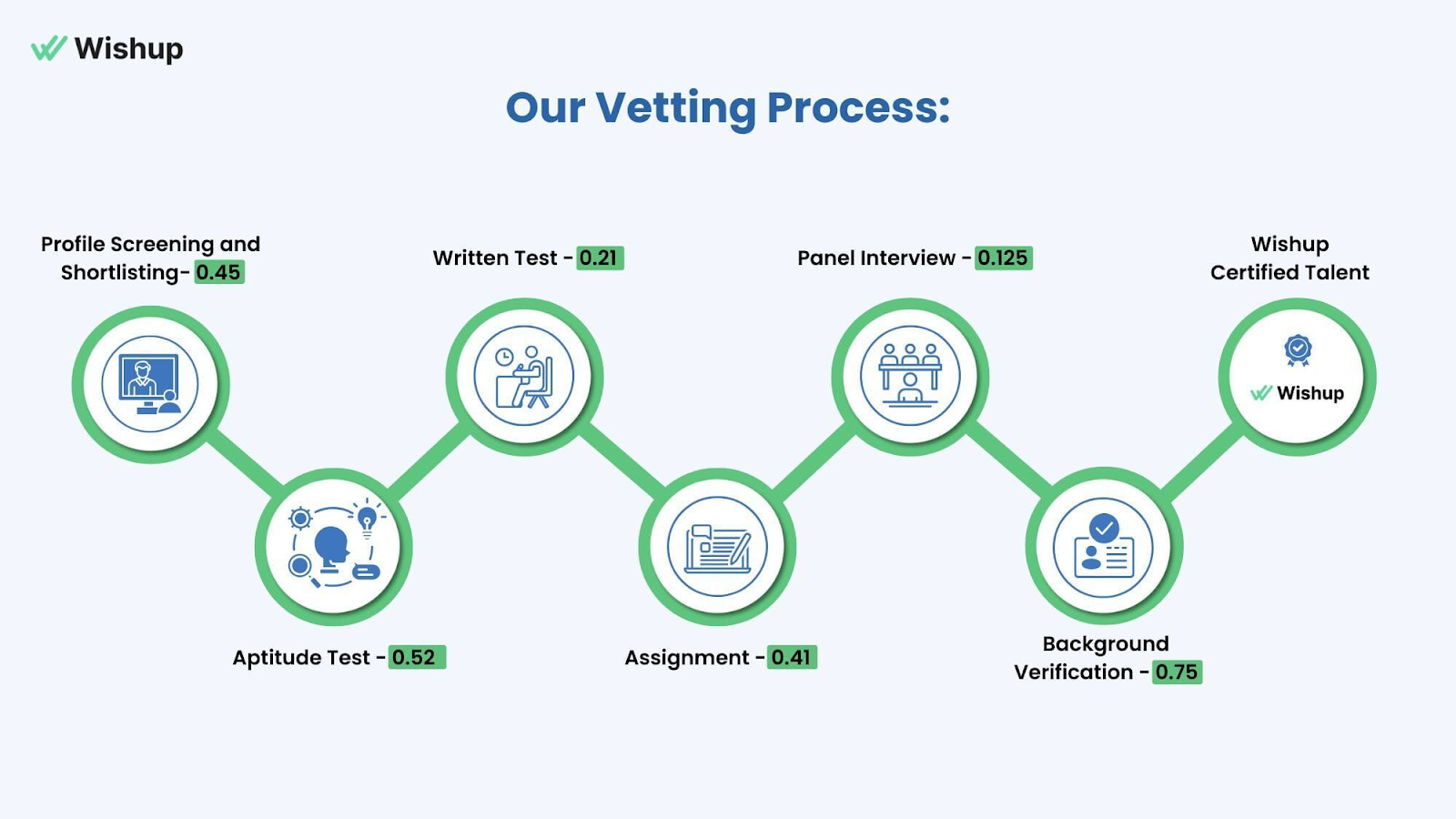
These six steps ensure that the talent that reaches you is “the créme dé la créme”. You can choose from Wishup’s listed profiles for virtual receptionist services. The selected personnel will be trained for professional etiquette and effective communication to protect your brand experience on calls.
Step 3: Set Up Your Call Handling + Scheduling Workflow
Once the selection process is done, the recruited professional virtual receptionist will be onboarded within 60 minutes. To make this process work quickly for you, provide:
- Your greeting and “what this business does” one-liner
- A simple routing rule (sales vs support vs scheduling vs urgent)
- Booking rules (buffers, reschedule policy, what can/can’t be booked)
Step 4: Put Guardrails in Place for Privacy and Urgent Calls
Put confidentiality guardrails, with “strict protocols” to safeguard information shared during calls or tasks. Once that gets done, place predefined escalation protocols so urgent matters get immediate attention and the right next action.
Step 5: Expand Coverage into Adjacent Lanes If Needed
If your “front desk” starts spilling into other channels, you can go through Wishup’s services like Phone Answering, Calendar Management, and Inbox Management. Wishup has set up an easy expansion into adjacent support that helps maintain the workflow.
Ready to Hire a Wisup Virtual Receptionist?
Now you know what is a virtual receptionist and why it matters: it’s a real human front desk, delivered remotely, that keeps your business responsive without pulling you into constant interruptions. If your calls, scheduling, and follow-ups are starting to feel like a daily leak, a virtual receptionist is one of the simplest fixes you can implement.

FAQs
What is a virtual medical receptionist?
A virtual medical receptionist is a remote receptionist who supports a clinic or practice by handling patient calls, appointment scheduling, intake follow-ups, and front-desk coordination.
The difference from a general virtual receptionist is the environment: they often work within privacy and compliance expectations (like HIPAA in the U.S.) and follow stricter scripts for patient communication.
How does a virtual receptionist work?
A virtual receptionist works using your phone system (VoIP/call forwarding), scheduling tool, and approved scripts. They answer calls, triage requests, book or adjust appointments, capture messages, and escalate urgent issues based on your rules. The setup succeeds when you provide call flows, booking rules, and an escalation path.
How much does a virtual receptionist cost?
$25 to $3,000 per month. Cost depends on the model and coverage you need. Common pricing structures include hourly, monthly retainer, or per-call. For more details related to pricing models, cost savings, and rates by country, check our exclusive blog on virtual receptionist cost.
Here's the cost details of a virtual receptionist at Wishup:
- Basic VA: Full-Time - $1999, Part-Time - $1299
- Elite VA: Full-Time - $2999, Part-Time - $1999.
Note: Wishup virtual assistants are skilled in virtual receptionist roles too.
What skills does a virtual receptionist need?
A strong virtual receptionist typically has:
- Clear spoken communication and a calm, professional tone
- Fast, accurate note-taking and message capture
- Scheduling coordination and basic calendar management
- Comfort with tools like VoIP systems, Google Calendar, Calendly, and CRM basics
- Judgment within boundaries (knowing when to follow a script vs escalate)
- Discretion and privacy awareness, especially in sensitive industries
Is a virtual receptionist worth it?
A virtual receptionist is usually worth it if you are missing calls, losing leads, getting constant interruptions, or dealing with scheduling chaos.
The ROI comes from fewer missed opportunities, faster response times, and protecting your team’s focus. If your inbound volume is low and predictable, a simple call routing or voicemail workflow may be enough.
How to become a virtual receptionist?
If someone wants to become a virtual receptionist at Wishup, it really starts with being great at communication and genuinely enjoying helping people. You need clear spoken and written English, a warm phone presence, and basic knowledge of tools like CRMs, Google Workspace, and scheduling platforms.
Most potential VRs apply through the careers page, go through a communication or aptitude assessment, and then a couple of interview rounds to see how well they handle real-life client scenarios. There’s also onboarding training where you learn how to manage calendars, screen calls, and represent clients professionally.
At the end of the day, being dependable, detail-oriented, and calm under pressure really makes all the difference, because clients are trusting you to be the first impression of their business.
