
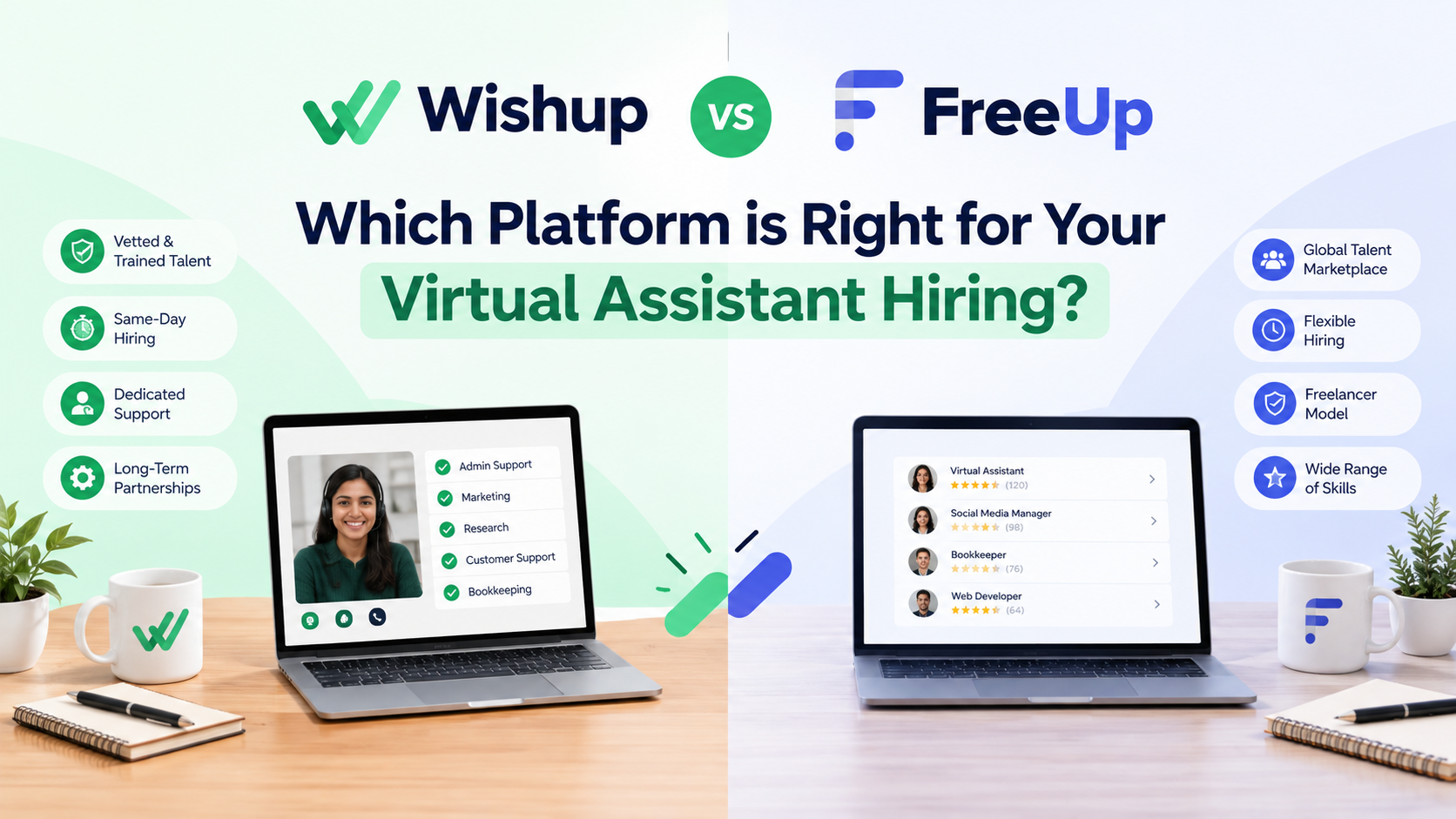
Short answer: These are not competing versions of the same product. FreeUp is a freelancer marketplace where you hire and manage contractors directly at hourly rates they set. Wishup is a managed service where you subscribe monthly to a dedicated assistant and a management layer sits between you and the work. The right choice depends on whether your workload is variable or steady, and whether you want to manage the person yourself.
If you have project-based or fluctuating needs and you're comfortable managing a freelancer, a marketplace model fits better. If you have a consistent weekly workload and you'd rather not manage anyone, a managed model fits better. Below is the detail behind that, with every claim sourced.
Side-by-side comparison
FreeUp details above are as published on freeup.net and its pricing page, checked 16 September 2026. Rates change; confirm current figures with each provider directly.
The structural difference that drives everything else
Most of the practical differences between these two companies follow from one thing: who employs the person doing your work, and who manages them.
On FreeUp, you are hiring a freelancer. FreeUp describes itself as a marketplace that recruits, interviews and vets freelancers, then gives businesses access to those who pass. Rates are set by the freelancers themselves. You interview the candidate, you agree the scope, and you direct the work. FreeUp provides the matching, the billing infrastructure and account-manager support around that relationship.
With Wishup, you are buying a service. The assistant is engaged through Wishup, works to a plan you subscribe to, and comes with an account manager and a VA manager. You define outcomes; the management layer handles the rest.
Neither arrangement is inherently better. They suit different situations, and they carry different kinds of overhead, one in money, one in your time.
Pricing: the honest arithmetic
This is where the two models diverge most clearly, and it's worth being precise rather than selective.
What each publishes
FreeUp's pricing page lists three tiers: Entry Level at $5 to $15 per hour, Mid Level at $15 to $30, and Expert Level at $30 to $75 or more. For the Virtual Assistant skill specifically, the published range is $7 to $12 per hour for non-US freelancers and $24 to $35 per hour for US, UK and Canada-based freelancers. FreeUp states there are no startup fees, no monthly fees and no minimums.
Wishup's pricing page lists $1,899 per month for a part-time assistant at 4 hours per day, and $2,849 per month for a full-time assistant at 8 hours per day, on a month-to-month basis.
What that works out to per hour
Assuming roughly 20 working days a month:
Read that table plainly. Against a non-US freelancer on FreeUp, Wishup's effective hourly rate is higher. That's not a comparison we can argue our way out of, and pretending otherwise would make everything else here less trustworthy.
Against a US, UK or Canada-based freelancer on FreeUp, the picture reverses: Wishup's full-time effective rate of roughly $17.80 sits below FreeUp's published $24 to $35 US range.
What the difference buys
If you choose the marketplace route at the lower hourly rate, the work of hiring, briefing, supervising, quality-checking and replacing sits with you. If you choose the managed route, it doesn't.
Whether that's worth the gap depends entirely on what an hour of your own time is worth and how much supervision the work actually needs. For a well-defined, repeatable task with clear instructions, the supervision cost is low and the marketplace maths is compelling. For varied work requiring judgement and context, supervision cost rises quickly and the managed model starts to look different.
We'd encourage you to do that calculation with your own numbers rather than take either company's word for it.
Hiring speed and process
FreeUp states it will pair you with a qualified candidate based on your job description within 24 hours, and describes access to pre-vetted freelancers within one business day. The process involves reviewing and interviewing the matched candidate before work begins.
Wishup states a 60-minute onboarding, which is possible because assistants are maintained on a trained bench rather than sourced per request.
The difference in stated speed is real, but it reflects a difference in what's happening. In the marketplace model you are choosing an individual, and that choice takes time by design. In the managed model the matching is done for you, which is faster but gives you less direct say in the selection.
If having final say over exactly which person works with you matters, that's a genuine argument for the marketplace approach.
Vetting and skills
Both companies publish claims about selectivity. FreeUp states it recruits, interviews and vets thousands of freelancers weekly and admits only the top 1% of applicants, assessed on skill, communication and attitude. Wishup states it works with the top 0.1% of applicants, with a minimum of three years' experience and a training programme before assignment.
Neither figure is independently audited, and we'd treat both with the same measure of caution. What's more useful than the percentages is the shape of the talent pool each has built.
FreeUp's published skill list leans heavily toward eCommerce, Amazon and digital marketing like Amazon PPC, private label, FBA, Vendor Central, Seller Metrics, product sourcing, listing optimisation, along with web development, graphic design and copywriting. It lists more than 85 skill sets, including developers across PHP, WordPress, Shopify and mobile.
Wishup's focus is narrower and different: administrative and executive support, bookkeeping, project management and process automation, with VAs trained across AI and automation tooling.
This matters more than either vetting claim. If you need an Amazon PPC specialist or a Shopify developer, FreeUp's marketplace has a deeper bench in exactly that area and is the more sensible place to look. If you need someone to run recurring admin, inbox and scheduling work and build automations around it, that's a different search.
Management, continuity and replacement
On FreeUp, you direct the freelancer. FreeUp offers account managers who can advise on who to hire and how to structure a project, and states 24/7 support via phone, email and live chat. Its No Turnover Guarantee states that if a freelancer quits, FreeUp will work to replace them immediately and cover applicable replacement costs.
With Wishup, a dedicated account manager and VA manager handle supervision, quality and continuity, and a replacement guarantee applies if the fit isn't right.
The practical distinction is where the management burden sits, not whether support exists. Both have support. Only one removes the day-to-day supervision from your plate — and you pay for that in the hourly differential shown earlier.
Where FreeUp is the better choice?
Your workload is spiky or project-based. Paying hourly with no minimum is straightforwardly better than a monthly subscription if you need 15 hours one month and 3 the next. A fixed plan you don't use is money wasted.
You need a specialist, not an assistant. An Amazon PPC expert, a Shopify developer, a conversion-rate specialist. FreeUp's marketplace is built around exactly that kind of hire and its published skill list reflects it.
You want to choose the individual yourself. Marketplace hiring gives you interview-and-select control that a managed bench model doesn't.
Your budget is tight and the task is well-defined. At $7 to $12 per hour for a non-US VA, a clearly specified, repeatable task is going to cost less on FreeUp. If you already have documented processes — which FreeUp's own guidance says its entry-level freelancers suit — the supervision overhead is manageable.
You want to test outsourcing cheaply before committing. No minimum and no monthly fee is a low-risk way to find out whether delegation works for you at all.
Where Wishup tends to be the better fit
Your workload is consistent. At 80 or 160 hours a month of steady work, the effective hourly rate closes considerably against US-based freelance rates, and the management layer is included rather than performed by you.
You don't want to manage anyone. This is the core of it. Many people hiring their first assistant are trying to reduce their management load, and hiring a freelancer directly adds to it initially.
You need coverage rather than a person. With a managed service, illness, holidays and turnover are the provider's problem to solve.
You want automation built, not just tasks done. Wishup trains VAs on automation tooling, which matters if you want processes improved rather than executed as-is.
You need one person across several functions. Admin plus bookkeeping plus scheduling from a single assistant, rather than assembling several specialists.
A practical way to decide
Two questions settle most cases.
First: how many hours a month, reliably? Under roughly 40, the marketplace model is very likely cheaper and a monthly plan is hard to justify. Above roughly 80 and steady, the comparison gets close and the included management starts carrying weight.
Second: how much supervision will this work need? Be honest rather than optimistic. If you can write the task down as a repeatable process today, supervision is low and hourly hiring works well. If the answer is "it depends, they'll need to use judgement," supervision is high and that cost lands on you in the marketplace model.
There's no rule that says you must choose one. Using a marketplace for specialist project work and a managed assistant for recurring operations is a perfectly reasonable arrangement, and plenty of businesses run exactly that way.
FAQ
Is FreeUp cheaper than Wishup? On published hourly rates for non-US freelancers, yes. FreeUp lists $7 to $12 per hour for virtual assistants outside the US, which is below Wishup's effective hourly rate of roughly $17.80 to $23.70 depending on plan. For US, UK and Canada-based freelancers, FreeUp's published $24 to $35 range sits above Wishup's full-time effective rate. The comparison also excludes your own management time, which the marketplace model requires and the managed model doesn't.
What's the actual difference between a marketplace and a managed VA service? In a marketplace you contract with a freelancer directly and manage them yourself; the platform handles matching and billing. In a managed service you contract with the company, and it supplies and supervises the assistant. The first gives you control and lower hourly cost; the second removes management work at a higher rate.
Can I use both? Yes, and it's often sensible. Specialist project work suits a marketplace; recurring operational work suits a dedicated assistant. They solve different problems.
Which is better for Amazon or eCommerce work? FreeUp publishes a substantially deeper specialist list in this area, covering Amazon PPC, private label, FBA, Vendor Central and product sourcing. If that's the core of your need, it's the more natural place to start looking.
Which is better for a first-time delegator? It depends on what you're trying to reduce. If you want to cut cost and are willing to manage, start with a marketplace. If you want to reduce your management load, a managed service is the more direct route. Hiring a freelancer for the first time does add supervision work before it removes any.
How quickly can each start? FreeUp states candidate matching within one business day, with interviewing before work begins. Wishup states 60-minute onboarding from a pre-trained bench. Both figures are the companies' own published claims.
Deciding for your own situation
If your workload is steady, your tasks span several functions, and you'd rather not spend your week managing a contractor, a managed assistant is worth pricing out. If your needs are spiky, specialist, or you simply want to keep hourly costs as low as possible and are happy to manage, a marketplace is the more sensible starting point.
Last verified 16 September 2026. FreeUp information is drawn from freeup.net and its published pricing page as at that date and may since have changed. Claims either company makes about its own vetting, training or talent standards are presented as that company's stated claims and have not been independently verified. Pricing, terms and service inclusions should be confirmed with each provider before making a decision. FreeUp is a trademark of its respective owner; this article is not affiliated with, endorsed by or sponsored by FreeUp. This comparison is published by Wishup and reflects information available at the time of writing.
