

Manufacturing operations management (MOM) covers every process between raw material receipt and finished goods shipment: production scheduling, inventory tracking, quality documentation, maintenance coordination, vendor communication, and compliance reporting. For manufacturing SMBs, this coordination work generates 15 to 25 hours of weekly admin that does not require a production engineer.
→ The delegable layer: most of those hours are data entry, ERP order processing, logistics follow-up, and compliance filing, all of which a manufacturing virtual assistant handles completely. A Wishup manufacturing VA starts at $1,299/month and deploys in 60 minutes, versus $63,000 to $85,000 a year for an in-house operations coordinator.
Manufacturing operations management covers every process between raw material receipt and finished goods shipment: production scheduling, inventory tracking, quality documentation, maintenance coordination, vendor communication, and compliance reporting.
For manufacturing SMBs, this coordination work consumes 15 to 25 hours per week in admin tasks that do not require a production engineer or a floor supervisor.
The majority of those hours go toward data entry, compliance documentation, vendor follow-ups, and reporting, work that a pre-trained virtual assistant handles completely.
Production managers and plant owners who delegate this layer reclaim their hours for floor decisions, quality reviews, and supplier negotiations that actually move output forward.
This guide covers:
- What manufacturing operations management is and the 6 components it covers
- Why MOM matters for manufacturing SMBs specifically
- The 5 most common MOM challenges that cost SMBs time and revenue
- Best practices for running an effective MOM system
- How a manufacturing VA supports each MOM component with specific tasks
- Which MOM tasks SMBs delegate first and why
- Tools a manufacturing VA uses across the MOM workflow
- How to measure MOM performance after delegating

Who Is a Manufacturing Operations Management VA?
A manufacturing operations management VA is a remote professional trained to handle the administrative, reporting, and coordination layer of production operations. It includes:
- Production schedule documentation,
- Inventory data entry,
- Quality compliance records,
- Vendor communication,
- Maintenance tracking, and
- MOM performance reporting, without occupying a seat on the shop floor.
They are not production engineers. A manufacturing VA does not operate machinery, interpret engineering drawings, or make floor-level output decisions.
They execute the operational backlog behind every floor decision: the data entry that precedes a production run, the vendor follow-up after a materials delay, the compliance documentation after a quality hold, and the report that feeds a weekly operations review.
For manufacturing SMBs, the alternative to a manufacturing VA is 1 of 3 options:
- Absorb the admin load into an existing floor supervisor's role,
- Creating decision fatigue and delayed tasks; hire a full-time operations coordinator at $45,000 to $65,000 per year, or
- Let MOM tasks run late and absorb the downstream cost in missed deadlines, inventory errors, and compliance gaps.
A manufacturing VA from Wishup costs $1,299 per month, arrives pre-trained in the tools SMBs already use, and is deployable in under 60 minutes.
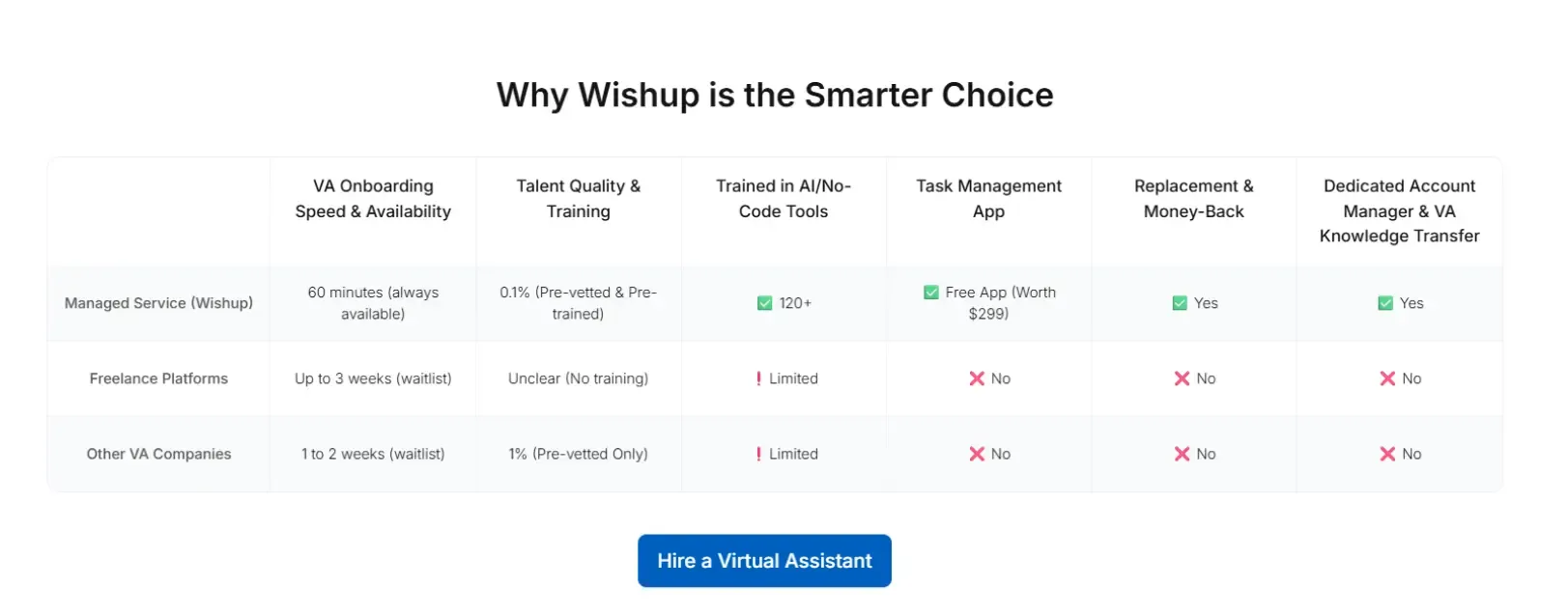
Manufacturing Operations Management VA vs. General VA

What Does a Virtual Assistant for Manufacturing Do?
A virtual assistant for manufacturing handles tasks in five categories. They include ERP order processing, inventory data entry, logistics and shipment follow-up, invoice and AR/AP management, and compliance documentation. Across Wishup's live manufacturing deployments, the highest-volume tasks a manufacturing VA owns are as follows:
- Order processing and ERP data entry: This includes creating sales orders, applying deposits, and running fulfillment inside NetSuite, Fishbowl, Ostendo, or Sage
- Logistics follow-up: they VAs verify shipping TAT, chase supplier pickups, and send customer tracking updates. This is one of the single largest daily task block take could eat 3 hrs/day
- Invoice processing and payment follow-up: In this, the VA applies for payments, reconciling billing, and chases overdue AR
- Documentation and PO filing. The VAs can build audit-ready records in SharePoint or Drive as a byproduct of daily work
These come directly from two live engagements: a motorsports aftermarket manufacturer on NetSuite whose VA runs 89+ hours of order-to-dispatch work monthly, and an electrical-components manufacturer whose VA handles 73 hours of documentation work that previously sat with a floor supervisor.
6 Key Components of Manufacturing Operations Management
Manufacturing operations management covers 6 operational components: production management, quality management, inventory management, maintenance management, workforce management, and compliance and documentation.
1. Production Management
Production management is the planning, scheduling, and control of every manufacturing run, from work order creation to output recording. It determines which products are built, in what sequence, with which resources, and on what timeline.
Admin tasks a manufacturing VA handles within production management:
- Create and update work orders in ERP systems such as QuickBooks, NetSuite, or Fishbowl
- Maintain daily production schedules and distribute updates to the floor team
- Compile shift handover reports and production summary logs
- Track actual output against planned targets and flag variances
- Coordinate rush-order changes with procurement and logistics
2. Quality Management
Quality management in manufacturing covers the processes used to ensure finished goods meet defined specifications, including in-process inspections, defect recording, non-conformance reporting, and corrective action tracking.
Admin tasks a manufacturing VA handles within quality management:
- Log inspection results and defect data into quality management spreadsheets or QMS platforms
- Draft and file non-conformance reports (NCRs) with root cause fields completed
- Maintain CAPA trackers and send follow-up reminders to responsible parties
- Compile supplier quality scorecards from incoming inspection records
- Organize documentation folders ahead of internal and third-party audits
3. Inventory Management
Inventory management tracks the movement and status of 3 asset categories: raw materials, work-in-progress (WIP) items, and finished goods. A stockout in raw materials halts a production run.
Overstock ties up capital. Inventory record inaccuracies, averaging 27% across manufacturing SMBs without dedicated inventory staff, create both simultaneously.
The administrative workload includes daily stock reconciliation, purchase order creation, goods receipt logging, reorder point tracking, and supplier follow-ups on delayed materials.
Admin tasks a manufacturing VA handles within inventory management:
- Reconcile physical inventory counts against system records in ERP platforms
- Create purchase orders for raw materials and consumables based on reorder thresholds
- Log goods receipts and update inventory ledgers upon delivery
- Track open purchase orders and follow up with suppliers on delivery timelines
- Flag slow-moving or obsolete inventory for management review
4. Maintenance Management
Maintenance management covers the scheduling, execution tracking, and documentation of all equipment maintenance activities, both preventive (scheduled) and corrective (breakdown response).
Unplanned downtime costs manufacturing SMBs an average of $50,000 per hour across production and labor, according to Aberdeen Group research. Preventive maintenance, consistently executed and documented, reduces unplanned downtime by 30 to 40%.
The administrative workload includes preventive maintenance schedule creation, work order generation for maintenance tasks, spare parts inventory tracking, maintenance log documentation, and vendor coordination for equipment servicing.
Admin tasks a manufacturing VA handles within maintenance management:
- Build and maintain preventive maintenance schedules across equipment assets
- Generate maintenance work orders and assign them to technicians or vendors
- Log completed maintenance activities and update equipment history records
- Track spare parts inventory levels and raise purchase orders at reorder thresholds
- Coordinate third-party service appointments and document vendor service reports
5. Workforce Management
Workforce management in manufacturing covers labor scheduling, skills tracking, training documentation, and productivity reporting across the shop floor.
The administrative workload includes shift schedule creation, attendance tracking, training record maintenance, skills matrix updates, and productivity report compilation.
Admin tasks a manufacturing VA handles within workforce management:
- Build weekly shift schedules and distribute to supervisors and floor leads
- Track attendance and maintain absence logs across shifts
- Update skills matrices as workers complete training or certifications
- Compile weekly productivity reports from floor output data
- Coordinate onboarding documentation for new floor hires
6. Compliance and Documentation Management
Compliance management covers the records, certifications, and reporting obligations that manufacturing SMBs must maintain under regulatory frameworks such as ISO 9001, OSHA, FDA 21 CFR, and EPA standards. A single documentation gap during a regulatory audit can result in fines, production holds, or loss of customer contracts.
The administrative workload includes certificate expiry tracking, regulatory report preparation, safety inspection documentation, environmental compliance records, and document control log maintenance.
Admin tasks a manufacturing VA handles within compliance and documentation:
- Track certificate and permit expiry dates across equipment, vendors, and facilities
- Prepare documentation packages for internal and third-party compliance audits
- Maintain the document control log with version histories and approval records
- File safety inspection reports and OSHA incident records within required timelines
- Compile environmental compliance data for periodic regulatory submissions
Why Manufacturing Operations Management Matters for SMBs?
Manufacturing operations management directly determines 3 financial outcomes for SMBs: production throughput, product quality costs, and operational overhead. SMBs without a structured MOM system lose revenue through 5 measurable failure modes: unplanned downtime, inventory errors, defect escapes, compliance penalties, and delayed deliveries.
1. Production throughput determines revenue capacity
A manufacturing SMB running at 75% of planned capacity because of scheduling mismatches, material delays, or maintenance gaps leaves 25% of its revenue potential on the floor.
Production management, the first component of MOM, directly closes this gap by aligning scheduling, procurement, and labor to the production plan.
2. Inventory errors generate costs on both sides of the balance sheet
A stockout stops a production run and creates an expedite fee. Overstock ties up working capital and increases carrying costs. SMBs managing inventory manually, without a documented MOM process, experience both.
The cost of a single raw material stockout that halts a production line for 8 hours at a 30-person SMB exceeds $12,000 in direct labor waste alone, before accounting for delayed shipments and customer penalties.
3. Compliance failures carry existential risk for SMBs
A larger manufacturer absorbs a $50,000 regulatory fine as an operational cost. An SMB, with 20 overhead, needs to pay about $1 million annually in regulatory compliance costs.
Documentation gaps are the leading cause of audit failures across manufacturing SMBs, and documentation is the component of MOM most readily delegated to a trained VA.
4. Delivery delays erode customer relationships in concentrated SMB customer bases.
A single consistent delivery delay pattern is enough to trigger a supplier review. MOM processes, specifically production scheduling and vendor coordination, are the operational layer that prevents delivery failures before they reach the customer.
The 3 MOM failure modes above share a common cause: the administrative work required to run each MOM component falls behind because the same people managing floor execution are also managing the documentation, reporting, and coordination that MOM requires.
A pre-trained manufacturing VA separates those two roles by owning the administrative layer completely.
5 Common Manufacturing Operations Management Challenges Costing SMBs Revenue
Most manufacturing SMBs do not fail because of bad products. They fail because the operational systems behind production break down under volume, complexity, or understaffing. These are the 5 challenges that appear most consistently across SMBs with 10 to 200 employees.
1. Production Scheduling Breaks Down Without a Dedicated Coordinator
Most SMBs run production schedules out of spreadsheets managed by a floor supervisor doubling as a planner. When a rush order arrives or a material delays, the entire schedule shifts manually, and errors compound across shifts.
The fix is a dedicated person maintaining the schedule, logging changes, and communicating updates. That is a task a manufacturing VA owns completely.
2. Inventory Records Fall Behind Real Stock Levels
Manual inventory reconciliation is accurate only at the moment it is completed. By the next shift, receipts are unlogged, materials are consumed without entry, and the system shows numbers that no longer reflect the floor.
SMBs operating with inventory accuracy below 90% experience stockouts and overstock simultaneously. Consistent daily reconciliation by a VA closes that gap without adding a full-time inventory clerk.
3. Maintenance Gets Deferred Until Equipment Fails
Preventive maintenance schedules exist in most SMBs. What does not exist is the administrative follow-through: generating work orders on time, tracking completion, logging outcomes, and ordering spare parts before they run out.
Deferred maintenance converts into unplanned downtime. Aberdeen Group data places the average cost of unplanned manufacturing downtime at $50,000 per hour. A VA managing the maintenance schedule and documentation layer prevents the deferral before it becomes a breakdown.
4. Compliance Documentation Accumulates Into Audit Risk
Quality logs, CAPA records, safety inspection reports, and certificate expiry tracking are all ongoing administrative obligations. In most SMBs, these records are maintained reactively, updated before an audit rather than throughout the year.
Auditors assess whether records are current, complete, and consistent. A VA maintaining these records daily produces an audit-ready documentation state as a byproduct of normal operations.
5. Vendor Communication Has No Single Owner
Purchase orders, delivery follow-ups, discrepancy disputes, and invoice reconciliation with suppliers fall across multiple people in most SMBs. No one owns the full vendor communication thread, and delays go unnoticed until a production line is waiting on materials.
A manufacturing VA centralizes vendor communication, tracks open POs, and flags delivery risks before they become line stoppages.
6 Best Practices for Manufacturing Operations Management in SMBs
These 6 practices separate SMBs that scale production cleanly from those that absorb operational problems as a cost of doing business.
1. Separate Floor Execution from Administrative Coordination
Floor supervisors make output decisions. Administrative coordinators maintain the records, reports, and communications that support those decisions. Mixing both roles into one person creates execution gaps in both.
The clearest structural fix is assigning MOM administrative work to a dedicated person, whether an in-house coordinator or a pre-trained manufacturing VA, so floor leadership stays on the floor.
2. Standardize Documentation Before You Automate It
Most MOM software implementations fail not because the software is wrong, but because the underlying documentation process is inconsistent. Automating an inconsistent process produces consistent errors.
Standardize work order formats, quality log templates, maintenance records, and inventory entry protocols first. Then automate. A VA enforcing standard templates across every record type builds that consistency without software investment.\
3. Set Reorder Points Before You Need Them
Reactive purchasing, ordering when a stockout has already occurred, costs SMBs in expedite fees, production halts, and supplier relationship damage.
Set documented reorder thresholds for every raw material and consumable. A VA monitors inventory levels against those thresholds daily and raises purchase orders before the floor feels the shortage.
4. Run Weekly MOM Reviews With Pre-Built Reporting
Production managers who review MOM performance weekly catch drift before it becomes a systemic problem. The barrier is not willingness. It is that building the weekly report takes longer than the review itself.
A VA pre-builds the weekly report from production data, quality logs, inventory records, and maintenance completion rates, so the review happens in 30 minutes rather than being deferred indefinitely.
5. Treat Vendor Relationships as Operational Infrastructure
On-time delivery, material quality, and pricing flexibility from suppliers are not procurement outcomes. They are MOM outcomes determined by how consistently and professionally your team communicates with vendors.
A VA owning vendor communication, PO tracking, and delivery follow-up converts supplier relationships from reactive transactions into managed operational partnerships.
6. Document Every Non-Conformance, Even Minor Ones
SMBs routinely skip NCR documentation for small defects, rework events, or near-misses because the paperwork feels disproportionate to the incident. Over time, those undocumented events become pattern data that is unavailable when a major quality failure requires root cause analysis.
A VA logging every non-conformance, regardless of severity, builds the quality history that makes corrective actions faster and audit responses credible.
How Does A Virtual Assistant Support Manufacturing Operations Management?
A virtual assistant deployed inside manufacturing and production-adjacent SMBs support across 4 operational functions: order and dispatch management, invoice and payment processing, logistics coordination, and documentation.
Manufacturing Operations Management VA Task Breakdown Table
The Workflow Inside a Live Manufacturing Operation
One Wishup client, a motorsports aftermarket manufacturer operating on NetSuite, has a VA running the complete order-to-dispatch cycle daily. The VA's workflow runs in this sequence:
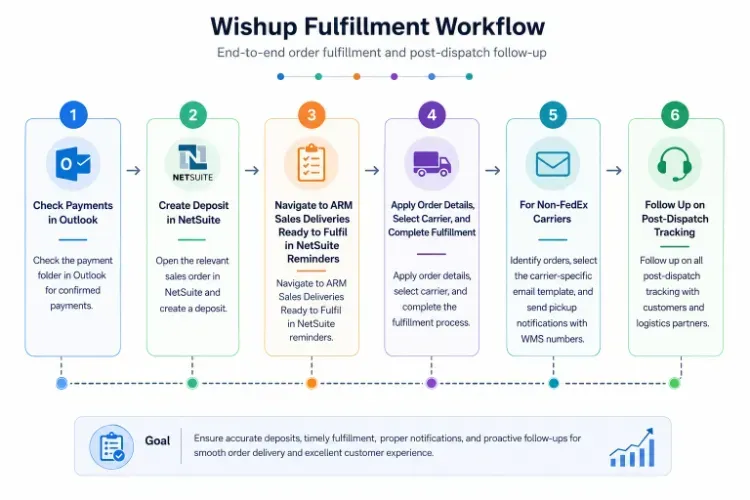
This one workflow alone accounts for over 89 hours of VA-managed work per month in that single engagement, freeing the operations team to focus on procurement, supplier negotiations, and floor-level production decisions.
A second manufacturing client, an electrical components manufacturer, uses a Wishup VA primarily for documentation management: logging sales orders, creating PO folders, and maintaining purchase order records.
That single function accounts for 73 hours per month of structured filing work that previously sat inside a floor supervisor's task list.
How Much Does a Virtual Assistant for Manufacturing Operations Management Cost?
The cost of a virtual assistant for manufacturing operations management starts from $1299 per month at Wishup.
Wishup offers 3 virtual assistant plans for manufacturing operations support.
All prices are in US dollars, billed monthly. Full-time means 8 hours of work per day. Part-time means 4 hours of work per day. Every plan includes onboarding in 60 minutes, a dedicated account manager, an NDA, and a replacement guarantee.
For comparison, a full-time in-house operations coordinator costs $45,000 to $65,000 per year in salary alone, plus benefits, equipment, and office overhead, totaling $63,000 to $85,000 annually for a single role. See Wishup's full pricing and plan details.
How to assign VA tasks in a Manufacturing Operations Management workflow?
Assigning MOM tasks to a manufacturing VA works in 3 steps.
Step 1: Map your highest-volume admin tasks first.
The EOD data across Wishup's manufacturing clients shows that order processing, logistics follow-up, and invoice management consistently consume the most VA hours. Start with the function generating the most administrative backlog, not the one that feels easiest to hand off.
Step 2: Document the exact steps before the VA starts.
The most successful manufacturing VA deployments use pre-written SOPs for recurring workflows. One client's dispatch VA follows a documented 9-step process inside NetSuite every morning. That documentation means a replacement VA can replicate the workflow within a day, with zero operational disruption.
Step 3: Define a daily EOD reporting format.
Every Wishup manufacturing VA submits a structured EOD report covering tasks completed, hours spent, blockers encountered, and next-day carry-overs. Production managers receive a written summary of every admin action taken that day without sitting in a status meeting.
What Manufacturing Tasks SMBs Delegate First (And Why)
The most effective manufacturing VA deployments start with 1 or 2 high-volume, process-driven tasks, build trust through consistent output, and expand scope over 30 to 60 days.
1. Logistics Follow-Up and Shipment Tracking
SMBs delegate it first because the work is high-frequency, time-sensitive, and entirely process-driven.
Verifying FedEx TAT, emailing suppliers for pickup confirmation, and sending tracking updates to customers does not require floor knowledge. It requires attention, consistency, and a working knowledge of the shipping platform. All three are VA-trainable in under a week.
The cost of not delegating it is real: a production manager spending 3 hours daily on tracking follow-ups is a production manager not on the floor.
2. Order Processing and ERP Data Entry
Sales order creation, deposit application, fulfillment processing, and carrier selection inside ERP systems like NetSuite and Ostendo follow a documented, repeatable sequence.
Once that sequence is written as an SOP, a VA executes it faster and with fewer errors than a supervisor multitasking between floor oversight and data entry.
One Wishup manufacturing client's VA handles the complete NetSuite order-to-fulfillment workflow daily, including deposit creation, payment application, order fulfillment, and carrier selection, as a single morning task block.
3. Payment Follow-Up Emails
Outstanding balances on sales orders create cash flow gaps that manufacturing SMBs cannot absorb. Following up on unpaid orders requires identifying the overdue sales order in the ERP, generating a PDF invoice, selecting the correct email template, and sending the follow-up with a payment link.
That 4-step workflow takes approximately 2 hours per day and produces a measurable AR reduction. SMBs delegate it early because the output is directly trackable: number of follow-ups sent, payments received, and overdue balance movement week over week.
4. Documentation and PO Filing
Purchase order organization, sales order entry, and folder creation in SharePoint or Google Drive sit at the bottom of every production manager's priority list. They rarely feel urgent.
But when an auditor asks for a specific PO from 6 months ago, or a supplier dispute requires the original documentation, the filing backlog becomes an expensive problem.
SMBs that delegate documentation early build an audit-ready records system as a byproduct of normal VA operations, rather than scrambling to reconstruct records before a compliance review.
5. Accounts Receivable and Payable Management
Finance assistance is the second-largest category of VA hours in Wishup's manufacturing client data, behind general administration.
AR and AP tasks, specifically reconciling statements, flagging discrepancies, and preparing payment runs, follow a defined process that does not require a CPA but does require daily execution.
Manufacturing SMBs that delegate AR/AP tracking to a VA report faster invoice turnaround and fewer overdue accounts, because the follow-up cadence is consistent rather than dependent on a part-time bookkeeper's availability.
What SMBs Delegate After the First 30 Days
Once the first 1 or 2 tasks are running cleanly, Wishup's manufacturing clients typically expand scope in this order:
- FedEx reporting and shipping data compilation
- Carbon and sustainability data management
- SOP creation for additional workflows
- Vendor communication and supplier follow-up
- Workforce scheduling and attendance documentation
The expansion is demand-driven, not arbitrary. As production managers see administrative time return to them, they identify the next highest-volume task consuming floor leadership hours and hand it to the VA.
Tools our VAs use in Manufacturing Operation Management
Wishup manufacturing VAs do not arrive, requiring tool onboarding. The tools below are used across active manufacturing client engagements.
1. ERP and Order Management
- NetSuite: Order creation, deposit processing, fulfillment, dispatch, payment application
- Ostendo: Sales order processing, invoice creation, payment recording
- Fishbowl: Inventory management, sales order entry, RMA processing, purchase order documentation
- SAP: ERP-level order and inventory management for larger SMB operations
- Sage: Accounting and operations management for manufacturing SMBs
- QuickBooks: AR/AP tracking, invoice reconciliation, vendor payment management
2. Logistics and Shipping
- FedEx portal: Label creation, shipment tracking, TAT verification, monthly reporting
- BTX Freight: Freight carrier coordination for domestic manufacturing shipments
- UPS: Alternative carrier tracking and label management
3. Communication and Coordination
- Microsoft Outlook: Operational inbox management, vendor communication, payment follow-up emails
- Microsoft Teams: Internal coordination, dispatch team updates, cross-department communication
- Zoom: Client catch-up calls, operations reviews, training sessions
- Slack: Team messaging, real-time dispatch channel monitoring
4. Documentation and Project Management
- Microsoft SharePoint: PO folder creation, sales order documentation, compliance filing
- OneDrive: Cloud document storage and backup for operational records
- MS Planner: Task tracking, operational to-do management, workflow prioritization
- Asana: Project and task coordination across manufacturing operations
- Monday.com: Workflow tracking and operational project management
- Microsoft Excel / Google Sheet: Reporting, AR tracking, carbon data analysis, inventory reconciliation
5. CRM and Customer Support
- Salesforce: CRM for customer order tracking and relationship management
- Zoho Desk: Support ticket management, customer query resolution, ticket documentation
- Zoho CRM: Customer record management, account tracking
- HubSpot: Quoting workflow support and CRM management
6. Automation and Reporting
- Zapier: Workflow automation between ERP and documentation systems
- Microsoft Power Automate: Automated folder creation, Zoho-to-Excel data sync, documentation workflows
- DocuSign: Contract and vendor agreement execution
How to Measure Manufacturing Operations Management Performance?
These are the 6 MOM performance metrics that manufacturing SMBs track across VA-managed workflows, with benchmark ranges drawn directly from Wishup clients.
1. Orders Processed Per Day
This is the highest-volume output metric in manufacturing VA deployments. Across Wishup's manufacturing client data, VAs consistently process 8 to 46 orders per day, depending on order volume and task scope.
A daily order processing count below the established baseline signals either a backlog build-up or a process bottleneck upstream in the ERP workflow. Tracking this metric daily catches drift before it reaches 3 to 5 days of backlog.
2. Dispatch Completion Rate
Dispatch completion rate measures the percentage of orders ready for dispatch that are actually dispatched by end of shift. In a well-run manufacturing VA workflow, this should be 100% daily.
Wishup manufacturing VAs log dispatch counts. Sample output from the data: "13 dispatch, 3 deposits and 1 sample order created" and "12 dispatch, 9 deposits created." These entries allow operations managers to verify dispatch completion without a separate review meeting.
3. Payment Follow-Up Execution Rate
Outstanding balances on sales orders represent delayed cash flow. Wishup manufacturing VAs send payment follow-up emails as a daily task, processing 5 to 24 follow-up emails per day based on the outstanding orders queue.
Tracking this metric weekly reveals whether AR is growing, shrinking, or flat. A week where follow-up volume increases but payments received stay flat signals a pricing dispute or customer issue that requires escalation above the VA level.
4. Documentation Filing Rate
Documentation filing rate measures the percentage of purchase orders and sales orders that have a corresponding folder and file created in SharePoint or Google Drive on the same day the order is processed.
Wishup VAs consistently achieve same-day filing. This metric confirms that the documentation system stays current rather than accumulating a filing backlog.
5. Logistics Follow-Up Coverage
Logistics follow-up coverage measures the percentage of in-transit orders that receive a tracking verification and status update on a given day. In Wishup's manufacturing client data, this task accounts for the single largest daily hour block, averaging 2.98 hours per day across 129 logged entries.
Tracking this metric reveals whether customer-facing delivery communication is consistent. Gaps in logistics follow-up produce customer service escalations that are far more expensive to resolve than the follow-up itself.
6. Support Ticket Resolution Rate
For manufacturing SMBs with a customer support function, ticket resolution rate measures the percentage of open tickets reviewed and actioned each day.
Tracking this at the weekly level reveals patterns in ticket volume, resolution time by issue type, and recurring customer complaints that can be escalated to the product or quality team.
Implementation Checklist: Getting Your Manufacturing Operations Management System Running
These 6 steps set up a working MOM performance measurement system in under a week.
- Define baseline volumes for each metric before the VA starts. Current order processing counts, outstanding AR balances, and dispatch completion rates establish the pre-VA baseline.
- Set up a structured EOD report format with 4 required fields: tasks completed, quantified output per task, blockers encountered, and next-day carryovers.
- Review EOD reports daily for the first 30 days. Pattern recognition across the first 20 to 30 EOD reports reveals where process documentation needs tightening and where output rates deviate from baseline.
- Build a weekly summary dashboard from EOD data covering the 6 metrics above. A Wishup manufacturing VA can build and maintain this dashboard as part of their weekly reporting task.
- Set performance thresholds for each metric and define escalation criteria. A documentation filing rate below 90% for 3 consecutive days, for example, triggers a workflow review rather than waiting for an audit to surface the gap.
- Review the metrics monthly with the operations lead and adjust VA task scope based on where output bottlenecks are appearing.
Wishup manufacturing VAs are pre-vetted, pre-trained in ERP systems including NetSuite, Fishbowl, and Sage, and deployable in under 60 minutes. No benefits, no equipment costs, no onboarding risk.
Hire a Manufacturing Virtual Assistant from Wishup, plans start at $1,299/month.
FAQs
What is manufacturing operations management?
Manufacturing operations management (MOM) is the set of processes that controls and monitors production activities between raw material receipt and finished goods shipment.
It covers 6 functions: production scheduling, quality control, inventory management, maintenance coordination, workforce management, and compliance documentation. MOM connects shop floor execution to business-level performance data.
What is the difference between MOM and MES?
MOM is the broader management discipline. MES is software that supports it.
MOM defines the processes, policies, and workflows that govern production operations. An MES executes and records those workflows digitally, capturing real-time data on machine status, labor hours, work order progress, and quality results.
A manufacturing SMB can run effective MOM without an MES. Many do, using ERP systems like NetSuite, Fishbowl, or Sage alongside spreadsheets and documented SOPs. An MES adds automation and real-time visibility but requires significant implementation investment that most SMBs under $20M in revenue cannot justify.
The administrative layer of MOM, including documentation, reporting, vendor communication, and compliance filing, remains a manual workload regardless of whether an MES is in place.
What Manufacturing Tasks Does a VA Handle on Day One?
The 3 tasks manufacturing SMBs delegate first are order processing and ERP data entry, logistics follow-up and shipment tracking, and payment follow-up on outstanding sales orders.
These are the highest-volume, most repeatable MOM admin tasks. Each follows a documented, step-by-step process inside the client's ERP system and produces measurable daily output.
What ERP Systems Do Wishup Manufacturing VAs Work In?
Wishup manufacturing VAs have active deployment experience in NetSuite, Fishbowl, Ostendo, Sage, SAP, and QuickBooks.
These are confirmed from EOD task logs across live manufacturing client engagements, not training documentation. VAs also work across Microsoft SharePoint, Outlook, Teams, and MS Planner for documentation and coordination workflows.
Does a Manufacturing VA Replace an Operations Coordinator?
A manufacturing VA handles the administrative and documentation layer of operations coordination:
- data entry,
- reporting,
- vendor follow-up,
- compliance filing, and
- scheduling support.
They do not replace the judgment functions of an operations coordinator, including supplier negotiations, production decisions, or quality escalation authority. The most effective deployment model uses a VA to absorb the admin backlog so an existing operations coordinator or plant manager focuses exclusively on decisions that require floor experience.
How much does a virtual assistant for manufacturing cost?
A Wishup manufacturing virtual assistant starts at $1,299/month part-time and $1,999/month full-time, compared to $63,000 to $85,000 a year for an in-house operations coordinator once salary, benefits, equipment, and overhead are included. Every plan includes onboarding in 60 minutes, a dedicated account manager, an NDA, and a replacement guarantee.
Can a virtual assistant work inside our ERP and manufacturing systems?
Yes. Wishup manufacturing VAs have live deployment experience in NetSuite, Fishbowl, Ostendo, Sage, SAP, and QuickBooks, plus SharePoint, Outlook, and Teams for documentation and coordination. They arrive pre-trained, so there is no ramp-up period spent teaching the platform on your time.
