📌 Quick Summary
- An outsourced executive assistant is a dedicated remote professional who manages executive operations through a managed service provider rather than as an in-house employee.
- Businesses typically outsource executive assistants to reclaim leadership time, reduce hiring overhead, and gain experienced support without full-time employment costs.
- An outsourced executive assistant can handle calendar management, inbox organization, stakeholder communication, travel planning, project coordination, research, and workflow automation.
- Compared to hiring an in-house executive assistant, outsourcing offers faster onboarding, lower operational costs, and provider-managed hiring, training, and replacement.
- The best outsourced executive assistants take ownership of the administrative tasks, build systems, automate repetitive workflows, and enable executives to focus on strategic decisions.
At times, executives don't realize how much they are doing that someone else could handle better and faster. They are not aware of how much time they are losing and the value of a fraction of that time.
This is not happening because they lack awareness. Certain tasks feel too sensitive to hand off, too context-specific to explain, or too small to justify a full hire. Therefore, executives handle it by themselves.
And then they wonder why the strategy keeps getting pushed to next week.
An outsourced virtual executive assistant solves this specific problem: you need high-level, reliable support without the overhead, the hiring cycle, or the management burden that comes with a full-time employee.
Before you outsource executive assistants, you need to know: the way the outsourced executive assistant works, the difference between an EA completing tasks and an EA who creates a workflow and an efficient system around your business.
This guide covers both.
What Is an Outsourced Executive Assistant?
An outsourced executive assistant is a senior-level remote professional who provides dedicated support to an executive, founder, or leadership team. These EAs are hired through a managed service provider rather than brought on as internal employees.
This distinction matters. When you hire internally, you own the entire employment relationship. It includes recruiting, onboarding, salary, benefits, performance management, and replacement if things don't work out. When you outsource, the service provider owns all of that. You get the output without the overhead.
An offshore executive assistant owns and manages systems, exercises discretion, and, over time, becomes embedded in how you operate. The best ones eventually sit in on investor calls, own your CRM, and handle communication that never gets delegated to a junior hire.
There is also a model distinction worth knowing: fractional executive assistants. They work part-time across one or two clients, while full-time outsourced EAs are dedicated to a single executive for the full working day. The right model is decided based on the volume, but the pattern across the engagement is consistent. According to Wishup’s 2026 VA industry report, 94.5% of businesses opt for dedicated full-time or half-day support instead of hourly arrangements. However, both still have the same managed service logic.
Read our in-depth blog: Executive Assistant to CEO.
When Do You Need an Outsourced Executive Assistant?
The clearest signal isn't busyness. Plenty of executives are busy doing exactly the right things.
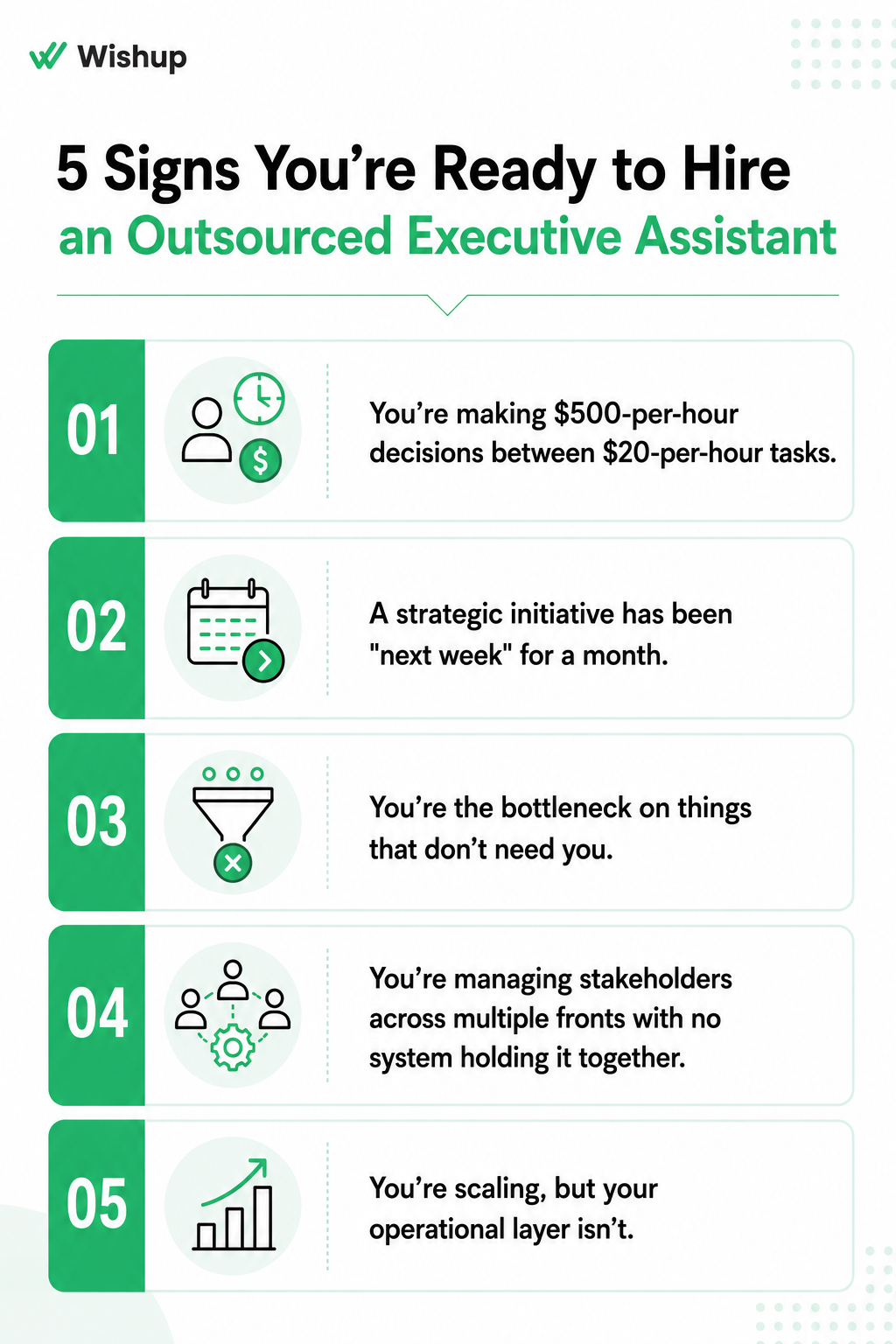
Here is a signal: you are making $500-per-hour decisions between blocks of $20-per-hour work such as scheduling, inbox triage, travel planning, and follow-up emails that require your name but not your brain.
Other signs that show up consistently:
Your calendar reflects other people's priorities, not yours. You are the bottleneck on decisions that shouldn't require you. You have delayed a strategic initiative for the third consecutive week because operations keep pulling you back. You are onboarding, scaling, or managing stakeholders across multiple fronts at once.
Outsourced EA support works best when you have genuine executive-level volume. The delegation concentrates on the volume. Executive and administrative work makes up 31.7% of all delegated tasks, the single largest category in Wishup's 2026 VA Industry Report. If your admin needs are light and intermittent, a task-based EA arrangement makes more sense. The EA model earns its value when the workload is consistent, and missed tasks can have real consequences.
What an Outsourced Executive Assistant Actually Does
The starting point is always the inbox and calendar. That's true across almost every engagement.
But that's rarely where it ends.
When one of our EAs joined with a C-level advisor, he was managing multiple inboxes, a heavy speaking schedule, and a growing content operation. Our EA started by manually triaging 120+ emails daily, tracking follow-ups across accounts, and managing his calendar. Within months, she had identified and cancelled unused software subscriptions, optimized his travel bookings, and saved him over $20,000. The virtual executive assistant services expanded, and the Wishup team has partnered with the same client for automation.
The entry was narrow, but the EA identified the potential workflow growth and filled that gap; that is how an EA streamlines your business.
The task coverage typically includes:
Communications: Inbox management, stakeholder follow-ups, investor updates, draft correspondence. For early-stage founders managing investor relationships, a good EA knows when to respond on your behalf and when to flag something for your eyes first. That judgment is not taught in a week. An expert EA learns your communication pattern, working style, and preferences and takes care of the communication.
Calendar and scheduling: This task goes beyond booking meetings to building a calendar architecture that protects your deep work hours, auto-sends meeting prep materials, and prevents the kind of double-booking that signals disorganization to external stakeholders.
Travel and logistics: End-to-end trip coordination, preference-aware booking, real-time itinerary management. The operational lift here is underestimated until you have had someone else handle it.
Research and reporting: Competitive monitoring, briefing documents, data aggregation. John Tiso's Wishup EA at JMT Consulting didn't just pull reports; she rebuilt their entire Salesforce operation, cleaned years of corrupted data, and created dynamic real-time dashboards. She eventually earned a seat on their Salesforce Steering Committee. Tiso's sales team called her "the differentiator."
Project and team coordination: Status tracking, cross-functional communication, keeping deliverables moving without the executive becoming the default project manager.
In-House EA vs. Outsourced Executive Assistant: The Cost Breakdown
The salary comparison is the obvious starting point, but it understates the actual gap.
A mid-level in-house executive assistant in a major US city earns between $70,000 and $150,000 annually. Add 25% for benefits, $11,000 per year for office space, and the HR overhead of a 41-day average hiring cycle and you are looking at a fully-loaded cost that can push well past $200,000 for a senior hire in a high-cost-of-living market.
Outsourced EA services remove most of that structure entirely. You don’t have to think about payroll, benefit administration, or a desk or a recruiting cycle when your EA moves out of the system since your provider handles replacement and maintains process continuity.
The 41-day hiring cycle compounds the cost further. Every week without support is a week the executive is absorbing the admin load themselves. Wishup's onboarding takes 60 minutes. It's a structural one, built on a pre-vetted, pre-trained talent pool that's ready before you are.
Many executives are opting to outsource an EA since it’s cheaper compared to hiring an employee; however, the cost model varies. You are paying for output and continuity, not headcount. For founders and executives who need senior-level support without the infrastructure of a full internal hire, that's a structurally better deal than a less expensive one.
One real limitation: if you need an EA deeply embedded in on-site operations, physical presence, or highly sensitive in-person environments, the outsourced model has constraints. Most executive functions don't require physical presence anymore. But it's worth being honest about the exceptions.
The Human + Automation Equation in EA
There is a version of the "AI executive assistant" conversation that misses the point right now. Tools that promise to automate your executive function, manage your relationships, and run your calendar without human judgment. Most of them can handle a small slice of the job. None of them handles the critical judgment layer.
The more useful question is not "AI or human?" It's "who is running the automation?"
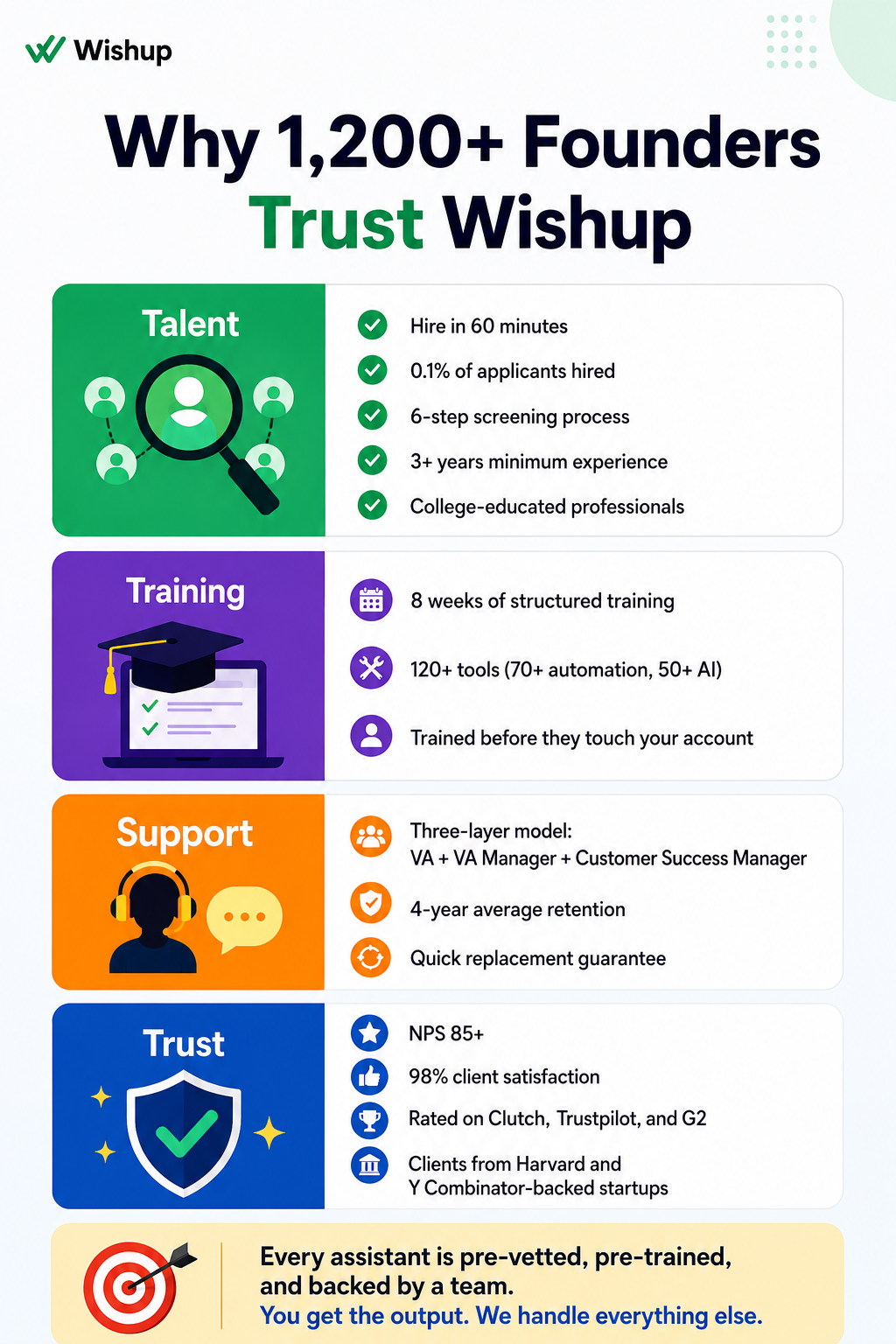
Wishup EAs are trained across 120+ automation tools. It consists of 70+ no-code platforms and 50+ AI tools. That includes workflow tools like Zapier and Zoho, CRMs like HubSpot and Salesforce, project management systems like Asana and ClickUp, and communication platforms across the stack. The 8-week structured training program provided to our EAs is built specifically around making them fluent in these systems before they touch a client account.
What that means in practice:
When John Tiso's CRM was producing poor reports that took hours to build manually, his Wishup EA fixed the reports, rebuilt the underlying data architecture, and automated the entire reporting function. The reports now pull in real time; the hours taken to finish this task are now allocated to some other critical tasks.
When one of our clients needed a system to manage 120+ daily emails across multiple inboxes, our VA didn't just read and flag; she mapped the workflow, identified where automation could replace repetition, and worked with a separate Wishup automation specialist to build the backend system.
The automation is not the product. An EA who knows when to build it, what to build, and how to maintain it is the product.
One important finding from real EA engagements: not every task or process should be automated. Ashmita, a Wishup EA supporting an early-stage AI finance startup, deliberately avoids automating investor communications. The founder's investors expect a personal touch. An automated response to a follow-up from a Series A lead investor is a relationship risk. A good EA reads the context and responds with the human touch, which AI cannot do.
This is one of the major differences between a task-taker and a systems-builder. Task-takers execute what's in front of them. Systems-builders look at the whole workflow, identify where human judgment is irreplaceable, and automate everything around it.
How to Choose the Right Outsourced Executive Assistant Service
The market roughly splits into two models: matchmaking platforms and managed services.
Matchmaking platforms connect you with freelance or independent EAs. You get access to a talent pool. Everything after that, whether it’s onboarding, training, performance management, or replacement, is your problem. In this model, you have outsourced the hiring, but this cannot include the management.
Managed services own the full stack. The provider hires, trains, manages, QAs, and replaces. You engage the output, not the individual.
The distinction matters most when something goes wrong. With a freelance match, a departing EA is your crisis. With a managed service, it's the provider's operational problem to solve.
Beyond the model, here's what separates strong providers from mediocre ones:
Vetting depth: Wishup hires 0.1% of applicants, that means one in a thousand, through a 6-step screening process that evaluates aptitude, English proficiency, communication, personality, and cultural fit. Most platforms don't publish their acceptance rate because it isn't selective enough to be a selling point.
Training structure: Pre-vetted talent with no structured training is still a gamble. The 8-week Wishup training program means EAs arrive already fluent in your likely tool stack; they don’t have to learn it after they join your system.
Support architecture: A single EA with no backup is a single point of failure. Wishup's three-layer model, ie, EA, VA Manager, and Customer Success Manager, gives a whole structure and multilayer accountability on tasks with various levels of seniority.
Retention: High EA turnover means you are constantly re-onboarding. Wishup's 4-year average retention rate is a direct indicator of how well the managed service model works for the people inside it.
What to Avoid When Hiring an Outsourced Executive Assistant
- Vague vetting language with no published acceptance rate
- No structured training program before client deployment
- No backup coverage when your EA is unavailable
- Client-to-EA ratio above 3:1
- No continuity plan when an EA exits
Read more: Offshore Executive Assistants: What They Do, What They Cost, and How to Hire One
Who Gets the Most Out of an Outsourced Executive Assistant
Not every executive extracts equal value from this model. The fit depends on how you work and what's actually creating drag.
Founders managing multiple ventures: When you are running two companies, the problem isn't capacity. It's that everything is connected to you personally. Investor follow-ups, client communications, document systems. An EA untangles that by building the infrastructure around you and completing the tasks.
C-suite executives in growth-stage companies: The 16-hour-per-week admin drain is real, but the more corrosive problem is what it does to decision quality. Leadership IQ research found 67% of executives have been less productive due to burnout, and 65% have made mistakes as a result. An EA who can own your operational layer can free up more hours, and this changes how the time has been spent or allocated for the right tasks.
Operations managers supporting multiple leaders: The challenge here is usually the span of control. Supporting 3 to 4 executives with no dedicated admin layer means the ops manager becomes the default EA for everyone. A Wishup EA - Ashmita, embedded in that structure, becomes the single coordination point, the role one of our EAs played at a firm, where she eliminated the chaos of agents pinging the tech team directly by becoming the single point of contact for all requests.
Solo practitioners and early-stage startup founders: This is where the fractional model earns its place. You don't need 8 hours of EA support daily. You need 4 hours of excellent support for inbox, calendar, and investor follow-ups from someone who understands your stage and doesn't need hand-holding. Wishup's part-time engagement option exists exactly for this.
Any founder, executive, or operator who needs a reliable right-hand can opt to hire an executive assistant. An EA who can own the operational layer, build workflows around how you work, and grow into the role as your business grows.
If you're at the stage where automation is on your radar but you don't have the bandwidth to build it yourself, a Wishup EA closes that gap. They come trained across 120+ automation tools, ready to set up the workflows, connect the systems, and maintain what they build. You get the output of an automation stack without hiring a separate ops or tech resource to run it.
