You have a strategic decision to make by noon. A board deck to review. Three investor emails to answer. And somehow, you are still managing your own calendar.
This is not a time problem. This is a leverage problem.
Offshore executive assistants exist to solve exactly this. Not as a budget workaround. Not as a temporary fix. As a structural upgrade to how senior leaders operate.
This guide breaks down everything you need to know: what offshore executive assistants actually do, what they cost, where the best talent comes from, how to hire well, and what separates a great offshore EA from an expensive disappointment.
Wishup is a virtual assistant company in the United States.
Pre-vetted, aptitude tested, onboarded in 60 minutes.
Hire an offshore executive assistant →
What "Offshore Executive Assistant" Actually Means
An offshore executive assistant is a highly skilled remote professional based outside your home country who supports executive-level work. They handle the operational layer of your day so you can focus on the decisions only you can make.
The word "offshore" just describes geography. This has nothing to do with the work quality. The best offshore executive assistants come with years of experience and have a college education. Their experience includes closely working with C-suite leaders, founders and senior directors. Many of them come with a formal background in business administration, communications and operations.
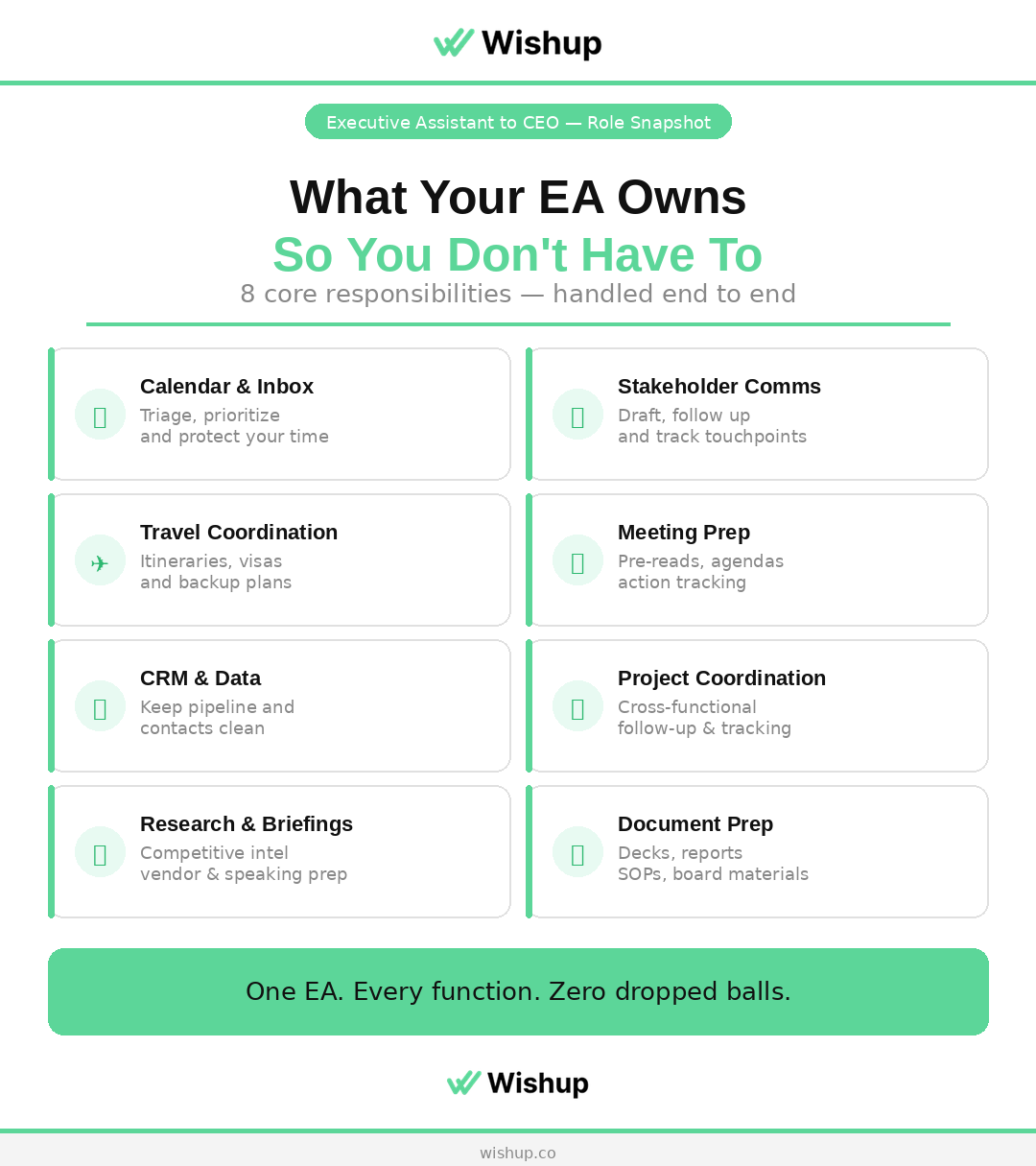
The key difference between a standard virtual assistant and an executive assistant is scope. A Virtual Assistant handles tasks, while an offshore executive assistant handles the operating rhythm of both you and the business, such as:
- Calendar and inbox management: Triage, prioritize, and protect your time
- Stakeholder communication: Draft, follow up, and track investor or client touchpoints
- Travel coordination: Complete itineraries, visa-related management, and backup plans for unexpected circumstances
- Meeting prep and notes: Pre-reads, agendas, action item tracking
- CRM and data management: Keep your pipeline and contacts clean and up to date
- Project coordination: Cross-functional follow-up and status tracking
- Research and briefings: Competitive intel, vendor evaluations, speaking prep
- Document preparation: Decks, reports, SOPs, board materials
For the full task list, see what a virtual executive assistant does.
Offshore assistant' is often used as an umbrella term covering several distinct roles. An offshore executive assistant supports one executive with calendar strategy, communications, and high-level coordination — the focus of this guide. An offshore personal assistant handles an individual's personal and lifestyle logistics rather than business operations. If you're looking for broader administrative or operational support rather than dedicated executive-level assistance, see our guide on Personal Assistant vs Executive Assistant: Key Differences & Salaries (2026)
The ceiling on this role is higher than most executives expect. When the fit is right, offshore EAs evolve from handling the inbox and calendar to owning entire operational systems.
How Much is Executive Admin Work Actually Costing You?
Before calculating the costs of getting an offshore executive assistant, it’s worth calculating what it’s already costing you to do everything yourself. The hours you are spending on tasks that are not directly contributing to business growth.
Research from the Admin Burden Index (2025) found that office workers spend an average of 5.6 hours every week on administrative tasks that could be delegated. For an executive, that is not 5.6 hours of "stuff." That is five to six hours stolen from decision-making, client relationships, and growth.
Administrative work is a top productivity killer for directors and above. The executives who get the most done are not the ones working harder. Those who have moved to outsourced administrative support have stopped doing things that someone else can do - and that is the difference.
Client testimonials
The math is straightforward. If your effective hourly rate as a CEO or founder is $200 or more, and you are losing even three hours per day to scheduling, email triage, and coordination, you are losing $600 per day in recoverable value. That is roughly $130,000 per year in executive time applied to work that does not require you.
An offshore executive assistant, by contrast, typically costs between $1,000 and $3,500 per month depending on the provider, experience level, and model.
The gap is not subtle.
Offshore Executive Assistant Costs: What You Actually Pay
| Hiring Model | Typical Cost | Who Manages Vetting & Compliance | Onboarding Speed | Best For |
|---|---|---|---|---|
|
Freelance Platform (Direct Hire) |
$5 to $15/hour | You |
Slow (20 to 40 hrs of your time) |
Experienced operators comfortable managing offshore hires |
|
Managed Service / Agency |
$1,000 to $3,500/month |
The agency |
Fast (often under a week) |
Founders who want quality floors, replacements, and less overhead |
|
US-Based Executive Assistant |
$80,000 to $125,000/year (fully loaded) |
You or HR | Moderate |
In-person roles, highly regulated industries |
|
Best Value Offshore EA from Wishup |
$1,299 to $1,999/month |
The provider |
60 minutes to start |
Executives who want premium talent at a lower cost |
For in-house and virtual rates side by side, see how much an executive assistant costs.
Where to Find Offshore Executive Assistants: 3 Ways
The best offshore executive assistants come from three sourcing routes, and each suits a different level of hands-on management.
- Freelance platforms: The lowest cost, but you handle vetting, contracts and replacements yourself.
- Managed services: The provider sources, vets and replaces the assistant, so you start faster with less risk.
- Direct overseas hiring: You recruit in the target country yourself. See how US businesses hire overseas virtual assistants.
The most common countries are the Philippines and India for offshore support, and Mexico, Colombia and Argentina for nearshore. Because the work is remote, the assistant doesn't need to be near you. An executive in Edinburgh, London or New York hires the same way and chooses by time zone overlap, not location.
What Offshore Executive Assistants Are Good At?
Areas offshore EAs consistently outperform:
- High-volume coordination work: Scheduling across time zones, managing complex travel logistics, stakeholder follow-up cadences, meeting prep and notes. This is process-driven work that benefits from a systematic, dedicated person who is not being pulled into your office politics.
- Asynchronous communication: Written emails, follow-up sequences, research briefs, internal summaries. Offshore executive assistants from countries with strong English proficiency are often excellent at written business communication.
- CRM and systems ownership. With the right onboarding, offshore EAs can own your HubSpot, Salesforce, or Notion setup. Cleaning data, building workflows, running reports.
- Document and presentation work: Board decks, meeting recaps, SOPs, vendor comparison documents.
Where you need to be realistic:
- Client-facing phone calls: This requires regional cultural fluency; it can be tricky depending on geography. For sensitive calls, this is worth factoring into your role design.
- Same-time-zone real-time availability: Supporting real-time availability across time zones requires deliberate planning. Philippines-based offshore EAs often work US hours, but if you need someone available the moment you pick up the phone at 7 AM Pacific, build that expectation explicitly into your contract.
- Highly sensitive legal and compliance tasks: These tasks at the most regulated level may still require domestic staff in certain industries.
The quality ceiling on offshore executive assistants is genuinely high. The variance is a sourcing and management problem, not a geography problem.
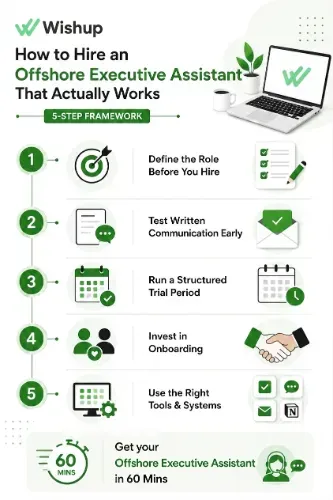
How to Hire an Offshore Executive Assistant That Actually Works Out
Most bad offshore EA hires are not a talent problem. They are a process problem.
Step 1: Define the role before you hire
Write down the 10 to 15 tasks you want to delegate in the first 30 days. Be specific. "Manage my calendar" is not a brief. "Own my calendar in Google Calendar, hold 2-hour daily focus blocks, batch all meetings to Tuesday through Thursday, and send a daily 8 AM summary" is a brief. The more concrete your onboarding plan, the faster the offshore executive assistant becomes effective.
Step 2: Test written communication early
The EA's written English is a proxy for how they will handle your inbox, draft your emails, and communicate with stakeholders. Before committing, give candidates a written scenario: a tricky email to draft, a meeting to summarize, a research question to answer. The output tells you almost everything.
Step 3: Run a structured trial period
30 to 60 days with clear performance criteria. Not a vague "see how it goes." Define what success looks like by Day 30. Does the calendar reflect your stated priorities? Are follow-up emails going out within 24 hours? Is the CRM clean?
Step 4: Invest in onboarding.
The biggest mistake executives make is under-investing in the first 30 days. Offshore executive assistants are not mind readers. They need to understand your communication style, your preferences, your stakeholders, and your priorities. That knowledge takes 20 to 40 hours to transfer. The executives who say their offshore EA "did not work out" often spent less than 3 hours on onboarding.
Step 5: Use the right tools.
A shared task manager (Asana, ClickUp, Notion), a clear inbox protocol, a communication cadence, and a standing weekly sync. These are not luxuries. They are the structural conditions that make delegation reliable. Given today’s technology-driven business environment, it is essential to check the tool knowledge of the EAs.
What Happened When These Founders Hired an Offshore Executive Assistant?
The clearest way to understand what offshore executive assistant support can become is to look at what happens when the fit is right.
When an EA Becomes Your Operational Backbone
John Tiso runs client services at a non-profit financial management firm that was scaling fast. He was managing multiple roles, calendars, and client touchpoints simultaneously. Beyond the admin overload, their Salesforce CRM was broken. Reports took hours to build, data was unreliable, and there was zero automation.
His Wishup EA started with the standard playbook: inbox and calendar management. Then the role evolved. The assistant cleaned the CRM data, built real-time dynamic reports, automated workflows, and eventually earned a seat on the Salesforce Steering Committee.
Critical reports that previously took hours now pull instantly. The EA received 5-star monthly performance ratings for two years straight. A sales leader within the firm called the offshore executive assistant "the differentiator."
When One EA Supports Two Companies at Once
Dr. Rikin Mehta was running two companies simultaneously: a biotech startup and a healthcare credentialing platform. He was drowning in investor communications, stakeholder follow-ups, and client coordination across both ventures. No system. Just chaos.
His Wishup offshore executive assistant built investor communication tracking from scratch, systematized client follow-ups, created a corporate document filing system, and handled calendar management across both organizations.
Investor communications are now fully tracked and on schedule. Client follow-ups shifted from reactive to systematic. Both companies publicly credited the arrangement. The brand recognized Wishup as a "strategic business partner" on LinkedIn, which is rare for any vendor relationship, and both companies nominated the EA for the Wishup Client Choice Awards.
The offshore EA in this case was not supporting one executive. She was context-switching across two industries, two stakeholder networks, and two sets of workflows at the same time.
The Questions Executives Ask Before Hiring Offshore (Answered Honestly)
"Will they understand my industry?"
Yes, but the answer depends heavily on who you hire through. Wishup's virtual executive assistant service places offshore executive assistants who come from the top 0.1 percent of pre-vetted applicants. Each assistant is aptitude tested, and onboarding takes 60 minutes. By the time an assistant reaches you, they have usually spent years supporting executives in similar fields.
"What about confidentiality?"
With a good provider, every EA signs an NDA before the engagement starts. Background checks are part of every placement, not something you have to ask for. If you are handing over inbox access, investor threads, and board materials, you want that baseline locked in before day one. Most executives are surprised by how routine this is once they ask.
"What if it does not work out?"
With a direct hire, a bad fit costs you months. With a managed provider, if the match is not right, a replacement is part of the model. You flag the issue, and the team moves on it. There is no starting over from scratch.
"Can they handle high-stakes communication?"
Yes, and this is where most executives set the bar too low when hiring. A good offshore executive assistant is not just responsive. They draft investor updates, manage client escalation threads, and prep you for board meetings. The ones who do this well have been given real context and clear standards early. That is an onboarding decision, not a geography one.
Offshore vs. Local EA: A Practical Decision Framework
Choose offshore staffing services if:
- You have structured delegation and a clear onboarding process
- Your work is primarily async or schedulable
- Cost matters, and you want leverage without the overhead of a local hire
- You are running a startup, growing firm, or lean operation where $80K+ for a domestic EA is not justifiable yet
Choose a local EA if:
- You need someone for in-person tasks and physical presence
- Your work involves highly sensitive regulated data where a domestic-only policy is mandated
- You need real-time phone availability with clients where offshore support is not viable
The hybrid approach: Many executives use an offshore executive assistant for the majority of operational work (calendar, inbox, research, CRM, document prep) and keep a part-time local coordinator for in-person logistics. This model captures most of the cost-benefit while covering edge cases.
Offshore vs. Nearshore vs. Local EA: A Practical Decision Framework
The right hiring model depends less on finding the "cheapest" option and more on matching the model to how time-sensitive your work actually is. Here's how the three options compare on cost, availability, and fit.
| Factor | Offshore (Asia) | Nearshore (Latin America) | Local (US-Based) |
|---|---|---|---|
| Typical cost | $700–$1,800/month | $1,200–$2,800/month | $60,000–$100,000+/year |
| Time zone overlap | 10–12 hour gap (async only) | 0–3 hour gap (real-time) | Full overlap |
| Turnover rate | Higher — reported 30-40% in markets like the Philippines | Lower — reported under 15% | Varies by role/market |
| Best for | Documented, async tasks: data entry, research, inbox batching | Real-time calendar management, client-facing work, high-context collaboration | In-person, regulatory, or highest-stakes work |
Why time zone overlap matters more than the headline rate
Offshore hiring (typically the Philippines or India) looks cheapest on paper, but the value only holds for tasks that don't need real-time responsiveness, batched research, scheduled data entry, or documentation. The moment a task requires same-day back-and-forth (live calendar changes, client communication, urgent requests), a 10-12 hour time gap turns simple exchanges into next-day delays.
Nearshore hiring (Mexico, Colombia, Argentina) sits in the middle: a modest cost premium over offshore, but a 0-3 hour overlap with US business hours means real-time collaboration is actually possible. This is why nearshore has become the more common default, specifically for executive assistant roles; the job is inherently about responsiveness, not just task completion.
Decision guide
- Choose offshore if: your workload is mostly async and clearly documented (research, data entry, inbox triage on a delay), and cost efficiency matters more than real-time availability.
- Choose nearshore if: you need same-day responsiveness for calendar management, client-facing communication, or judgment calls, without paying full US-based cost.
- Choose local/US-based if: the role requires in-person presence, or the work is high-stakes enough (board-level, regulatory, legal) that you want zero time-zone or cultural-context risk.
How to Evaluate Offshore EA Providers: Six Things That Actually Matter
Not all offshore executive assistant services are equal. Here is how to evaluate them.
1. Vetting and screening process: What percentage of applicants make it through? Top providers accept 1% to 3% of applicants. A structured 40+ day training program is a strong signal.
2. Replacement policy: What happens if the EA is not the right fit after 30 days? Get this in writing before you sign.
3. Dedicated vs. shared support: Some providers give you a dedicated offshore executive assistant. Others rotate or share across clients. Dedicated is almost always better for executive-level work.
4. AI tool proficiency: The best offshore EAs are proficient in AI tools: ChatGPT for drafts, Notion AI for documentation, CRM automation platforms, and project management tools. Ask specifically about AI skill coverage.
5. Time zone coverage: Be explicit about your availability window. If you need coverage from 8 AM to 6 PM ET, confirm the EA works those hours before committing.
6. Account management and escalation path: You should have a named account manager at the provider. Not a ticket system. A person who picks up the phone.
To compare providers directly, see our ranking of executive assistant staffing agencies.
A Practical 30-Day Onboarding Plan
Week 1: Access and context
- Grant access to the calendar, inbox, task manager, and CRM
- Share a written brief: your communication preferences, key stakeholders, recurring meetings, and things you hate doing
- Walk through one full week's schedule together
- Set daily 15-minute check-ins
Week 2: Supervised execution
- EA drafts all emails; you review and send
- EA manages the calendar but flags all changes before making them
- Review together at the end of the week: what worked, what needs adjustment
Week 3: Independent execution with review
- EA sends emails autonomously for pre-approved categories
- EA manages the calendar independently
- Weekly review replaces daily check-in
Week 4: Full delegation + retrospective
- EA runs independently on all agreed tasks
- 30-day retrospective: what should be added, what should be modified, what is working well
By Day 30, a well-onboarded offshore executive assistant should own your calendar completely, be handling inbox triage and most outbound communication, and have a clear list of the next set of tasks to take over.
The Bottom Line
Offshore executive assistants are not a compromise version of real executive support. For most founders and senior executives, they are the most practical path to regaining leverage without a domestic hire's overhead.
The math favours it. The talent quality, when sourced well, supports it. The case studies confirm it.
The difference between a great outcome and a frustrating one almost always comes down to three things: how well you define the role before hiring, how much you invest in the first 30 days, and whether you choose a provider with a genuine quality bar.
If you are spending more than two hours a day on work that your offshore executive assistant should be doing, the decision is already made. The only question is when you act on it.
Wishup's virtual executive assistant plans start at $1299 a month, with 60-minute onboarding.
