
Key Takeaways
- JMT Consulting, a finance firm providing financial management solutions to non-profits, hired a Wishup virtual assistant (VA) to support the Director of Client Services with inbox, calendar, and event coordination.
- Within months, the VA identified deeper issues in JMT's Salesforce CRM and began fixing them proactively, without being asked.
- Over 2 years, the engagement expanded from executive admin into full ownership of Salesforce data cleanup, workflow automation, real-time reporting, and tool integrations.
- The VA earned a permanent seat on JMT's internal Salesforce Steering Committee.
- The Director of Client Services rates the VA 5 stars every month and publicly describes him as his "right hand."
- Today's scope covers inbox, calendar, events, Salesforce administration, CRM data governance, reporting, automation, and multi-tool integration, a role that would otherwise require both an executive assistant and a Salesforce administrator.
Why Salesforce becomes a bottleneck for finance and consulting firms before they hit $20M in revenue
For finance consulting firms scaling past the founder-led stage, Salesforce is usually positioned as the "single source of truth." In practice, without a dedicated administrator, it drifts into the opposite: a CRM nobody fully trusts, with inconsistent client data, half-built automations, manually compiled reports, and disconnected integrations across sales, client services, and operations.
The leaders responsible for client outcomes like Directors of Client Services, VPs of Operations, and Heads of Client Success end up doing two jobs. Their actual role, and an unpaid second shift as part-time Salesforce administrators.
The conventional fixes don't quite work at this size. Hiring a full-time Salesforce admin costs $80,000 to $130,000 per year in the US, which is hard to justify for a firm under $20M in revenue. Hiring a Salesforce consultancy is fast but project-based, and the system regresses the moment they leave.
A trained virtual assistant who can own Salesforce administration alongside executive support is a third option most mid-market finance firms haven't considered. This case study is what that looks like over a 2-year engagement.
Background: JMT Consulting and the original VA scope
JMT Consulting provides financial management solutions to non-profit organizations. The firm was scaling, and John Tiso, Director of Client Services, was juggling multiple roles, calendars, and client touchpoints.
He hired a Wishup virtual assistant, Tirthdeep Mukherjee, with a clean, narrow scope:
- Inbox management
- Calendar management
- Meeting and event coordination
- General administrative support
The original goal was conventional: free up the leader's time on repetitive admin so he could focus on clients and strategy. Nothing more.
The turning point: a Salesforce CRM problem hiding underneath the admin problem
Within the first few weeks, Tirthdeep noticed patterns. The calendar conflicts, the missed follow-ups, the reporting requests John was making — they all traced back to Salesforce.
The CRM was supposed to be the company's single source of truth. Instead:
- Client data was inconsistent across records.
- Page layouts were chaotic, with critical fields buried.
- Automation was nearly non-existent, so routine handoffs required manual work.
- Reports took hours to build because the underlying data needed cleaning every time.
This is the unglamorous reality of most mid-sized firms' Salesforce instances. The system works, but it leaks time at every level of the org, and nobody owns fixing it because it isn't anyone's primary job.
Tirthdeep wasn't hired to fix it. He started fixing it anyway.
How a Wishup virtual assistant took over Salesforce administration at a mid-market finance firm: the 2-year arc
The expansion didn't happen through a contract renegotiation or formal promotion. It happened through a series of small, proactive interventions that compounded.
Months 1 to 3 (Foundation). Continued executing the original executive admin scope while quietly mapping Salesforce inefficiencies. Asked the questions internal staff had stopped asking because they'd learned to live with the gaps.
Months 3 to 9 (Data cleanup). Began standardizing client data, cleaning duplicate and incomplete records, and reorganizing page layouts so the most-used fields surfaced first. Started documenting how the CRM should be used so the cleanup wouldn't immediately regress.
Months 9 to 18 (Workflow automation and reporting). Built automated workflows for repetitive sequences like handoffs, follow-ups, and status updates. Introduced dynamic, real-time reports so leadership could see leads, pipelines, and opportunities at a glance, without manual data assembly.
Months 18 to 24 (Integration and governance). Connected Salesforce with adjacent tools so data flowed cleanly across teams instead of being re-entered. Earned a seat on JMT's Salesforce Steering Committee, the internal task force responsible for the company's CRM strategy.
What changed at JMT after a VA took over Salesforce administration and CRM operations
The changes inside Salesforce produced operational changes across the firm:
- Reports moved from hours to minutes. Critical reports that previously required manual compilation could be pulled instantly, with leadership trusting the underlying data.
- Client data became trustworthy and accessible. Sales, client services, and operations stopped working from conflicting versions of the same record.
- Decision-making accelerated. Visibility into leads, pipelines, and opportunities improved across the leadership team, not just for John.
- Administrative load on senior staff dropped. Tirthdeep absorbed work that had been silently distributed across multiple roles.
- The CRM shifted from operational tax to strategic asset. A sales leader internally referred to Tirthdeep as "the differentiator." Another team member said, "We would be lost without you."
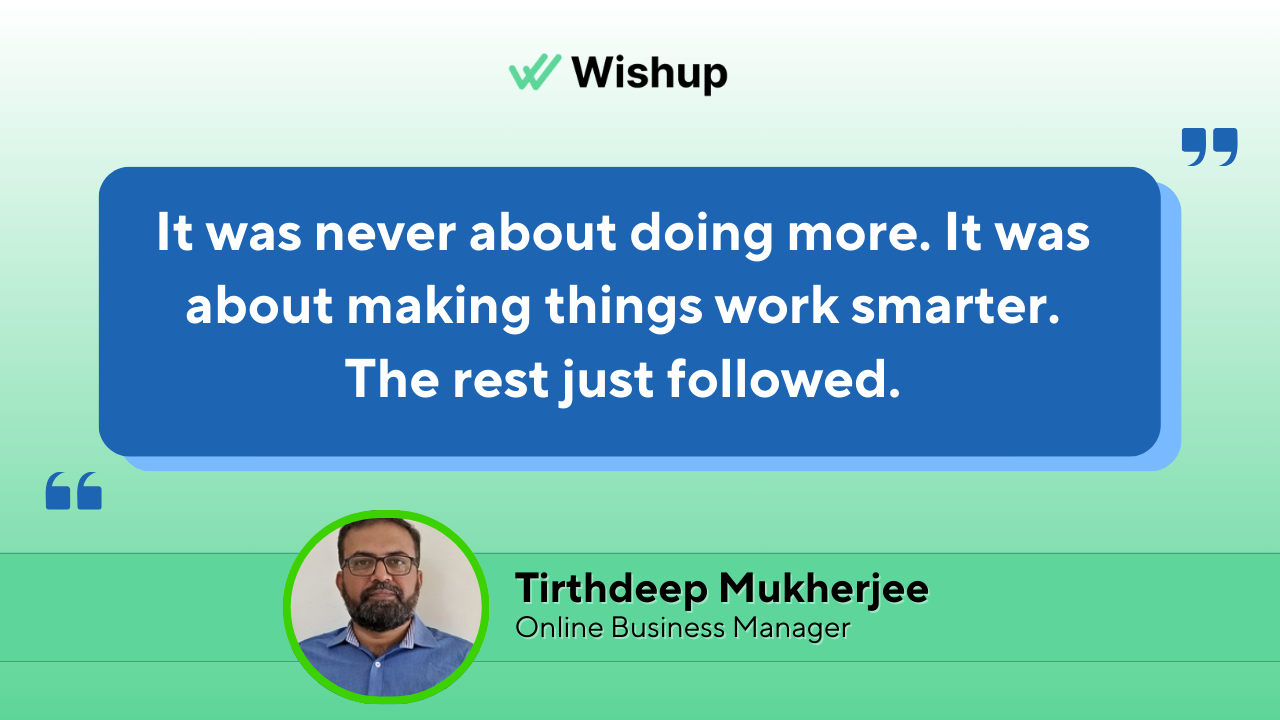
The Wishup Impact - In Client’s Words:
“When Tirthdeep first started working with me and my team, he was brought on to support some of my administrative tasks like managing my inbox, handling my calendar, coordinating events, and so on. He did all of that extremely well.
As time went on, I began to discover more and more of his skills and strengths. I was learning about the range of capabilities he brought to the table, which allowed him to take on responsibilities far beyond the initial admin work.
Now, I truly consider him my right hand. He owns and manages several systems and administrative functions across our entire company (areas that I’m responsible for), and he supports me with all of them.
One thing I really appreciate about Tirthdeep is his willingness to take on new challenges. He dives right in, never complains, and is always happy to give something a try. No matter what the task is, he finds a way to make it work and get it done successfully.
Tirthdeep has made me significantly more effective in my role. He’s also helped our team and company operate more efficiently overall. His contributions are continuous and impactful, and honestly, he’s just pretty great.”
— John Tiso (JMT Consulting Group)
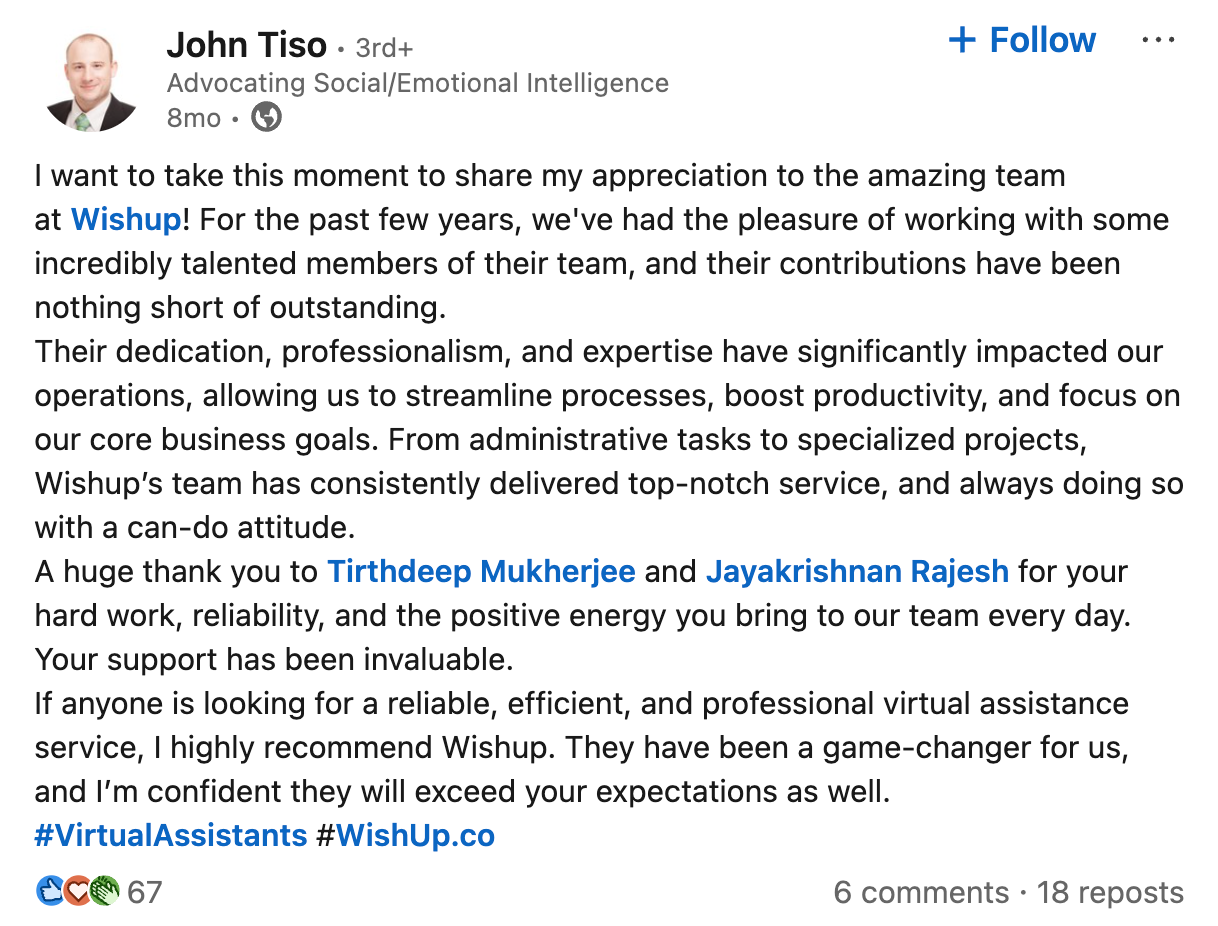
When a Salesforce-capable virtual assistant is the right hire for a finance, consulting, or professional services firm
This engagement generalizes well to a specific kind of firm and a specific kind of leader. It's likely a fit if:
- Your company uses Salesforce (or HubSpot, Pipedrive, Zoho) and the system has drifted from "source of truth" to "source of confusion."
- You're a Director, VP, or department head spending 5+ hours a week on CRM cleanup, reporting, or admin you shouldn't be doing personally.
- You can't yet justify a $100K+ full-time Salesforce administrator hire, but the cost of not fixing the CRM is showing up in slow reporting, missed follow-ups, or forecasts you don't trust.
- You want long-term ownership of the system, not a project-based consultancy fix that decays the moment the consultant rolls off.
- You need someone who can also handle executive admin (inbox, calendar, events), so the engagement covers two functions in one hire.
It's likely not the right fit if:
- You need a Salesforce architect to lead a major implementation or org migration. That's a different role and a VA is the wrong tool for it.
- You're running a complex multi-cloud setup with Service Cloud, Marketing Cloud, and CPQ all in play. You probably need a certified admin in addition to, not instead of, a VA.
- You have no internal capacity to supervise the work in the first 60 days. Even proactive VAs need context to set direction.
What Salesforce administration tasks can a virtual assistant actually handle for a finance firm
Based on this engagement and similar Wishup placements at mid-market finance and consulting firms, a trained VA can typically own:
- Data hygiene: Deduplication, standardization, field validation, and ongoing record maintenance.
- Page and layout configuration: Reorganizing fields, page layouts, and record types so the most-used data surfaces first.
- Workflow automation: Building and maintaining flows in Salesforce Flow Builder (and Process Builder for legacy setups) for follow-ups, handoffs, and status changes.
- Reporting and dashboards: Creating dynamic reports and real-time dashboards for sales, pipeline, client services, and leadership visibility.
- User management: Setting up new users, managing permission sets, and adjusting access as the team scales.
- Integration administration: Connecting Salesforce with adjacent tools (Outlook, Gmail, Slack, accounting platforms, marketing tools) and maintaining the integrations.
- Documentation and governance: Writing SOPs for CRM use so the cleanup doesn't regress when team members onboard or roles change.
Hire a Virtual Assistant from Wishup in Just 60 Minutes

Frequently asked questions
Can a virtual assistant actually administer Salesforce for a finance or consulting firm?
Yes, for the day-to-day administration that most mid-market finance firms need: data cleanup, page layout adjustments, workflow automation in Flow Builder, dashboard and report creation, user management, and tool integrations. Complex declarative development or Apex coding sits outside the typical VA scope and would need a certified Salesforce developer.
How long does it take for a VA to fully take over Salesforce administration?
Based on the JMT Consulting engagement, expect roughly 3 months to stabilize executive admin and audit the CRM, 6 to 9 months to complete data cleanup and standardization, and 12 to 18 months to build out automation and reporting in a way that compounds. Full strategic ownership at the steering committee level tends to emerge in year 2.
How much does it cost to hire a Wishup VA for Salesforce administration and executive support?
Wishup plans start at $1,299 per month for a dedicated virtual assistant. A full-time US-based Salesforce administrator costs $80,000 to $130,000 per year. The math gets stronger when one VA covers both CRM administration and executive admin, which at this size is realistically one role rather than two.
What if our VA doesn't have Salesforce experience on day one?
Wishup VAs are trained on Salesforce, HubSpot, and 120+ other business tools, but the specific configuration of your Salesforce instance is something they learn during onboarding. The pattern in this case study, where the VA started with executive admin and grew into Salesforce ownership over months, is more common than starting with full CRM expertise from day one.
How is a Salesforce-capable VA different from hiring a Salesforce consultant?
A consultant runs a project and leaves. A VA stays and owns the system over time, which means the cleanup, automation, and documentation don't regress after the engagement ends. Consultants are appropriate for major implementations or migrations. VAs are appropriate for ongoing administration, governance, and incremental improvements that compound over months and years.
Will a virtual assistant stay long enough for this kind of engagement to pay off?
Long-tenure engagements are the norm for system-owning VA roles. The JMT engagement is 2 years and ongoing. Wishup provides instant replacement and full knowledge transfer if a VA exits, so the system ownership stays with the engagement, not the individual person.
What size finance or consulting firm benefits most from this model?
The clearest fit is firms between $2M and $20M in revenue, with 10 to 75 employees, where Salesforce is in active use but no one owns it full-time. Above that size, a full-time Salesforce administrator usually becomes justifiable. Below it, a VA is often the only cost-effective way to get the CRM working properly.
How Wishup places Salesforce-capable virtual assistants with finance and consulting firms
Wishup places pre-vetted virtual assistants with finance firms, consulting firms, and growing mid-market companies that need executive admin and CRM administration handled together. VAs are trained on Salesforce, HubSpot, and 120+ other business tools, sign NDAs before access to any client system, and onboard within 60 minutes of the matching call.
If your Salesforce CRM has become the bottleneck instead of the engine, and you're a leader doing work that should sit one or two levels below you, a Wishup VA is built for exactly this kind of engagement.

Neelesh Rangwani · Co-founder at Wishup
With 10+ years in the virtual assistant space, Neelesh has helped 1000+ US and global founders build efficient remote teams by matching them with top 0.1% virtual assistant talent. He writes about virtual assistants, hiring frameworks, remote productivity, and scaling ops.
More posts by Neelesh → · Connect on LinkedIn