
A medical virtual assistant for allergists is a remote, HIPAA-trained professional who handles the scheduling, insurance verification, EHR documentation, and prior authorization work of an allergy and immunology practice.
Hire a medical virtual assistant for allergists via Wishup, starting at $1,299 per month.

By the end of this blog, you will know:
- Who a medical virtual assistant for allergists and immunologists is and the difference they have from a general virtual assistant.
- The responsibilities of allergy virtual assistants
- The benefits of a medical virtual assistant for allergists
- Tasks you can delegate to them
- And why Wishup can be your service provider for allergist virtual assistants at just $1,299.
Who Is A Medical Virtual Assistant for Allergists and Immunologists?
A medical virtual assistant for allergists and immunologists is a remote professional who manages the administrative and patient-coordination aspects of an allergy practice, with a working knowledge of allergy- and immunology-specific care: skin testing, immunotherapy scheduling, biologic prior authorization, and chronic condition management for asthma, food allergies, and chronic urticaria.
The role differs from a general virtual assistant in how it handles recurring, authorization-heavy treatment cycles. A general virtual assistant books an appointment. An allergy virtual assistant schedules a weekly immunotherapy injection series, tracks the biologic PA renewal date before coverage lapses, and follows up on a skin test result before the next consultation.
General Virtual Assistant vs. Allergy Virtual Assistant: Capability Comparison
Wishup matches this specialty depth across its full range of medical virtual assistant services. For a closer look at how prior authorization and chronic-care coordination plays out elsewhere in respiratory-adjacent care, see how Wishup virtual assistants support pulmonology practices with comparable biologic PA and chronic disease documentation work.
Case Studies of Wishup Healthcare Virtual Assistants


Benefits of Hiring an Allergist Virtual Assistant
An allergist virtual assistant delivers five benefits: fuller immunotherapy schedules, faster biologic prior authorizations, fewer missed allergy-shot appointments, lower admin cost than an in-house hire, and more clinician time for patients.
- Fuller immunotherapy schedules: the virtual assistant books and confirms recurring allergy-shot visits and backfills cancellations, so the shot schedule stays dense and revenue steady.
- Faster biologic prior authorization: the virtual assistant chases payer approvals for biologics like omalizumab and dupilumab, so severe-asthma and chronic-urticaria patients start treatment without delay.
- Fewer no-shows: reminders and real-time follow-up cut the missed allergy-shot and testing appointments that disrupt immunotherapy courses.
- Lower cost: from 1299 dollars a month, versus roughly 75,000 dollars a year for an in-house allergy admin before benefits.
- More clinician time: the allergist spends time on patients and testing, not on payer portals and the phone.
What Are the Responsibilities of Allergist Virtual Assistants?
An allergist virtual assistant carries responsibility across three areas: testing and treatment coordination, prior authorization and insurance management, and practice operations, each covering a distinct part of how an allergy practice runs day to day.
1. Testing and Treatment Coordination
The virtual assistant schedules skin testing, challenge testing, and recurring immunotherapy injection visits, tracks dosing schedules, and confirms patients are current on their treatment series.
2. Prior Authorization and Insurance Management
The virtual assistant submits and tracks PA requests for biologic medications and specialty treatments, monitors renewal dates before coverage lapses, and verifies insurance eligibility for testing and immunotherapy before each visit.
3. Practice Operations
The virtual assistant manages appointment scheduling and rescheduling, monitors the patient portal, processes prescription refills, organizes medical records, and maintains documentation compliance across the practice.
Knowing the scope of the role matters less than knowing why a practice would delegate it in the first place. That comes down to what prior authorization and administrative load are actually costing allergists right now.
What Tasks Can You Delegate to the Virtual Assistant for Allergy & Immunology?
An allergy and immunology virtual assistant handles administrative, operational, and patient-coordination tasks, from immunotherapy scheduling to prior authorization, insurance verification, and EHR documentation, without taking on clinical decision-making.
- New patient intake and pre-visit documentation: The virtual assistant collects intake forms, allergy history, and referral records ahead of the first consultation, managed in Epic, Athena, or AdvancedMD, depending on the practice's EHR.
- Appointment scheduling and confirmation: The virtual assistant books and confirms consultations, testing appointments, and follow-ups, sends reminders, and handles rescheduling to reduce no-shows.
- Immunotherapy injection scheduling: The virtual assistant manages the recurring visit cadence for immunotherapy injections, tracks dosing schedules, and confirms patients stay current on their treatment series.
- Skin and challenge testing coordination: The virtual assistant schedules skin prick tests, intradermal testing, and oral food or drug challenges, and ensures results are attached to the chart before the next visit.
- Biologic prior authorization management: The virtual assistant submits and tracks PA requests for biologic medications used in severe asthma and chronic urticaria, and monitors renewal dates before coverage lapses.
- Insurance eligibility verification: Before each appointment, the virtual assistant verifies coverage for testing, immunotherapy, and biologic treatment, flagging out-of-pocket costs upfront.
- EHR documentation and chart updates: The virtual assistant keeps testing results, immunotherapy dosing logs, and treatment plan notes current in the EHR between visits.
- Prescription refill coordination: The virtual assistant processes refill requests for maintenance medications, routing anything requiring provider review and handling standard refills directly.
- Medical billing and claims coordination: The virtual assistant logs allergy-specific CPT and ICD-10 codes, submits claims, tracks denials tied to testing and immunotherapy, and follows up on unpaid balances, typically through the practice's billing software or QuickBooks for smaller operations.
- Patient communication and phone coverage: The virtual assistant answers calls and portal messages about appointment logistics, testing prep, and medication timing, using tools like RingCentral for call handling.
- Telehealth visit coordination: For virtual follow-ups, the virtual assistant sends secure video links ahead of time and confirms the patient is ready to connect before the appointment starts.
Automation Workflows Our Healthcare Virtual Assistants Have Built
Wishup virtual assistants don't just work inside your tools, they automate the repetitive parts. Two examples from live healthcare deployments:
Healthcare · Customer Support & Admin
The headache it removed: Staff retyped the same details from a spreadsheet into a document by hand, then created a folder, found the order, renamed it, and filed it, every single time.
Built with: Excel · VBA · Python
Healthcare · Operations
The headache it removed: Staff built the same five folders by hand for every new patient, over and over. Nothing gets forgotten or misnamed now.
Built with: Google Apps Script · Google Drive

Tasks only run smoothly with the right person behind them. The next section covers where to find a virtual assistant who already understands allergy and immunology-specific workflows, instead of one who needs months to get there.\
Hire an Immunology and Allergy Virtual Assistant from Wishup
Wishup is where allergy and immunology practices go to hire a virtual assistant who already understands immunotherapy scheduling, biologic prior authorization, and chronic condition documentation, without the practice absorbing months of training cost.
- Experienced professionals: Every Wishup virtual assistant has a minimum of 3 years of professional experience, selected from the top 0.1% of applicants through a 6-step hiring process.
- HIPAA-compliant: All medical virtual assistants complete HIPAA training specific to healthcare practice workflows before deployment.
- Fast turnaround: Virtual assistants respond within 5 minutes during working hours, and a dedicated client success manager responds within 60 minutes.
- 36-month average retention rate: Wishup's virtual assistant stay with clients significantly longer than the industry norm for outsourced admin support.
- Direct interviews: Practices interview virtual assistants directly at no cost, with a 90%+ interview success rate among shortlisted candidates.
- A dedicated team, not a single hire: Every engagement includes a virtual assistant, a virtual assistant manager, and a customer success manager, at the price of one hire.
- $1,000 welcome offer: New clients get $500 worth of productivity tools and $500 worth of bookkeeping services free.
- Free virtual assistant management app: Clients track productivity and task completion through Wishup's built-in workforce management platform at no added cost.
- Trusted at scale: Wishup supported 1,200+ founders in 2026, with 1,500+ virtual assistants managing 5,000+ tasks monthly.
- Tool expertise: Virtual assistants train on 200+ AI tools and 70+ no-code tools across an intensive 8-week program.
- Zero risk: No cancellation fees, no interview fees, and no 30-day notice requirement to end an engagement.
- Proven reliability: 98.8% client satisfaction, with a 4.7 rating on Trustpilot and a perfect 5 on Clutch.
- Fastest onboarding: Practices match with a pre-vetted virtual assistant in 60 minutes through a 3-step process.
For a side-by-side look at how Wishup compares to other providers on exactly these criteria, see the full breakdown of the best medical virtual assistant companies, which covers vetting depth, HIPAA compliance, and pricing across the market.
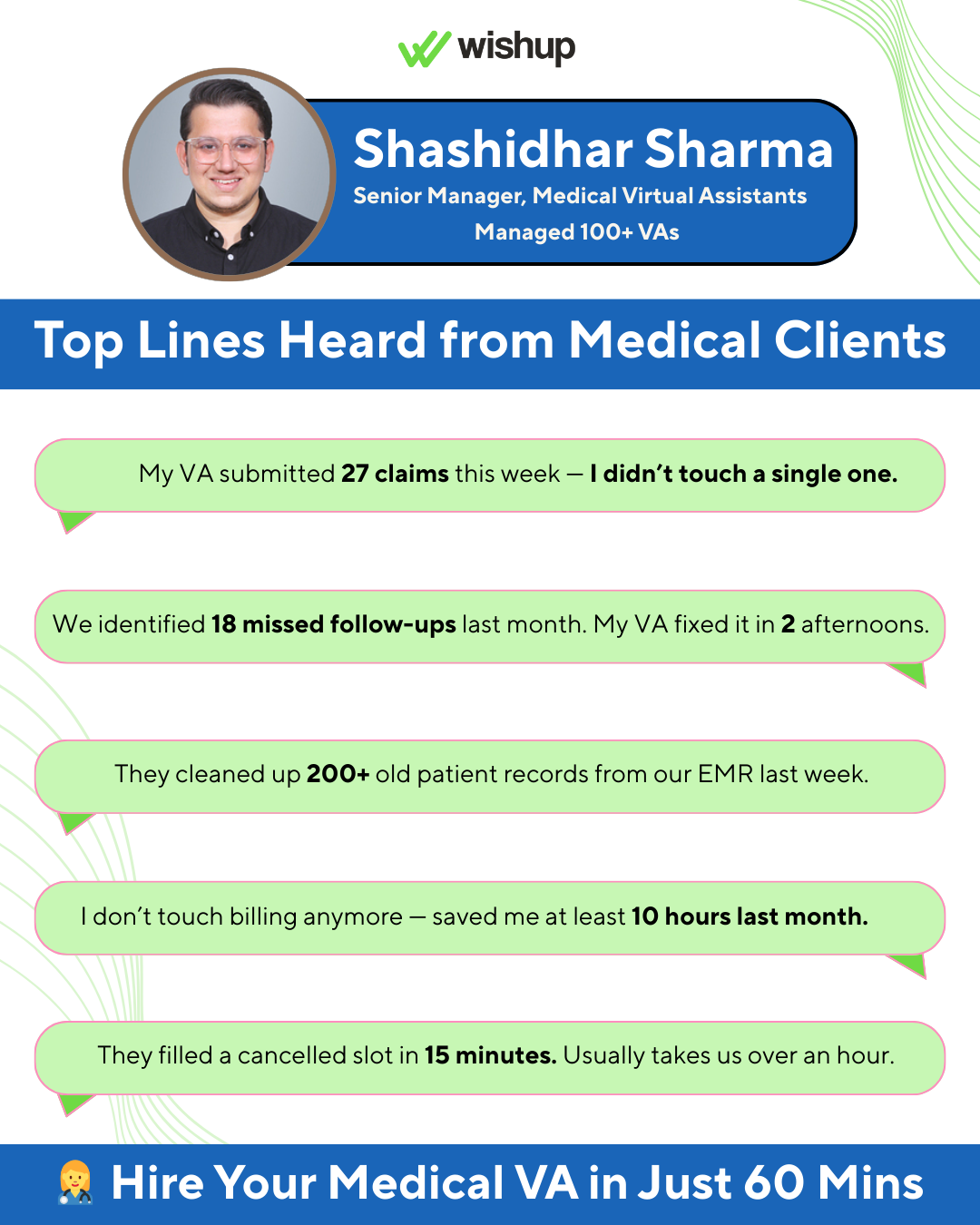
Trust and vetting answer the "who is doing this work" question. The next question most practices ask is what it costs.
How Much Does a Virtual Assistant for Allergy and Immunology Cost?
A Wishup medical virtual assistant for allergists starts at $1,299 per month, compared to $75,060 per year for an in-house medical admin hire once salary, benefits, payroll taxes, and office overhead are factored in.
A full-time Wishup allergy virtual assistant saves a practice roughly $51,000 a year against an in-house hire, a 68% cost reduction, with no benefits, payroll tax, office space, or recruitment cost added on.

Wrapping Up
Immunotherapy scheduling, biologic prior authorization, and chronic condition documentation take up hours an allergy practice can't get back once they're gone. A specialty-trained virtual assistant closes those gaps without the cost or ramp-up time of an in-house hire.
Delegate Your Allergy Practice in Just 60 Minutes
Get a HIPAA-trained Allergy VA from $1,299/month. Save $100 on your first month.
Book a Free Consultation →Frequently Asked Questions on Allergy and Immunology Virtual Assistants
What does a medical assistant do in an allergy clinic?
A medical assistant in an allergy clinic performs clinical intake support like recording vitals, assisting with skin testing, and preparing patients for immunotherapy injections. Administrative work, scheduling, prior authorization, insurance verification, and billing, is handled separately by a virtual assistant, who does not perform clinical duties.
How much does a virtual assistant for allergy and immunology cost?
A Wishup virtual assistant for allergy and immunology starts at $1,299 per month for 80 hours, or $1,999 per month for a full-time, 160-hour engagement. Both plans include HIPAA training, a dedicated virtual assistant manager, and a customer success manager at no added cost.
Is an allergy virtual assistant the same as a medical scribe?
No. A medical scribe documents clinical encounters in real time during patient visits. An allergy virtual assistant handles the administrative and coordination work around those visits: scheduling, prior authorization, testing coordination, and billing. Some practices use both.
Can a virtual assistant handle immunotherapy and allergy shot scheduling?
Yes. A trained allergy virtual assistant manages the recurring visit cadence immunotherapy requires, tracks dosing schedules, and confirms patients stay current on their treatment series, administrative coordination, not clinical dosing decisions.
Does a virtual assistant manage prior authorization for allergy testing and biologics?
Yes. An allergy virtual assistant submits and tracks PA requests for skin testing, challenge testing, and biologic medications used in severe asthma and chronic urticaria, and monitors renewal dates so coverage doesn't lapse mid-treatment.
How do virtual assistants handle sensitive patient information in an allergy practice?
Wishup's virtual assistant sign NDAs, complete HIPAA training before deployment, and work within secure, monitored access systems set up during onboarding, the same standard applied across every medical specialty Wishup supports.
Who handles patient communication for an allergy practice, software or a virtual assistant?
Patient communication software manages reminders and portals, but a virtual assistant for allergists runs the communication itself: sending reminders, following up on allergy-shot schedules, answering portal and phone messages, and chasing no-shows, inside the practice's existing systems.
For most allergy practices, a trained virtual assistant from $1299 a month covers both the software and the human follow-up it cannot do on its own.
