
One of our clients in the healthcare industry, a medical practice in the US, had a Google rating of 3.0. Today it is 4.5. It was Wishup’s healthcare reputation management virtual assistant who put 2 and 2 together to deduce that it was operational matters that would increase the reputation of the clinic.
The rating went up because the practice fixed the reason patients were unhappy in the first place: hardly anyone was answering the phone.
So, if you hire a pre-vetted healthcare reputation management virtual assistant from Wishup and start fixing the causes behind your reviews, not just the reviews themselves, you might see the change.

This guide covers:
- What healthcare reputation management actually involves
- Why patients leave negative reviews for medical practices
- How a practice raises its Google rating, step by step
- How to handle a negative review so the same complaint stops recurring
- Which review platforms and directories a practice needs to manage
- What a healthcare reputation management virtual assistant does day to day
- The tools involved, and where AI genuinely helps
- What the role costs in 2026
What Is Healthcare Reputation Management?
Healthcare reputation management involves monitoring and improving how a medical practice appears to patients across review sites, booking platforms, directories, and search results.
Operationally, covers four things:
- keeping your listings accurate,
- encouraging satisfied patients to leave reviews,
- responding to the reviews that arrive, and
- fixing the operational problems that cause negative reviews in the first place.
Most practices do the first three. The fourth is the one that usually gets skipped, and it is normally what keeps a rating stuck.
So who is a virtual assistant for healthcare reputation management?
A virtual assistant for healthcare reputation management is a trained professional who works remotely and monitors, manages, and responds to public reviews, feedback, and online directory listings for medical practices, and healthcare providers.
They also analyse and look after operational tasks to ensure that nothing leads to patients leaving a negative review.
Why Do Patients Leave Negative Reviews for Medical Practices?
Patients rarely leave a bad review about clinical care. They leave it because of badly managed operations; for example, an unanswered call, unresponsiveness online, a badly managed GMB that could delay reaching out, etc could lead to patients leaving negative reviews for your medical practices.
On the practice account behind this guide, four causes sat behind the 3.0 rating. They are:
- Unresponsiveness: Nobody was answering the phone. This was the single biggest driver. Patients called, could not reach anyone, and said so publicly.
- Lack of coordination: The team that worked virtually had no set-up coordination between them. Many tasks were unassigned and had no one with ownership.
- Lack of process: The back-office processes were not streamlined. Medical records requests and prior authorizations moved slowly, which left patients waiting without knowing where their request had gotten to.
- Inconsistency: What a patient read on one platform did not always match what staff told them on the phone, and that gap cost trust.
How Does a Practice Raise Its Google Rating?
The best way to do this is by going back to the root of the issue itself. If the operational problems are fixed, then the complaints themselves will be taken care of. Asking a frustrated patient for a review only produces more of what you already have.
Here is the order the work ran in on this account.
1. Read what the reviews actually say and get the gist.
2. Measure before fixing anything. For our client, the practice moved to a new phone platform specifically so it could see who was picking up calls and who was not. Without that reporting, there was no way to prove the problem or track whether it improved.
3. Fix the phones. When the work started, the call answer rate was under 20%. It now consistently stays in the 80s, reaching 85 to 86, and has touched 90, across roughly 800 calls a week.
4. Give every task a named owner. The assistant met each team member individually to understand their workload, strengths, and weaknesses, then rebuilt the task list so work was delegated to the person best suited to it. The reported result was an improvement of more than 70% in how efficiently the team functioned.
5. Confirm appointments faster. Bookings coming through the practice’s booking platform used to take two to three days to confirm, and some expired before anyone got to them. That is now under an hour.
6. Make the listings agree with each other, so patients get one answer wherever they look.
7. Then ask for reviews, and reply to the ones that arrive.
This is the whole process that moved the rating from 3.0 to 4.5, and complaints about staff being unreachable or rude also stopped appearing.
Case Studies of Wishup Healthcare Virtual Assistants


How Should a Practice Handle Negative Reviews?
A negative review needs two responses, not one. There is the public reply, which protects how the practice looks to the next patient reading it. Then there is the fix behind it, which stops the same complaint from arriving again next month. Most practices only do the first.
Here is the approach used on this account.
Work out why the review was left
Before anything gets written, the assistant looks at what actually happened. Was the call never returned? Did the appointment get moved twice? Did a records request sit untouched? The review tells you the symptom, and the system tells you the cause.
Reach out to the patient directly
The aim is to resolve the thing they were unhappy about, not to argue about the rating. Many patients will update or soften a review once someone has actually dealt with the problem.
Fix the broken part of the process
This is the step that changes the rating over time. If three patients complained that nobody called them back, replying politely to all three solves nothing. Finding out why callbacks were not happening does.
Keep the public reply within privacy rules
A public response must never confirm that the reviewer was a patient, and no patient information belongs in a reply, even to correct something factually wrong. Anything that needs detail moves to a private channel.
Learn how to automate the review requests after a successful visit.
Why is this work for a virtual assistant rather than the practice manager?
Replying to a review takes five minutes. However, tracing back to the root cause of the issue and fixing it with deliberation and ownership takes consistency and time. A practice manager is handling a full clinic, so that might hinder the process.
However, a healthcare reputation management virtual assistant is specialised in operational as well as marketing-based tasks. It will prove to be effective because it is the same person who usually also sits across patient communication and intake; they can see both the review and the process that produced it.
What Does a Healthcare Reputation Management Virtual Assistant Do?
When you hire a healthcare reputation management virtual assistant, operationally they will handle four areas: the practice’s search presence, review monitoring and response, the operational coordination behind patient experience, and patient communication flows.
1. Search presence and listings
In this category, the virtual assistant for healthcare reputation management will:
- Maintain the practice website and keep service information current
- Run on-page SEO work for practice pages
- Manage the practice’s AI SEO service account and supply it with the practice data it needs
- Keep details consistent across Google Business Profile, booking platforms, and medical directories
2. Review monitoring and response
This category includes a healthcare reputation management virtual assistant to:
- Monitor Google Business Profile, the booking platform, and the patient messaging platform for new reviews
- Investigate why a negative review was left before drafting a reply
- Contact the patient to resolve the underlying issue
- Pass the cause back to whoever owns that process so it gets fixed
3. Operational coordination
The virtual assistant will work on:
- Mapping tasks to team members based on what each person is actually good at, and keeping ownership clear
- Keeping back-office requests such as records and prior authorizations moving so patients are not left waiting
- Treating call answer rate as a reputation metric, not just a service one
4. Patient communication
In the category of communications, the virtual assistant for healthcare reputation management handles:
- Running appointment booking and reminder flows through the practice’s patient messaging platform
- Confirming appointments by phone on top of automated reminders, because patients routinely ignore texts and emails
Apart from these, the major marketing tasks our healthcare virtual assistant can do for you to substantiate the reputation include:
- Review request outreach: It involves asking patients for a review while the visit is still fresh, usually by text or email a day or two afterwards.
- Review response management: It includes replying to positive, neutral and negative reviews within a set window, with negative replies drafted for practice approval before anything goes live.
- Google Business Profile management: It means keeping hours, locations, services, photos and the Q&A section accurate, and publishing practice updates as posts.
- Multi-platform monitoring: This entails checking Google, Healthgrades, Yelp, ZocDoc, Vitals, RateMDs, WebMD and Facebook for new reviews rather than only watching Google.
- Negative review escalation: The virtual assistant flagging anything serious to the practice the same day, so a problem review does not sit unseen over a weekend.
- Brand mention monitoring: The virtual assistant tracking what is said about the practice outside review sites, including social comments, local directories and community groups.
- Review reporting: The virtual assistant prepares monthly reporting on average rating, review volume, response times, sentiment and which complaints keep repeating.
- Provider profile upkeep: The VA can update bios, credentials and specialties across directories whenever staff join, leave or change roles
- Listing consistency checks: The virtual assistant maintains making sure hours, phone numbers and services match everywhere a patient might look
- Social media management: The virtual assistant for healthcare reputation management keeps the practice’s social presence active, since a dormant page undermines an otherwise good rating.
- Content and SEO support: The VA sets publishing patient-facing content and running on-page SEO so the practice ranks for the care it provides. The wider set of work here is covered in content marketing tasks you can delegate to a virtual assistant
Which Tools Are Used for Healthcare Reputation Management?
The following are the tools that our VAs have used in the practice:
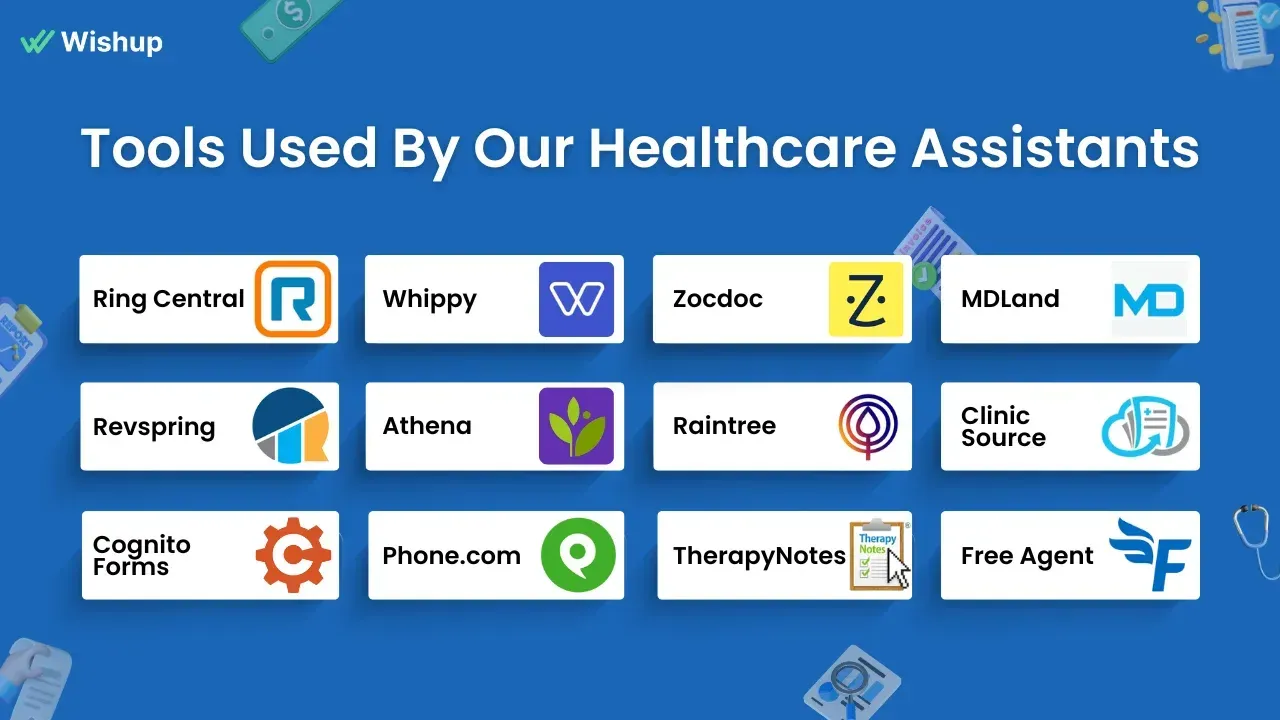
- Google Business Profile: The assistant keeps the listing accurate, publishes updates, and monitors incoming reviews here first.
- ZocDoc: Booking and reviews sit in the same place, so a rating here affects appointment volume directly.
- NexHealth: This handles patient messaging, appointment booking and automated reminders. Registration forms and privacy forms also go out through it once a booking is made. It is used because it meets healthcare privacy requirements, which ordinary messaging apps do not.
- SurferSEO: Used for on-page SEO work on practice and location pages, so patients searching for care in the area actually find the practice.
- ChatGPT: Used to research insurance questions quickly and to generate options for improving a process that keeps causing complaints.
- Gemini: Used to rewrite and tighten emails and text messages before they go out to patients.
Wishup’s virtual assistant uses AI for research and drafting. Deciding why a review happened, and deciding what to change in the practice, is still done by a person.
Automation Workflows Our Healthcare VAs Have Built
Wishup VAs don't just work inside your tools, they automate the repetitive parts. Two examples from live healthcare deployments:
Healthcare · Customer Support & Admin
The headache it removed: Staff retyped the same details from a spreadsheet into a document by hand, then created a folder, found the order, renamed it, and filed it, every single time.
Built with: Excel · VBA · Python
Healthcare · Operations
The headache it removed: Staff built the same five folders by hand for every new patient, over and over. Nothing gets forgotten or misnamed now.
Built with: Google Apps Script · Google Drive
How can a virtual assistant automate review requests after a successful visit?
The request is triggered from the practice’s patient messaging platform once a visit is marked complete.
The virtual assistant sets up the timing, writes the message, and adds a single follow-up for patients who do not respond the first time. The trigger does the sending.
The assistant decides who should be asked, keeps the wording natural rather than templated, and removes anyone who should not receive a request.
On the practice behind this guide, staff ask patients directly after a good interaction instead of running an automated sequence.
That works well at a single location. Automation becomes worth setting up once the practice is running enough daily visits that asking by hand stops being realistic.
If social content is the bigger gap, that work can also sit with a dedicated social media manager rather than being bundled into the reputation role.
How Much Does Healthcare Reputation Management Virtual Assistant Cost?
A healthcare reputation management virtual assistant from Wishup costs $1,299 to $2,999 per month, depending on the hours and tier you need. A full-time assistant works out to $23,988 a year. That price includes vetting, training, a dedicated account manager, and replacement cover. Here are the pricing details.
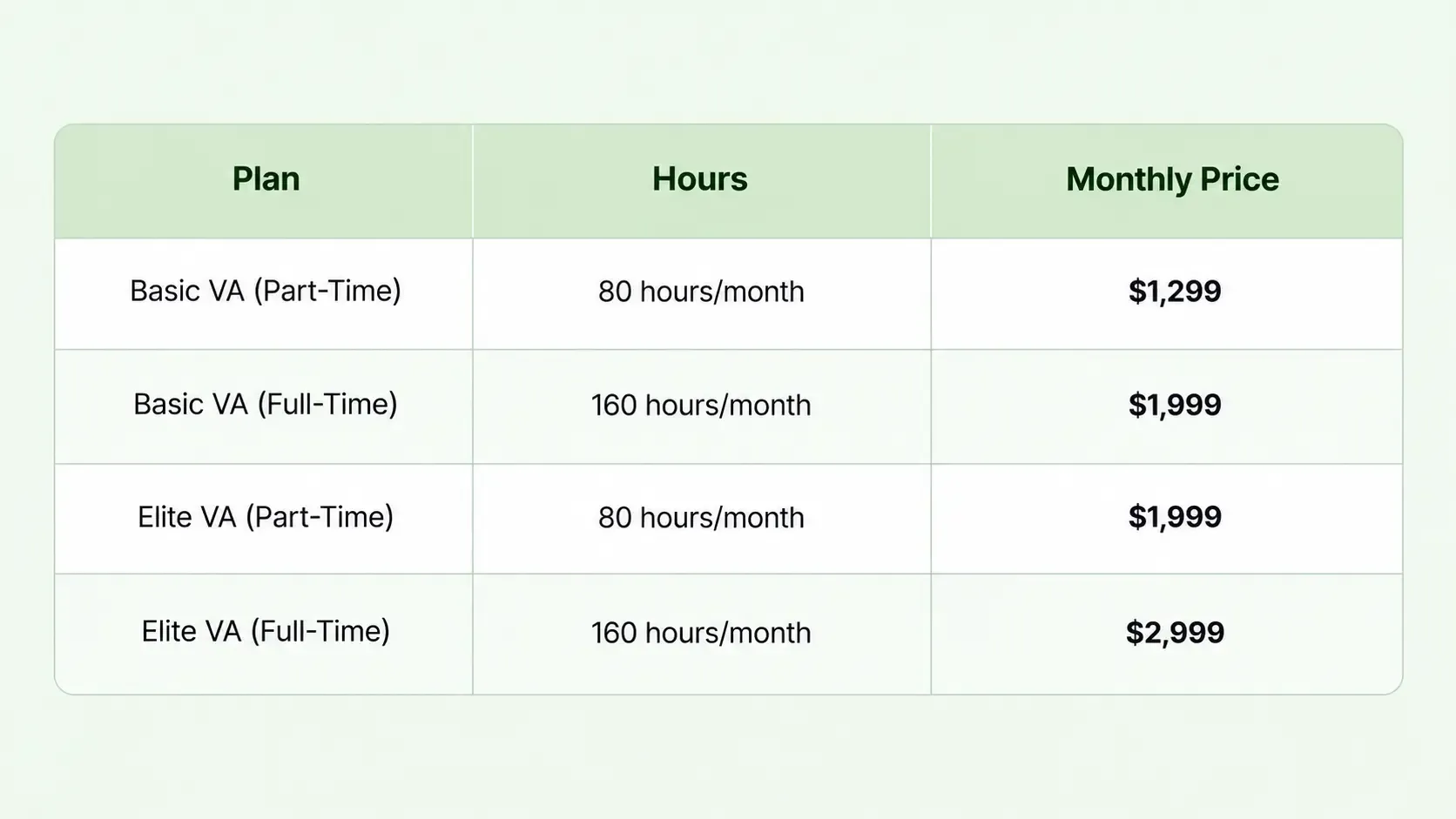
If you are still not convinced how it is a beneficial deal, let us share with you some levers against which the comparison will become crystal clear.
You can get a subscription to a reputation management software. It will monitor, review requests, and report. It will also share with you the data to point out that your rating dropped and which review caused it. However, it will not find out why the patient was unhappy, call them, or fix the process that produced the complaint. Only a human can do it. This brings me to my next point.
You can hire someone from offshore staffing providers for the reputation management work at around $8 an hour, but that would leave so many aspects open for you. The option is definitely cheaper until you account for vetting, training, healthcare-specific knowledge, and what happens when the person leaves six months in. This type of issue with accountability brings me to the third lever of comparison.
It is an in-house hire. Usually, for this matter, you will be hiring a practice marketing coordinator or a patient experience coordinator. A US-based role at that level costs $42,641/year in salary alone, before benefits, payroll taxes, and recruitment costs.
Doesn’t a full-time virtual assistant costing $23,988 a year from Wishup, who will be vetted, trained, and have experience in the healthcare industry, sound good and reasonable?

Why Hire a Healthcare Reputation Management Virtual Assistant From Wishup?
Wishup places pre-vetted virtual assistants who are trained for healthcare operations. Every assistant clears a six-step selection process, and only the top 0.1% of applicants are placed.
They arrive already trained on 120+ tools, which means they can work inside your booking platform, patient messaging system, and listings from the first week rather than spending a month learning them. When you hire them, you get:
- No multi-week hiring process because you can sort it out with a 60-minute onboarding.
- One assistant across reputation and operations. This review handling and the intake problems behind the reviews get managed by the same person
- A dedicated account manager who monitors quality and handles anything that needs escalating
- An instant replacement guarantee, with a trained backup available the same day if your assistant is unavailable
- Free business tools worth $500
- An NDA covering patient records, review data, and practice information
- Annual HIPAA training for every assistant working on a healthcare account.
Hire a healthcare reputation management virtual assistant from Wishup and get matched with a trained assistant in under 60 minutes.

Wrapping Up
While you may think that a low rating is a review problem, the issue goes deeper and can only be found if one is diligent enough to have an eye for it. That is why asking for more reviews and replying faster tends to produce so little.
The practice in this guide moved from 3.0 to 4.5 because the phones started getting answered, every task got a clear owner, and appointment confirmations stopped taking days, and all of it happened after hiring a healthcare reputation management virtual assistant.
FAQs on Healthcare Reputation Management Virtual Assistant
How long does it take to improve a practice’s Google rating?
Longer than most vendors suggest. A rating is an average, so it only moves once enough new reviews accumulate to shift it. On the account in this guide there was a rocky stretch after the new team came on before anything showed up in the rating at all. Expect to see operational metrics improve first and the rating follow later.
Which review platforms should a medical practice monitor?
Google Business Profile matters most, because it is what patients see first. Beyond that, monitor the booking platforms you use, since a rating there affects appointment volume directly, plus the medical directories patients check: Healthgrades, Vitals, RateMDs, WebMD, Yelp and Facebook. The goal is consistent information everywhere, not just a good score in one place.
Is responding to a patient review a HIPAA risk?
It can be if handled carelessly. A public reply must never confirm that the reviewer was a patient, and no patient information belongs in a response, even to correct something the reviewer got wrong. Anything requiring detail moves to a private channel instead.
How much does healthcare reputation management virtual assistant cost?
A Wishup healthcare reputation management virtual assistant costs $1,299 to $2,999 per month depending on hours and tier, or $23,988 a year for full-time support. That covers vetting, training, a dedicated account manager and replacement cover.
How is a reputation management virtual assistant different from reputation management software?
Software monitors, requests and reports. It is good at telling you what happened. An assistant does the part software cannot: contacting the unhappy patient, finding the breakdown that caused the review, and working with the practice to fix it. Most practices that have both find the software surfaces the problem and the assistant resolves it.
