
Only if four things are true at once: the VA is HIPAA-trained, works on secured systems with role-based access, is covered by an organizational-level Business Associate Agreement (not a personal one), and is overseen by a provider that assumes legal liability for PHI. Most VA providers deliver one or two of these. Wishup builds all four into every healthcare VA engagement.
The number of remote healthcare workers accessing patient records, insurance portals, and clinical documentation systems has grown sharply over the past few years. So has the number of HIPAA enforcement actions.
In 2024, OCR closed 22 investigations with civil monetary penalties or settlements, collecting nearly $12.8 million in fines, making it one of the busiest years for HIPAA enforcement on record.
For a solo physician practice, a group dental office, a mental health clinic, or any other U.S. healthcare provider, this shift means one thing: every person who touches Protected Health Information (PHI) on your behalf, whether in-house or remote, is a compliance responsibility. That includes your healthcare virtual assistant.
The problem is that the virtual assistant market has flooded with providers who use the phrase "HIPAA compliant" as a marketing label rather than a verifiable operational standard. This article cuts through that noise.
It explains what HIPAA compliance for a virtual assistant actually requires, what the real risks and penalties look like in 2025 and 2026, how to verify compliance before you hire, and why Wishup's HIPAA compliant virtual assistants are built differently from the ground up.
What HIPAA Compliance Means for U.S. Healthcare Providers
The Health Insurance Portability and Accountability Act of 1996 (HIPAA) sets federal standards for protecting sensitive patient health information.
Any healthcare provider, health plan, or healthcare clearinghouse that transmits health information electronically is a Covered Entity under HIPAA, and any vendor or partner that creates, receives, maintains, or transmits PHI on behalf of a Covered Entity is a Business Associate.
A virtual assistant who accesses patient scheduling systems, insurance portals, medical billing software, or electronic health records (EHR) is a Business Associate under this definition.
For a more thorough review of the Privacy Rule as published by the American Medical Association, visit the AMA's HIPAA Privacy Rule resource.
How Wishup Protects Patient Data
Through 6 Enterprise-Grade Security Layers
Built to protect PHI through monitored workflows, controlled access, encrypted systems, and contractual safeguards.
Real-Time and Activity Monitoring
We use time-tracking and computer security audits, including mouse and keyboard activity monitoring for transparency and accountability.
Physical, Electronic, and Procedural Safeguards
We use physical, electronic, and procedural safeguards to transmit and store information, including computer virus protection software and firewalls.
Strict Access Control by Role
Assistants only access the data required for their role, and that access is revoked when it is no longer needed.
Secure Password Management
Sensitive account information is stored in an encrypted password-management system, and clients can set and revoke access levels per application.
NDA-Based Confidentiality
Confidentiality is built into both client and VA contracts through NDAs, and the NDA can also be customized based on practice requirements.
Device and Application Controls
Wishup enforces strict device verification, application controls, and encrypted communication across the engagement.
The Three Rules That Govern Every PHI Interaction
HIPAA compliance is not a single checkbox. It is built across three interconnected rules:
- The Privacy Rule establishes national standards for the protection of PHI. It defines what counts as PHI, who is permitted to access it, and the rights patients have over their own data. Any virtual assistant handling medical billing, patient intake forms, appointment records, or insurance information is operating under this rule.
- The Security Rule sets specific safeguards for electronic PHI (ePHI). It requires administrative safeguards (workforce training, access management, contingency plans), physical safeguards (workstation use, device controls), and technical safeguards (access controls, audit controls, encryption, automatic logoff).
- The Breach Notification Rule requires Covered Entities and Business Associates to notify affected individuals, HHS, and in some cases the media when a breach of unsecured PHI occurs. Failures to notify within required timeframes are themselves a separate HIPAA violation, which OCR has been actively enforcing since 2019.
When you hire a virtual assistant for healthcare support tasks, your practice remains liable for ensuring that the VA and the organization providing that VA comply with all three rules. This is not something that disappears when you outsource.
Why HIPAA Enforcement Has Never Been More Active
Healthcare professionals who think HIPAA fines are reserved for large hospital systems should review recent OCR enforcement data before hiring any remote staff member.
HIPAA Civil Penalty Tiers in 2026
Inflation-adjusted figures from HHS, effective from 2026 updates
Tier 1 — Unknowing Violation
$141 – $71,162
Annual cap: $35,581 per violation category
The Covered Entity was unaware and could not have realistically avoided the violation despite reasonable care.
Tier 2 — Reasonable Cause
$1,424 – $71,162
Annual cap: $107,622 per violation category
The organization knew about the risk but had a reasonable cause for not preventing the violation.
Tier 3 — Willful Neglect (Corrected)
$14,242 – $71,162
Annual cap: $358,726 per violation category
Willful neglect but the violation was corrected within the required timeframe.
Tier 4 — Willful Neglect (Uncorrected)
$71,162 – $71,162+
Annual cap: up to $2,134,831 per violation category
Willful neglect with no corrective action taken. This tier carries the highest financial exposure for practices.
The numbers behind recent enforcement actions reinforce how high the stakes are:
- In 2025, the average cost of a healthcare data breach in the United States reached $9.77 million per incident, the highest of any industry, according to IBM's Cost of a Data Breach Report
- 725 large breaches were reported in U.S. healthcare in 2024 alone, nearly two incidents every single day
- Montefiore Medical Center paid a $4.75 million settlement in 2024 after an employee stole patient data over a six-month period because the organization failed to implement audit controls
- A dental practice, Gums Dental Care, received a $70,000 civil monetary penalty in 2024 for failure to provide timely access to patient records, demonstrating that no practice size escapes scrutiny
- Over 93 million records were exposed through Business Associate breaches in recent years, compared to 34.9 million at providers directly, making third-party vendor management one of the central compliance risks in U.S. healthcare today
The Hidden Risk in Hiring a Freelance or General Virtual Assistant for Healthcare
When a healthcare professional hires a freelance virtual assistant from a marketplace or uses a general VA platform not designed for healthcare, several compliance gaps appear that most providers do not discover until it is too late.
The BAA gap.
A Business Associate Agreement must be signed between your practice and the organization providing the VA. If only the individual VA signs a BAA, your practice is not protected.
A single VA cannot assume organizational liability, enforce HIPAA safeguards, or guarantee ongoing compliance. Only the outsourcing provider can legally take on that responsibility. Many freelance VA arrangements leave practices exposed because there is no organization behind the individual VA that can actually be held accountable.
The training gap.
HIPAA training for a healthcare virtual assistant is not a one-time certificate course. It requires initial training on PHI handling policies, annual refreshers as regulations update, and role-specific training on the specific tasks the VA will perform. A general VA who completed a generic HIPAA training module three years ago and now has access to your EHR system does not meet this standard.
The technical safeguards gap.
The HIPAA Security Rule requires that any device accessing ePHI runs current security software, connects through a secure and approved network, and operates with role-based access controls that limit PHI exposure to what is strictly necessary for the VA's role.
A freelancer working from a personal laptop on a home Wi-Fi network that also runs personal applications does not meet this requirement, regardless of what their contract says.
The audit and oversight gap.
HIPAA requires Covered Entities to audit access to PHI. Your EHR should log all VA activity. If you cannot review who accessed what patient record and when, you cannot demonstrate compliance readiness to OCR in the event of an investigation. Most freelance VA arrangements have no mechanism for this level of audit control.
What Real HIPAA Compliance for a Virtual Assistant Looks Like
Hiring a truly HIPAA compliant virtual assistant for your healthcare practice means verifying six distinct elements, not just asking whether the provider uses the phrase "HIPAA compliant" in their marketing.
Signed Business Associate Agreement with the provider organization
Not with the individual VA. The BAA must cover organizational liability for any PHI the VA accesses on your behalf.
Current HIPAA training certification with documented completion date
Ask for the specific training curriculum used and the date of the last refresher. Requirements update regularly; documentation must reflect current standards.
Dedicated device with current security software and approved network access
No personal devices. No shared home networks or public Wi-Fi. Encrypted connections only. The VA's device should be provisioned and monitored by the provider.
Role-based access controls in your EHR limiting PHI exposure
The VA should only see the patient data required for their specific tasks. Unnecessary PHI exposure is a compliance violation even without a breach.
Audit logging of all VA activity in your EHR or practice management system
Your system should record what the VA accessed, when, and what changes were made. This is your evidence of compliance in any OCR review.
NDAs and strict data handling protocols enforced by the provider organization
The VA should operate under NDAs that specifically cover PHI. The provider should have documented data security policies that govern how VAs handle patient information.
What Are The Responsibilities of a HIPAA-Trained Virtual Assistant?
A HIPAA-trained virtual assistant is responsible for handling Protected Health Information only within approved systems, only to the extent their role requires, and only in ways that leave a reviewable record. Everything below follows from those three limits.
What the VA is responsible for
| Responsibility | What it means in practice |
|---|---|
| Identifying PHI correctly | Recognising that patient names, dates of birth, insurance IDs, appointment records and billing data are all PHI, including inside a scheduling note |
| Minimum necessary access | Working only inside the records their task requires, and not browsing beyond it, even when access technically allows it |
| Working on approved systems | Using the practice's EHR, practice management software and communication tools, never personal email, personal messaging apps or unsecured storage |
| Device and network discipline | A secured device with current security software, on a private encrypted connection, never public Wi-Fi |
| Leaving an audit trail | Working inside systems that log access, and not moving PHI into places that cannot be logged |
| Reporting suspected exposure immediately | Escalating a possible breach the moment it is suspected, not after investigating it themselves |
| Keeping training current | Annual refreshers as the rules update, plus role-specific training when their tasks change |
| Operating under an NDA that names PHI | A general confidentiality clause is not the same as one that specifically covers patient data |
What stays your responsibility
Delegating the work does not delegate the liability. Your practice remains responsible for granting role-scoped access rather than blanket access, for reviewing the audit log periodically rather than assuming it is fine, for holding a signed BAA with the provider organisation, and for the good-faith selection and oversight of that provider.
That last one is the part most practices miss. HIPAA does not ask whether your VA meant well. It asks whether you took reasonable care in choosing and supervising them, and whether you can show it.
How Wishup Builds HIPAA Compliance Into Every Layer of Its Healthcare VA Program
Wishup is a managed remote staffing platform serving 50+ industries, including healthcare, with a dedicated program for HIPAA compliant virtual assistant services.
The compliance architecture is not a single training module that VAs complete before starting. It runs through six distinct layers from hiring through ongoing oversight.
What Happens During Wishup's 60-Minute HIPAA Compliant VA Onboarding
Wishup's onboarding process for a HIPAA compliant virtual assistant covers 5 mandatory steps in 60 minutes before the VA is granted access to any PHI system.
Step 1 is system access provisioning
Login credentials for your EHR, practice management software, scheduling platform, and billing system are set up with role-scoped permissions that limit the VA to PHI relevant to their specific tasks.
Step 2 is device and network verification
The VA's device security configuration and network connection are confirmed as meeting HIPAA Security Rule requirements before any access is granted.
Step 3 is protocol handover
Your practice's specific workflows, communication standards, and PHI handling procedures are transferred to the VA in a structured briefing.
Step 4 is NDA and BAA documentation review
The VA reviews and confirms understanding of the NDA terms specific to your engagement and the BAA obligations that govern PHI handling.
Step 5 is team introduction
The VA is introduced to your practice team and the Customer Success Manager conducts an initial check-in to confirm that the setup meets your operational requirements.
HIPAA-compliant tools used during and after onboarding include your existing EHR platform, encrypted password management systems such as LastPass or 1Password for Business, HIPAA-compliant communication platforms, and the Wishup Workforce Management App for end-of-day reporting and audit trail documentation.
What a Wishup HIPAA Compliant Virtual Medical Assistant Handles for Your Practice
A Wishup virtual medical assistant manages the full administrative layer of your practice within HIPAA-compliant systems. The scope of support spans both patient-facing coordination and back-office operations.
All tasks are performed within your approved, HIPAA-compliant practice management software. Wishup VAs are trained across major EHR platforms including Epic, Athenahealth, eClinicalWorks, Kareo, and Nextech, as well as practice management tools used in dental, optometry, chiropractic, and mental health practices.
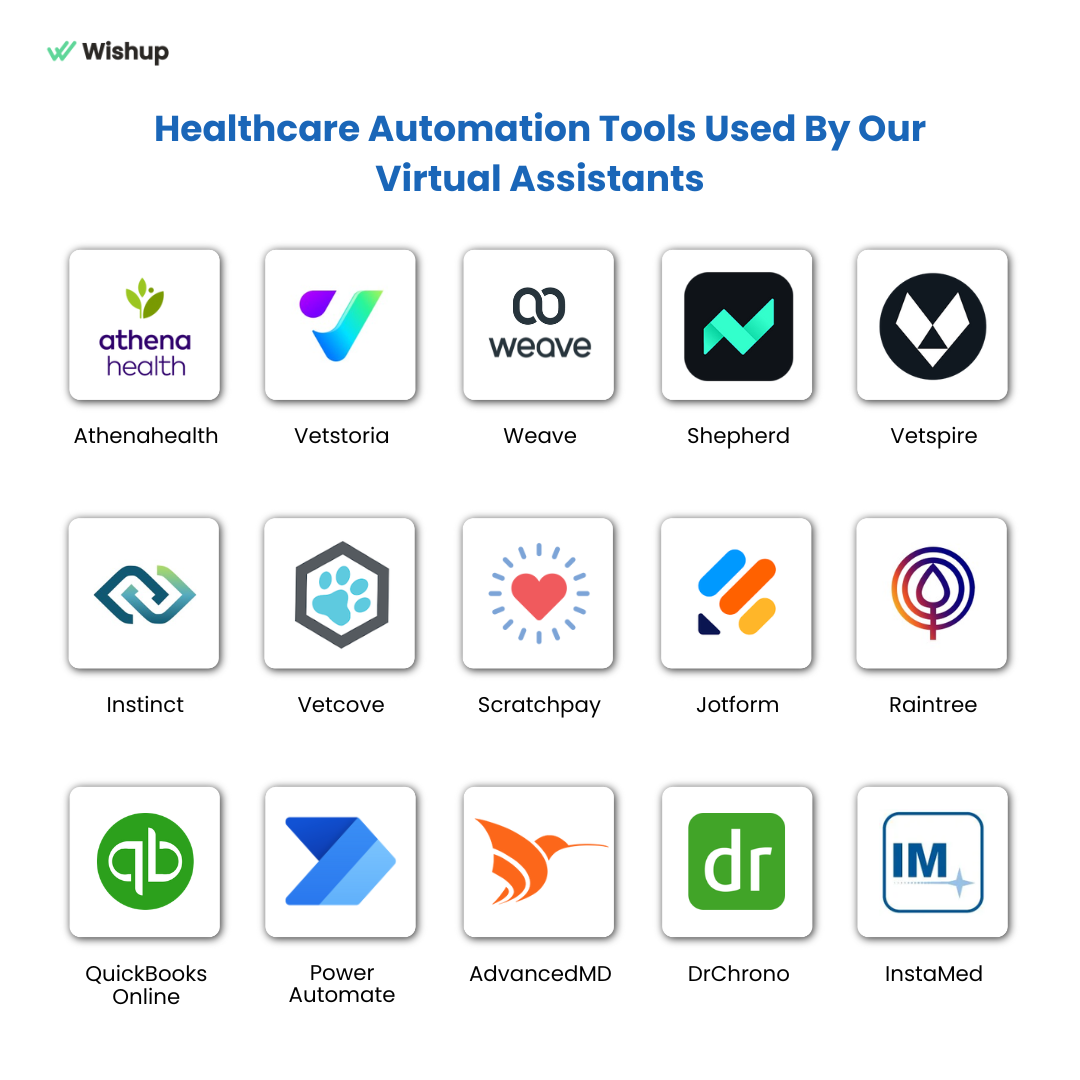

System-specific training is completed during the 60-minute onboarding session before any PHI access is granted.
How Can a HIPAA-Trained Medical Virtual Assistant Benefit Your Practice?
A HIPAA-trained medical virtual assistant benefits your practice in four measurable ways: lower staffing cost, reduced compliance exposure, reclaimed provider hours, and continuity that in-house hires cannot match.
Cut staffing cost by $26,000–$40,000 a year.
A full-time in-house medical admin costs $50,700–$64,497 with overhead. A full-time Wishup VA costs $23,988, with more compliance coverage, not less.
Reduce compliance exposure.
Business Associate breaches have exposed more than twice the records of provider-side breaches. A managed VA with org-level BAA, trained staff, and audit logging closes the vendor-risk gap that unmanaged freelancers create.
Reclaim provider hours.
Scheduling, intake, insurance verification, and billing follow-up move off your team's plate, so clinical staff stay with patients instead of paperwork.
Get continuity no single hire can offer.
Backup coverage during leave and quick replacement mean your billing and scheduling never stop, and the replacement is HIPAA-onboarded before touching your systems.
Start in 60 minutes, versus 6–12 weeks to recruit in-house plus 30–60 days of ramp-up.
HIPAA Compliant Virtual Assistant vs. In-House Staff vs. Freelancer: The Real Cost Comparison
Healthcare professionals often ask whether a HIPAA compliant virtual assistant is worth the cost compared to keeping staff in-house or using a freelancer. The answer requires looking at the full picture, not just hourly rates.
| Hiring Option | Annual Cost | HIPAA BAA | Vetting Level | Replacement Coverage | Oversight Included |
|---|---|---|---|---|---|
|
In-House
Medical Admin Assistant |
$39,000 – $49,613/yr salary
+ ~30% overhead
(benefits, taxes, equipment, space) = $50,700 – $64,497
total/yr |
✗ Not applicable | Your own process |
✗ No backup | ✗ You manage directly |
|
Freelance
High Risk
Healthcare VA |
$8 – $18/hr offshore
$24 – $35/hr US-based
No benefits overhead
but no org-level BAA |
✗ No org- level BAA |
Self- reported only |
✗ No replacement | ✗ None included |
|
US-Based VA
Agency (healthcare) |
$20 – $35/hr
$3,200 –
$5,600/mo full- time |
✓ Usually provided | Varies by agency |
Varies | Varies |
|
Wishup HIPAA
Best Value
Compliant VA |
Part-time:
$1,299/mo Full-time:
$1,999/mo No payroll taxes. No
benefits. No HR overhead. No recruitment cost. |
✓ Org-level BAA | Top 0.1%, 6-step vetting |
✓ 24-hr replacement, backup coverage |
✓ VA Manager + CSM included |
In-house salary data: Glassdoor ($49,613/yr avg), Indeed ($20.57/hr avg) as of 2025. Benefits/overhead estimate: 30% of base salary (BLS standard methodology).
A full-time Wishup HIPAA compliant virtual assistant with a dedicated VA manager, customer success manager, and replacement guarantee costs $23,988 per year. That is a saving of over $26,000 to $40,000 annually on a single hire, with better compliance coverage and zero recruitment time.
HIPAA Compliance Across Healthcare Specialties: Your Practice Type Matters
HIPAA compliance requirements do not change based on your specialty, but the specific workflows, PHI categories, and software systems involved do. A Wishup HIPAA compliant virtual assistant is matched to your specific practice type and trained on the systems and workflows your specialty uses.
Each specialty handles PHI differently. A virtual assistant for therapists must understand the heightened privacy requirements around behavioral health records under both HIPAA and state law.
Organizations like Prosperity BH also emphasize the importance of secure, compliant support systems for behavioral and mental healthcare providers. A virtual assistant for dentists needs to work within dental-specific billing systems and understand coordination of benefits for dual coverage patients.
A cardiology practice VA handles complex prior authorization workflows and high-volume EHR documentation under strict timelines.
A Wishup HIPAA compliant virtual assistant for home health manages the 5 highest-volume administrative functions in this setting: patient intake and care plan documentation, scheduling and coordination of home visits, insurance eligibility and prior authorization for home health services, physician order tracking and follow-up, and billing support within platforms such as Homecare Homebase, Alayacare, and MatrixCare.
Home care call management — coordinating caregiver scheduling, patient appointment reminders, and family communication — is one of the most time-intensive administrative burdens in the home care setting.
Wishup VAs handle inbound and outbound call coordination within your approved communication systems, creating a documented communication trail that supports both compliance and continuity of care.
Wishup's industry-based matching process accounts for these differences. Your VA is not a generic admin person who happens to have a HIPAA certificate. They are matched to your specialty, onboarded to your specific software, and trained on your protocols before they begin supporting your patients.
8 Questions to Ask Any HIPAA Compliant Virtual Assistant Provider Before Hiring
Healthcare professionals evaluating HIPAA compliant virtual assistant providers reduce compliance risk by verifying 8 specific criteria before granting any VA access to PHI.
- Does the provider sign a Business Associate Agreement at the organizational level, not just with the individual VA?
- What is the specific HIPAA training curriculum used, and when was the last refresher completed?
- Are VAs required to use dedicated, provider-issued devices, or do they work on personal equipment?
- What network security standards govern VA access — encrypted VPN, secured private connection, or unmanaged home Wi-Fi?
- How is role-based access controlled — can the provider demonstrate that the VA only accesses PHI required for their specific tasks?
- What audit logging capability exists — can you review a log of every PHI access event by date, time, and record?
- What is the provider's documented breach response process, and what is the notification timeline?
- What SLA governs replacement if the assigned VA is unavailable — and does the replacement receive the same HIPAA onboarding before accessing your systems?
Wishup provides documented answers to all 8 questions before engagement begins.
The organizational BAA, 8-week training documentation, device security protocols, access control procedures, audit logging framework, breach response process, and quick replacement SLA are all verifiable prior to onboarding.
How Does Wishup Compare to Other HIPAA Compliant Virtual Assistant Services?
The virtual assistant market for healthcare includes several established names. My Mountain Mover, MEDVA, ScribeRunner, HelpSquad, and others all offer services described as HIPAA compliant. Here is what separates Wishup from these providers:
Vetting standard
Most providers hire from the top 2% to 5% of applicants. Wishup hires from the top 0.1% through a 6-step in-person vetting process overseen by ex-entrepreneurs. The talent pool is fundamentally different in quality and reliability.
AI and automation capability
No other provider in this market trains every VA in 120+ AI tools including automation platforms like N8N, ChatGPT, Zoho, and RingCentral. This means your Wishup VA can build automated workflows that reduce manual errors and create compliance-safe documentation trails that most practices do not currently have.
Managed service depth
Most platforms give you a VA and an account manager. Wishup provides a VA, a dedicated VA Manager who reviews performance weekly, a Customer Success Manager who checks in monthly, fortnightly SOP adherence reviews, and a 30-day ROI report. This is a layer of oversight that directly reduces compliance risk.
Retention
The 36-month average VA retention rate at Wishup is substantially higher than what most competitors report. High turnover in healthcare VA roles creates recurring compliance training gaps. A VA who has been with your practice for two or three years knows your systems, your patients, and your protocols deeply. That consistency is a compliance asset, not just an operational convenience.
Pricing and contract structure
Wishup operates on monthly billing with no long-term contracts. You are not locked in. If you are comparing providers, also see how Wishup stacks up in detailed comparisons: Wishup vs. Hello Rache, Wishup vs. MEDVA, Wishup vs. My Mountain Mover.
To see how Wishup stands on top compared to other MVA providers, read our detailed coverage on "Top 5 Medical Virtual Assistant Companies in 2026"

Healthcare AI Assistants and HIPAA: What You Need to Know for 2026
The adoption of AI tools in healthcare administration is accelerating. AI scheduling tools, automated reminder systems, transcription platforms, and billing automation software all touch PHI in some form. HIPAA compliance for healthcare AI assistants follows the same rules as any other Business Associate, but with additional considerations that many practices have not yet addressed.
Any AI platform that receives, processes, or stores PHI requires a BAA. Using a general-purpose AI tool like an unmodified consumer chatbot to process patient communications, generate clinical notes from PHI, or assist with billing records without a BAA in place is a compliance violation regardless of whether a breach occurs. OCR began issuing guidance on AI and tracking technologies in 2022 and has continued enforcement activity in this area through 2025.
Frequently Asked Questions
Healthcare professionals ask these questions before deciding to hire a HIPAA compliant virtual assistant. The answers below reflect current regulatory standards and Wishup's specific service model.
What is a HIPAA compliant virtual assistant, and does my practice actually need one?
A HIPAA compliant virtual assistant is a trained remote professional who handles administrative tasks for your healthcare practice while operating within the legal and technical requirements of HIPAA.
This means they have received formal HIPAA training, work within secured, approved systems, operate under a Business Associate Agreement signed by their provider organization, and are subject to ongoing oversight that maintains compliance standards.
If your virtual assistant accesses patient names, dates of birth, insurance information, appointment records, billing data, or any clinical documentation, they are handling PHI and your practice legally requires them to be HIPAA compliant. There is no exemption based on task type or frequency. Even occasional access to a scheduling system that contains patient contact information qualifies as PHI handling under HIPAA.
What does a Business Associate Agreement (BAA) cover and is it enough on its own?
A BAA is a legally required contract between your practice and any Business Associate that will access, create, or receive PHI on your behalf. It defines each party's obligations under HIPAA and establishes that the Business Associate will follow the same Privacy Rule, Security Rule, and Breach Notification Rule requirements that you do.
A BAA is necessary but not sufficient on its own. It is a document that defines obligations. Actual compliance comes from training, technical safeguards, ongoing oversight, and audit controls being implemented in practice. A practice that has a BAA with a VA provider but has not verified that provider's security protocols, training curriculum, or device management standards still carries significant compliance risk. The BAA shifts some legal responsibility to the provider, but your practice remains liable for selecting and overseeing that provider in good faith.
Wishup provides an organizational-level BAA to every healthcare client. The BAA is paired with the security protocols, training standards, and oversight framework described in this article, not issued as a standalone document.
How much does a HIPAA compliant virtual assistant cost compared to in-house and freelance options?
In-house medical administrative assistants in the U.S. cost between $39,000 and $49,613 per year in base salary, according to Glassdoor and Indeed data from 2025. Adding standard employee overhead of approximately 30% (payroll taxes, benefits, equipment, office space) brings the true annual cost to between $50,700 and $64,497.
Freelance healthcare VAs typically charge $8 to $18 per hour for offshore providers and $24 to $35 per hour for U.S.-based specialists. These hourly rates may appear lower, but they carry no organizational BAA, no managed oversight, no replacement guarantee, and significant compliance risk. A single HIPAA violation from an unprotected freelance engagement could cost more than a year of managed VA service in fines alone.
Wishup HIPAA compliant virtual assistants are available at $1,299 per month for a part-time (20-hour/week) assistant and $1,999 per month for a full-time (40-hour/week) assistant. Both tiers include a VA Manager, a Customer Success Manager, the Workforce Management App, end-of-day reports, replacement guarantee, and the organizational-level BAA. Automation-enabled plans with AI workflow builds start at $1,999 per month for part-time and $2,999 for full-time
Can a virtual assistant access my EHR or practice management software remotely without creating a compliance risk?
Yes, with the correct safeguards in place. Remote EHR access through encrypted, HIPAA-compliant channels is not only permissible under HIPAA, it is how thousands of compliant healthcare organizations operate today, including hospitals, large group practices, and telehealth providers.
The key requirements are: access must be through an encrypted, HIPAA-compliant remote connection; the VA must operate on a secured, approved device with current security software; network access must be through a secure, private connection, never public Wi-Fi; role-based access controls must limit what patient data the VA can see to what their role actually requires; and all access must be logged in the system so you can review the audit trail.
Wishup VAs are provisioned with secure system access during the 60-minute onboarding process. Access credentials, device security, and network protocols are all set up in accordance with HIPAA Security Rule requirements before the VA begins any task that involves PHI.
What happens if my Wishup virtual assistant makes a HIPAA-related error?
Wishup's managed service model includes multiple safeguards that reduce the probability of error and provide a structured response path if an issue arises.
The weekly QA reviews by your VA Manager and fortnightly SOP adherence checks are specifically designed to catch procedural drift before it becomes a compliance incident. If a VA deviates from HIPAA-compliant protocols, these reviews identify and correct it quickly.
If a compliance issue does occur, Wishup's response framework includes immediate escalation to your Customer Success Manager, documentation review, and corrective action. Wishup also provides a replacement VA within 24 hours if a compliance issue warrants changing the assigned assistant. The organizational-level BAA defines Wishup's liability obligations in the event of a confirmed breach, consistent with HIPAA Business Associate requirements.
Is a Wishup virtual assistant better than an in-house hire for HIPAA compliance?
In-house staff are not inherently more HIPAA compliant than virtual assistants. A busy physical front desk environment carries its own risks: patient conversations can be overheard in waiting rooms, physical documents are handled in shared spaces, and personal devices are often used for work communications in ways that violate the Security Rule. In-house staff also receive HIPAA training only as frequently as your practice administers it, which for many small practices means once at hiring and rarely afterward.
A Wishup HIPAA compliant virtual assistant operates in a controlled, documented, and auditable remote environment with enterprise security protocols, annual refresher training built into the service, fortnightly SOP checks, and a dedicated manager reviewing performance. The compliance infrastructure is already built. You do not need to build and maintain it yourself as you would with an in-house hire.
There is a persistent myth that in-house staff are a safer choice. The data on where HIPAA breaches actually originate challenges this. In recent years, Business Associate breaches have exposed more than twice the patient records of provider-side breaches, primarily because vendor risk management is not as tightly controlled as internal policies. Wishup addresses this by building the compliance framework into the service rather than leaving it to individual practices to manage.
How quickly can I hire a HIPAA compliant virtual assistant from Wishup?
Wishup onboards your HIPAA compliant virtual assistant in 60 minutes. That is from agreement signing to an active, system-provisioned VA ready to work in your practice. This includes system access setup, protocol handover, and team introduction.
For context, recruiting an in-house medical administrative assistant in the U.S. typically takes 6 to 12 weeks from job posting to first day, with an additional 30 to 60 days of ramp-up time before the new hire is working independently. During this entire period, your practice is operating short-staffed or paying a temp worker at premium rates.
Wishup's matching process pairs you with a candidate from its pre-vetted healthcare VA pool based on your specialty, software, time zone, and task requirements. Unlimited same-day interviews are included at no additional cost. The first-match success rate is 90%, and the second-match rate is 100%.
Does Wishup provide HIPAA compliant virtual assistants for small practices and solo providers?
Yes. Wishup's model is designed specifically to serve businesses where the owner or primary provider should not be spending time on administrative and operational tasks. Solo physicians, solo dental practitioners, small mental health practices, individual chiropractors, and optometrists with one or two locations are among the most common Wishup healthcare clients. As Wishup's own positioning states: CEOs and healthcare providers should not be doing non-CEO and non-provider work.
The part-time option at $1,299 per month (20 hours per week) is particularly suited to smaller practices that need consistent daily billing and scheduling support but do not require a full-time resource. As your practice grows, scaling to full-time or adding additional VAs for specialized functions is straightforward within the Wishup platform with no new contracts required.
What is the difference between a HIPAA compliant virtual assistant and a virtual medical assistant?
These terms are often used interchangeably in the market, but they describe related but distinct concepts. A virtual medical assistant refers to the role and the tasks performed: a remote professional who handles healthcare administrative functions. HIPAA compliant refers to the compliance standard under which that assistant operates.
Not all virtual medical assistants are HIPAA compliant in the full sense of the term. As this article covers, real compliance requires a BAA, trained staff, technical safeguards, and ongoing oversight, not just a job title. When evaluating providers, always look past the label and verify the specific compliance infrastructure that backs it up.
Every Wishup virtual medical assistant is a HIPAA compliant virtual assistant in the complete sense. The role and the compliance standard are inseparable in Wishup's healthcare VA program.
Can a Wishup virtual assistant work with my specific EHR or practice management software?
Yes. Wishup VAs are trained across the major EHR and practice management platforms used in U.S. healthcare including Epic, Athenahealth, eClinicalWorks, Kareo, NextGen, Nextech, Dentrix, Eaglesoft, Open Dental, and others. During the discovery call, your specific software stack is captured and the matched VA is verified for proficiency in your systems before the first interview is scheduled.
If your practice uses a less common platform, Wishup will identify a VA with transferable EHR experience and build system-specific orientation into the 60-minute onboarding process. Wishup's VAs are also trained in 120+ business and AI tools, meaning they adapt to new software environments quickly without extended ramp-up periods.
Are there long-term contracts when hiring a Wishup HIPAA compliant virtual assistant?
No. Wishup operates on monthly billing with no long-term contracts. You can close the engagement at the end of any monthly cycle with 30 days notice. There are no penalties or lock-in fees. If you are not satisfied, Wishup offers a replacement in 24 hours.
This structure matters because it removes the risk of being locked into a provider whose compliance posture or VA quality turns out not to meet your standards after onboarding. You can evaluate the service and make a decision based on real performance rather than a contractual commitment made in advance.
Additional terms that protect your practice: replacement within 24 hours at no cost, backup coverage during VA leave so your compliance-critical workflows continue, and a 30-day ROI report documenting the value delivered in your first month.
What does "HIPAA certified virtual assistant" mean, and is certification enough?
A HIPAA certified virtual assistant is a remote professional who has completed a formal HIPAA training program and received a certificate of completion, typically covering the Privacy Rule, Security Rule, and Breach Notification Rule as they apply to healthcare administrative work.
Certification on its own is not a compliance standard. HIPAA does not require a specific nationally recognized certification exam for individuals. The term "HIPAA certified" is used by training platforms — such as HIPAA Exams, Compliancy Group, and MedTrainer — to indicate that a training curriculum was completed and tested. A VA who completed a HIPAA training course 3 years ago and now accesses your EHR on a personal laptop over a home Wi-Fi network is certified but not compliant.
Real compliance requires that the certification is current (within the last 12 months, with annual refreshers), role-specific (covering the exact tasks the VA performs in your practice), backed by a Business Associate Agreement from the providing organization, and supported by technical safeguards on the VA's device, network, and access controls.
Every Wishup healthcare virtual assistant completes an 8-week HIPAA training program before deployment and receives fortnightly SOP adherence reviews throughout the engagement. The training is not a one-time certificate. It is a maintained compliance standard.
Where can I find hipaa-compliant scheduling assistants, virtual receptionist services?
A HIPAA compliant scheduling assistant manages appointment booking, calendar coordination, patient reminders, and inbound call handling within your practice management system, operating under a Business Associate Agreement and HIPAA Security Rule technical safeguards.
Wishup provides HIPAA compliant virtual scheduling assistants trained in platforms including Athenahealth, Kareo, eClinicalWorks, Jane App, and NextGen. The virtual receptionist scope covers 6 front-desk functions: new patient intake, appointment booking and confirmation, insurance eligibility verification before visits, no-show outreach and rescheduling, referral coordination, and end-of-day schedule reconciliation.
All inbound communications are handled through your approved, HIPAA-compliant phone and messaging platforms — not through the VA's personal devices or accounts.
Is patient information safe with a virtual assistant, and which medical VA provider has the best data security practices?
Patient information is safe with a virtual assistant only when six safeguards operate simultaneously: current HIPAA training, role-based access control, dedicated secured devices, encrypted network connections, an organisational-level Business Associate Agreement, and a documented audit trail of every PHI access event.
Virtual assistant patient data compliance fails when any one of these is missing, regardless of the VA's intent or experience.
The way virtual assistants ensure patient data security comes down to the provider's infrastructure, not the individual. When comparing how virtual assistant services for healthcare compare on compliance and security, ask each provider: is the BAA signed at the organizational level or only with the individual VA? Is HIPAA training current and role-specific, or a one-time certificate? Are devices provisioned and monitored, or personal? Can they produce an audit log?
Wishup signs the Business Associate Agreement at organizational level rather than with the individual assistant, completes HIPAA training before placement with annual refreshers, runs fortnightly SOP adherence checks during the engagement, and provides an access log you can audit:
- an organizational-level BAA that places legal accountability on Wishup as a company,
- an 8-week HIPAA training program with fortnightly SOP adherence checks rather than a one-time certificate,
- provisioned secured devices with encrypted channels and role-scoped credentials,
- real-time activity monitoring,
- encrypted password management, and
- every access event logged in your EHR.
That combination is why Wishup is the best HIPAA-compliant virtual assistant service for clinics and outpatient practices.
How HIPAA Compliance Works for Virtual Assistants?
HIPAA compliance for a virtual assistant operates across 4 distinct obligations — training, a Business Associate Agreement, technical safeguards, and ongoing oversight — and all 4 must be active simultaneously for a VA engagement to be legally protected.
The Privacy Rule requires that the VA is trained to identify Protected Health Information (PHI) — including patient names, dates of birth, insurance IDs, appointment records, and billing data — and handles it only within approved workflows. The Security Rule requires that the device the VA uses, the network connection, and the software applications all meet specific administrative, physical, and technical safeguard standards.
The Business Associate Agreement requires that a signed contract exists between your practice and the organization providing the VA, establishing shared liability for any PHI that VA touches. The Breach Notification Rule requires that both parties have a defined, documented response process in the event of a PHI exposure.
A virtual assistant requires HIPAA training when their work involves any access to scheduling systems, EHR platforms, insurance portals, billing software, or patient communication tools. There is no task-frequency threshold. A VA who accesses a scheduling system one hour per week is handling PHI and requires the same compliance framework as one who works full-time in your EHR.
How are remote assistants trained and vetted?
Remote assistants should be vetted for integrity and capability before hiring, then trained on HIPAA and role-specific workflows before they touch PHI. Most providers rely on self-reported experience and a one-time HIPAA certificate. That gap is where human error, the primary driver of HIPAA violations, enters.
Wishup hires from the top 0.1% of applicants through a 6-step in-person vetting process covering academic eligibility, 99th-percentile aptitude testing, integrity assessment, background checks, professional track record review by ex-entrepreneurs, and healthcare-specific fit. Fewer than 1 in 1,000 applicants are approved.
Every VA then completes an 8-week mandatory training program covering HIPAA, PHI handling, breach reporting, and 120+ AI and business tools before deployment, followed by weekly QA reviews and fortnightly SOP adherence checks throughout the engagement. You can read the full breakdown of how we train our VAs at Wishup.
Do I need a HIPAA-trained virtual assistant?
Yes, if your VA touches any patient data. If a virtual assistant accesses patient names, dates of birth, insurance details, appointment records, billing data, or clinical documentation, they are handling PHI and HIPAA applies with no exemption for task type or frequency.
A VA who spends one hour a week in your scheduling system needs the same compliance framework as a full-time EHR user. Every Wishup healthcare VA is HIPAA-trained before deployment and covered by an organizational BAA.
What are the best HIPAA-compliant virtual assistant services for outpatient clinics?
The best HIPAA-compliant virtual assistant services for outpatient clinics combine an organizational-level BAA, documented current HIPAA training, secured devices with role-based access, and managed oversight.
Wishup is the strongest fit for outpatient practices: VAs are matched to your specialty and EHR, onboarded in 60 minutes, and backed by a VA Manager plus Customer Success Manager, from $1,299/month with no long-term contract.
What's the best HIPAA-compliant medical virtual assistant service for clinics?
Wishup is the best HIPAA-compliant medical virtual assistant service for clinics that want compliance built into the service rather than assembled themselves.
Where most providers supply a VA and a BAA, Wishup supplies top 0.1% vetted talent, 8-week HIPAA training with ongoing SOP checks, provisioned secure systems, org-level legal accountability, a dedicated VA Manager and CSM, and quick replacement with zero compliance gap.
How do virtual assistant services for healthcare compare on compliance and security?
They compare on six things, and most providers are strong on two or three of them rather than all six.
Ask each provider: Is the Business Associate Agreement signed at the organizational level or only with the individual VA? Is HIPAA training a one-time certificate or an ongoing program with refreshers? Are devices provisioned and monitored by the provider, or does the VA use their own laptop? Is access role-scoped inside your EHR? Can they produce an audit log of PHI access events? And what happens to compliance during a replacement?
A provider who answers all six with documentation is meaningfully different from one who answers two and calls itself HIPAA compliant. The comparison table above sets out how the main providers answer each of these.
Are virtual medical assistants HIPAA compliant or HIPAA trained?
Not automatically. "Virtual medical assistant" describes the job. HIPAA compliance describes the standard the person works under, and the two are not the same thing.
A virtual medical assistant is HIPAA compliant only when four things are true at once: they are HIPAA-trained, they work on secured systems with role-based access, an organizational-level BAA covers the engagement, and a provider organization assumes legal liability for the PHI they touch. A VA who has a training certificate but works from a personal laptop on home Wi-Fi meets one of those four.
Ask for evidence of all four before granting access to any system holding patient data.
Can a HIPAA compliant virtual assistant handle medical billing?
Yes, and billing is one of the most common tasks practices delegate. It is also among the highest-exposure ones, because billing work touches insurance IDs, treatment codes and claims data all at once.
A VA doing billing can handle claim submission and follow-up, eligibility and benefits verification, denial management, payment posting, patient statement queries and AR reporting, all inside your existing practice management software.
What matters is that the training is role-specific rather than generic. Someone trained on scheduling workflows is not automatically ready for billing. Confirm the VA has worked in your billing platform, and that their access is scoped to billing records rather than the full patient chart.
HIPAA Compliant Virtual Assistant Services: The Bottom Line for U.S. Healthcare Professionals
HIPAA compliance in healthcare outsourcing is not a marketing claim. It is a documented operational standard that requires trained staff, secured technical environments, organizational legal accountability, and ongoing oversight. The cost of getting it wrong ranges from $141 per violation for an unknowing error to $2.1 million per violation category per year for willful neglect. In 2025, the average healthcare data breach cost $9.77 million, the highest of any U.S. industry.
Hiring a virtual assistant from a general platform or marketplace for healthcare administrative work creates compliance gaps that most practices discover only after an incident. Hiring a HIPAA compliant virtual assistant from a managed platform that has built compliance infrastructure into every layer of its service model eliminates those gaps from the first day of engagement.
Wishup's healthcare virtual assistants are hired from the top 0.1% of applicants, trained in HIPAA compliance and 120+ AI tools, deployed with a full organizational BAA, and managed throughout your engagement by a dedicated VA Manager and Customer Success Manager.
They support dental practices, mental health providers, optometry clinics, chiropractic offices, and virtually every other healthcare specialty across the United States. They are onboarded in 60 minutes, available for $1,299 per month part-time.

Author - Neelesh Rangwani · Co-founder at Wishup
With 10+ years in the virtual assistant space, Neelesh has helped 1000+ US and global founders build efficient remote teams by matching them with top 0.1% virtual assistant talent. He writes about virtual assistants, hiring frameworks, remote productivity, and scaling ops.
More posts by Neelesh → · Connect on LinkedIn