
An EHR data entry virtual assistant refers to a trained remote professional who works inside your electronic health record system. The reason being to handle charting, patient records, scheduling entries and front-end billing data.
They log in with credentials you control, follow your workflows, and keep every chart current. The difference lies in the fact that they do not perform clinical work.
Patient records power everything from clinical decisions to billing and compliance. An EHR data entry virtual assistant helps healthcare practices maintain accurate records, reduce administrative workload, and keep their EHR systems running efficiently.
The American Medical Association reports that ambulatory physicians spend an average of 5.8 hours in the EHR for every 8 hours of scheduled patient time. The AMA's 2024 physician survey found doctors working 57.8 hours a week, with only 27.2 of those hours spent on direct patient care. The rest disappears into documentation, order entry, insurance forms, and chart work.
There is a second cost hiding inside that first one. Experian Health's 2025 State of Claims survey found that 41 percent of providers now face denial rates of 10 percent or higher, and inaccurate or incomplete information collected at intake has become one of the most common causes.
Industry analyses consistently trace 60 to 70 percent of denials back to front-end errors such as eligibility and patient data mistakes. The chart work you are drowning in is also the work that decides whether you get paid.
An EHR data entry virtual assistant exists to take that work off your desk without taking patient data out of your systems. I run the team at Wishup that has been placing healthcare virtual assistants with US practices since 2015.
The workflows our virtual assistants have built
After supporting more than 4,000 businesses and founders, we've learned that administrative work often becomes one of the biggest bottlenecks to practice efficiency. That's where an EHR data entry virtual assistant can help.
Let's get started with answering your questions in this guide.
What Is an EHR Data Entry Virtual Assistant?
An EHR data entry virtual assistant is a trained remote professional who works inside your electronic health record system to handle charting, patient records, scheduling entries, and front-end billing data. They log into your EHR with credentials you control, follow your workflows, and keep every chart current so your clinical team is never working from incomplete information.
If you are still mapping out what is a virtual medical assistant in the broader sense, the short version is this: an EHR data entry virtual assistant is a specialized type of virtual assistant in healthcare, focused on the system where every piece of patient information lives.
EHR or EMR: Does the difference matter when hiring?
Not much, in practice.
An EMR (electronic medical record) is the digital chart within one practice.
An EHR (electronic health record) is built to share records across providers.
Vendors and practices use the terms interchangeably, and a trained healthcare virtual assistant works in both the same way. What matters is whether the medical virtual assistant knows your specific system, which we cover below.
A person, not a software bot
Search results increasingly blur human assistants with AI charting tools.
To be clear: an EHR data entry virtual assistant is a person.
They pick up the phone when a payer calls. They notice that a scanned insurance card does not match the policy number in the chart. Software can speed them up, and the good ones use automation heavily, but judgment is the product.
Our medical virtual assistant the complete guide for healthcare practices goes deeper on where human assistants and AI tools each fit.
What an EHR Data Entry Virtual Assistant Handles Every Day
The honest answer is: most of the administrative work that currently interrupts your clinical day. Here is the workload, organized the way your practice actually experiences it.
Patient records and daily chart work
- Entering patient demographics and medical histories exactly as they appear on source documents
- Updating charts with visit notes, lab results, and diagnostic reports
- Prepping charts the day before appointments and flagging missing labs, imaging, or screenings
- Cleaning duplicate records and chasing missing paperwork before it becomes a problem
- Processing referrals, both outbound letters and inbound specialist notes
- Organizing prescription refill requests in the EHR for your final review and signature
- Managing the patient portal inbox and routing clinical questions to the right staff member
Many practices also route document-heavy work like visit transcription through the same assistant.
If dictation volume is high, our comparison of medical transcription outsourcing companies in USA explains when a dedicated transcription service makes more sense.
Front-end billing support, where most denials start
This is the part of the role that pays for itself. Front-end billing support means the data work that happens before a claim is created:
- Verifying insurance eligibility through payer portals before the date of service
- Checking coordination of benefits so primary and secondary payers are filed correctly
- Submitting and tracking prior authorizations, including follow-up calls payers hope you will not make
- Scrubbing the billing queue for typos, missing policy digits, and demographic mismatches before claims go out
- Sorting daily clearinghouse rejections and re-submitting corrected claims
- Posting payments and sending patient statements on schedule
Prior authorization alone can swallow a staff member's week, which is why many practices hire prior authorization virtual assistant support as a dedicated role.
And if your front desk is also fielding nonstop calls, a virtual medical receptionist handles scheduling and phones while your EHR data entry virtual assistant keeps the records side moving.
These administrative assistant services are usually combined into one full-time role for solo and small-group practices.
What an EHR data entry virtual assistant will not do
Anything clinical.
No diagnosing, no treatment decisions, no triage judgment, no crisis response. Those belong to you and your licensed clinical staff. If a distressed patient reaches the assistant by phone, they follow a routing script we write with you during onboarding, warm on the line, and transfer to your designated clinician or emergency resources.
Drawing this line clearly is what keeps the role safe, compliant, and genuinely useful.
One sizing rule from a decade of placements: one full-time assistant comfortably covers the administrative workload of about two providers.
Beyond that, split the role before quality slips.
Benefits of Hiring an EHR Data Entry Virtual Assistant
The benefits of hiring the EHR data entry VA fall into five areas: clinician hours returned, fewer front-end denials, faster chart turnaround, lower overhead than an in-house hire, and continuity that a freelancer cannot offer.
1. Count how much clinician hours you get back
A physician spends up to 5.8 hours in the EHR for every 8 hours of scheduled patient time. Their tasks may include moving chart prep, demographics entry and result filing to a dedicated assistant returns most of that directly, and it is the benefit practices notice in the first fortnight.
2. You get fewer denials, because the errors never enter the chart
Industry analysis traces 60 to 70 percent of denials to front-end errors. It could include a policy number missing a digit, an expired plan nobody verified, a demographic mismatch. However, an assistant scrubbing the billing queue before submission stops these issues from arising at the point they are cheapest to fix.
3. Charts that close the same day
When someone owns chart prep the day before appointments and enters visit documentation the day of, notes stop accumulating. That removes after-hours charting, which is the leading driver of documentation burnout.
4. You get help at a cheaper cost than an in-house records clerk
A part-time virtual assistant for EHR data entry starts at $1,299 a month at Wishup. This replaces a role that carries salary, payroll taxes, benefits, recruiting costs and management time.
5. Your workflows outlive the person running them
A documented, trained virtual assistant who stays means your practice's specific rules live in a written procedure rather than in one person's memory. If the person takes leave, a briefed backup picks the work up from the written procedures rather than from memory. That is the benefit that compounds, and it is the one freelance arrangements cannot offer.
How an EHR Data Entry Virtual Assistant Protects Your Revenue
Look at your last ten denials.
Industry research says most of them were preventable, and the majority started at the front end: a policy number missing a digit, an expired plan nobody verified, an authorization nobody obtained.
Worse, analyses of denial patterns show that as many as 65 percent of denied claims are never resubmitted at all. That is not a billing problem.
That is a data entry problem with a billing consequence.
This is why we train every Wishup healthcare assistant on denial prevention specifically: the top denial reasons, the front-end errors that cause them, and the eligibility checks that stop them.
The result across our healthcare clients is a first-submission claim acceptance rate above 95 percent.
You will see the difference in your own numbers.
Every healthcare practice that hires through us receives a 30-day ROI report after the first month: what the assistant completed, the volume handled, and where coverage gaps remain.
If the report does not justify the cost, you can end the engagement at the close of the billing month. We put that in writing because front-end accuracy is measurable, and we are comfortable being measured.
Which EHR Systems Can a Wishup Virtual Assistant Work In?
A fair question, and the place where most agencies get vague.
Here is the specific answer.
The major EHR systems our assistants work in
Wishup medical virtual assistants work across the systems that dominate US practices:
- Epic,
- Oracle Health (Cerner),
- eClinicalWorks,
- Athenahealth,
- NextGen Healthcare, and
- Allscripts (now Veradigm).
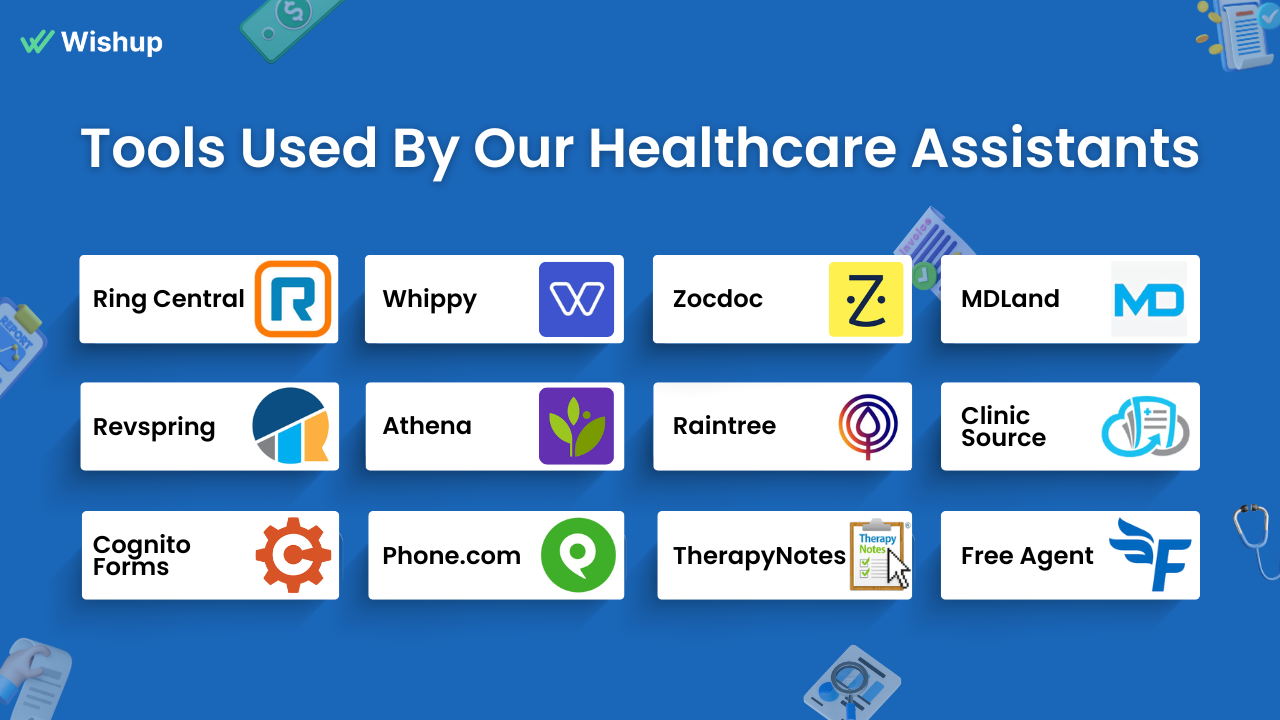
On the independent-practice side, that extends to:
- Tebra (formerly Kareo),
- AdvancedMD,
- DrChrono,
- Practice Fusion,
- RainTree,
- MDLand, and
- ModMed.
Along with the supporting tools practices run alongside the EHR are:
- Acuity and Zocdoc for scheduling,
- RingCentral for phones,
- NexHealth for patient messaging and reminders, and
- CoverMyMeds for prior authorizations.
For a system-by-system breakdown of how assistants operate in each platform, see our guide to the EHR softwares used by healthcare virtual assistants.
Enterprise and ambulatory leaders
Specialty practice systems
Specialty EHR platforms by practice type
Specialty practices rarely run the big-hospital systems.
Our medical virtual assistants also work in the platforms built for specific fields:
- SimplePractice, TherapyNotes, and Valant for behavioral health,
- Dentrix, Eaglesoft, and Open Dental for dental offices,
- ChiroTouch and Jane for chiropractic care,
- RevolutionEHR for optometry, ezyVet and Cornerstone for veterinary clinics,
- Nextech for dermatology and plastic surgery,
- OncoEMR for oncology,
- Experity for urgent care, and
- Healthie and Practice Better for dietitians and wellness practices.
Today's schedule
Assistant: confirms & preps chartsPatient chart
Assistant: enters & updates recordsBilling queue
Assistant: scrubs claims pre-submissionWhat happens when your system is not on the list
Your medical administrative virtual assistant learns it in the first week. EHR systems differ in layout, not logic: registration, charting, orders, and billing queues exist everywhere.
An assistant who has worked across several platforms picks up a new one quickly, and deep training on your specific configuration happens with you, inside your setup, on your rules.
At Wishup, we don't claim expertise in every EHR platform available in the market. What we do know is that experienced healthcare virtual assistants can adapt quickly to new systems with proper onboarding and training.
What to Look for in a Virtual Assistant for EHR Integration
You must judge candidates on five things: the platform depth versus platform breadth, whether they document things as they learn, familiarity with the interfaces around your EHR, denial-prevention instinct, and who supervises the work.
1. See the depth they have around system
Always start with which system the virtual assistant has spent the most hours in and what they found hardest about it. Real users have a specific complaint. People who have seen a demo do not.
2. Do they document their learning?
The assistant who turns your click-by-click workflow into a written procedure in week one is building an asset your practice keeps. The one who learns it by memory is a single point of failure.
3. How good their understanding of the system is
Most practices run a clearinghouse, a payer portal, a scheduling tool and a phone system alongside the EHR. Integration work is largely about moving data cleanly between them. Ask which of those the candidate has used.
4. How strong their denial-prevention instinct is
Ask what they check before a claim goes out. A strong answer names eligibility, coordination of benefits, policy number accuracy and demographic match without prompting.
5. Who reviews the output they produce
Data entry errors are invisible until they surface as a denial six weeks later. Ask who checks the work, how often, and what the escalation path is when something is wrong.
How Wishup Trains Its Medical Virtual Assistants on Different EHR Systems
Healthcare is not the kind of work anyone should pick up on the job.
Before accessing a client's system, every Wishup healthcare virtual assistant completes a comprehensive healthcare training program in addition to our core eight-week virtual assistant training curriculum.
This specialized program covers healthcare workflows, compliance requirements, patient data handling, medical terminology, and EHR best practices, helping ensure a smooth and secure transition into your practice.
The seven-part healthcare training program
- HIPAA certification first: Every healthcare assistant earns HIPAA certification through Alison and hipaatraining.us before anything else, and must show proof. The training covers patient data handling, treatment and billing rules, breach protocols, and secure remote work.
- Healthcare terminology and insurance basics: Clinical terms, EMR language, plan types like HMO and PPO, and the difference between a copay, a deductible, a referral, and an authorization. When a payer calls, the assistant is not guessing.
- The full patient journey: Registration through final payment, so the assistant understands how a typo at intake becomes a denial six weeks later.
- Billing and denial prevention: The top reasons claims get denied and the front-end habits that prevent them.
- What real practices deal with: A panel summary drawn from our existing healthcare clients: how their days run and where mistakes cost the most.
- The tools they will use: Working familiarity with the EHR platforms listed above, plus schedulers, phone systems, and payer portals.
- A quiz they have to pass: Before an assistant can be shortlisted for your practice, they pass a healthcare assessment covering HIPAA, workflows, and billing. We track readiness on a scorecard. No pass, no placement.
Learning your specific EHR setup
Platform familiarity gets a virtual assistant to day one.
Your configuration is its own course. In the first week, your assistant works from your screens, documents your click-by-click workflows into written procedures, and submits them for your approval.
You end week one with a trained ehr data entry virtual assistant and a written operations manual your practice keeps forever. We then run fortnightly checks to make sure the documented procedures are actually being followed.
How a HIPAA Compliant Virtual Assistant Keeps Patient Data Safe
This is the section to read twice. It is also the section where I can be most specific, because data security is where Wishup's model differs most from the industry default.
Your patient data never leaves your systems
Most agencies answer the security question with encryption acronyms. Here is our architectural answer: the assistant works inside your EMR, on your logins, under your rules. Nothing is exported to our servers, because nothing needs to be.
- They never see your passwords: Credentials live in a password manager that auto-fills at login. The assistant uses the system without ever viewing the password itself.
- Access runs through your systems: Your IT sets up the login. Every action appears in your own audit logs, not in a report we generate for you.
- Least privilege, always: The assistant accesses only the tools and records their work requires. The day the engagement ends, access ends.
- You can cut access instantly: No request ticket, no waiting period. Revoke the credential and the work stops.
- Activity is visible daily: Hours, tools used, and tasks completed are tracked through Time Doctor, with a summary delivered to you every evening.
Your patient data never leaves your systems
The paperwork signed before work begins
A Business Associate Agreement is signed before anyone touches patient data. That is required by law, and we treat it that way.
Our standard BAA can be adjusted by your legal team to add state-specific wording. We operate as a business associate under HIPAA and the HITECH Act, and every assistant signs a strict NDA with us from their first day of employment, not from the day they are assigned to you.
When you are comparing providers, our checklist for how to hire HIPAA compliant virtual assistant support lists every document to ask for.
If something ever goes wrong
No agency in this market publishes an incident protocol. Here is ours. If there is ever an issue involving patient data, you hear from us within 24 hours.
The assistant's access is cut immediately. You receive a plain-language report covering what happened, what we are changing, and anything your compliance team needs.
Any new safeguards are added at no cost to you.
We publish this not because incidents are common, but because a vendor's plan for a bad day tells you more than their promises about good ones.
Wishup Automation Expert Virtual Assistants
Repetitive data entry should be reduced wherever the tools allow. Every Wishup assistant is trained on the AI and no-code tools that speed up routine admin, whether it is batching eligibility checks, scheduling reminder and recall runs, generating the reports your practice reviews weekly. Building custom integrations into your EHR stays with your IT or your vendor.
Our assistants built more than 50 client automations last quarter alone.
What automation looks like inside a practice
The pattern is always the same: the assistant does the work manually first, documents it, then automates the repeatable parts and supervises the output.
- New patient intake forms flow into the EHR without retyping, and the assistant verifies each entry instead of creating it
- Appointment reminders, recall outreach, and no-show follow-ups run on schedules the assistant maintains
- Eligibility checks run in batches the night before clinic days, with exceptions flagged for human follow-up
- Reports your practice reviews weekly are generated automatically and checked before they reach you
The mechanics differ by field. Our walkthroughs on how to automate healthcare workflows with a virtual assistant cover the general playbook, while the guides on how to automate therapy practice workflows with a virtual assistant and how to automate dental practice workflows with a virtual assistant show what the same approach looks like in those settings.
The point is the pairing: automation handles volume, and a trained person handles judgment. Practices that buy software alone get neither.
Who You Get When You Hire Through Wishup
Most virtual assistant solutions describe their people as "pre-vetted" and stop there. Here are our actual numbers.
The hiring funnel, with real figures
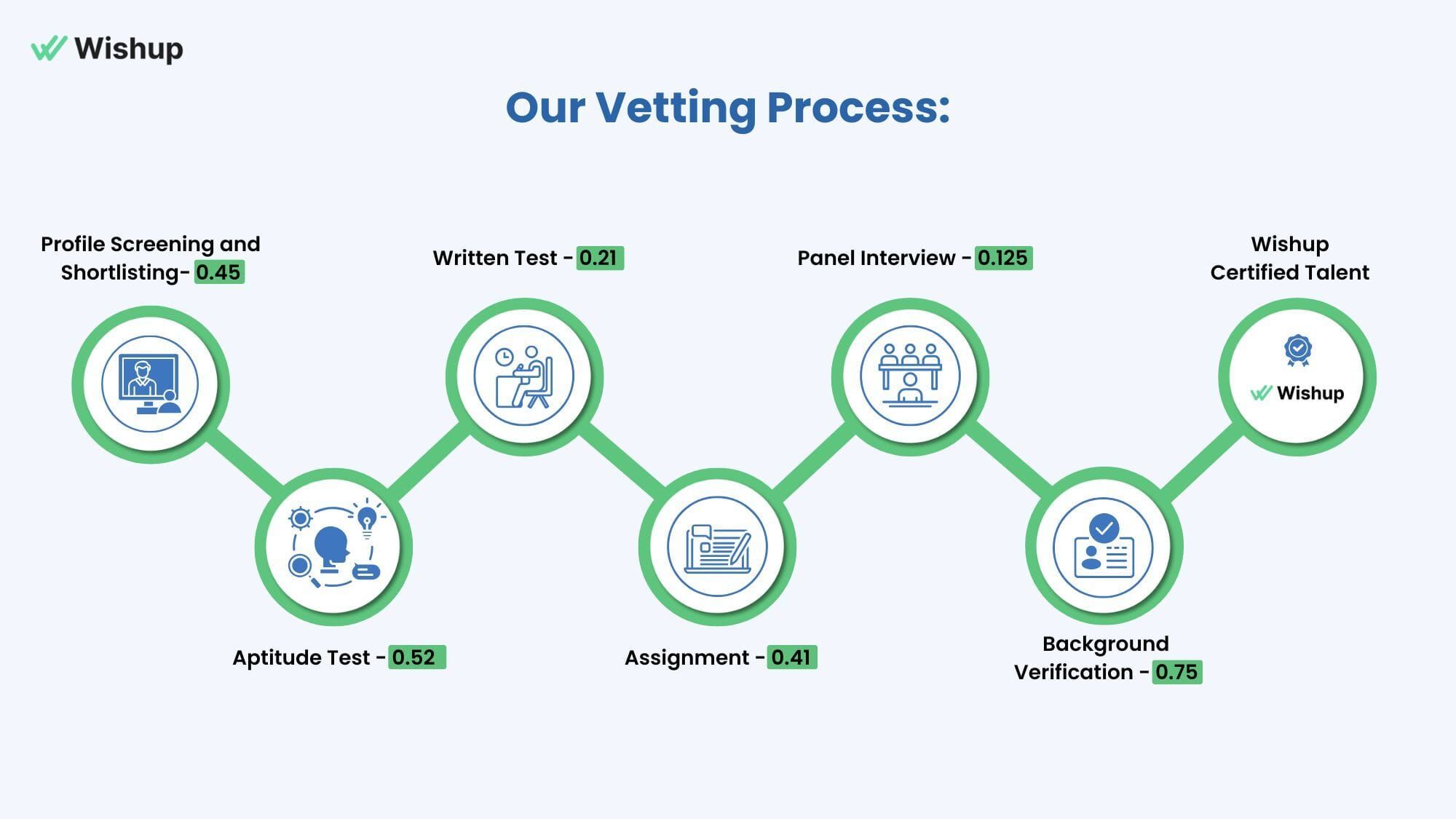
Last year, 1,79,110 people applied to work at Wishup.
We hired 179.
That is fewer than 0.1 percent, and every candidate passes six stages: background screening, an aptitude test where we accept only 99.9 percentile scorers, an English and empathy assessment built around patient scenarios, a personality evaluation for patient-facing temperament, reference checks with past employers, and a final interview with our leadership.
Our recruiters are ex-entrepreneurs who hire the way founders hire, for ownership rather than attendance.
Healthcare backgrounds, not re-trained generalists
Every ehr data entry virtual assistant is a full-time Wishup employee, never a freelancer, with at least five years of professional experience before joining us.
Our healthcare assistants mostly arrive with medical grounding already in place: pharmacy degrees (B.Pharma and M.Pharma), medical scribing experience, insurance claims work, UK healthcare administration, and prior hands-on time in systems like Epic, athenahealth, and eClinicalWorks.
The average assistant stays with us 3.7 years, which means the person who learns your workflows is still running them years later.
Your patients hear one familiar voice, not a rotating cast.
One hire, three people: the managed model
When you hire one ehr data entry virtual assistant through Wishup, three people join your account.
The ehr data entry virtual assistant who does the work. A dedicated virtual assistant manager who runs weekly quality reviews on their output. And a dedicated Customer Success Manager who owns your account, answers within 60 minutes during working hours, and is one named person, not a ticket queue.
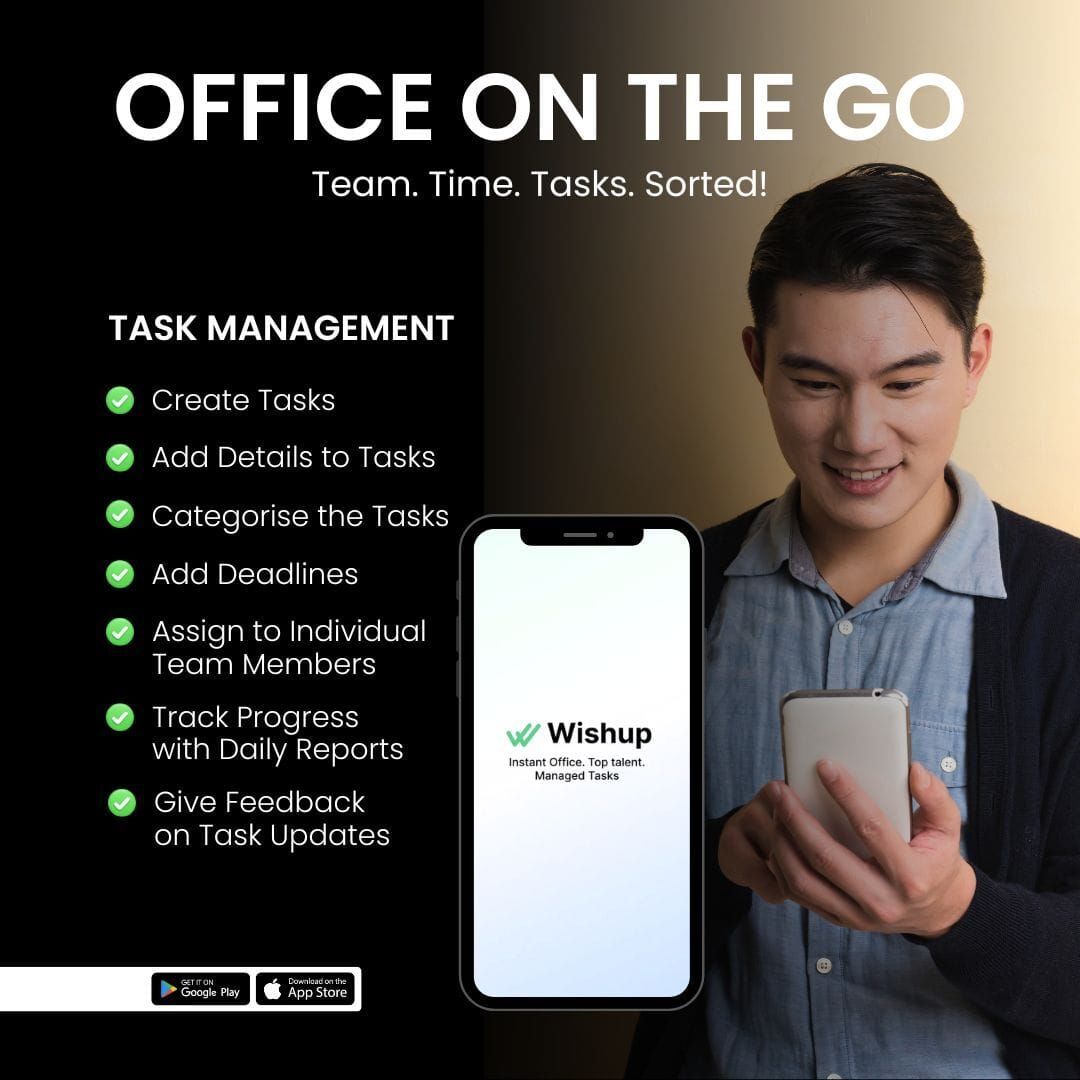
You also get free lifetime access to the Wishup Workforce Management App, end-of-day reports, and live time tracking.
There is no recruitment cost, no payroll, and no HR overhead on your side. We call it hiring three at the price of one, because that is the arithmetic.
How EHR Work Changes by Medical Specialty
No two practices delegate the same task list, because no two specialties run the same day.
The virtual assistants for therapists we place spend their time on session notes, intake packets, and superbills inside SimplePractice or TherapyNotes.
A virtual assistant for dentists lives in Dentrix or Open Dental, juggling hygiene recall, insurance breakdowns, and lab case tracking.
The work differs again for a virtual assistant for veterinarians, where records follow patients who cannot fill out their own forms, and for a virtual assistant for chiropractor offices, where care plans and visit frequency drive the schedule.
Our piece on the chiropractic office management virtual assistant role breaks that workflow down step by step.
The pattern holds across every field we staff: a virtual assistant for optometrists manages recall and optical orders in RevolutionEHR, virtual assistants for psychiatrists handle medication refill queues and prior authorizations, and a virtual assistant for mental health practice settings combines both with strict confidentiality workflows.
Procedure-heavy fields bring their own rhythms, whether that is a virtual assistant for oncology coordinating infusion schedules and authorizations in OncoEMR, a virtual assistant for cardiology managing diagnostic reports and referrals, or a virtual assistant for gastroenterologists keeping procedure schedules and prep instructions moving.
The same goes for a virtual assistant for urgent care center operations built on Experity, virtual assistants for dietitians running Healthie, virtual assistants for plastic surgeons working consult pipelines in Nextech, and a virtual assistant for dermatologists balancing medical and cosmetic scheduling.
Because Wishup is not a single-specialty agency, you are matched with a data entry virtual assistant whose background fits your field, not handed whoever is available.
How Much Does an EHR Data Entry Virtual Assistant Cost?
Transparent numbers, because you will not find them on most competitor sites.
| Plan | Part-time (4 hrs/day) | Full-time (8 hrs/day) |
|---|---|---|
| Prime VA | $1,299/month | $1,999/month |
| Elite VA | $1,999/month | $2,999/month |
| US-based VA | $3,000/month | $5,400/month |
All prices are in US dollars, billed monthly. Part-time means 4 hours of work per day and full-time means 8 hours per day, matched to your practice hours and time zone.
For comparison, hiring an in-house medical records clerk in the US means a salary, payroll taxes, benefits, recruiting costs, and the management time nobody budgets for.
A part-time Prime plan costs less than most practices spend on overtime fixing front-end billing errors.
If you want to see how we stack against other providers, our reviewed list of the best medical virtual assistant companies and our direct Wishup vs Hello Rache virtual assistant comparison are both written to be checked, not believed.
Rated 4.9 on Clutch and 4.8 on Trustpilot.
How to Get Started, and How to Leave
Hiring takes 60 minutes, not 60 days
Tell us your EHR system, your specialty, and your task list.
We shortlist assistants whose backgrounds match, and you interview as many candidates as you want in a single day, at no cost.
Once you choose, onboarding takes 60 minutes.
Your assistant starts with a first-task completion guarantee, and 90 percent of clients keep their first match. If the fit is wrong, we replace the assistant within 24 hours, free, no questions asked.
Only 4 percent of clients ever need to.
Before you talk to us or anyone else, run through the things to do before hiring a medical virtual assistant so you arrive with your task list ready.
Leaving is as clean as starting
Monthly engagements end at the close of the billing month.
Access is revoked, your written procedures are handed over, and your patient data stays exactly where it always was: in your systems.
There is no extraction project, because nothing was ever extracted.
Frequently Asked Questions
How much does a Wishup EHR data entry virtual assistant cost?
Plans start at $1,299 per month for a part-time Prime assistant working 4 hours per day, and $1,999 per month full-time at 8 hours per day. Elite and US-based plans are priced at $1,999 to $5,400 per month depending on hours. All plans are billed monthly in US dollars.
How quickly does a Wishup EHR data entry virtual assistant respond?
Within 5 minutes during working hours. Your dedicated point of contact at Wishup responds within 60 minutes.
How long does it take to get an EHR data entry virtual assistant replacement from Wishup?
24 hours. Replacement is free, with no questions asked, and a backup assistant is briefed on your account so coverage never drops to zero. Only 4 percent of clients ever request a replacement.
Can I scale my EHR data entry virtual assistant hours up or down?
Yes. You can move between part-time and full-time plans, add a second assistant as you add providers, or bring in a billing specialist alongside your existing assistant. One assistant typically covers the administrative load of two providers.
Do I get to interview my EHR data entry virtual assistant at Wishup?
Yes. Unlike most virtual assistant solutions, Wishup lets you interview unlimited candidates in a single day at no cost before anyone starts. You choose the person, not us.
How long does it take to onboard an EHR data entry virtual assistant from Wishup?
60 minutes. Deeper training on your specific EHR configuration happens during the first week, when your assistant also documents your workflows into written procedures you keep.
Is a Wishup EHR data entry virtual assistant HIPAA compliant?
Yes. Every healthcare assistant is HIPAA certified through Alison and hipaatraining.us with proof on file, a Business Associate Agreement is signed before any patient data is touched, and each assistant signs a strict NDA from their first day of employment.
Can a Wishup EHR data entry virtual assistant work in my EHR system?
Almost certainly. Our assistants work across Epic, Oracle Health (Cerner), eClinicalWorks, athenahealth, NextGen Healthcare, Allscripts (now Veradigm), RainTree and MDLand, and the leading specialty platforms. If your system is not one they have used, they are up to speed within the first week.
What happens if my Wishup EHR data entry virtual assistant is sick or on leave?
Short absences are covered by your point of contact, who keeps urgent items moving. Longer absences are covered by a trained backup assistant. Your practice should never feel the gap.
What happens to my data when I stop working with Wishup?
Nothing has to happen to it, because it never left your systems. The engagement ends at the close of the billing month, access is revoked, and your documented procedures are handed over to you.
What are the best healthcare-focused virtual assistant companies for managing EHR data entry?
The providers worth shortlisting for EHR data entry share three traits: assistants trained on healthcare platforms before placement rather than on your time, HIPAA certification with proof on file, and a Business Associate Agreement signed at organizational level rather than by an individual.
Wishup assistants are HIPAA certified before placement, work across Epic, Oracle Health, eClinicalWorks, athenahealth, NextGen and the major specialty platforms, and come with a dedicated manager running weekly quality reviews. Plans start at $1,299 a month.
For a full side-by-side, see our comparison of the best medical virtual assistant companies.
