
Healthcare operations are complex. Patient scheduling, insurance verification, billing, prior authorization, and clinical documentation consume resources that could otherwise improve patient care.
Virtual medical assistants (also known as healthcare virtual assistant) have become essential operational infrastructure for healthcare practices seeking to balance administrative demands with clinical excellence.

What Is a Virtual Medical Assistant?
A virtual medical assistant is a trained remote professional who handles the administrative and operational work of a medical practice: patient scheduling, insurance verification, prior authorization, EMR and chart updates, billing support, and patient communication. They work inside your existing systems from a remote location, and they do not perform clinical work or make treatment decisions.
The role is also called a medical virtual assistant, a healthcare virtual assistant, or MedVA. The terms are used interchangeably and mean the same thing.
What a virtual medical assistant is not
- Not a medical scribe: A scribe documents the clinical encounter in real time during the visit. A virtual medical assistant handles everything around the visit.
- Not a virtual receptionist: A virtual receptionist answers calls. A virtual medical assistant owns workflows that continue after the call ends, including the insurance follow-up and the chart update.
- Not a clinical role: No diagnosis, no treatment decisions, no triage. Anything requiring a licence stays with your clinicians.
- Not a generalist admin working remotely: The distinction is training: HIPAA, EMR fluency, payer portals and coding familiarity before day one, rather than learned on your practice's time.

Healthcare Practices Face Growing Operational Pressure
The healthcare industry confronts unprecedented operational challenges. Clinician burnout, driven largely by administrative burden, affects nearly 63% of physicians according to recent research.
Staff shortages in clinical support roles have left practices scrambling to maintain scheduling efficiency, manage patient intake, and keep insurance claims moving through approval processes. The result is practices that cannot streamline administrative workflows lose revenue, compromise patient satisfaction, and accelerate clinician burnout.
Understanding Virtual Medical Assistants as Operational Systems
A virtual medical assistant is not simply a remote receptionist or administrative support person working from a distance. Our medical virtual assistants function as integrated operational support systems that directly engage with your practice's clinical workflow, technology infrastructure, and revenue cycle.
They manage patient interactions, healthcare staffing coordination, EMR management, and the administrative layers that connect your therapy team, billing department, and insurance vendors.
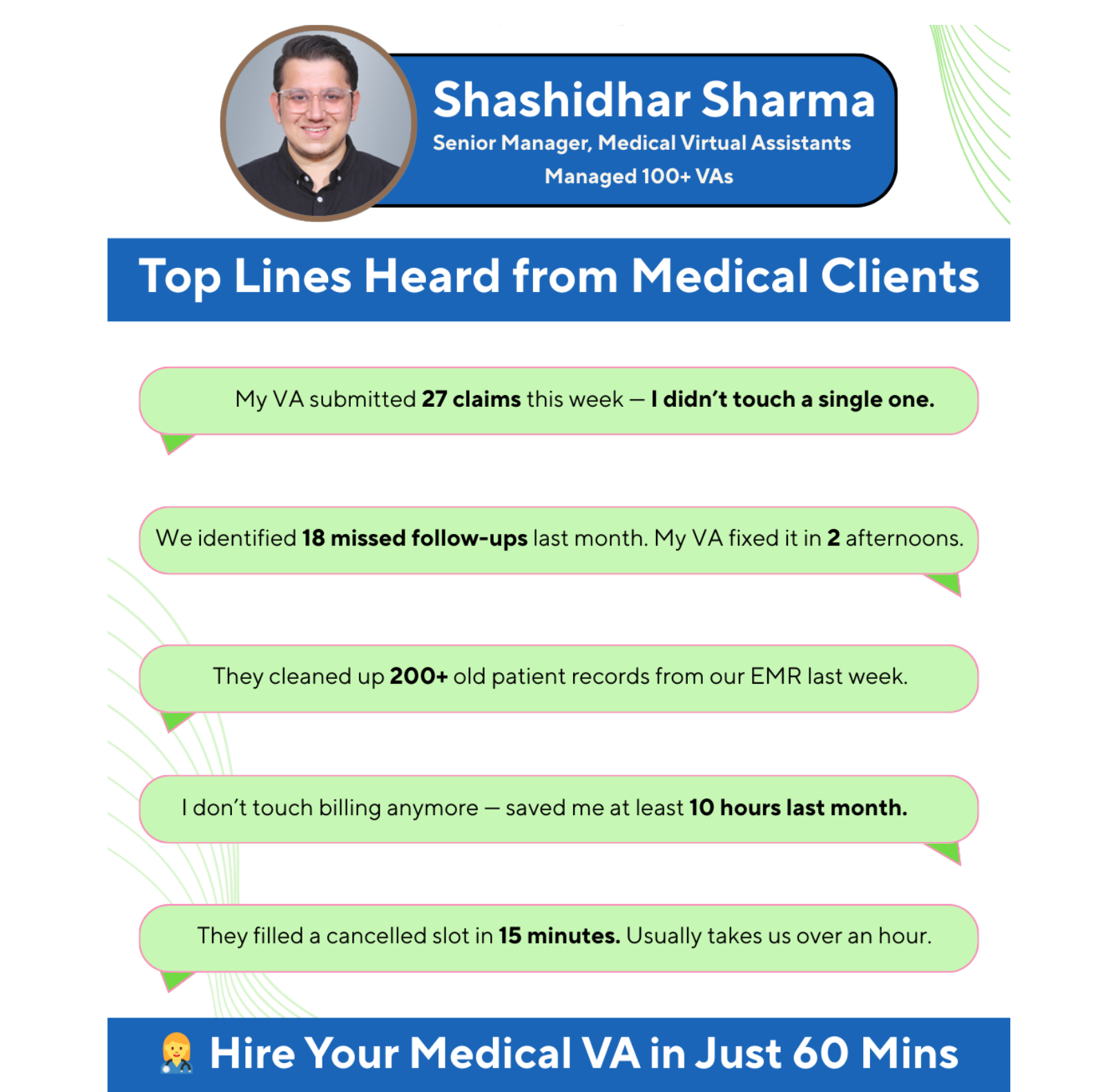
What distinguishes this operational model from traditional outsourced services is specialization.
Rather than hiring a generalist who answers phones, our medical virtual assistants in healthcare settings become deeply embedded in your specific operational challenges. They understand your EHR system, your patient population, your billing complexities, and your scheduling constraints.
The Operational Reality
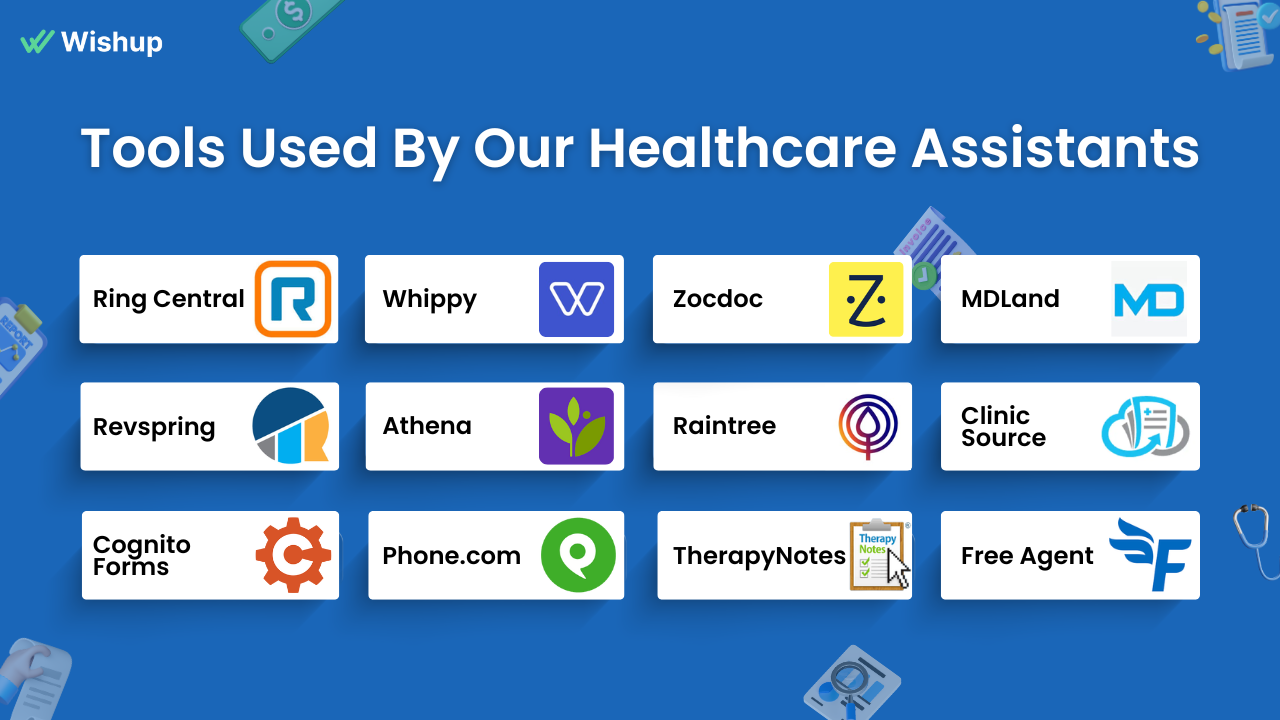
When a pediatric therapy practice with 300 patients, 19 therapists, and complex insurance authorization requirements brought in a medical virtual assistant, the clinic did not hire someone to "help with the front desk."
They implemented an operational system that reduced accounts receivable by 60% in three months, eliminated the need for two in-house receptionists (saving $4,000 to $5,000 monthly), and created specialized roles in scheduling optimization, patient intake coordination, and insurance claim management.
Case Studies of Wishup Healthcare Virtual Assistants


What Tasks Can You Delegate to a Virtual Medical Assistant?
The specific responsibilities of our medical virtual assistants depend on your practice's operational structure and pain points. However, certain functions define how virtual medical assistants create measurable operational value in healthcare environments.
Insurance Verification and Claims Management
Insurance administration represents one of healthcare's most complex operational challenges. Medical billing requires coordinating with multiple insurance carriers, managing prior authorization requests, verifying patient coverage, and managing claim denials.
Our medical virtual assistants handle the end-to-end prior authorization workflow. This involves verifying medical necessity requirements, submitting authorization requests to insurance carriers, tracking approval timelines, and communicating authorization status to your clinical team.
Claims submission, denial management, and accounts receivable follow-up require systematic coordination. A specialized medical virtual assistant can manage claim auditing, identify claim submission patterns that trigger denials, and implement process improvements that increase first-submission approval rates.
Before scheduling treatment, patients require insurance verification to ensure coverage and identify cost-sharing obligations. This administrative step prevents billing surprises and improves patient satisfaction.
Key Metrics: Our medical virtual assistants achieve 95% first-submission claims acceptance rates and have reduced accounts receivable by as much as 60% within three months of implementation.

Patient Scheduling and Appointment Coordination
Scheduling in healthcare practices requires coordination across multiple dimensions:
- Therapist Availability
- Patient Preferences
- Facility Capacity
- Treatment Protocols
Poor scheduling creates inefficient resource utilization and reduces practice revenue.
Our hipaa trained medical virtual assistants prioritize filling high-utilization time slots that generate the greatest revenue per hour, preventing schedule gaps that represent lost clinical income.
When patients cancel, specialists must rapidly reschedule these slots or pursue makeup appointments. A dedicated scheduling medical virtual assistant can proactively manage cancellations, identify cancellation patterns, and develop retention strategies.
Your Patients Trust You With Their Data.
We Take That Seriously.
Enterprise-grade safeguards designed to protect patient information, maintain compliance, and ensure operational accountability.
Real-Time Activity Monitoring
We use time-tracking and computer security audits, including mouse and keyboard activity monitoring for transparency and accountability.
Physical, Electronic & Procedural Safeguards
Secure transmission and storage practices, including antivirus protection, encrypted systems, and firewall security.
Strict Access Control by Role
Assistants only access the information necessary for their role, with permissions revoked when no longer needed.
Secure Password Management
Sensitive credentials are stored in encrypted password-management systems, with customizable access controls per application.
NDA-Based Confidentiality
Built-in NDA protection across both client and assistant agreements, with customizable confidentiality clauses.
Device & Application Controls
Strict device verification, application-level controls, and encrypted communication systems.
Specialized healthcare virtual assistants can plan schedules one to two months in advance, identifying bottlenecks before they affect patient wait times or therapist utilization rates. This forward-planning capability transforms scheduling from reactive firefighting into strategic resource optimization.
Patient Intake and Onboarding
The patient intake process determines the quality of information captured, compliance with intake procedures, and the initial experience that shapes patient satisfaction. This represents a critical operational touchpoint that directly impacts new patient conversion rates and practice growth.
Our medical virtual assistants managing patient intake coordinate all initial patient contact, including form completion, insurance collection, guardian communication, and evaluation scheduling.
For inquiry-driven practices, this function directly impacts patient conversion rates and new patient quality. Intake coordination ensures that inquiries convert to scheduled evaluations, reducing lost revenue from incomplete intake processes.

Virtual Medical Assistant Duties
A virtual medical assistant's duties fall into five areas: scheduling, patient intake, insurance and authorization, documentation, and patient communication. Here is what each looks like day to day.
Scheduling and calendar
Books and confirms appointments, manages cancellations and the waitlist, backfills gaps the same day, coordinates across multiple providers and rooms
Patient intake
Sends and chases intake forms, collects insurance details, verifies coverage before the visit, registers new patients in the EMR
Insurance and prior authorization
Verifies eligibility, submits prior authorization requests through payer portals, follows up daily on pending approvals, manages denials and appeals
Documentation and EMR
Updates charts and demographics, uploads documents, prepares referral paperwork, keeps records audit-ready
Patient communication
Answers portal messages, phone and email, sends appointment reminders, follows up after missed appointments, handles billing questions.
Duties a virtual medical assistant does not have
Clinical assessment, triage decisions, prescribing, or anything requiring a licence. If a provider asks a virtual medical assistant to make a clinical judgement, that is a scope problem rather than a capability one.
Virtual Medical Assistant Roles and Responsibilities
A virtual medical assistant's core responsibilities fall into five areas: appointment scheduling, patient intake, insurance verification and prior authorization, EMR and chart management, and patient communication. Here is what each role covers day to day:
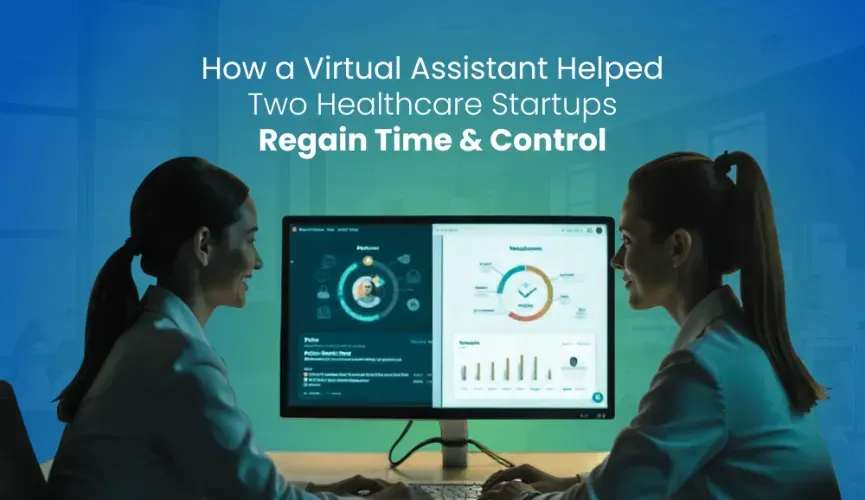
- Scheduling and calendar management: booking and confirming appointments, managing cancellations and the waitlist, backfilling gaps the same day, and syncing appointments between booking platforms like ZocDoc and the practice EMR.
- Patient intake: sending and chasing intake forms, collecting insurance details, verifying coverage before the visit, and registering new patients in the EMR.
- Insurance verification and prior authorization: checking eligibility before every appointment, confirming co-pays and PCP referral requirements, submitting authorization requests, and following up on approvals.
- EMR and chart management: updating charts and demographics, uploading documents, preparing referral paperwork, and keeping records audit-ready.
- Patient communication: answering phone, email, and portal messages, sending appointment reminders, running no-show follow-up, and handling prescription refill coordination.
How Virtual Medical Assistants Solve Specific Healthcare Operational Challenges
Generic administrative support does not address the specific operational problems healthcare practices face. Effective medical virtual assistants solve concrete, measurable problems that impact practice sustainability.
Reducing Clinician Burnout Through Administrative Burden Relief
Clinicians report that administrative tasks consume 50% of their workday, directly contributing to burnout. When virtual medical assistants assume responsibility for scheduling coordination, insurance communication, and patient record management, clinicians recover time for clinical work and patient relationships.
Before virtual medical assistant implementation, the healthcare professionals manage their own scheduling, respond to insurance inquiries, handle patient billing questions, and coordinate with front desk staff. This fragmented administrative engagement disrupts clinical flow and diverts attention from patient care.
After virtual medical assistant implementation, healthcare professionals focus on patient care. Medical virtual assistants manage all insurance communication, coordinate scheduling, and handle patient administrative inquiries. Clinicians have clear communication pathways with the administrative team, receiving only necessary information at appropriate times.
Solving Staffing Shortages Without Expanding Facility Overhead
Hiring additional in-house staff requires facility space, employment benefits, payroll processing, and management overhead. Virtual medical assistants provide operational capacity without these costs.
A practice that previously maintained two in-house receptionists (representing approximately $4,000 to $5,000 in monthly labor costs plus facilities and benefits) can transition to virtual medical assistant support without occupying physical office space.
This operational shift redeploys real estate to clinical use, improves patient experience through reduced reception area congestion, and maintains administrative capacity. The cost structure advantage becomes even more pronounced when practices require multiple administrative support roles.
Improving Patient Satisfaction Through Responsive Communication
Patient satisfaction correlates directly with administrative responsiveness. When patients reach out regarding scheduling, billing, or care coordination, rapid, knowledgeable responses improve satisfaction metrics.
Our medical virtual assistants manage patient communication across multiple channels: phone, email, text, and patient portals. This distributed communication model ensures patients receive consistent, timely responses without overwhelming clinical staff.
What Is a Virtual Medical Assistant's Role in Patient Portals?
A virtual medical assistant manages the patient portal as the practice's front line: responding to portal messages, sending appointment reminders and confirmations, distributing intake and registration forms, and relaying prescription and lab updates to patients.
The portal is where most non-clinical patient communication now happens, and a virtual medical assistant keeps it moving so messages do not sit unanswered.
In practice, this means answering patient questions through the portal, sending HIPAA-compliant reminders and rescheduling notices through tools like NexHealth, confirming that patients received prescription refills and lab results the provider has reviewed, and routing anything clinical to the provider.
The virtual medical assistant handles the portal communication; the clinician handles the clinical decision.
Measurable Benefits and Return on Investment
The value of virtual medical assistant engagement becomes concrete when practices measure specific operational outcomes. Here are the real-world improvements that healthcare practices achieve:
- Accounts receivable reduction of 60% to 80% within three months through systematic claims auditing and denial management
- Monthly labor cost savings of $4,000 to $5,000 when transitioning from in-house reception staff to virtual medical assistant support
- Improved claims submission accuracy, achieving 95% first-submission acceptance rates on medical claims
- Reduced scheduling gaps and cancellation rates through specialized scheduling coordination
- Clinician time recovery, freeing administrative hours for direct patient care
- Faster prior authorization processing, reducing treatment delays caused by insurance administrative requirements
- Improved patient satisfaction through responsive communication and faster intake processing
When a pediatric therapy practice scaled from 100 patients and 6 therapists to 300 patients and 19 therapists, virtual medical assistant support enabled this growth without proportional administrative overhead expansion.
The operational system scaled to accommodate clinical expansion, managing increasingly complex insurance coordination, patient intake processing, and revenue cycle management.
Implementation Workflow for Healthcare Practices
Bringing virtual medical assistant support into your practice requires structured implementation to maximize integration with your existing workflow and technology infrastructure.
Step One: Workflow Assessment and Role Definition
Your medical virtual assistant cannot optimize what remains undefined. Work with your team to document specific administrative pain points, identify time-consuming tasks that divert clinician attention, and clarify the operational outcomes you prioritize. This assessment informs role specialization and responsibility delegation.
Step Two: Technology Integration and Training
Your medical virtual assistant requires access to your EHR system, scheduling software, billing platform, and communication tools. Comprehensive training on these systems and your practice-specific workflows ensures rapid productivity. Training typically requires two to four weeks, depending on system complexity.
Step Three: Process Documentation and Standard Operating Procedures
Document how tasks are currently completed, what information flows between your clinical team, administrative staff, and billing operations, and what communications you send to patients and insurance carriers. Your medical virtual assistant works within these established processes before suggesting optimization improvements.
Step Four: Gradual Responsibility Expansion
Rather than assigning complete operational domains immediately, begin with focused responsibilities that allow your medical virtual assistant to develop practice-specific expertise. As proficiency increases and your team develops confidence, responsibility scope expands. This graduated approach minimizes disruption and allows refinement of workflows.
Step Five: Performance Monitoring and Continuous Optimization
Track key operational metrics: claims approval rates, accounts receivable aging, scheduling utilization rates, patient satisfaction scores, and clinician feedback regarding administrative burden. Use these measurements to identify optimization opportunities and refine processes continuously.
How to Hire a Medical Virtual Assistant from Wishup
Wishup specializes in placing medical virtual assistants into healthcare practices, managing the vetting, training, and ongoing support that transforms remote administrative support into reliable operational infrastructure.
Initial Consultation
Share your practice's specific operational needs, current workflow challenges, and the administrative outcomes you want to achieve. This consultation clarifies role requirements and ensures alignment with available medical virtual assistant expertise.
Candidate Matching
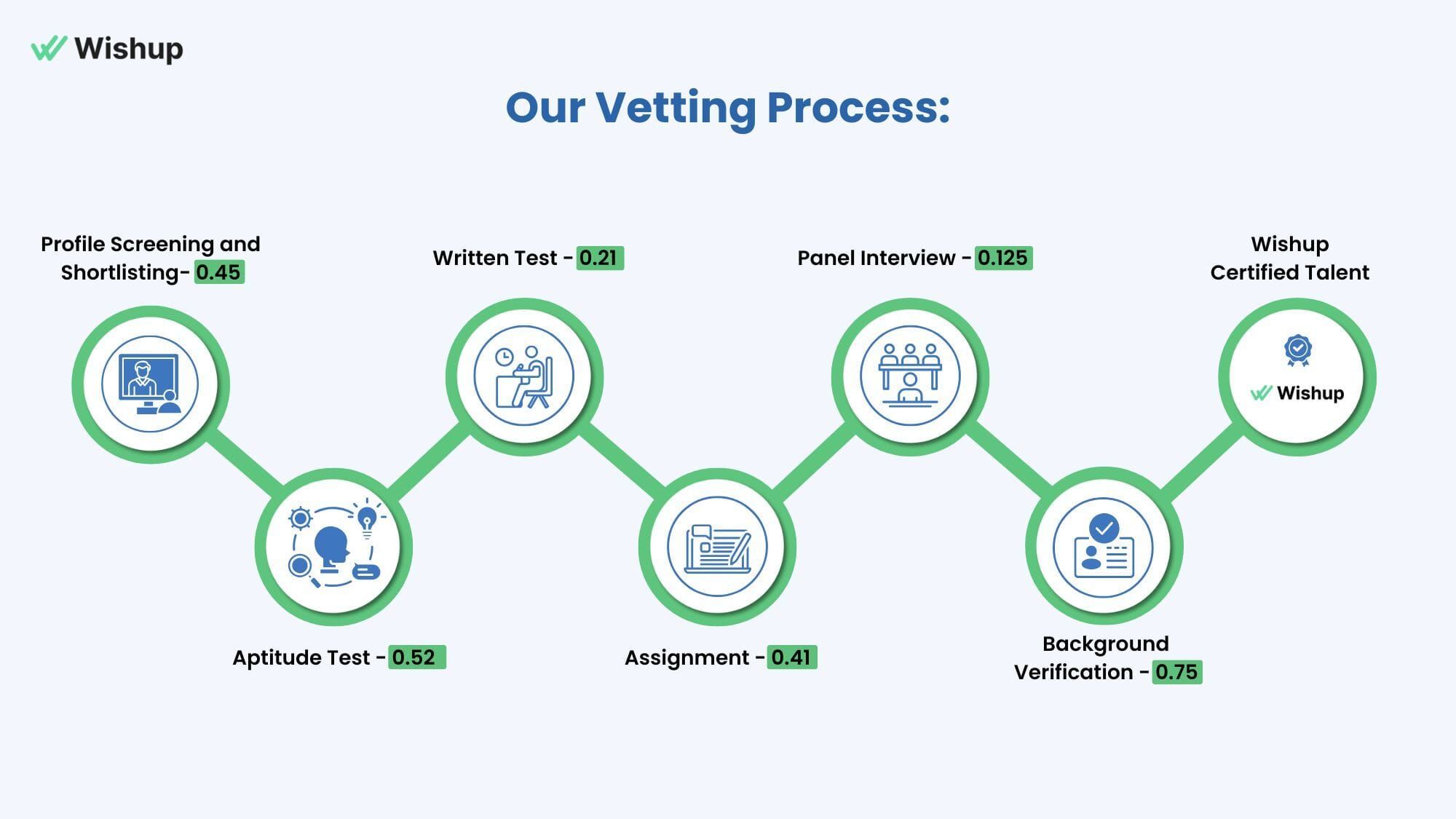
Wishup applies a 6-step stringent vetting process, evaluating candidates across communication skills, operational reliability, healthcare knowledge, and technology proficiency. Candidates hired by Wishup complete 8 weeks of mandatory AI and communications training, ensuring baseline competency regardless of previous healthcare experience.
Interview and Selection
You conduct unlimited same-day interviews with matched candidates at no cost.

Wishup's structured interview process produces a 90% first match success rate and a 100% second match success rate. If your initial match does not develop into a productive working relationship, Wishup replaces the medical virtual assistant quickly, at no additional charge.
Onboarding and Ongoing Support
After hire confirmation, Wishup provides ongoing quality assurance through weekly QA reviews by virtual assistant managers, fortnightly SOP adherence checks, and monthly CSM evaluations. This support structure ensures your medical virtual assistant remains productive, maintains process compliance, and continues improving operational delivery.
Benefits of Hiring a Medical Virtual Assistant from Wishup
Choosing Wishup for medical virtual assistant placement provides operational advantages beyond simply hiring a competent administrator.
90% First Match Success Rate
Wishup's vetting process matches candidates to your practice's specific operational needs with exceptional accuracy, minimizing hiring uncertainty and accelerating time to productivity.
Quick Replacement Guarantee
If your medical virtual assistant requires replacement, Wishup provides a replacement candidate quickly at no additional charge, protecting your operations from staffing disruptions.
Comprehensive Training Program
All Wishup medical virtual assistants complete 8 weeks of mandatory AI and communications training, ensuring baseline healthcare knowledge and professional communication standards. This training foundation means your new virtual medical assistant arrives ready for productive work, not requiring weeks of onboarding.
Weekly Quality Assurance Reviews
Your medical virtual assistant receives weekly QA reviews by Wishup's virtual medical assistant managers, identifying performance improvement opportunities and ensuring consistent operational excellence. This regular feedback loop maintains performance standards and addresses issues proactively.
5-Minute Response Time in Working Hours
Wishup medical virtual assistants maintain a 5-minute turnaround time for task inquiries during working hours. Any Wishup POC responds within 60 minutes for urgent practice coordination needs, ensuring administrative continuity.
30-Day ROI Report
Wishup provides a detailed ROI report within 30 days of hire, documenting the specific operational improvements and efficiency gains your medical virtual assistant delivered. This documentation clarifies the value investment and identifies areas for continued optimization.
Hire 3 at the Price of 1
For practices requiring multiple medical virtual assistants across different operational functions, Wishup offers a specialized pricing model that reduces overall costs while maintaining full support and quality assurance for your HVA + Task Support Team + Dedicated Customer Success Manager.
This pricing structure makes it economically feasible to build specialized support teams.
Backup Coverage and Continuous Support
When your medical virtual assistant requires time off, Wishup provides backup coverage at no additional charge, ensuring your operations continue without interruption. This continuity protection prevents administrative backlog when your primary virtual medical assistant is unavailable.
AI-Ready Operations
Wishup positions your practice for AI integration through guaranteed AI readiness training and implementation of 50+ AI automations in recent quarters. As healthcare becomes increasingly automated, your medical virtual assistant helps transition workflow processes to AI-assisted operations, protecting your practice's competitive positioning.
Wishup Virtual Medical Assistant Pricing
Wishup offers three virtual medical assistant plans: Prime virtual medical assistant, Elite virtual medical assistant, and US-based virtual medical assistant.
- The Prime virtual medical assistant plan costs $1,999 per month for full-time and $1,299 per month for part-time.
- The Elite virtual medical assistant plan costs $2,999 per month for full-time and $1,999 per month for part-time.
- The US-based virtual medical assistant plan costs $5,400 per month for full-time and $3,000 per month for part-time.
Note: In every plan, full-time means 8 hours of work per day, and part-time means 4 hours of work per day. All prices are in US dollars and billed monthly.

Ready to Eliminate Administrative Bottlenecks?
The decision to engage a virtual medical assistant represents an investment in your practice's operational capacity and clinical sustainability. Wishup's structured hiring process, comprehensive training, and ongoing quality assurance ensure your medical virtual assistant delivers measurable operational improvements from day one.
Explore how our medical virtual assistants can transform your practice's administrative operations.
Ready to Take the Admin Work Off Your Team?
Get specialized virtual medical assistant support to improve efficiency, reduce costs, and give clinicians more time for patients.
Talk to Wishup →FAQs on Virtual Medical Assistant
Can a Virtual Medical Assistant Support a Telehealth Practice?
Yes, and telehealth practices tend to get more out of a virtual medical assistant than in-person practices do, because the entire workflow is already remote. There is no front desk to work around.
A virtual medical assistant supporting a telehealth practice handles: pre-visit technology checks and link distribution, intake forms completed before the session rather than in a waiting room, eligibility verification for telehealth-specific coverage rules, which vary by state and payer, no-show follow-up, which runs higher in telehealth than in-person, post-visit documentation and follow-up scheduling, and coordination when a virtual visit needs to convert to an in-person referral.
On a live New York practice account, calling patients in real time at the appointment slot, rather than only end-of-day, reduced no-shows by 10 to 15%.
What does a virtual medical assistant do?
A virtual medical assistant does five things: manages the appointment schedule, handles patient intake, works insurance verification and prior authorization, keeps the EMR and charts current, and answers patient communication across phone, email and portal.
Day to day that means booking and confirming appointments, backfilling cancellations, chasing intake forms, verifying coverage before a visit, submitting authorization requests and following up on them, updating charts and demographics, and responding to patient messages.
Most practices start a virtual medical assistant on three of those five and expand once they run without correction. One virtual medical assistant typically covers two providers plus front-desk admin.
What is the difference between a virtual medical assistant and a medical scribe?
A medical scribe documents the clinical encounter as it happens. A virtual medical assistant handles everything around the encounter.
A scribe sits in on the visit, live or remotely, and writes the clinical note in real time so the provider does not have to type while talking to a patient. Their work is confined to the visit itself and to clinical documentation.
A virtual medical assistant works before and after: booking the appointment, verifying insurance, chasing the prior authorization, updating the chart afterwards, following up with the patient, and handling the billing question that comes three weeks later.
How much does a virtual medical assistant cost?
(your pricing currently sits at the very bottom of the page, after the conclusion, with no FAQ version)
A virtual medical assistant costs $1,299 to $5,400 a month depending on hours and whether you need a US-based assistant.
Wishup pricing: Prime virtual medical assistant at $1,299 a month part-time or $1,999 full-time. Elite virtual medical assistant at $1,999 part-time or $2,999 full-time, for automation-heavy or multi-platform work. US-based virtual medical assistant at $3,000 part-time or $5,400 full-time, where you need domestic hours and direct patient phone coverage. Part-time is four hours a day, full-time is eight, five days a week.
Is a virtual medical assistant HIPAA compliant?
A virtual medical assistant is HIPAA compliant only when four things are true at once: they are HIPAA-trained, they work on secured systems with role-scoped access, an organizational-level Business Associate Agreement covers the engagement, and a provider organization carries legal liability for the PHI they handle.
Ask for evidence of all four before granting access to any system holding patient data. For the full verification checklist, see our guide to hiring a HIPAA compliant virtual assistant.
What is the difference between a virtual medical assistant and a virtual receptionist?
A virtual receptionist answers calls and takes messages. A virtual medical assistant owns the workflows that continue after the call, verifying insurance, submitting the prior authorization, updating the chart, and following up on the refill. The receptionist handles the moment; the virtual medical assistant handles the process.
Why should a healthcare provider hire a virtual medical assistant?
Healthcare providers hire a virtual medical assistant to cut administrative burden, the driver of nearly 63% of physician burnout, without adding in-house staff or facility overhead. Practices commonly recover clinician hours, reduce accounts receivable, and lift call answer rates from under 20% to the high 80s after bringing one on.
