

If you run or manage a US healthcare practice, you already know the math is not working.
Patient demand keeps climbing, qualified administrative staff keep getting harder to find, and the paperwork attached to every patient keeps growing.
This guide is my attempt to give you a single, honest resource that answers every practical question about hiring a medical virtual assistant, so you can decide whether one belongs in your practice and how to bring one on without the usual hiring pain.
My goal is simple. By the time you finish reading, you should have every answer you need, and you should understand exactly why practices choose to hire from Wishup.
Sources: American Medical Association (2024–2025), Kodiak Solutions State of the Healthcare Revenue Cycle (2025), ADA Health Policy Institute (2025).
What a medical virtual assistant costs in 2026
Medical virtual assistant pricing falls into three bands in the US market.
Offshore freelance, $6 to $20 per hour. Sourced through marketplaces.
No organizational Business Associate Agreement, no managed oversight, no
backup cover. Lowest rate, highest administrative and compliance load on
the practice.
Managed offshore service, $1,299 to $2,999 per month. A flat monthly
fee covering the assistant, vetting, training, a manager, backup cover and
an organizational BAA. Part-time is typically 80 hours a month, full-time
160.
US-based assistant, $3,000 to $5,400 per month. Same managed
structure with a US-located assistant, native English on patient calls and
US background checks.
In-house comparison: a full-time medical administrative assistant in
the US costs $50,700 to $64,500 a year once benefits, payroll taxes and
overhead are added to base salary, using a standard 30% overhead
methodology. Sources: Glassdoor, Indeed, BLS, 2025.
Wishup's plans sit in the second and third bands: Prime at $1,299
part-time and $1,999 full-time, Elite at $1,999 and $2,999, US-Based at
$3,000 and $5,400. Billing is monthly with no setup, recruitment or
replacement fee.
What is a medical virtual assistant?
A medical virtual assistant (MVA) is a remote professional, either self-employed as a freelancer or working as an independent contractor through a managed service, who provides administrative support to healthcare providers while working outside the office.
MVAs work closely with the healthcare system and are trained to support physicians, doctors, nurses, hospitals, clinics, patients, payers, pharmacies, and labs and diagnostics providers.
You can delegate administrative, clerical, clinical, and operational tasks such as patient care management, billing, insurance verification, ChartSwap management, medical records management, revenue cycle management, credentialing, medical transcription, CPT code tracking, and prior authorization. There is a wide range of work you can delegate to a remote medical administrative assistant.
By offloading these tasks to a medical VA, you can reclaim up to 20 hours per week, improve the patient experience, reduce denial and no-show rates, and improve no-show recovery.


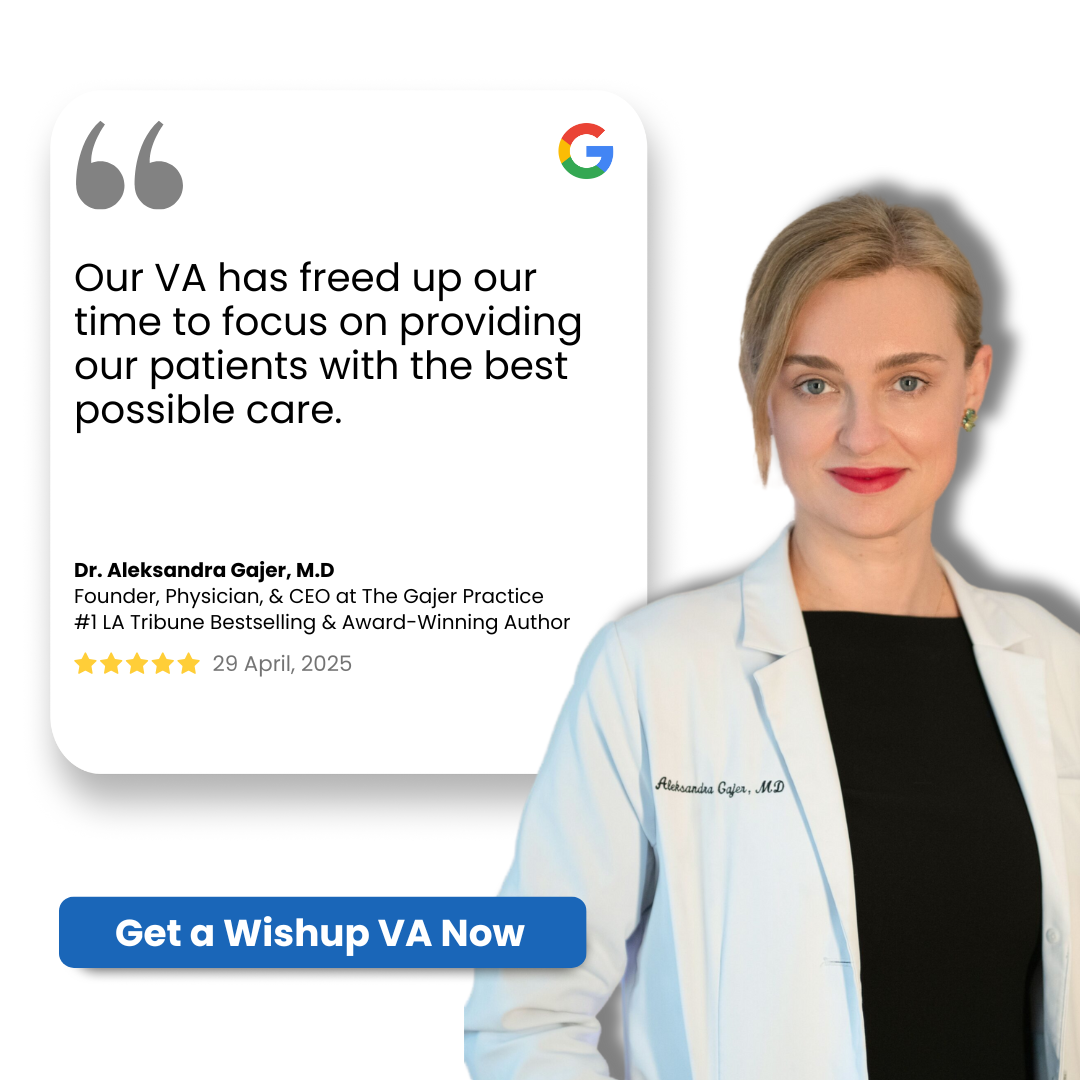
At Wishup, you get a stringently vetted medical virtual assistant in 60 minutes from the top 0.1%, HIPAA-trained in EHR and EMR systems, medical abbreviations, terminology, and daily task workflows.
You get one dedicated, full-time MVA in your time zone who can adapt as your needs change, at a fixed and predictable monthly price of $1,299.
We also provide enterprise-grade security, NDAs, background checks, SOC 2 and GDPR support, and password management workflows.
Your Patients Trust You With Their Data.
We Take That Seriously.
Enterprise-grade safeguards designed to protect patient information, maintain compliance, and ensure operational accountability.
Real-Time Activity Monitoring
We use time-tracking and computer security audits, including mouse and keyboard activity monitoring for transparency and accountability.
Physical, Electronic & Procedural Safeguards
Secure transmission and storage practices, including antivirus protection, encrypted systems, and firewall security.
Strict Access Control by Role
Assistants only access the information necessary for their role, with permissions revoked when no longer needed.
Secure Password Management
Sensitive credentials are stored in encrypted password-management systems, with customizable access controls per application.
NDA-Based Confidentiality
Built-in NDA protection across both client and assistant agreements, with customizable confidentiality clauses.
Device & Application Controls
Strict device verification, application-level controls, and encrypted communication systems.
What Does a Medical Virtual Assistant Do?
As mentioned above, a medical virtual assistant is not limited to administrative work. They act as a bridge between patients, healthcare providers, insurance companies, pharmacies, laboratories, and diagnostic centers, helping information and communication flow smoothly between all parties.
Depending on your practice's needs, a medical virtual assistant can support patient scheduling, insurance coordination, medical documentation, EHR management, clinical operations, front-desk support, and other healthcare administrative tasks.
Here are some of the tasks a medical virtual assistant can perform:
- Review patient insurance information and follow up with insurance companies for authorization updates
- Send absence letters and other required documentation to patients, parents, or caregivers
- Track no-show patients, conduct follow-up calls, and maintain attendance records
- Coordinate patient recruitment activities for clinical trials and research studies
- Identify claim denial reasons and assist with claims follow-up
- Interpret payer requirements and support coding and billing workflows
- Manage communication trackers for patients affected by insurance changes or coverage issues
- Track clinician capacity and patient volume to support scheduling decisions
- Generate reports on no-shows, unpaid claims, outstanding authorizations, and incomplete sessions
- Provide remote support to front-desk teams and answer operational queries
- Audit SOAP notes and clinical documentation based on predefined guidelines
- Manage the end-to-end authorization and reauthorization process
- Review patient visit recordings and prepare clinical documentation, including History of Present Illness (HPI), Physical Examination findings, Assessments, Results, and Care Plans
- Use Electronic Health Record (EHR) and healthcare software systems to enter, update, and maintain patient information
- Organize, summarize, and maintain medical records to support accurate documentation
- Coordinate communication between patients, providers, payers, pharmacies, and diagnostic centers
- Handle routine administrative and operational tasks that help healthcare practices run efficiently
The responsibilities of a medical virtual assistant vary from one healthcare practice to another. A physical therapy clinic may need help with authorizations and scheduling, while a behavioral health practice may require support with patient intake, documentation, and insurance follow-ups.
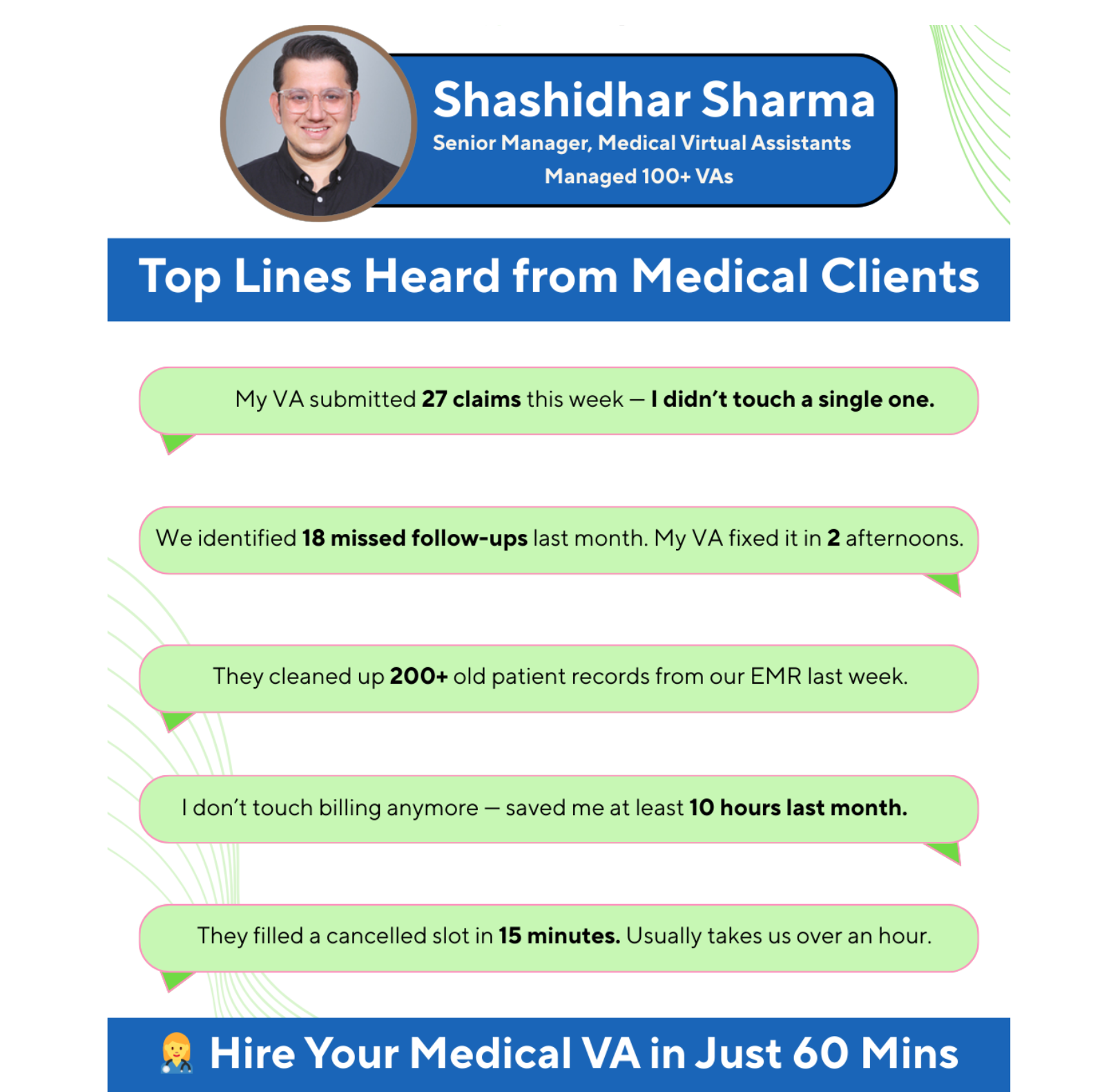

When you outsource a medical virtual assistant, the role is customized to your specific requirements. During the consultation process, you can discuss your workflows, operational challenges, and daily responsibilities with the service provider to determine exactly which tasks should be delegated to your virtual assistant.
This flexibility allows healthcare providers to offload time-consuming administrative work, improve operational efficiency, and spend more time focusing on patient care.
Duties you can delegate to a virtual medical assistants
Let me start with the question I get most often: what does a medical virtual assistant actually do all day?
The honest answer is that a good one absorbs the administrative work that is currently pulling your clinical team away from patients.
A medical virtual assistant is a trained remote professional who handles the operational and administrative side of your practice, from the first phone call a patient makes to the final posting of a paid claim.
I want to be precise here, because the term gets used loosely.
A virtual medical assistant is not a generalist who happens to answer phones from home. The role is built around the specific, recurring workflows that keep a healthcare practice running and compliant.
If you want the full primer on the role, we wrote a dedicated explainer on what is a virtual medical assistant.
Front-office and patient communication
This is the most visible layer of the job and usually the first thing a practice delegates.
A medical virtual assistant answers inbound calls, returns voicemails, responds to patient portal messages, and manages the inbox that would otherwise pile up between visits.
They schedule new appointments, confirm upcoming ones, and handle the reschedule-and-cancellation churn that quietly drains revenue when no one is on top of it.
The reason this matters more than it sounds: missed calls are missed patients. When the front desk is overwhelmed, calls go to voicemail, new patients book elsewhere, and the no-show rate climbs because no one is sending reminders.
A dedicated assistant whose entire job is patient communication closes those gaps. They run the kind of reminder sequence that actually works, a message several days out, one the day before, and one the morning of, each with an easy way to confirm or reschedule.
Scheduling and calendar optimization
Good scheduling is not just filling slots. It is filling the right slots in the right order so your providers are neither idle nor buried.
A skilled medical virtual assistant prioritizes high-utilization appointments, fills cancellations from a waitlist before the slot is lost, and plans the calendar a month or two ahead so bottlenecks get spotted before they turn into long patient wait times.
This turns scheduling from daily firefighting into something closer to strategic resource planning.
Clinical documentation and medical scribing
Documentation is the single heaviest administrative weight on clinicians today, and it is where a virtual medical scribe earns their place fast.
A medical scribe provides documentation coverage for assigned providers. They listen to audio recordings of patient visits, then use the right tools to summarize the clinical facts into professional, structured notes, the History of Present Illness, the Physical Exam, Results, and the Assessment and Plan.
They navigate your healthcare software fluently and enter those clinical reports and data directly into your electronic health record, following your clinic's specific guidelines and workflows.
Throughout, they hold a high documentation standard that meets your requirements, not a generic template.
The payoff is direct: charts close on time, billing is not delayed by open notes, and the provider goes home without a backlog of after-hours charting.
Insurance verification and eligibility
Before a patient is ever seen, someone has to confirm that the visit will be covered, and that work is exacting.
A medical virtual assistant conducts insurance verification by contacting carriers directly to confirm patient eligibility and benefits. They document the details that determine whether you get paid, co-pays, deductibles, out-of-pocket expenses, authorization requirements, and visit limits, and they make sure every verification is finished before the scheduled appointment, not after.
When coverage details conflict, they follow up with the carrier to resolve the discrepancy rather than letting it surface as a denial weeks later.
Prior authorization management
Prior authorization deserves its own line because it has become one of the most punishing administrative tasks in US medicine.
A medical virtual assistant handles the end-to-end process: determining whether prior authorization is even required for a service, identifying the submission requirements, initiating the request, and following up with the insurer until a decision lands.
They coordinate with physicians, clinics, and internal teams to gather the documentation payers demand, track the status of every request, keep accurate records in your system, and work denials and resubmissions when they happen.
If your practice has ever lost a day to chasing one approval, you understand why this role exists. Our deeper breakdown of how to hire prior authorization virtual assistant support walks through the workflow in detail.
Medical billing, coding, and revenue cycle support
The revenue cycle is where administrative quality turns directly into cash flow.
A medical virtual assistant supports billing by preparing and submitting clean claims, posting payments, managing accounts receivable follow-up, and chasing the denials that would otherwise sit unworked.
A medical coding virtual assistant assigns and reviews the correct codes so claims do not bounce on technicalities.
Together they protect first-submission acceptance rates and shorten the time it takes to get paid, which for most practices is the difference between a healthy month and a stressful one.
Remote patient monitoring and care coordination
For practices managing chronic conditions, a medical virtual assistant supports remote patient monitoring by tracking incoming patient data, flagging readings that need clinical attention, logging the time and touchpoints that monitoring programs require for reimbursement, and keeping the care-coordination loop moving between visits.
They also handle referrals and laboratory orders, the connective tissue that keeps a care plan from stalling.
Medical transcription and records management
Virtual medical transcription converts dictation and recorded encounters into accurate, timely written records inside your EHR.
Alongside it, records management keeps patient files complete and current, requests and files outside records, and makes sure nothing a provider needs at the point of care is missing.
It is unglamorous work, and it is exactly the kind of work that quietly breaks a practice when it falls behind.
Credentialing and practice management
A medical virtual assistant can manage provider credentialing, the paperwork-heavy process of getting and keeping providers enrolled with payers, tracking expiration dates and re-credentialing deadlines so a lapse never costs you a payer contract.
On the broader practice-management side, they handle vendor coordination, supply ordering, basic bookkeeping support, reporting, and the dozens of small operational tasks that make up an office manager's week.
The honest version
No single assistant does all of this at once, and you should be wary of anyone who promises that.
What a good medical virtual assistant does is own a defined set of these workflows completely, so the work gets done the same way every time without you supervising each step.
The art is matching the right tasks to the right specialist, which is the entire point of the next section.
Customized staffing for medical specialties
From dental practices to surgery centers to behavioral health facilities, the staffing challenges in US healthcare are not generic, and the support you bring in should not be either.
The pressure each setting faces is specific.
A dental front desk is fighting a different fire than a psychiatry intake coordinator or an orthopedic billing team.
That is why I do not believe in dropping a general-purpose assistant into a specialized practice and hoping it works.
At Wishup, we source qualified medical virtual staff tailored to your specialty, which takes the stress out of hiring and, just as importantly, out of training.
When an assistant already understands the rhythm of your kind of practice, the codes you bill, the payers you fight, and the software you live in, the ramp-up is short and the work is right the first time.
Below are the core staffing functions we customize by specialty.
Think of these as the building blocks you can combine into the exact role your practice needs.
Virtual Medical Receptionist
The voice of your practice. Answers calls, manages the schedule, confirms appointments, and makes sure no patient inquiry goes unanswered. We cover this role in depth in our guide to the virtual-medical-receptionist function.
Virtual Medical Administrative Assistant
Owns the operational backbone, records, vendor coordination, reporting, supply orders, and the day-to-day administration that keeps an office running without a full-time on-site manager.
Virtual Medical Scribe
Documentation coverage for your providers, turning recorded visits into structured clinical notes entered directly into your EHR so charts close on time and after-hours charting disappears.
Remote Patient Monitoring
Tracks incoming patient data, flags readings that need a clinician, and logs the touchpoints and time that monitoring programs require for reimbursement.
Virtual Medical Transcription
Converts dictation and recorded encounters into accurate, timely records inside your system, keeping documentation current without adding to a provider's evening.
Virtual Billing & Revenue Cycle Support
Prepares and submits clean claims, posts payments, and works accounts receivable follow-up so revenue does not stall in unworked denials.
Medical Coding Virtual Assistant
Assigns and reviews codes accurately so claims do not bounce on technicalities, protecting your first-submission acceptance rate.
Prior Authorization Virtual Specialist
Runs the end-to-end authorization process, from determining requirements to following up with payers and working denials, so approvals do not delay care.
Medical Credentialing
Manages provider enrollment and re-credentialing, tracking deadlines so a lapse never costs you a payer contract or a billable day.
Healthcare Practice Management
Coordinates the whole operation, the broader office-manager layer that connects scheduling, billing, vendors, and reporting into one accountable workflow.
You do not have to choose just one.
Most practices start with the function that is hurting most, often the front desk or prior authorization, and expand once they see what a dedicated specialist frees up.
The point of customized staffing is that you get a person who fits your practice, not a seat you have to train from scratch.
Different types of medical virtual assistants you can hire from Wishup
When practices come to us, they rarely ask for a job title.
They describe a problem, the phones are ringing out, the notes are piling up, the front desk just quit.
So it helps to translate those problems into the specific kinds of medical virtual assistant you can actually hire.
Here are the ones we are asked for most.
Virtual scribes for physicians
If your physicians are spending their evenings finishing notes, this is where to start.
Virtual scribes for physicians shadow the visit through audio, capture the clinical narrative in real structure, and enter it into your EHR to your documentation standard. The result is measured in hours returned to the physician and charts that close the same day.
Given that physicians report spending close to two hours on paperwork for every hour of direct patient care, a scribe is often the single highest-leverage hire a practice can make.
Virtual front-desk receptionist
A virtual front-desk receptionist is the dependable voice patients hear when they call. They answer promptly, schedule and confirm, triage messages to the right person, and keep the patient experience warm and organized. For a practice losing new patients to missed calls, this role pays for itself quickly.
Virtual nursing assistants
Virtual nursing assistants handle the clinical-adjacent coordination that does not require hands on the patient, managing care plans between visits, coordinating referrals and lab orders, following up on results, and keeping the lines between provider, patient, and pharmacy moving.
They extend your clinical team's reach without adding a clinical salary.
Dental virtual receptionist
Dentistry has its own cadence, recall scheduling, treatment-plan follow-up, insurance that works differently than medical. A dental virtual receptionist understands that cadence.
They keep the hygiene recall engine running, follow up on unscheduled treatment, verify dental benefits, and make sure the chair stays full.
With dental practices naming staffing as their number-one challenge, this is one of the fastest-growing requests we see.
Physical therapist receptionist
Physical therapy lives and dies on visit frequency and authorization limits.
A physical therapist receptionist manages the high-volume scheduling that a plan of care demands, tracks visit limits against authorizations so you never deliver care you cannot bill, and keeps the cancellation-and-rebook cycle tight so patients complete their episodes of care.
Orthodontic answering service
An orthodontic answering service keeps a high-volume, appointment-dense practice responsive, fielding calls about adjustments, payment plans, and scheduling, capturing new consultation requests, and making sure no parent or patient gets sent to voicemail during a busy clinic day.
A note on how we staff
Every one of these roles is filled by a pre-vetted assistant, not a generalist we relabel.
Because Wishup medical virtual assistant services are not focused on a single specialty, you get someone matched to your kind of practice, trained on the tools you use, and backed by a managed-service structure rather than a lone freelancer.
More on exactly why that structure matters when we get to cost and compliance.
Specialties a medical virtual assistant serves
No two healthcare practices operate the same way, so the tasks you delegate will change from one specialty to the next.
The medical virtual-assistants-for-therapists will have a different role compared to a healthcare assistant working with dentists.
Because Wishup's medical virtual assistant services are not focused on one specialty, you get to work with an assistant who specializes in yours.
Below, I have walked through the specialties we support most, the specific administrative weight each one carries, and how a Wishup assistant is deployed against it.
Dental Practices
Roughly 62% of dentists name staffing as their single biggest business challenge, and front-desk roles are among the hardest to keep filled. The admin load is recall scheduling, treatment-plan follow-up, dental insurance verification, and claims.
A Wishup dental assistant keeps the recall engine running, verifies benefits before the visit, and works claims so production converts to collections. Our virtual-assistant-for-dentists page goes deeper on the dental workflow.
Orthodontic Practices
Orthodontics runs on appointment density and long treatment arcs. The administrative pressure is constant scheduling, payment-plan management, and consultation capture, all while the clinic floor stays busy.
A Wishup assistant handles the answering-service load, protects the consult pipeline, and keeps payment plans current so the practice's recurring revenue does not leak between adjustments.
Healthcare Systems
Larger systems carry the heaviest revenue-cycle exposure. With US providers leaving an estimated $48 billion in net revenue unrecovered in 2025 on rising denials, disciplined accounts-receivable ownership is now a financial imperative, not a back-office detail.
Wishup deploys assistants across verification, prior authorization, and denial work as a coordinated layer, so a multi-site operation gets consistent process rather than location-by-location improvisation.
Veterinary Virtual Assistant
The AVMA has flagged a structural workforce shortage, with vet assistants and front-desk roles seeing churn as high as 30% to 40% a year, pushing more load onto credentialed staff and lengthening appointment waits.
A Wishup virtual-assistant-for-veterinarians absorbs phones, scheduling, reminders, and records so the in-clinic team can stay with the animals in front of them.
Orthopedic Virtual Assistant
Orthopedics combines surgical scheduling, imaging coordination, and physical-therapy referral management with authorization-heavy procedures. The documentation and prior-auth burden is significant.
A Wishup orthopedic assistant manages surgical and imaging scheduling, runs prior authorizations end to end, and keeps the referral loop with PT and primary care moving.
Dermatologist Virtual Assistant
Dermatology sees high patient volume with a mix of medical, surgical, and cosmetic visits, each with different billing and scheduling rules. Pre-visit verification and product-and-procedure coordination add to the load.
A Wishup assistant keeps the high-throughput schedule full, verifies coverage across visit types, and handles the follow-up that cosmetic and medical derm both depend on. See our virtual-assistant-for-dermatologists breakdown.
Psychiatry and Mental Health
Behavioral health carries some of the highest no-show rates in medicine and heavy insurance-billing complexity, which HRSA cites as a top reason providers limit insurance participation. Intake friction quietly drives cancellations.
A Wishup assistant runs digital intake, multi-touch reminders, and benefits verification, and supports the billing that mental health practices find most draining. Explore our virtual-assistants-for-psychiatrists and virtual-assistant-for-mental-health-practice pages.
Virtual Assistant for Radiology Centers
Radiology is authorization-intensive, advanced imaging almost always requires prior approval, and scheduling must align equipment, technologist, and patient prep.
A Wishup assistant secures imaging authorizations before the appointment, coordinates complex scheduling, and manages the report-distribution loop back to referring providers.
Virtual Assistant for Med Spa
Med spas operate like a consumer business with a clinical core, membership management, package tracking, consultation booking, and responsive client communication all matter to revenue.
A Wishup assistant manages bookings and memberships, follows up on consultations and packages, and keeps client communication fast so the calendar stays full.
Virtual Assistant for Fertility Clinics
Fertility care involves long treatment cycles, time-sensitive coordination, and emotionally sensitive patient communication, alongside dense insurance and financial counseling needs.
A Wishup assistant coordinates cycle scheduling, manages the authorization and financial-counseling paperwork, and keeps compassionate, timely communication flowing through a demanding journey.
Virtual Assistant for Endocrinologists
Endocrinology is heavy on chronic-condition management, recurring labs, medication management, and ongoing monitoring for conditions that need steady follow-up.
A Wishup assistant manages recurring lab orders and results follow-up, supports remote monitoring for chronic patients, and keeps the long-term care calendar on track.
Virtual Assistant for Rheumatologists
Rheumatology relies on expensive biologic therapies that almost always require prior authorization and frequent re-authorization, a relentless administrative cycle.
A Wishup assistant owns the biologic authorization and re-authorization workflow, tracks approvals against treatment schedules, and works denials so therapy is not interrupted.
Virtual Assistant for Urologists
Urology blends office visits, diagnostics, and procedures, each with distinct scheduling, prep, and authorization requirements that complicate the calendar.
A Wishup assistant coordinates procedure and diagnostic scheduling, manages authorizations, and keeps pre-procedure prep communication clear so cases are not delayed or canceled.
Virtual Assistant for Neurologists
Neurology carries dense documentation, advanced imaging coordination, and complex referral patterns, with many authorization-heavy diagnostics.
A Wishup assistant supports detailed documentation, coordinates imaging and testing authorizations, and manages the referral network that neurology depends on.
Virtual Assistant for Podiatrists
Podiatry mixes routine care, procedures, and durable medical equipment, each with its own billing and documentation rules, plus high recurring-visit volume.
A Wishup assistant manages high-volume scheduling, handles DME documentation and authorizations, and keeps recurring-care patients on schedule.
Virtual Assistant for Pulmonologists
Pulmonology involves diagnostic testing, equipment coordination, and chronic-disease monitoring for conditions like COPD and sleep disorders, all documentation-heavy.
A Wishup assistant coordinates testing and equipment, supports chronic monitoring programs, and manages the authorizations these diagnostics require.
Virtual Assistant for Allergists
Allergy and immunology run on recurring treatment series like immunotherapy, requiring tight scheduling, inventory awareness, and consistent patient follow-through.
A Wishup assistant keeps immunotherapy series on schedule, manages reminders to protect adherence, and handles the verification and billing for recurring visits.
Virtual Assistant for OB-GYN
OB-GYN combines prenatal care schedules, preventive visits, and procedure coordination, with sensitive communication and steady authorization needs.
A Wishup assistant for adjacent surgical specialties and OB-GYN alike manages the recurring prenatal and preventive calendar, verifies coverage, and keeps patient communication timely and warm.
Several more specialties round out where a medical virtual assistant moves the needle.
Chiropractic practices lean heavily on visit-frequency scheduling and recurring billing, which we cover in our virtual-assistant-for-chiropractor and chiropractic-office-management-virtual-assistant resources.
Optometry balances clinical exams with an optical-retail layer, detailed in our virtual-assistant-for-optometrists guide.
Oncology and cardiology both carry intense authorization and care-coordination demands, which is why we maintain dedicated virtual-assistant-for-oncology and virtual-assistant-for-cardiology teams.
And the operationally distinct settings, gastroenterology with its procedure scheduling, urgent care with its walk-in volume, and the nutrition-counseling cadence of dietitian practices, each get specialized support through our virtual-assistant-for-gastroenterologists, virtual-assistant-for-urgent-care-center, and virtual-assistants-for-dietitians resources.
The common thread across every specialty is this: the clinical work is yours, the administrative work does not have to be. A specialty-matched assistant means you are not paying to teach someone your world before they can help in it.
When practices should hire a medical virtual assistant?
Timing matters.
Hire too late and you have already lost patients, revenue, and probably a staff member to burnout.
Hire reactively, in a panic, and you tend to choose poorly.
So here are the honest signals that tell me a practice is ready for a medical virtual assistant. If two or three of these are true for you, it is time.
Your phones go to voicemail during clinic hours
If calls regularly ring out while your team is with patients, you are losing new patients in real time. Every unanswered call is a booking that may go to a competitor. This is the most common and most fixable trigger.
Your providers are charting after hours
When clinicians finish notes from home, that is not dedication, it is an unmanaged documentation burden. Physicians report spending roughly two hours on paperwork for every hour of patient care, and that load is the leading driver of burnout. A scribe or documentation assistant directly reverses it.
Prior authorizations are eating your staff's week
The average physician completes about 40 prior authorizations a week, consuming roughly 13 hours of clinical and staff time, and 40% of physicians have been forced to hire staff specifically to handle that paperwork. If your team is drowning in authorizations, a dedicated specialist is far cheaper than another full-time clinical hire.
Your accounts receivable is climbing
If claims sit unworked, denials pile up, and your AR days keep stretching, you have a revenue-cycle staffing gap. With denial rates near 11.8% on first submission and payers leaning harder on medical-necessity and authorization denials, unworked claims turn into permanent leakage fast.
You just lost a front-desk or billing employee
Turnover is the moment most practices feel the pain most acutely, and it is also when the true cost of in-house staffing becomes visible, recruiting, onboarding, and the productivity gap while the seat is empty. A managed virtual medical assistant fills the gap quickly and removes the recruiting cycle entirely.
You are growing and the admin work is outpacing your team
Growth is a good problem, but it is still a problem if your administrative capacity cannot keep up. Adding a virtual assistant lets you scale operations without adding facility space, benefits, or payroll overhead, so growth does not stall on logistics.
A useful exercise
The AMA recommends a simple first step that costs nothing: write down every administrative task your team currently performs, then mark which ones could be done remotely and which truly require an in-person or licensed presence.
The remote list is almost always longer than people expect, and it becomes the exact job description for your first medical virtual assistant.
Our checklist of thing-to-do-before-hiring-a-medical-virtual-assistant walks through this in order.
How to Choose a Virtual Medical Assistant for Your Practice
Choose on six criteria: healthcare-specific training, EHR fluency before day one, who manages performance after placement, coverage when your assistant is away, HIPAA documentation at organizational level, and pricing with nothing behind it.
1. Healthcare training, not general admin relabelled
Ask what a candidate is trained on before placement. Medical terminology, payer workflows and appointment-type logic are learned, not intuited. Ask for the training curriculum, not the claim.
2. EHR fluency on your specific system
Ask which platforms the assistant has actually worked in, not how many the company lists. Working in Epic is not working in TherapyNotes. Every hour spent learning your system is an hour you pay for twice.
3. Who owns performance after placement
If the answer is "you work directly with the assistant", you have not delegated management, you have relocated it. Ask who reviews the work, how often, and what happens when quality slips.
4. Coverage when your assistant is unavailable
Ask what happens on a Tuesday when they are out, and whether backup is included or billed separately.
5. HIPAA documentation you can actually see
Ask for a Business Associate Agreement at organizational level, evidence of annual training, and how PHI access is logged. An individual freelancer signing a BAA does not protect your practice. Only an organization can assume HIPAA liability and enforce safeguards.
6. Pricing with nothing behind it
Setup fees, interview charges, recruitment fees, replacement costs and minimum contracts are where cheaper providers recover margin. Ask for the all-in monthly figure and what triggers anything extra.
How much does it cost to hire a medical virtual assistant?
This is the section everyone scrolls to, so I am going to be straight with you.
There are three real ways to bring on a medical virtual assistant, and they cost very differently, not just in dollars, but in your time, your risk, and your compliance exposure. The cheapest hourly rate is almost never the lowest total cost.
Let me walk through all three honestly, including the trade-offs marketing pages tend to skip.
Option one: do it yourself
In the DIY model, you write the job post, screen the applicants, run the interviews, handle the hire, set up payroll, and manage and train the person yourself. The appeal is control and, on paper, a lower rate. The reality is that you are taking on the entire cost of recruiting and the entire risk of a bad hire.
Consider what the in-house equivalent actually costs. A full-time medical administrative assistant in the US runs roughly $50,700 to $64,500 per year once you add benefits and overhead to base salary, using standard methodology of about 30% on top of wages. Beyond the dollars, you absorb the recruiting time, the onboarding ramp, the management overhead, and the exposure when the person leaves and you start over. For most providers, the hidden cost here is the one that hurts, your own hours spent hiring and supervising instead of treating patients.
Option two: hire a freelancer
Freelancers have been the go-to for healthcare providers looking to outsource administrative work.
You look at freelance platforms. You see $15/hr. You do the math. "I can hire three people for the cost of one full-timer." You feel smart.
You're not. You're just not seeing the actual cost yet.
But here's what the numbers tell us.
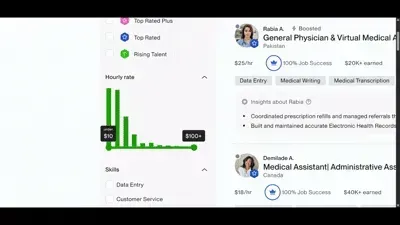
$10/hr or less: This is the entry-level tier. These are freelancers from Nigeria, Philippines, Pakistan, and India who are just starting out.
They're exploring opportunities, building their portfolio, and haven't yet developed the specialized skills healthcare requires.
You'll be spending your time training and hand-holding rather than delegating. One bad data entry? One missed referral? That's your patient relationship and compliance risk.
$15-30/hr: This middle band is where you'll find workers from Mexico, Canada, Egypt, and parts of the Philippines. Some have experience; some don't.
Here's what the Upwork data shows: A medical coder from Islamabad (Awais I.) charges $15/hr, has completed 6 jobs, earned $9K+ total, and carries a 5.0 rating. But look closer: 6 jobs in how many years?
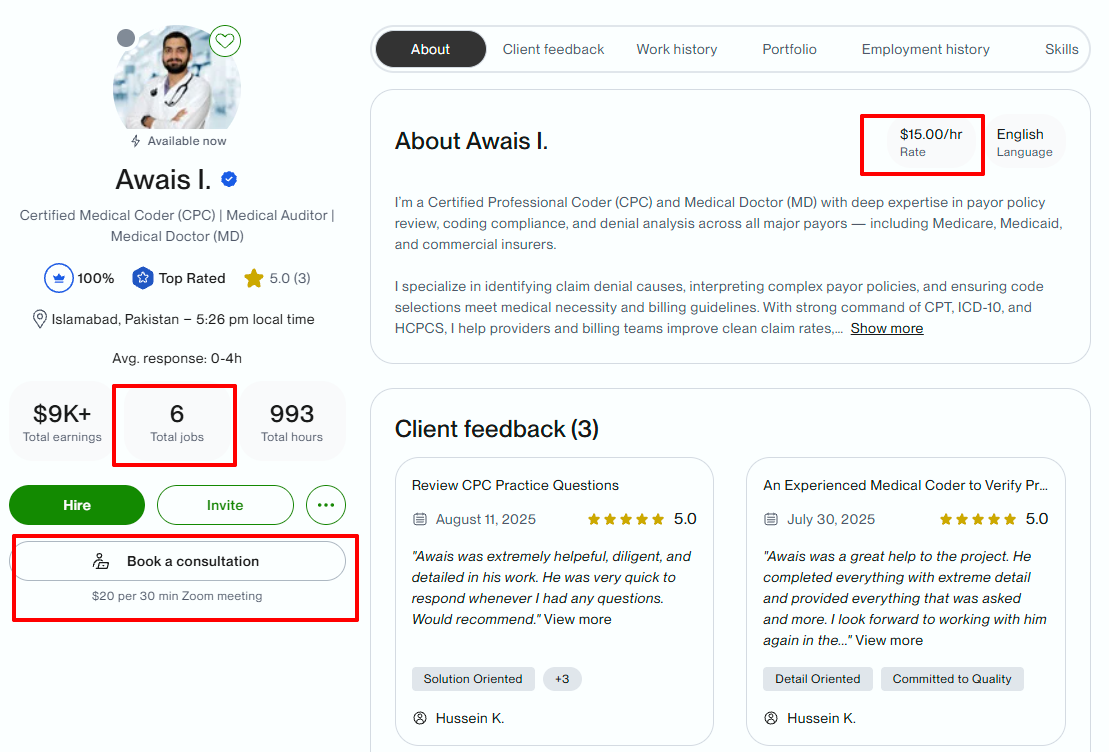
That's thin experience for managing your patient records and insurance claims.
Compare that to Kyle J., a Clinical Neuropsychologist from Chicago charging $170/hr. He's got 100% job success, 5-star reviews, $20K+ in earnings, and deep subject matter expertise.
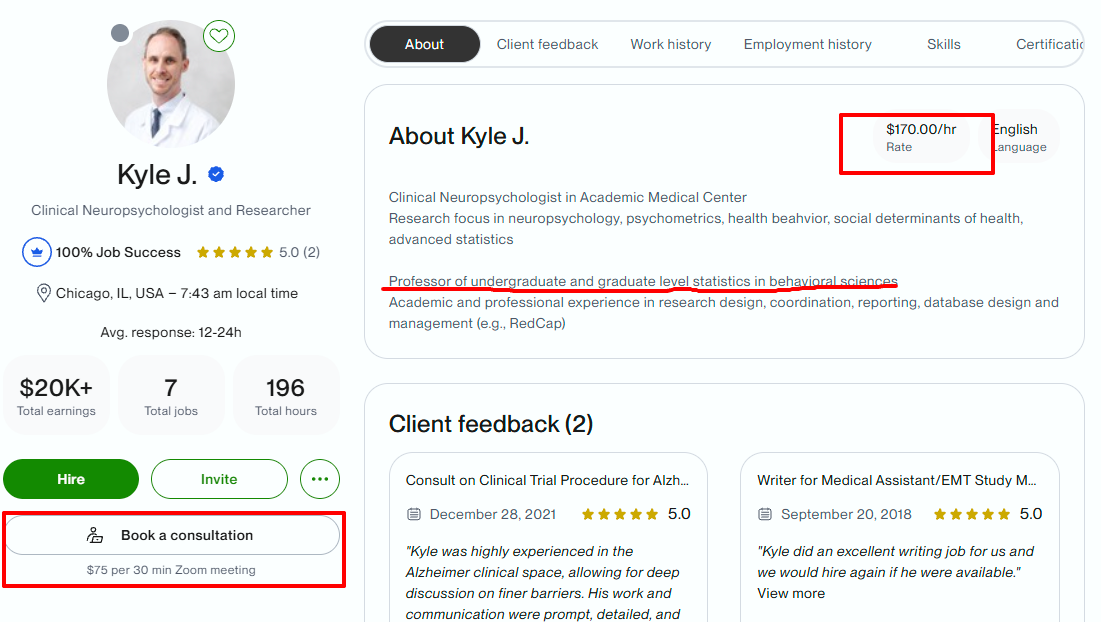
Here you're paying for competence and accountability. But can you afford them full-time? And even a 30 minute consultation call is costing you $75. (But with a managed service provider like Wishup the consultation call does not cost you a penny.)
$30-100+/hr: These are your certified nurses, medical coders with advanced credentials, and healthcare professionals moonlighting as freelancers. Yes, they're excellent.
Yes, you can afford them full-time but not without your overhead crushing your margins.
So what's the other option at your disposal?
Now compare that to hiring someone dedicated who doesn't disappear, doesn't make careless mistakes, and takes responsibility.
Suddenly, $12/hr doesn't look cheap anymore, as monthly it comes up to $1299.
Third option is the cost of hiring a medical virtual assistant from an outsourcing companies.
Now lately virtual assistant have been the most popular option amongst the healthcare providers in the United States. And the cost to hire them is affordable and comes with multiple benefits.
Option three: a managed service like Wishup
The managed model is where Wishup operates, and I will explain why I think it is the right answer for most healthcare practices, then let you judge.
In a managed service, you are not hiring an individual, you are engaging an organization that hires, vets, trains, deploys, and manages the assistant for you, and that signs the Business Associate Agreement as an accountable entity that can actually stand behind it.
Wishup pricing for medical virtual assistant support starts at $1299 a month, with full-time dedicated engagements structured as predictable monthly plans rather than fluctuating hourly bills. A medical virtual assistant costs $1,299 to $5,400 per month depending on experience tier and hours. Wishup does not bill hourly; all plans are fixed monthly.
That sits below the cost of a US-based in-house hire and, critically, it includes the things the other two options make you provide yourself: vetting, training on your tools, a dedicated manager, backup coverage, a replacement guarantee, and an organization that carries the compliance responsibility with you.
Medical virtual assistant pricing, 2026
| Plan | Part-time (80 hrs/mo) | Full-time (160 hrs/mo) | Best for |
|---|---|---|---|
| Prime VA | $1,299/mo | $1,999/mo | Scheduling, intake, insurance verification, records |
| Elite VA | $1,999/mo | $2,999/mo | Multi-workflow ownership, automation, vendor and team coordination |
| US-Based VA | $3,000/mo | $5,400/mo | Practices needing US hours, native English, US background checks |
Part-time is 4 hours a day, full-time is 8 hours a day, 5 days a week. Annual billing saves 5%.
What is included in the monthly price
Candidate sourcing, six-step vetting, skills assessment, background verification, eight-week pre-deployment training, onboarding, a dedicated VA Manager, workforce management app access, ongoing QA, and replacement. No setup fee, no recruitment fee, no interview fee, no replacement fee.
The pattern in that table is the whole argument.
The DIY and freelance routes look cheaper per hour because they price labor only. They quietly hand you the recruiting, training, management, backup, and compliance work, which is most of the real cost of having a reliable team member.
A managed service prices the whole system around the assistant, which is why the rate sits a little higher and the total cost, and the total risk, sits lower.
For a fuller market view, our guides on best-medical-virtual-assistant-companies and hire-hipaa-compliant-virtual-assistant compare the landscape in detail.
If you take one thing from this section, take this: a Business Associate Agreement signed only by an individual freelancer does not protect your practice.
Only an organization can assume HIPAA liability, enforce safeguards, and guarantee ongoing compliance.
That single fact is why so many practices that start with freelancers end up moving to a managed service after their first scare.
How to hire a medical virtual assistant from Wishup?
I have made the cost and compliance case.
Now let me show you how simple the actual hiring is, because the process is genuinely the part practices are most surprised by.
There is no job posting to write, no stack of resumes to wade through, and no weeks of waiting. We hire medical virtual assistants in three steps.
1. Share your requirements
Tell us your specialty, your workflow, the tools you use, and the tasks you want off your team's plate. This is a conversation about your practice, not a form. The clearer your task list, the sharper the match.
2. We match you with the top 0.1%
We match you with a pre-vetted assistant from the top 0.1% of applicants, chosen for your specialty and your tools. Because the vetting and training are already done, the person you meet is ready to work, not ready to be trained.
3. Interview free, onboard in 60 minutes
Run unlimited same-day interviews at no cost, and hire only if you are satisfied. Once you say yes, your assistant can be onboarded in about 60 minutes. No recruiting cycle, no payroll setup, no HR overhead.
What to ask in a medical virtual assistant interview
Five questions that separate candidates quickly:
- Walk me through how you would verify a patient's benefits before an appointment. (Tests whether they know the workflow or just the words.)
- Which EHR have you spent the most hours in, and what did you find hardest about it? (Real users have a complaint. People who have seen a demo do not.)
- A patient calls describing symptoms and asks what they should do. What do you say? (The only right answer routes to a clinician.)
- How do you keep track of authorizations that are pending across different payers? (Tests whether they have a system or rely on memory.)
- Tell me about a time a claim was denied and what you did next. (Tests denial-handling instinct, which is where revenue leaks.)
Two numbers tell you how well the matching works.

Our first-match success rate is 90%, which means nine out of ten practices are happy with the very first assistant we introduce.
And our second-match success rate is 100%, so in the rare case the first match is not right, the second one is.
You are never stuck, and you never pay for the interviews it takes to get there.
The reason we can offer unlimited free interviews is that we are confident in the match. Most virtual assistant companies charge for client interviews precisely because their matching is weaker and the interviews are a revenue stream.
We treat interviews as the natural way for you to confirm fit, which is how it should be.
Why hire a medical virtual assistant from Wishup?
There are a lot of places to hire a medical virtual assistant, so let me be direct about what makes Wishup different.
It comes down to a model built on four commitments: we hire elite talent, we train them rigorously, we deploy them in 60 minutes, and we manage them for you after onboarding.
Below is what each of those actually means, followed by the proof points and guarantees that back them.
1. We hire elite talent
The quality of the work starts with the quality of the hire, so our front door is deliberately narrow. We accept roughly the top 0.1% of candidates through a rigorous six-step, in-person vetting process. Every assistant is a college graduate, aptitude-tested at the 99th percentile, and brings at least three years of professional experience. Just as important for a healthcare practice, our average retention sits at 36 months, so the person you onboard is someone who stays, not someone who churns out mid-project.
2. We train them rigorously
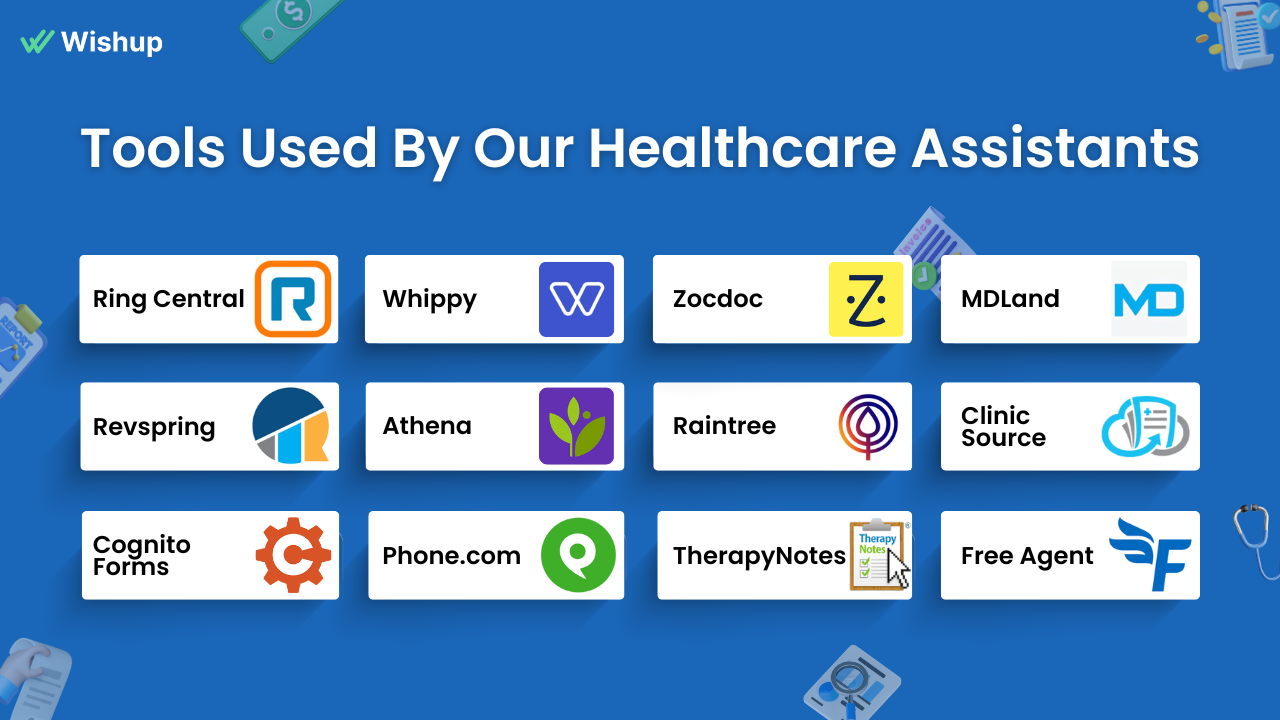
A great hire still needs the right tools and the right polish, so every assistant completes structured training before deployment. They are trained across 120+ AI tools and EHR and EMR systems, the practical stack a modern practice runs on, including platforms like N8N, Canva, Monday.com, Zoho, ChatGPT, Apollo, and RingCentral. Our overview of the ehr-softwares-used-by-healthcare-virtual-assistants shows the clinical-tool depth in detail.
3. We deploy them in 60 minutes
Speed is a feature, not a slogan. Because we match on industry and have already done the vetting and training, we can place an assistant in about an hour. There is no charge for client interviews with your assistant, unlike other virtual assistant companies that monetize that step. And you carry no recruitment, no payroll, and no HR overhead, we handle all of it. You go from "I need help" to "my assistant is working" the same day.
4. We manage the talent after onboarding
This is the part that separates a managed service from a staffing referral, and it is where most of the long-term value lives. Every engagement is supported by a structure, not just a single person. You get a bookkeeper, a task-support team, and a dedicated Customer Success Manager. If your assistant is ever not the right fit, we provide an instant replacement guarantee. Your data is protected by enterprise-grade security, strict NDAs, secured systems, and monitored workflows. You get free lifetime access to the Wishup Workforce Management App, daily End-of-Day reports, time tracking and live monitoring, and a consistent feedback cycle so the work keeps improving.
The guarantees and standards behind the model
I would rather show you the specifics than ask you to trust adjectives, so here is the operating detail of how a Wishup engagement actually runs.
What kind of work this is suited for
Wishup is built for recurring operations and admin work, consistent support that functions like an in-house employee, an "employee as a service" rather than a gig. It is loyalty without the commitment of a permanent hire. It is not built for micro-gigs or one-off ad-hoc tasks, and we will tell you honestly if your need is a better fit elsewhere.
Vetting and training
Every assistant passes a six-step stringent vetting process and completes an eight-week mandatory AI and communications training before they are deployed.
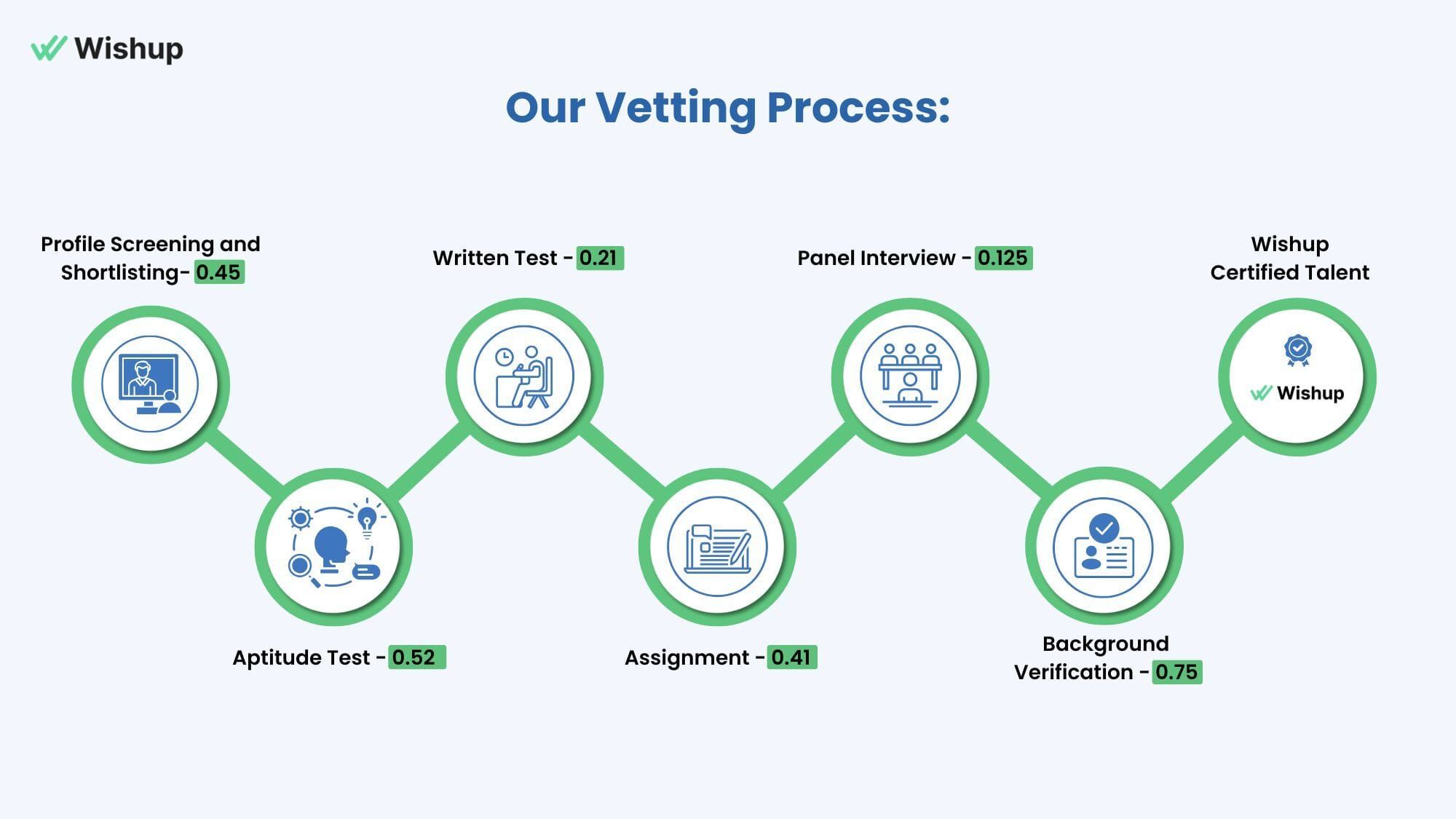
They are peer-trained specifically for US-based businesses, so the communication norms and operational expectations match your market.
Ongoing support and quality
Quality is maintained on a cadence, not left to chance: weekly QA reviews by the assistant manager, fortnightly SOP adherence checks, and monthly Customer Success Manager check-ins.
You also get a 30-day ROI report so the value is measured, not assumed, and a first-task completion guarantee so the relationship starts with a win.
Coverage, replacement, and responsiveness
You can effectively hire three at the price of one in terms of coverage, because backup is built in for when your assistant is on leave, replacement happens within 24 hours, and there is no additional charge for replacement.
Responsiveness is held to a five-minute turnaround during working hours and a 60-minute response time from any point of contact.
Security and compliance
Security is handled with NDAs, background checks, SOC 2 and GDPR alignment, and a password-manager workflow so credentials are never handled loosely.
For healthcare specifically, that means real-time activity monitoring, role-based access so an assistant only ever sees what their task requires, encrypted systems, and NDA-based confidentiality across both client and assistant agreements.
AI readiness and results
Our assistants come AI-ready by design, our teams shipped more than 50 AI automations in the last quarter alone, and on the revenue side, we see over 95% acceptance of claims on first submission. Those are the outcomes the model is built to produce.
Healthcare automation experts
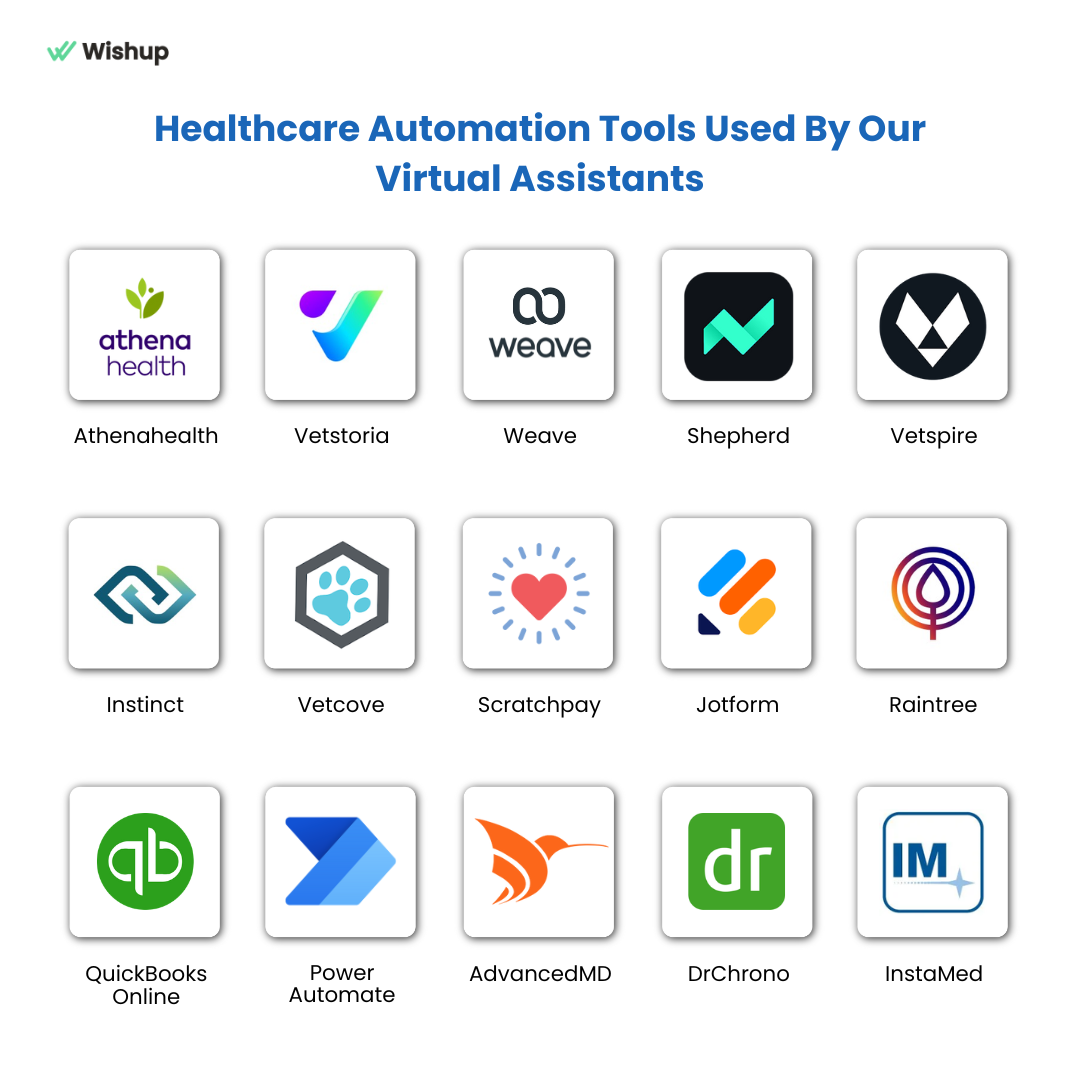
Here is where Wishup medical virtual assistants go beyond the traditional definition of the role. Our assistants are not only handling tasks, they are building the automations that make those tasks disappear.
Using tools like n8n, Zapier, and other automation platforms, they design workflows that run the repetitive operational work on their own, so your team is freed from the copy-paste layer of the job, not just helped with it. This is the difference between an assistant who does the work and one who engineers the work away.
I want to show you what that looks like with real numbers rather than a promise. Below is a snapshot from our automation portfolio, the kind of dashboard our teams use to track the impact of the workflows they build. These are actual figures from automation work our assistants have delivered.
The healthcare workflows our medical virtual assistants have built
The point of starting with a non-clinical example is to show the engineering capability is real and measurable. Now look at how it lands inside healthcare specifically.

One of our healthcare clients had a single automation, built and maintained by their Wishup assistant, that saved 133 hours a month, roughly $5,320 in monthly value, across customer-support and admin functions, using Macro VBA, Python, and Excel.
One automation. One assistant. A hundred and thirty-three hours a clinician or coordinator no longer spends on manual work.
A single healthcare automation, built by a Wishup assistant
Built and maintained by the client's dedicated assistant using Macro VBA, Python, and Excel, automating recurring customer-support and admin work that had been done by hand. This is the model in miniature: a vetted assistant who does not just absorb the task but removes it from the human workload entirely.
The story for your practice is the same playbook.
Most teams quietly lose hours every week to operational work that nobody should be doing by hand, the manual juggling that causes delays, missing paperwork, and errors.
A Wishup healthcare automation expert virtual assistant starts by doing that work reliably, then identifies the pieces that can run on their own and builds the automation to make it so.
The only question is which time-sink you tackle first.
Our guides on how to how-to-automate-healthcare-workflows-with-a-virtual-assistant and how to how-to-automate-therapy-practice-workflows-with-a-virtual-assistant show exactly how that sequence runs in a clinical setting.
How Wishup medical virtual assistants have helped healthcare professionals
Numbers in a brochure are easy to discount, so let me ground this in what actually happened for real practices.
These are outcomes from healthcare clients who brought on a Wishup medical virtual assistant, and each one maps to a problem I described earlier in this guide.
A healthcare brand cut accounts receivable by 60%
With denial rates rising and revenue leaking through unworked claims across the industry, this practice put a Wishup assistant on disciplined accounts-receivable follow-up and denial work. The result was a 60% reduction in AR, cash that was already earned, finally collected. Read the full account: how-a-healthcare-brand-cut-ar-by-60-with-virtual-assistant.
A virtual assistant rescued a healthcare CEO from burnout
Administrative overload does not only exhaust front-line clinicians, it consumes leadership too. By handing the operational weight to a dedicated assistant, this healthcare CEO recovered the time and headspace to run the organization instead of drowning in its admin. The full story: how-a-virtual-assistant-rescued-healthcare-ceo-from-burnout.
A virtual assistant helped a healthcare startup regain time and control
For a growing startup, the admin work was outpacing the team. A Wishup assistant absorbed the operational load so the founders could scale the business without losing their grip on day-to-day execution. The full story: how-a-virtual-assistant-helped-healthcare-startup-regain-time-and-control.
One more example worth naming, because it shows the scale of the operational change.
When a pediatric therapy practice with 300 patients and 19 therapists brought in a Wishup medical virtual assistant, they did not simply add front-desk help.
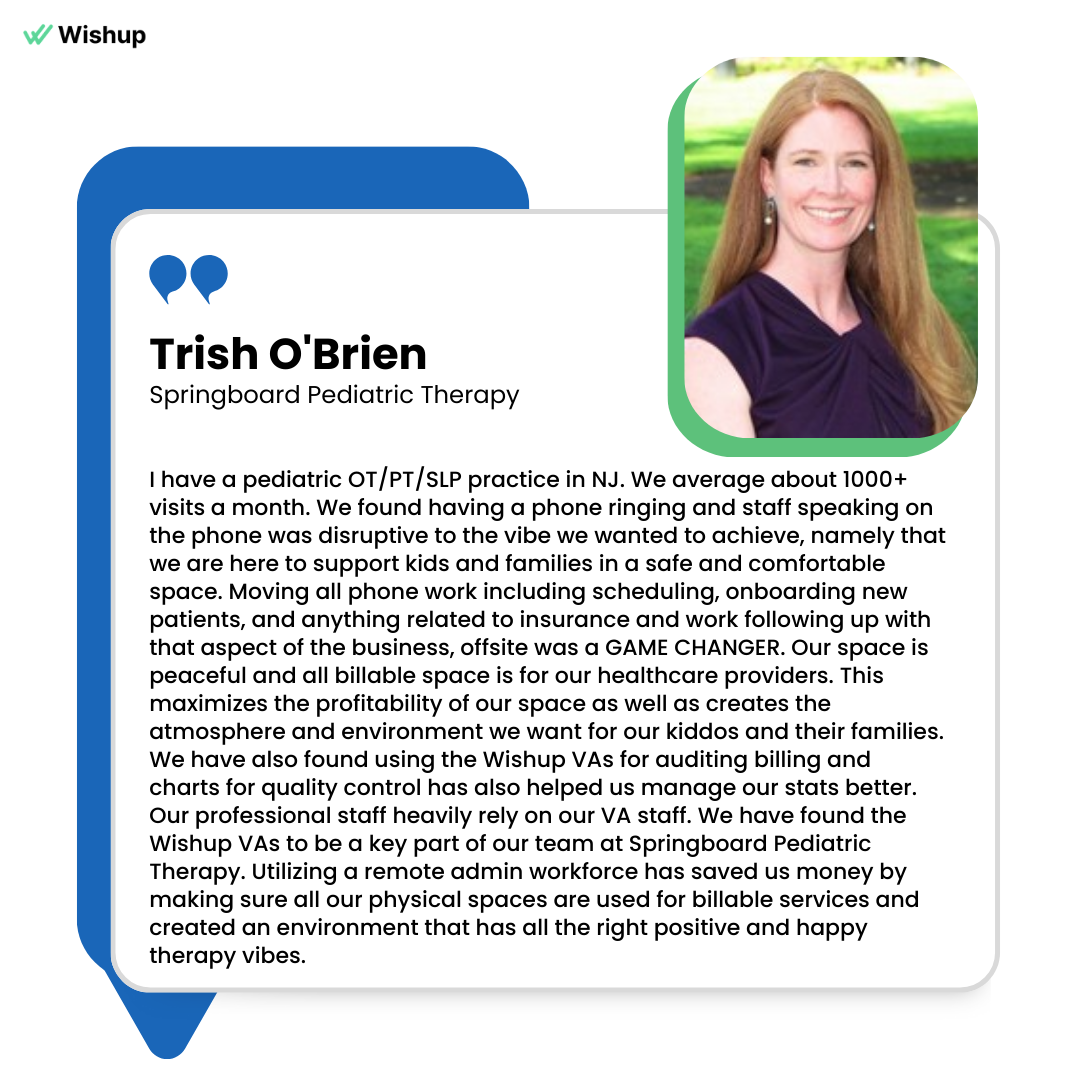
They implemented an operational system that reduced accounts receivable by 70% in three months and let them avoid the cost of two in-house receptionists, a saving of roughly $4,000 to $5,000 every month, while creating specialized roles in scheduling, intake coordination, and insurance claim management.
That is what it looks like when administrative work is owned rather than merely covered.
Across all of these, the assistant did not just take tasks off a list. They changed how the practice ran, and the numbers followed.
How to use a medical virtual assistant in your office
Bringing on a hipaa compliant medical virtual assistant works best when you are deliberate about it.
The practices that get the most value are not the ones that hand over a vague pile of work, they are the ones that integrate the assistant the way they would a strong in-house hire.
Here is the approach I recommend, drawn from what works.
Start with one painful workflow, then expand
Resist the urge to delegate everything at once.
Pick the single workflow causing the most pain, often inbound calls and scheduling, or prior authorization, and let your assistant own it completely first.
Once that is running cleanly, add the next.
This builds trust quickly and gives you a clear before-and-after on each function.
Document your process once, reap it forever
Spend an hour walking your assistant through how you want each task done, ideally captured as a simple standard operating procedure.
A good assistant will often turn that walkthrough into a documented SOP you both work from.
After that, the work runs to your standard without you re-explaining it, and the SOP becomes an asset that survives any future transition.
Give them real access to your systems, securely
An assistant kept at arm's length cannot help much.
Through a secure, role-based setup, with credentials in an encrypted password manager and access limited to exactly what each task requires, your assistant works inside your EHR, your scheduling system, your billing platform, and your phone system.
This is what lets them own a workflow rather than just advise on it, and it is done within the security framework described earlier.
Set a communication rhythm
Decide how you want to stay in sync, a daily End-of-Day report, a quick weekly check-in, a shared task board.
With Wishup, you also have a Customer Success Manager and the Workforce Management App to keep visibility high without micromanaging.
The goal is clear pathways so your clinical team gets only the information it needs, when it needs it, and nothing more.
Treat them as part of the team
The practices that see the best retention and results treat their assistant as a genuine team member, looped into changes, trusted with ownership, and given feedback.
Because Wishup assistants average 36 months of retention, this is an investment that compounds, the longer they are with you, the more of your practice's nuance they hold.
Benefits of virtual assistants in a healthcare setting
Pulling the threads together, here is what a medical virtual assistant actually delivers to a US healthcare practice.
I have kept this grounded in the realities covered throughout the guide rather than reaching for inflated promises.
Reduced administrative burden and clinician burnout
This is the headline benefit.
Administrative load is the leading driver of physician burnout, and physicians spend close to two hours on paperwork for every hour with patients.
Moving that work to a dedicated assistant gives clinicians their time and attention back, which is good for them, good for patients, and good for retention of your most valuable people.
More patients seen, fewer lost
When calls are answered, reminders go out, and cancellations get refilled, your schedule stays full and your no-show rate drops.
The capacity you already have gets used, which is often a faster revenue win than anything else you could do.
Stronger cash flow and fewer denials
With denial rates near 11.8% and payers leaning harder on authorization and medical-necessity denials, disciplined verification, prior authorization, and AR follow-up directly protect revenue.
A 95%-plus first-submission acceptance rate and faster collections are the difference between leaking revenue and capturing it.
Lower overhead than in-house staffing
You add operational capacity without facility space, benefits, payroll taxes, or HR overhead.
Compared with the $50,700 to $64,500 annual cost of an in-house administrative hire, a managed assistant is both cheaper and lower-risk.
Built-in compliance and continuity
With a managed service, an accountable organization signs your Business Associate Agreement, enforces safeguards, and provides backup and replacement coverage.
You get HIPAA-aligned handling of protected health information and continuity that a lone hire or freelancer simply cannot guarantee.
Scalability and automation upside
As you grow, you scale support without a hiring cycle each time. And because Wishup assistants are automation-capable, they do not just keep pace with your workload, they shrink it by building workflows that run on their own.
How a healthcare virtual assistant works
If you have read this far, you can probably assemble the picture yourself, but let me make it concrete by walking through what actually happens, end to end.
It begins with you describing your practice and the work you want handled. Wishup matches you with a pre-vetted assistant from the top 0.1% of applicants, already trained on healthcare tools and EHR and EMR systems, and already cleared through a six-step vetting process and an eight-week AI and communications training program. You interview as many candidates as you like at no cost, and once you are satisfied, the assistant is onboarded in about 60 minutes.
From there, your assistant logs into your systems through a secure, role-based setup and begins owning the workflows you assigned, answering calls, managing the schedule, scribing notes into your EHR, verifying insurance, running prior authorizations, working claims, whatever you delegated.
They follow your documented standards, send you End-of-Day reports, and operate under continuous quality oversight: weekly QA reviews, fortnightly SOP checks, and monthly Customer Success Manager check-ins.
Behind your assistant sits the managed-service structure, a dedicated Customer Success Manager, a task-support team, backup coverage for leave, a 24-hour replacement guarantee, and an organization that carries HIPAA accountability with you through a signed Business Associate Agreement.
Over time, as your assistant learns your practice, they move from doing the work to optimizing and automating it.
That is the full arc, from a phone that rings out today to a practice that runs on dependable, compliant, increasingly automated operations.
Hire a healthcare virtual assistant for your practice in 60 minutes from Wishup
I set out to write a guide that answered every practical question a US healthcare provider has about medical virtual assistants, and to do it without the empty filler that fills most pages on this topic.
So let me close with the honest summary.
The administrative pressure on US healthcare is not easing, staffing is scarce, paperwork is growing, denials are rising, and burnout is real and measured.
A medical virtual assistant is one of the few moves that addresses all of those at once, and it does so without the overhead and risk of another in-house hire.
The model you choose matters: doing it yourself hands you the recruiting and management burden, a freelancer leaves you exposed on compliance and continuity, and a managed service like Wishup gives you a vetted, trained, managed, compliant assistant who can be working in your practice today.
If your phones are ringing out, your providers are charting at midnight, your authorizations are piling up, or your AR is climbing, you already have your answer.
The next step is simply to tell us what you need.
Get a medical virtual assistant working in your practice today
Share your requirements, interview pre-vetted, specialty-matched assistants at no cost, and onboard in about 60 minutes. Backed by a 90% first-match success rate and a fully managed, HIPAA-aligned service.
Talk to Wishup →Frequently Asked Questions About Medical Virtual Assistant
How do medical virtual assistants shorten admin backlogs?
A medical virtual assistant shortens admin backlogs by taking ownership of a specific queue rather than helping across all of them. Backlogs form because administrative work has no deadline attached, so it loses every time to the patient in front of you.
In practice the clearing sequence is: pick the queue costing you most, usually unworked claims, open charts or pending authorizations. Assign it entirely to the assistant. Set a daily target rather than a weekly one. Then measure the queue depth each Friday.
Practices typically see the first backlog clear within three to four weeks, because the work was never difficult, it was only ever unowned. One pediatric therapy practice cut accounts receivable by 70% in three months this way, without adding clinical staff.
Why do small practices hire medical virtual assistants?
Small practices hire medical virtual assistants for a reason larger ones do not face: they need front-desk and billing capacity but cannot justify a full-time in-house hire against it.
A full-time medical administrative assistant costs $50,700 to $64,500 a year once benefits and overhead are counted. A solo or two-provider practice rarely has enough administrative volume to fill that seat, but has far too much to leave with the provider.
A part-time assistant at $1,299 a month fills exactly that gap. It is also why small practices tend to start with one workflow, usually inbound calls and scheduling, and expand only once it runs without correction.
Which medical virtual assistant provider has the best performance for Rx reminders and follow-ups?
Providers differ less on whether they send reminders than on what happens after one. Most platforms and providers handle the outbound message. The performance difference shows up in the replies.
When judging providers on this, ask three things: who monitors reminder replies and how quickly, whether refill requests are routed to the provider queue or answered by the assistant, and whether the assistant works inside your EHR's messaging or a separate system that creates a second inbox.
Wishup assistants run the full loop inside your existing systems: reminder sequences timed several days out, the day before and the morning of; monitoring and handling of replies; refill request routing; and no-show recovery outreach. Response standard is five minutes during working hours.
Will my medical virtual assistant work in my local time zone?
Yes. Wishup medical virtual assistants work according to your business hours and time zone. Whether your practice operates in Eastern Time (ET/EST), Central Time (CT/CST), Mountain Time (MT/MST), or Pacific Time (PT/PST), your assistant can align their schedule with your working hours. This allows real-time communication, faster task completion, and seamless coordination with your team throughout the day.
What are the standard working hours for part-time and full-time?
Wishup offers both part-time and full-time healthcare virtual assistants.
- Part-time assistants work 4 hours per day, 5 days a week, for a total of 80 hours per month.
- Full-time assistants work 8 hours per day, 5 days a week, for a total of 160 hours per month.
These hours are typically aligned with your clinic's business hours and time zone. If your practice has specific scheduling needs, we can discuss suitable working arrangements during onboarding.
Is real-time availability guaranteed (e.g., response within X minutes)?
Yes. Wishup trains its medical virtual assistants to be highly responsive during their scheduled working hours.
- Medical virtual assistants are expected to respond to messages and requests within 5 minutes during their working hours.
- If a practice owner, healthcare provider, or clinic staff member needs assistance from a Wishup point of contact, they can expect a response within 60 minutes during business hours.
These response standards are part of our training and operating processes to ensure smooth communication and timely support for healthcare practices.
Can I request split shifts (morning + late afternoon)?
Yes. If your operations require coverage during different parts of the day, at Wishup we can discuss split-shift arrangements based on your requirements and the assistant's availability. This is particularly useful for healthcare practices that experience peak activity during specific hours.
What happens during public holidays (ours vs. the assistant's country)?
Wishup works closely with clients to plan holiday schedules in advance.
- If your clinic remains open during a holiday, coverage options can be discussed beforehand.
- Assistants communicate their planned leave in advance so there are no surprises.
- For critical workflows, coverage arrangements can be coordinated when needed.
This ensures business continuity and clear expectations for both sides.
How do you handle weekend or after-hours coverage?
Wishup medical virtual assistants typically work during the hours included in your plan and aligned with your clinic's time zone. If your practice requires weekend or after-hours support, we can discuss those requirements during onboarding and recommend a suitable coverage plan.
For practices that need extended availability, multiple assistants can also be assigned to create broader coverage across different shifts and time zones. This helps ensure important tasks such as appointment scheduling, patient communication, and administrative follow-ups continue without interruption.
Coverage requirements are planned in advance so your practice always knows when support will be available.
What happens during public holidays (ours vs. the assistant's country)?
Wishup works with healthcare practices to plan holiday schedules well in advance.
If your clinic, medical practice, or healthcare facility remains open during a public holiday, coverage requirements are discussed ahead of time so important tasks such as appointment scheduling, patient follow-ups, insurance coordination, and administrative support continue without disruption.
Assistants communicate planned leave in advance, allowing healthcare providers and practice managers to prepare accordingly. For critical workflows, backup coverage options can be coordinated when needed.
This proactive planning helps ensure that patient communication, provider schedules, and day-to-day practice operations continue to run smoothly during holiday periods.
How do you track hours and share timesheets?
Wishup uses Time Doctor to track the working hours of medical virtual assistants. However, if your healthcare practice requires the use of a different time-tracking tool for compliance or internal policies, we can work with your preferred system.
As a healthcare provider, you also get access to Wishup's workforce management app, where you can:
- View monthly timesheets
- Track daily work activities through end-of-day (EOD) reports
- Monitor attendance and leave requests
- Review completed tasks and ongoing work
- Stay updated on your assistant's productivity and performance
This gives practice owners and healthcare administrators complete visibility into their virtual assistant's work, hours, and day-to-day activities from a single dashboard.
Do you support daily standups or end-of-day summaries?
Yes, we do.
At Wishup, we provide detailed end-of-day (EOD) reports through our workforce management app. Once your medical virtual assistant is onboarded, they submit a daily work report outlining the tasks completed, work in progress, pending items, challenges faced, and priorities for the next day.
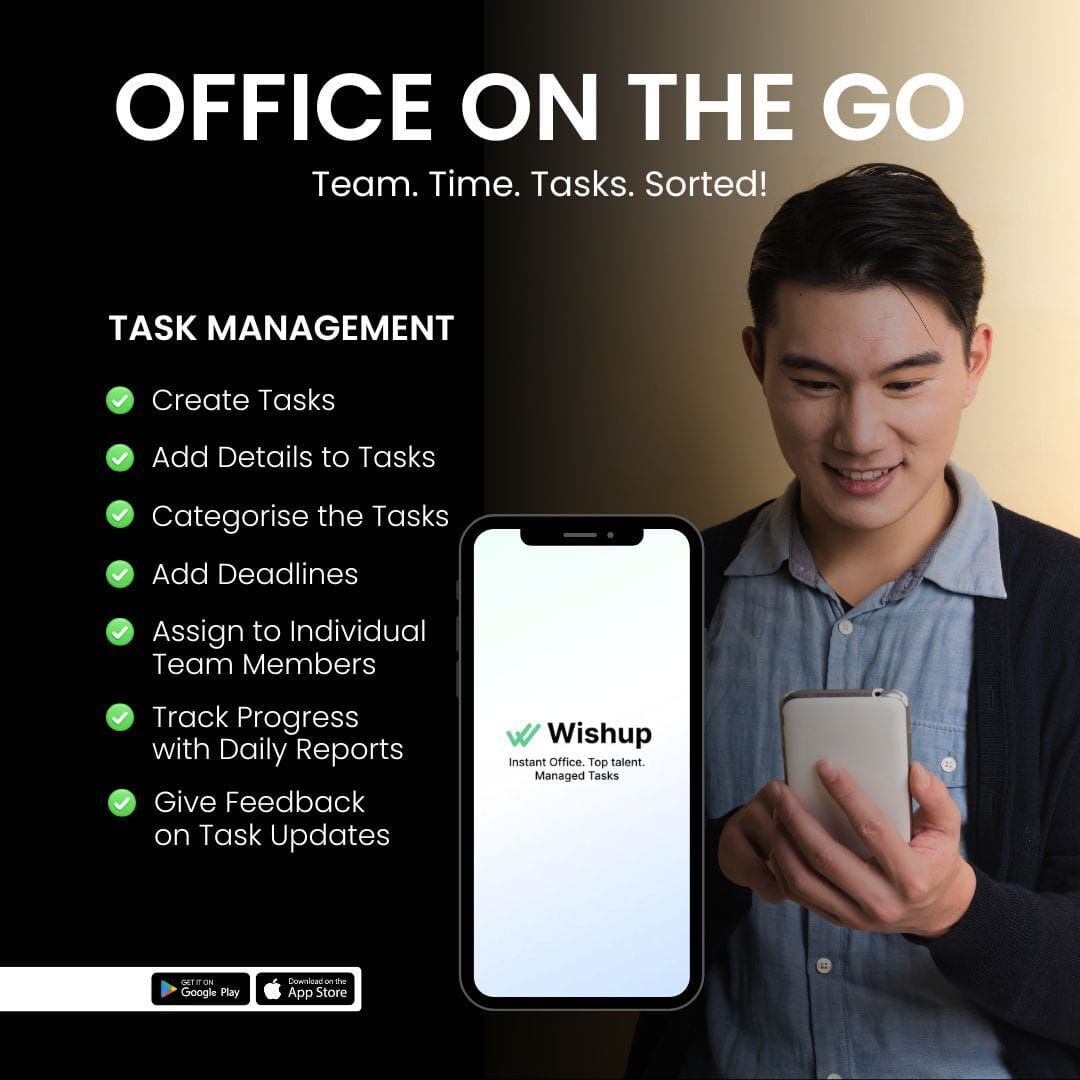
As a healthcare provider or practice owner, you can access these reports anytime. You can review your assistant's work, ask questions, request updates, provide feedback, and track progress directly through the platform.
We also adapt to the way your practice operates. If you prefer daily standups, morning huddles, weekly progress reviews, sprint-based workflows, or one-on-one check-ins, we can align your medical virtual assistant with those processes.
In addition to the assistant, we provide support through a dedicated Virtual Assistant Manager who monitors performance and helps maintain service quality. Our Client Success team stays in regular contact to understand your requirements, gather feedback, and ensure you are getting the support you need.
We also share periodic performance reports that help you understand the impact of your medical virtual assistant on your practice. These reports highlight completed work, key achievements, productivity improvements, and operational efficiencies.
Our goal is to give you complete visibility into your assistant's work while reducing the time you spend on supervision, so you can focus more on patient care and less on administrative management.
Can I align multiple assistants to create rolling coverage across time zones?
Yes. For growing healthcare organizations, multiple Wishup assistants can work together across different functions such as scheduling, patient intake, billing support, and executive assistance. This allows clinics to create broader coverage windows and ensure work continues smoothly across different time zones and departments.
Do you provide temporary coverage when my assistant is sick or on leave?
Yes. Wishup provides management support and backup planning to minimize disruption. If an assistant is unavailable due to illness or planned leave, the team works to ensure important tasks are covered and business-critical workflows continue. This helps maintain continuity without placing additional burden on the client.
What healthcare tasks can a VA handle without touching PHI?
A Wishup healthcare virtual assistant can support numerous operational tasks without directly accessing patient health information, including:
- Calendar and inbox management
- Appointment coordination
- Follow-up scheduling logistics
- Vendor coordination
- Insurance eligibility follow-ups at a process level
- Report preparation and operational dashboards
- File organization and SOP management
- Provider scheduling
- Referral tracking
- Social media and marketing support
- Daily executive digests and activity reports
- Team coordination and administrative communication
The exact scope is defined based on the clinic's security policies and access requirements.
Can you manage appointment scheduling, recalls, and follow-ups securely?
Yes. Wishup Healthcare VAs regularly manage:
- New patient intake scheduling
- Evaluation appointments
- Recurring therapy sessions
- Recall campaigns
- Appointment reminders
- Rescheduling requests
- Waitlists
- No-show recovery workflows
- Follow-up communication
For our client, Springboard Therapy , our medical virtual assistants manage scheduling for more than 300 active patients while ensuring high-value therapy slots remain filled and therapy resources are optimally utilized.
How do you handle insurance verification and claims communication?
Wishup VAs coordinate insurance-related workflows, including:
- Collecting insurance information
- Submitting verification requests
- Following up on eligibility checks
- Tracking authorizations
- Coordinating with billing teams
- Monitoring claim status
- Communicating with insurance representatives
- Escalating denials and authorization issues
For example, the Springboard Therapy VA acts as the communication bridge between therapists, patients, insurance providers, administrative teams, and billing teams to ensure claims and authorizations move forward efficiently.
Can you coordinate with EHR/Practice Management systems without direct PHI access?
Yes. Many healthcare organizations structure access based on role permissions. Wishup medical virtual assistants can:
- Coordinate workflows around EHR systems
- Manage scheduling modules
- Run operational reports
- Track tasks and authorizations
- Route information between departments
- Monitor workflow status
Access levels can be customized according to the clinic's compliance requirements. Some clients grant broader system access, while others restrict VAs to operational functions that do not require direct PHI exposure.
What phone etiquette and scripting do you train for patient interactions?
At Wishup we emphasize:
- Professional and empathetic communication
- Active listening
- Clear articulation
- Neutral and easy-to-understand English
- Appropriate escalation protocols
- Handling sensitive conversations professionally
- Appointment scheduling etiquette
- Patient intake conversations
- Insurance-related discussions
- Consistent adherence to client-specific scripts and workflows
For healthcare practices, VAs are trained to recognize when clinical questions should be escalated to licensed providers rather than answered independently.
How do you manage cancellations, no-shows, and rebooking?
Wishup VAs proactively manage schedule utilization through:
- Cancellation tracking
- Waitlist management
- Rebooking workflows
- Recall outreach
- Make-up appointment scheduling
- Priority slot management
- Patient follow-up campaigns
In the Springboard Therapy account, a dedicated virtual assistant ensures cancelled therapy sessions are replaced whenever possible and works to maximize therapist utilization across hundreds of active patients.
Can you produce daily revenue/ops reports for the practice owner?
Yes.Wishup virtual administrative assistants generate and maintain:
- Daily operational reports
- Scheduling reports
- Productivity dashboards
- Appointment utilization reports
- Authorization tracking reports
- Accounts receivable summaries
- Revenue-supporting operational metrics
- Executive daily digests
- Weekly leadership summaries
These reports help practice owners make staffing, scheduling, and operational decisions with greater visibility.
How do you coordinate with clinicians vs. front-desk staff?
Wishup virtual assistants serve as the operational hub between multiple stakeholders:
For Clinicians
- Therapy schedule coordination
- Documentation follow-ups
- Authorization updates
- Referral coordination
- Patient onboarding communication
For Front Desk / Administrative Team
- Appointment management
- Intake coordination
- Call handling
- Scheduling changes
- Patient communication
Leadership
- Reporting
- Escalations
- Operational updates
- Priority management
In larger practices, VAs frequently coordinate among clinicians, billing teams, intake teams, practice managers, and owners simultaneously.
What safeguards prevent mixing patient data across clinics?
Wishup follows a dedicated-client operating model designed to maintain data separation:
- Dedicated VA assignment
- Client-specific access controls
- Separate login credentials
- Client-controlled system permissions
- VPN and access restrictions where required
- Role-based access to platforms
- Documented workflows and SOPs
- Activity tracking and reporting
- Password-management tools for credential security
Each client environment operates independently, ensuring information remains confined to authorized systems, users, and workflows.
Do you offer hourly pricing or only monthly plans?
At Wishup, we offer fixed monthly pricing plans for medical virtual assistants. We do not offer hourly pricing.
You can choose between part-time and full-time plans based on the level of support your practice needs.
Part-time Medical Virtual Assistant
- Works 4 hours per day
- 80 hours per month
- 5 days per week
Full-time Medical Virtual Assistant
- Works 8 hours per day
- 160 hours per month
- 5 days per week
We offer three service tiers:
All prices are in U.S. dollars and billed monthly.
What’s included in the monthly price (and what’s not)?
At Wishup, the monthly price covers much more than just hiring a medical virtual assistant. The exact benefits depend on the plan you choose.
Prime Medical VA Plan
The Prime VA plan is designed for healthcare providers who need reliable administrative support and day-to-day task execution.
This plan includes:
- Top 0.1% of applicants
- 3+ years of professional experience
- Training in 120+ AI and no-code tools
- Administrative, support, operations, and online reputation management assistance
- Dedicated VA Manager
- 8 weeks of hands-on training
- Free VA replacement if needed
- 60-minute onboarding process
- Support aligned with your time zone
Elite Medical VA Plan
The Elite VA plan is designed for healthcare practices that need a more experienced professional capable of handling complex workflows and stakeholder management.
Everything included in the Prime VA plan, plus:
- 5+ years of cross-industry experience
- Training in 120+ automation workflows
- Ability to manage teams, vendors, and stakeholders
- Dedicated VA Manager and Client Success Manager
- Budget and P&L management experience
- Backup VA support during planned absences
- C-suite and leadership-level support capabilities
- Graduates from Tier-1 colleges
- Three custom workflow automations included
- Quarterly ROI and performance audits
US-Based Medical VA Plan
The US-Based VA plan is designed for healthcare providers who prefer a virtual assistant located in the United States.
Everything included in the Prime VA plan, plus:
- Works in U.S. time zones and business hours
- Native English speaker
- Verified U.S. background checks
- Familiarity with U.S. compliance and regulatory requirements
- Alignment with U.S. federal holidays
- Training in U.S. workplace tools and systems
- Weekly accountability reviews
- Familiarity with U.S.-based vendors
- Cultural alignment with U.S. healthcare organizations
What is not included?
The monthly fee does not typically include:
- EHR or practice management software subscriptions
- Phone systems and telecom costs
- Third-party software licenses
- Medical billing software subscriptions
- Any technology or software purchased directly by your practice
If your medical virtual assistant requires access to a tool already used by your practice, you would generally provide that access.
Do you offer quarterly or annual discounts?
Yes. We offer discounted pricing when you choose annual billing. A 5% discount on annual billing.
We do not currently offer additional discounts for monthly or quarterly billing. The savings are available only when you commit to an annual plan.
Prime Medical VA
Part-Time (4 Hours/Day)
- Monthly: $1,299/month
- Annual: $1,234/month
- Save $779 per year
Full-Time (8 Hours/Day)
- Monthly: $1,999/month
- Annual: $1,899/month
- Save $1,199 per year
Elite Medical VA
Part-Time (4 Hours/Day)
- Monthly: $1,999/month
- Annual: $1,899/month
- Save $1,199 per year
Full-Time (8 Hours/Day)
- Monthly: $2,999/month
- Annual: $2,849/month
- Save $1,799 per year
US-Based Medical VA
Part-Time (4 Hours/Day)
- Monthly: $3,000/month
- Annual: $2,850/month
- Save $1,800 per year
Full-Time (8 Hours/Day)
- Monthly: $5,400/month
- Annual: $5,130/month
- Save $3,240 per year
By choosing annual billing, healthcare providers can lock in lower pricing while maintaining uninterrupted support throughout the year.
Do you charge any setup or onboarding fees?
No. We do not charge any setup fees, recruitment fees, sourcing fees, onboarding fees, or replacement fees.
Your monthly fee covers:
- Candidate sourcing
- Screening and vetting
- Skills assessments
- Background verification processes
- Onboarding support
- Dedicated account management
- Workforce management tools
- Ongoing quality monitoring
- Performance management support
This allows healthcare providers to hire a medical virtual assistant without worrying about additional upfront costs.
Is there a minimum commitment or can I go month-to-month?
We offer flexible monthly plans and do not require a long-term commitment.
You can hire a medical virtual assistant on a month-to-month basis and pay monthly. We do not lock healthcare providers into lengthy contracts. If your requirements change, you can discuss your options with our team. You can scale up and down as and when required.
This flexibility allows you to scale support based on your practice's needs without making a long-term commitment upfront.
How much does a part-time medical virtual assistant cost per month?
You can hire a part-time medical virtual assistant from Wishup starting at $1,299 per month under our Prime VA plan.
A part-time medical virtual assistant works 4 hours per day, 5 days a week, providing 80 hours of dedicated support per month.
When you hire a medical virtual assistant through Wishup, you get more than just an assistant. Every candidate goes through a rigorous selection and training process to ensure they can support healthcare providers effectively.
Our part-time medical virtual assistants come with (and same applies to full-time hire):
- Access to the top 0.1% of applicants
- A rigorous 6-step vetting process, including in-person assessments
- College graduates who have passed aptitude and communication assessments
- Candidates with 3+ years of professional experience
- An average employee retention period of 36 months
- The ability to onboard a virtual assistant in as little as 60 minutes
- Stable and reliable support compared to hiring freelancers
- Unlimited same-day interviews at no additional cost
- A 90% first-match success rate
- A 100% second-match success rate if a replacement is ever needed
- A dedicated Virtual Assistant Manager
- Time-zone aligned support
- Ongoing training and performance monitoring
If your healthcare practice requires more experienced support, we also offer:
- Elite medical VA: Starting at $1,999/month for part-time support
- US-Based medical VA: Starting at $3,000/month for part-time support
The right plan depends on your practice's requirements, workflow complexity, and the level of expertise you need from your medical virtual assistant.
How much does a full-time medical virtual assistant cost per month?
At Wishup, the cost of a full-time medical virtual assistant depends on the service tier you choose.
- Prime VA: $1,999/month
- Elite VA: $2,999/month
- US-Based VA: $5,400/month
A full-time medical virtual assistant works 8 hours per day, 5 days per week, providing 160 hours of dedicated support per month.
The final plan you choose depends on your practice's requirements, workflow complexity, and preferred level of experience.
How do I communicate with my medical virtual assistant?
There are plenty of communication channels to ensure you can stay in touch with your medical virtual assistant at Wishup, including email, Slack, and WhatsApp. We also have an internal app that helps you track your virtual assistant’s daily activities.
