
The biggest leak in medical billing rarely shows up as a denied claim. It shows up earlier than that, as an encounter note that never got closed, which means a claim never got created in the first place. No denial to track, no appeal to file, just revenue that quietly never existed.
Everything in this guide comes from Wishup's virtual assistants currently running billing support on a live US multi-provider practice account.
This isn’t theoretical process documentation; it’s the actual daily workflow, the actual numbers, and the actual bottlenecks a real practice runs into.
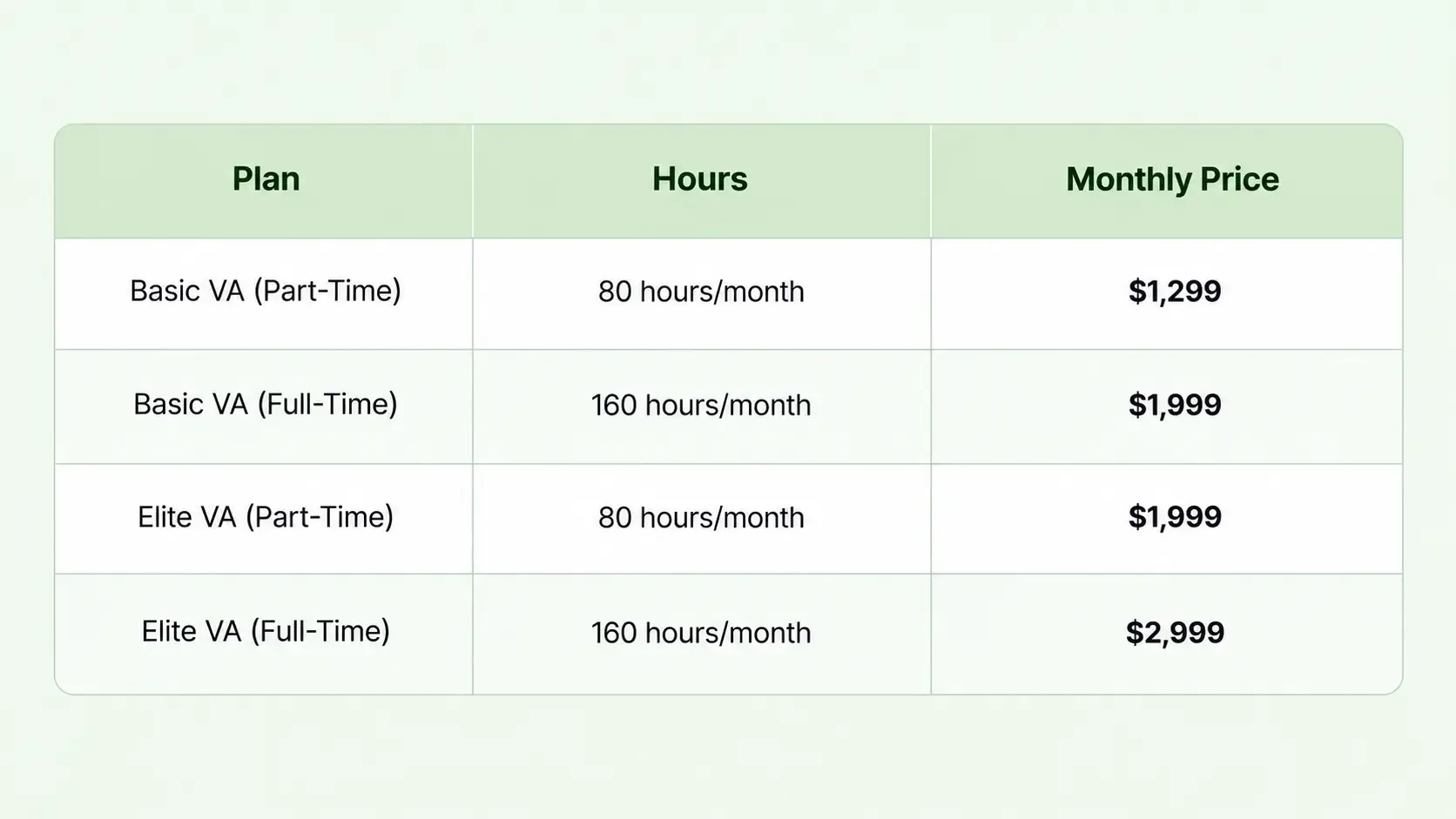
Hire a medical billing virtual assistant via Wishup, starting at $1,299 per month.

By the end of this guide, you’ll know exactly
- what a billing virtual assistant does before a claim exists,
- what happens after it’s submitted,
- what tools the role runs on, and
- what it costs compared to an in-house hire.
Who Is a Medical Billing Virtual Assistant?
A medical billing virtual assistant is a remote professional who supports the billing process end to end: preparing encounter notes for billing, verifying insurance eligibility, chasing what’s holding claims up, and tracking patient-responsibility balances. The role is a support layer around billing, not a replacement for a certified biller or coder.
Put plainly: the virtual assistant prepares, verifies, chases, and records. Coding sign-off and final claim clearance stay with the practice or its billing team. This distinction matters enough to define upfront, because it shapes every task described in this guide.
A billing virtual assistant makes a claim billable. The practice and its billing team decide what actually gets billed.
How Does the Billing Process Happen by the Virtual Assistant?
The billing process runs in two halves: everything that has to be right before a claim can exist, and what happens once it’s submitted. A virtual assistant owns the first half directly and supports the second.
Pre-Billing: Before a Claim Can Exist
- Financial clearance before the visit. The next day’s schedule is reviewed patient by patient to confirm active insurance, self-pay status, and co-pay amount.
- Referral requirements identified. Specialty visits under certain plans need a primary care referral. The virtual assistant flags these in advance and contacts the patient by call, text, or email to obtain one.
- Inactive coverage flagged early. Where insurance has lapsed, the patient is contacted before the appointment for an active member ID.
- Appointment confirmed. Confirmation is treated as a billing function, since an unconfirmed booking still costs the practice.
- Encounter note reviewed after the visit. The virtual assistant opens each note and checks the procedure (CPT) codes the provider entered against the diagnosis (ICD) codes on the chart.
- Practice coding checklist applied. Codes are checked against the practice’s own checklist, updated as payer rules change, flagging anything that needs adding or removing.
- Time component recorded, where the code depends on time spent with the patient.
- Eligibility re-verified for the date of service. If coverage wasn’t active that day, the encounter routes to self-pay.
- Note cleared for billing and moved to the billing team, who run a second check before the claim goes out.
On one account, this runs to 130 to 150 patient notes a day, roughly 20 to 25 per provider.
Post-Billing: After the Claim Leaves
Claim submission, denial management, appeals, payment posting, and accounts receivable follow-up sit with the billing team or billing company, not the virtual assistant. The virtual assistant’s role here is supporting and chasing: tracking what’s outstanding, recording what’s been collected, flagging what’s stuck.
Patient-responsibility balances are the part that comes back to the virtual assistant: co-pays, self-pay amounts, and cancellation or no-show fees, applied through the practice’s payment system once the visit is coded.
Case Studies of Wishup Healthcare Virtual Assistants


What Are the Tasks That a Virtual Assistant for Medical Billing Companies Does for You?
A billing virtual assistant handles five groups of tasks: pre-visit financial clearance, encounter and charge review, chasing what holds billing up, patient-responsibility collection, and claim-side support. The first four come from daily work on a live practice account. The fifth is general industry practice.
Pre-Visit Financial Clearance
- Verify insurance is active on the next day’s schedule
- Identify self-pay patients and flag them before the visit
- Confirm co-pay amounts so the front desk knows what to collect
- Spot plans that require a primary care referral and chase the patient to get one
- Contact patients with lapsed coverage and request an active member ID
Encounter and Charge Review
- Open each day’s notes by provider and patient
- Check procedure codes against the diagnosis codes on the chart
- Flag codes that need adding, removing, or correcting
- Apply the practice’s coding checklist as payer rules change
- Record the time component where the code depends on it
- Re-verify coverage for the date of service
- Clear the note so the billing team can work it
Chasing What Holds Billing Up
- Track how many notes providers have left unclosed
- Send practice leadership a backlog report every Monday
- Email each provider their own pending note count every Tuesday
- Email each provider their open follow-up items from the past 90 days every Friday
This group matters more than it looks. An unclosed note is a claim that doesn’t exist yet, and a fixed reporting rhythm is what gets providers to clear their backlog.
Patient-Responsibility Collection
- Apply the practice’s no-show and late-cancellation fee policy
- Charge co-pays and cancellation fees through the practice’s payment system
- Route uncovered encounters to self-pay
- Flag failed charges so the practice can follow up
Claim-Side Support
- Track claim status and outstanding balances
- Record denials and route them to the billing team
- Support payment posting and reconciliation
- Follow up on aging accounts receivable
- Prepare simple reports on collections and aging
The virtual assistant supports this group rather than owning it. Claim submission and appeals stay with the billing team or billing company.
What Other Tasks Can Wishup’s Billing Process Virtual Assistants Do for You?
Billing virtual assistants often handle adjacent administrative work for the same patients and systems. On one account, the same team covers all of the following.
- Appointment scheduling and calendar management. The virtual assistant moves bookings from the patient booking platform into the practice system and blocks booked slots across the next seven days so availability never double-books. See the healthcare appointment scheduling service.
- No-show reduction. The virtual assistant makes confirmation calls the day before and calls in real time when a patient hasn’t arrived, then offers same-day or next-day rescheduling.
- Inbound and outbound patient calls. The virtual assistant handles the practice’s daily call volume, covered in the virtual medical receptionist guide.
- Prescription refill queue management. The virtual assistant checks eligibility and routes refill requests to providers.
- Prior authorization support. The virtual assistant identifies requests that need authorization and routes them, with submission handled separately, as covered in how to hire a prior authorization virtual assistant.
- Lab result follow-up. The virtual assistant sends reviewed results to patients and books any follow-up visit.
- Fax handling for documents from labs, pharmacies, and other clinics.
- Patient recall campaigns. The virtual assistant contacts patients due for an annual visit by text and email.
- Chart and record upkeep, covered in the EHR data entry virtual assistant guide.
Trusted by Healthcare Leaders
See how doctors use Wishup Medical Virtual Assistants to save time and improve operations.
What Does a Billing Virtual Assistant Not Handle?
A billing virtual assistant does not sign off on codes, make clinical judgments, adjust balances, or submit claims. The virtual assistant prepares the claim and the practice decides what gets billed.
- No final coding sign-off: The virtual assistant flags codes that need adding, removing, or correcting against the practice’s checklist approval stays with the practice or its billing team.
- No clinical judgment: The virtual assistant does not decide what was performed or whether it was medically necessary.
- No balance adjustments or write-offs without practice authorization.
- No claim submission or clearance: The billing team runs the second check and sends the claim.
A virtual assistant makes the claim billable. That line protects the practice from liability and keeps each role accountable for its own part of the revenue cycle.
In-House Biller vs. Billing Company vs. Virtual Assistant: Which Fits a Practice?
A billing virtual assistant is not an alternative to a biller. It is the layer that feeds one, so a practice can run a virtual assistant alongside either an in-house biller or a billing company.
A practice with an in-house biller uses a virtual assistant to clear notes and verify eligibility before claims reach that person. A practice with a billing company uses a virtual assistant to make sure clean, complete encounters arrive on their desk. In both cases, the virtual assistant fixes the upstream errors that cause denials downstream.
Pricing differs by model. Billing companies typically charge 4 to 10% of collections, and most practices pay 5 to 7%. An in-house billing coordinator earns roughly $38,000 to $48,000 in base salary, before benefits, software, and clearinghouse costs. A Wishup billing virtual assistant is a flat monthly plan from $1,299, or $23,988 a year full-time.
What Software Does a Medical Billing Virtual Assistant Use?
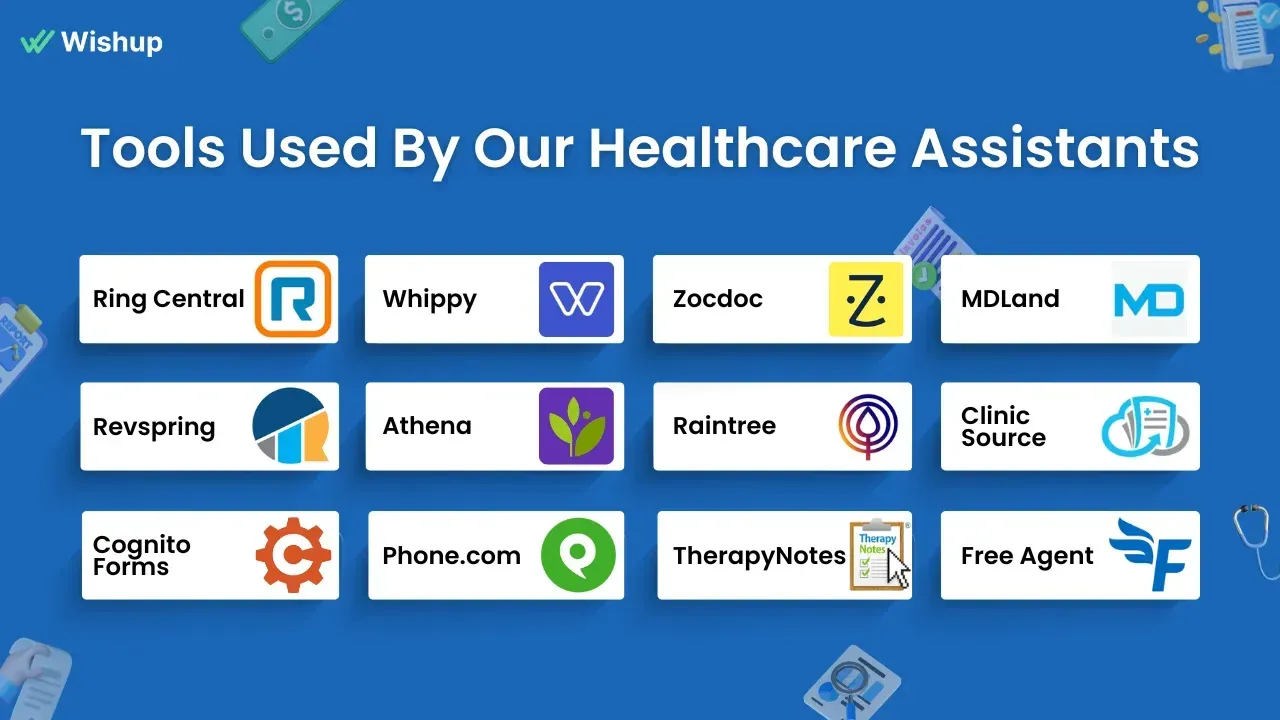
A medical billing virtual assistant works across four software categories: EHR and practice management platforms, eligibility and clearinghouse tools, patient payment processors, and general productivity tools.
A virtual assistant learns the practice’s own stack rather than arriving with a fixed one.
- EHR and practice management: Epic, Cerner, athenahealth, AdvancedMD, Kareo, eClinicalWorks, NextGen, DrChrono, and Tebra. This is where the virtual assistant opens encounter notes, checks codes, and clears notes for billing. See the guide to EHR software used by healthcare virtual assistants,
- Eligibility and clearinghouses: Availity and Waystar. The virtual assistant uses these to verify coverage before the visit and again for the date of service.
- Patient payments: Stripe and comparable processors, used to charge co-pays and cancellation fees.
- General tools: Google Workspace and Excel, used for provider backlog reports, tracking sheets, and follow-up emails.
Many practices run proprietary or regional systems, so a Wishup’s Billing Process Virtual Assistants the client’s setup during onboarding, drawing on training across 120+ tools.
Is a Medical Billing Virtual Assistant HIPAA Compliant?
A medical billing virtual assistant is HIPAA compliant when the provider trains the virtual assistant on HIPAA before deployment, requires a signed NDA, and limits access to the systems the role needs. Wishup’s Billing Process Virtual Assistants complete HIPAA training before starting client work, with refreshers every year.
The virtual assistant works inside the practice’s own systems, with permission levels set to the role, and handles only the patient data the billing tasks require. For a fuller breakdown of what to require from any provider, see how to hire a HIPAA-compliant virtual assistant.
What Are the Benefits of a Medical Billing Virtual Assistant for Your Practice?
A medical billing virtual assistant benefits a practice in three measurable ways: recovered revenue from encounters that would otherwise go unbilled, fewer denials from upstream accuracy, and a lower cost per claim reworked.
Revenue Recovered From Unbilled Encounters
Healthcare organizations lose an estimated 3 to 5% of net revenue each year to charge capture errors. That loss never appears as a denial, because the claim never existed.
A virtual assistant who reviews every encounter note and chases providers to close the backlog catches these before they become missing revenue.
Fewer Denials From Upstream Accuracy
The industry average initial denial rate reached 11.8% in 2024, while HFMA treats anything below 5% as best-in-class. Around 60% of denials trace back to front-end and coding errors a practice controls.
Eligibility checks before the visit, a second check for the date of service, and a coding review against the practice’s checklist address those causes directly.
Lower Rework Cost Per Claim
Reworking a single denied claim costs roughly $25 at a physician practice. A practice with a 10% denial rate on a few thousand claims a month absorbs that cost in staff time that never shows up as a line item. Preventing the denial is cheaper than appealing it.

Hire a Medical Billing Virtual Assistant from Wishup
Wishup is where practices go to hire a medical billing virtual assistant who already understands pre-billing review, eligibility checks, and provider follow-up, without months of training.
Continuity is the strongest proof in revenue cycle work. The live account behind this guide has run a multi-person Wishup team for over three years. A virtual assistant who already knows a practice’s payer rules and coding checklist is worth more than added headcount.
- Dedicated account manager: Every engagement includes a virtual assistant manager and a customer success manager.
- Instant replacement guarantee: If a virtual assistant becomes unavailable, a trained replacement steps in.
- $500 in free productivity tools with every new hire.
- NDA and HIPAA training: Every virtual assistant signs an NDA and completes HIPAA training before deployment.
- No risk: No cancellation fees and no notice period.
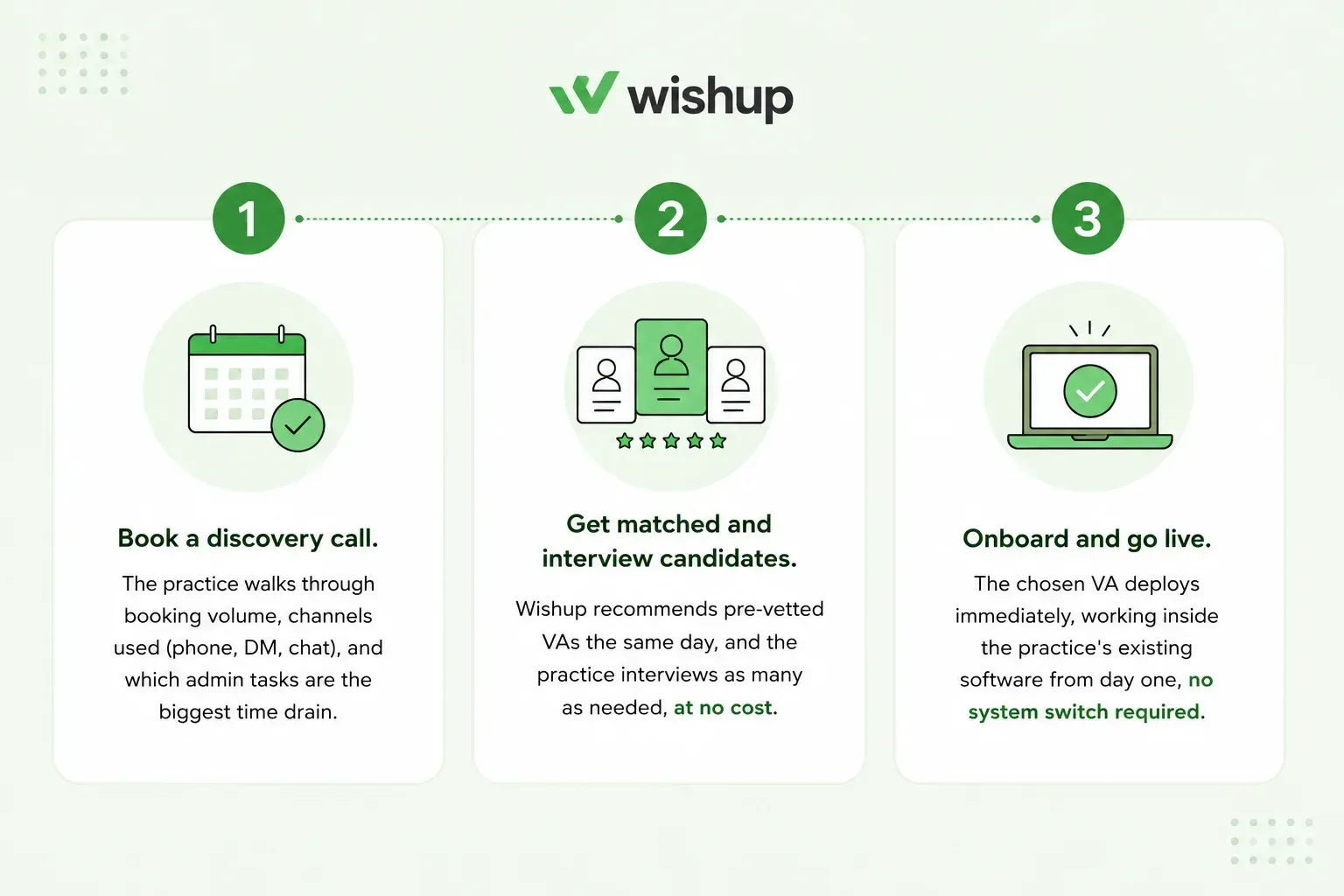
- 60-minute onboarding: Practices match with a pre-vetted virtual assistant in as little as 60 minutes.
Wrapping Up
Most billing problems start before a claim exists. A medical billing virtual assistant fixes that upstream, clearing notes, verifying coverage, and chasing providers so the billing team receives clean encounters.
For practices that also want support beyond billing, Wishup’s patient management service covers the surrounding workflow.

Frequently Asked Questions on Medical Billing Virtual Assistants
How does a virtual assistant prepare a note so it can be billed?
The virtual assistant opens each encounter note and checks the procedure codes the provider entered against the diagnosis codes on the chart.
Codes that need adding, removing, or correcting are flagged against the practice’s coding checklist, and the time component is recorded where the code depends on it.
Insurance is re-verified for the date of service, then the cleared note moves to the billing team for a second check.
How does a virtual assistant handle patient-responsibility balances?
The virtual assistant identifies what a patient owes before the visit, such as self-pay status and co-pay amount, and applies the practice’s no-show and late-cancellation policy afterward.
Charges run through the practice’s payment system. If a card declines, the virtual assistant records it and flags it for the practice to follow up.
Can a virtual assistant submit claims and handle denials?
A virtual assistant supports claim tracking and records denials, but submission and appeals sit with the practice’s biller or billing company. The virtual assistant’s job is to make the claim billable and chase what is stuck.
Can a virtual assistant work inside our existing billing software or EMR?
Yes. Wishup’s Billing Process Virtual Assistant learns the practice’s own EMR, eligibility tools, and payment system during onboarding, rather than requiring a switch.
Will AI replace medical billers?
AI is taking over repetitive checks like eligibility lookups and code suggestions. The work in this guide, reviewing notes against a practice’s own checklist, chasing providers, and calling patients, still depends on people. On the live account behind this guide, none of this work is automated.
How is a virtual assistant different from a medical billing outsourcing company?
A billing company takes over claims, denials, and collections for a percentage of what it collects. A virtual assistant works inside the practice’s own systems for a flat monthly plan and feeds clean encounters to whoever submits the claims.
