

Bookkeeping for gyms means tracking recurring membership dues, personal training packages, retail sales, and equipment costs separately, not as one lump revenue number. Most gym owners run into trouble here because their membership software, payment processor, and bank statement rarely show matching figures, and generic small-business bookkeeping advice doesn't account for that gap.
This guide breaks down what bookkeeping for gyms actually involves, where most owners get it wrong, and how to build a system that holds up whether you're running one location or scaling to five. If you'd rather skip the DIY route entirely, we'll also get into what outsourced bookkeeping and a virtual bookkeeper look like in practice and what it actually costs.

Why Bookkeeping Matters More for Gyms Than Most Small Businesses
Every business needs accurate books. But bookkeeping for gyms carries more weight than it does for most small businesses, for a few reasons specific to how this industry actually makes money.
- Recurring revenue hides problems until they're expensive: A membership-based gym can look healthy on paper - steady sign-ups, a full class schedule - while quietly losing money to failed payments, undetected churn, or a pricing tier nobody's tracking separately. Without gym bookkeeping that's current and accurate, none of that shows up until it's already a pattern, not a one-off.
- Lenders and investors expect clean records on short notice: Loan applications, investor conversations, and franchise expansion all require accurate historical financials, often going back 12-24 months. A gym that can't produce them loses leverage in those conversations before they even start.
- Tax compliance gets harder with more revenue streams: Between memberships, PT packages, and retail, gym accounting involves more moving parts than a typical service business. Sales tax treatment alone can vary by revenue type and state, which makes accurate categorization a compliance issue, not just a reporting preference.
- Most gyms fall into one of two situations, and both need attention: Some have no structured accounting for gyms in place at all. Transactions are tracked loosely or inconsistently, and the priority is getting organized. Others already have a bookkeeping process in place but keep running into accuracy problems, reconciliations that don't match, reports that lag, numbers that shift after the fact. Both are common. Both are fixable. Understanding why bookkeeping matters in the first place is what separates gyms that fix it early from ones that let it compound into a bigger problem. But they call for different starting points, and knowing which one you're in matters more than which software you're using.
What Bookkeeping for Gyms Actually Involves
Gym bookkeeping isn't just "recording income and expenses." It's the process of tracking every dollar that moves through a business with several revenue streams running at once, each with its own billing rhythm.
A law firm bills clients and gets paid. A gym collects recurring membership fees, one-time drop-in payments, personal training packages that might be paid upfront or in installments, retail and supplement sales, and sometimes corporate wellness contracts on top of all that. Each of these needs its own paper trail, because the IRS treats them differently and because you, as the owner, need to know which one is actually making you money.
This is where general small-business bookkeeping advice falls short for gyms. A freelancer invoicing five clients a month doesn't need a reconciliation process. A gym billing 400 members automatically through a membership platform absolutely does.
Why Gyms Need to Track Revenue by Stream, Not as One Lump Sum
Most gyms have at least three distinct revenue layers, and treating them as a single "Sales" line in your books is one of the most common mistakes owners make.
Membership revenue: Recurring monthly or annual dues, the backbone of most fitness businesses.
Personal training and class revenue: Packages, drop-in class fees, and sometimes contractor-based trainer arrangements that complicate how the income and related costs get recorded.
Retail and ancillary revenue: Supplements, merchandise, and add-on services, usually lower margin but still taxable and still worth tracking on its own.
Lump these together, and you lose the ability to see which part of the business is actually profitable. You also increase your risk of getting sales tax treatment wrong, since retail is often taxed differently than membership dues depending on your state. Separating these from day one means your profit and loss statement actually tells you something useful instead of just showing a top-line number.
How to Reconcile Membership Revenue Across Multiple Systems
Here's the part almost no gym-bookkeeping resource covers in any real depth, and it's usually the biggest source of financial confusion for owners.
Your membership software (think Mindbody, Glofox, or similar) shows one number. Your payment processor shows another. Your bank statement shows a third. They rarely match exactly, and the gap isn't a mistake; it's the natural result of how the money actually moves.
Here's why the numbers diverge:
- Timing differences: A membership charge on the 1st might not hit your bank account until the 3rd or 4th, depending on processor settlement schedules.
- Failed payments and retries: A declined card gets retried automatically, sometimes multiple times, creating noise in your membership report that doesn't reflect actual collected revenue.
- Refunds and chargebacks: These often post on a different date than the original charge and need to be tracked separately, not just netted against future income.
- Processor fees: What lands in your bank is net of fees; your membership software usually shows gross billed amounts.
A basic monthly reconciliation checklist looks like this:
- Pull your membership platform's billing report for the month
- Pull your payment processor's settlement report for the same period
- Match transactions and flag anything that didn't settle (declines, retries, holds)
- Confirm your bank deposits tie back to the settled processor total, accounting for fees
- Record refunds and chargebacks as their own line items, not silent deductions
Skip this step, and your books will technically balance, but they won't reflect reality. That's the difference between having numbers and actually understanding your business.

Gym Chart of Accounts Template
A chart of accounts is just a structured list of every category your money moves through. Most gym owners either don't have one at all or inherited a generic template that doesn't reflect how a fitness business actually earns and spends. Here's a practical starting structure:
This isn't exhaustive, but it's a real starting point you can hand to a bookkeeper or build directly into QuickBooks or Xero. The goal is that every transaction has an obvious home, so your monthly reports actually mean something when you look at them.
Payroll: Employees vs. Contractor Trainers
This is one of the most common compliance mistakes in gym bookkeeping, and it's an expensive one to get wrong.
If a trainer works set hours, uses your equipment, follows your class schedule, and is effectively directed by you day-to-day, they likely need to be classified as a W-2 employee. If they run their own client base, set their own schedule, and simply use your space, they may qualify as a 1099 contractor. Misclassifying this either way can trigger back taxes, penalties, and in some states, real legal exposure.
Payroll for W-2 staff needs standard tax withholding, W-2 filing, and benefits tracking if applicable. Contractor payments still need to be recorded carefully and reported via 1099 at year-end, even though there's no withholding involved. Either way, this isn't a category to guess at. It is worth a direct conversation with an accountant or bookkeeper who understands the difference before you scale your trainer roster.
This is also where bookkeeping for personal trainers overlaps with gym bookkeeping but isn't identical to it. A trainer running their own independent client base, inside your gym or across multiple locations needs their own income and expense tracking, separate from the gym's books, even if a portion of their revenue flows through your systems.
Depreciating Gym Equipment: What You Can Deduct
Gyms carry more fixed assets than most small businesses their size. Cardio machines, racks, plates, and specialty equipment aren't cheap, and they don't get expensed all at once, they depreciate over their useful life.
The most common approach for gym equipment is straight-line depreciation, where the cost is spread evenly across the asset's expected lifespan. This affects both your financial statements and your tax return, since depreciation is a legitimate deduction that reduces taxable income. Skipping this, or lumping equipment purchases into a generic "expenses" bucket, means you're likely leaving deductions on the table every single year.
On the inventory side, retail items (supplements, apparel) need basic stock tracking so you know what's actually selling versus sitting on a shelf losing value.
A quick note on deductibility: gym-related expenses are generally deductible when they're ordinary and necessary for running the business: equipment, rent, marketing, software, and staff costs typically qualify. Personal gym memberships for non-business use don't. If you're ever unsure whether a specific expense qualifies, that's a conversation for your accountant, not a guess.
Gym Financial KPIs: ARPM, Growth Rate, and CA
Clean books are the foundation, but the real value comes from what you do with the numbers. A few metrics matter more than most owners realize:
- Average Revenue Per Member (ARPM): Total monthly revenue divided by active members. This tells you whether upsells (PT, retail, add-ons) are actually working, not just whether membership count is growing.
- Membership growth rate: New sign-ups minus cancellations, tracked monthly. A gym adding 20 members and losing 18 isn't really growing, even if the sign-up number looks good in isolation.
- Cost per member acquired (CAC): Marketing and sales spend divided by new members gained. Without this, it's impossible to know if a promotion actually made money or just brought in bodies at a loss.
None of these require complicated software. They require books that are accurate and current enough to pull real numbers from, which is the entire point of getting the bookkeeping right in the first place.
Bookkeeping vs. Accounting for Gyms: What's the Actual Difference
These two terms get used interchangeably, but they're not the same function.
Bookkeeping is the day-to-day recording layer: transaction entries, reconciliations, categorizing revenue and expenses, keeping the books current and organized.
Accounting sits a layer above that: financial reporting, analysis, forecasting, and strategic decisions built on top of what the bookkeeping produced.
In growing fitness businesses, this often splits across two roles. A bookkeeper handles revenue entries, order and payment reconciliation, and month-end closing. Someone in a CFO or fractional finance role, if the business has scaled enough to need one, handles cash flow planning, forecasting, and bigger financial strategy. Tax filing, notably, is usually a separate function entirely, often handled by an external CPA or tax partner on a project basis rather than baked into either role.
For most independent gyms and studios, you don't need a full finance department. You need consistently accurate books, and a plan for who handles tax filing when the time comes.
DIY, Software, or Outsourced Bookkeeping: What Actually Fits Your Gym
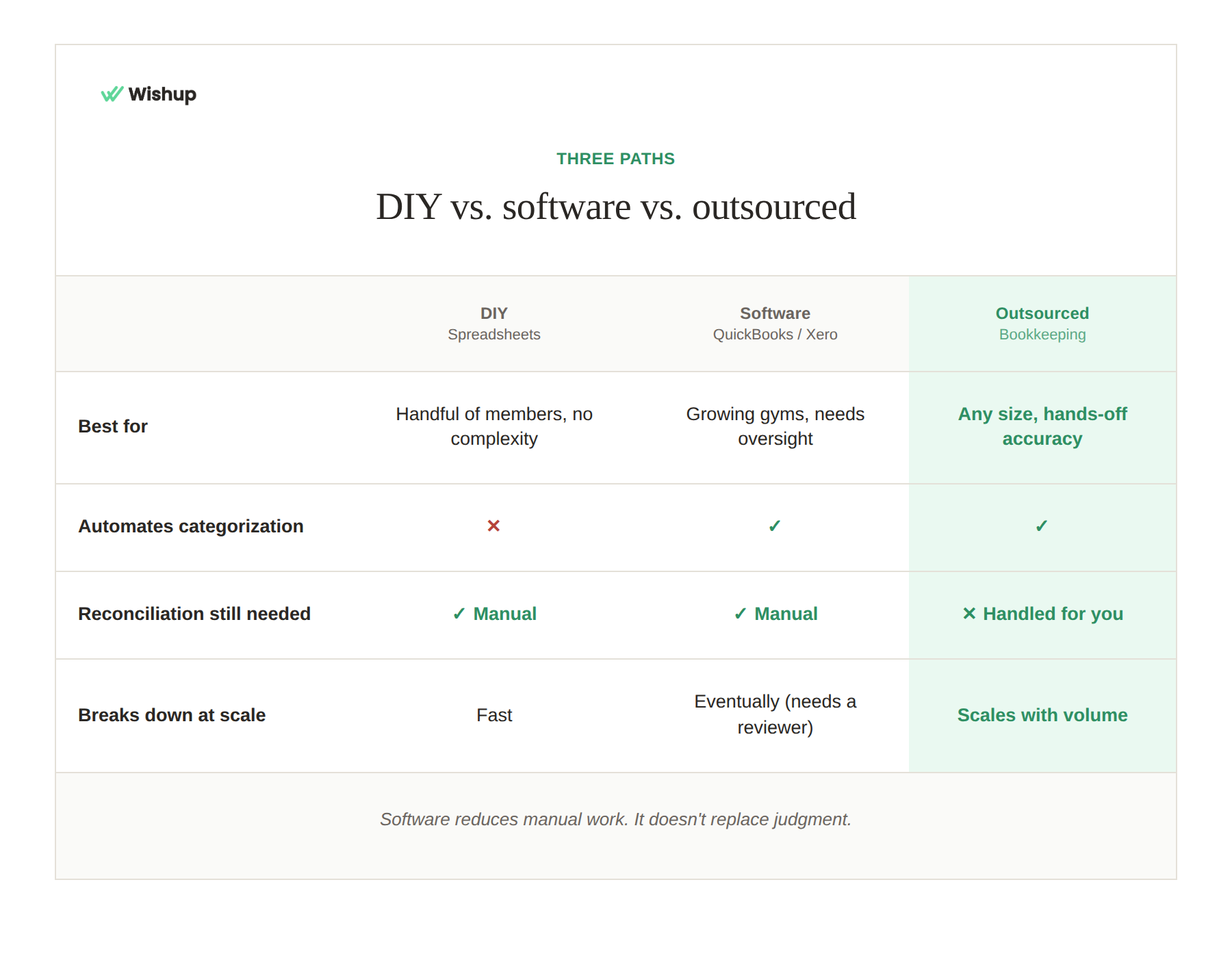
There are three realistic paths, and the right one depends less on gym size and more on transaction volume and how much time you're willing to give up.
DIY with spreadsheets works only in the very early days, with a handful of members and almost no complexity. It breaks down fast once you add PT packages, retail, or more than one staff member.
Accounting software (QuickBooks, Xero) is the most common middle step. It automates a lot of the categorization and reporting, but someone still has to reconcile it, review it for errors, and actually understand what the reports mean. Software reduces manual work; it doesn't replace judgment.
Outsourced bookkeeping hands the entire process to a dedicated professional or team, who reconciles, categorizes, and reports on a set schedule, using whatever software you're already on. QuickBooks outsourced bookkeeping is the most common setup for gyms specifically, since most membership platforms already integrate with it; you're not migrating systems, just handing off who manages what's inside them.
The businesses that tend to need outsourced support fall into two camps: gyms without any structured accounting system yet, who need someone to organize things from scratch, and gyms that already have bookkeeping in place but keep running into accuracy issues, mismatched reconciliations, late reports, and inconsistent categorization. AI-powered tools can help automate parts of this (invoice generation, expense tagging, transaction matching, scheduled reports), but automation alone doesn't catch exceptions, doesn't handle judgment calls, and doesn't take responsibility for accuracy. Human review is still what keeps books reliable, especially heading into tax season, a loan application, or an investor conversation.
Why Outsource Accounting Services for Your Gym and What It Costs
The case for outsourcing usually comes down to two things: time and error cost.
Time is the obvious one. Reconciling three different systems every month, chasing down failed payments, and categorizing transactions correctly takes hours most owners would rather spend on member retention, programming, or actually running the floor.
Error cost is the less obvious one, and it's usually bigger. Misclassified expenses mean missed deductions. Bad reconciliation means you're making decisions off numbers that don't reflect reality. Messy books at tax time mean either a bigger CPA bill to clean things up, or worse, filing something inaccurate.
This is true whether you're a single studio or scaling to multiple locations; the reasoning to outsource bookkeeping for small business doesn't really change with size, only the volume of what needs managing. A gym with 150 members and one with 1,500 face the same core problem: books that fall behind stop being useful the moment they do.
How much does outsourced accounting cost for a gym? It varies depending on transaction volume, whether it's part-time or full-time support, and how much reporting complexity is involved. Simpler setups with lower transaction volume cost less; multi-location gyms with payroll, contractor payments, and multiple revenue streams need more hands-on support and price accordingly. The honest answer is that it scales with your business's complexity, not a flat industry rate, which is exactly why a conversation about your specific setup matters more than a generic price list.

How Wishup Supports Bookkeeping for Gyms and Fitness Studios
If everything above sounds like more than you want to manage alongside actually running your gym, that's the exact gap Wishup fills.
Wishup is an outsourced bookkeeping service built around dedicated, pre-vetted professionals rather than a shared pool or a software-only tool. Bookkeepers work inside your existing systems: QuickBooks, Xero, or whatever your gym already runs on. Every bookkeeper goes through an 8-week structured training program and comes in with 3+ years of professional experience, so you're not training someone from scratch on how membership reconciliation or contractor payroll works.
For gyms that need more than transaction entry, reconciliation, reporting, and month-end close handled together, Wishup's outsourced accounting bookkeeping services cover that full scope rather than splitting it across multiple vendors.
A few things that matter specifically for a gym owner evaluating this:
- A 6-step vetting process means only the top 0.1% of applicants make it through, you're not gambling on quality.
- A three-layer support model (bookkeeper + manager + customer success manager) means you're never dependent on one person's availability or bandwidth.
- 5-minute response times and same-day task turnaround during business hours, so reconciliation issues or reporting questions don't sit for days.
- No payroll, HR, or compliance overhead on your end; Wishup manages that layer entirely.
- A money-back and replacement guarantee, so there's no risk in trying it.
Wishup maintains an 85+ NPS score, a 98% client satisfaction rate, and an average 4-year retention across engagements, numbers that matter when you're trusting someone with your financial records long-term, not just for a one-off cleanup.
FAQs
How do you account for a gym? Start by separating revenue into distinct streams (memberships, PT, retail), set up a chart of accounts specific to fitness businesses, reconcile your membership platform against your bank deposits monthly, and track equipment depreciation separately from regular expenses. Most gyms use accounting software as the base layer and either handle reconciliation in-house or bring in a dedicated bookkeeper once transaction volume grows.
What category is a gym expense? It depends on what the expense is for. Equipment falls under fixed assets and depreciation. Rent and utilities are occupancy expenses. Marketing, software subscriptions, and staff wages each get their own category. The goal is specificity, a catch-all "gym expenses" category defeats the purpose of having a chart of accounts in the first place.
What are the 4 important activities in bookkeeping? Recording transactions, categorizing income and expenses, reconciling accounts against bank and processor statements, and generating financial reports (like a P&L). For gyms working with vendors, equipment suppliers, or contractor trainers, accounts payable is often the piece that falls behind first once transaction volume picks up.
Are gym fees tax deductible? Business-related gym expenses: equipment, rent, marketing, staff costs, software, are generally deductible as ordinary business expenses. A personal gym membership for non-business use isn't. If you're a gym owner asking this about your own business's expenses rather than a personal membership, most operating costs qualify; confirm specifics with your accountant.
How much does outsourced accounting cost for a gym? It depends on transaction volume, whether you need part-time or full-time support, and how much reporting and reconciliation complexity is involved. A single-location gym with straightforward membership billing costs less to support than a multi-location business with payroll, contractor payments, and retail inventory. Getting an accurate number means walking through your specific setup rather than relying on a flat industry estimate.
Talk to a Bookkeeper Who Understands Fitness Businesses
Your books shouldn't be the reason you're guessing about how your gym is actually performing. Wishup's dedicated bookkeepers can take reconciliation, reporting, and month-end close off your plate, so you can get back to the part of the business you actually started this for. Book a free consultation with Wishup →
