

The legal sector is experiencing a significant shift as technology redefines traditional law firm operations. Virtual assistants are leading this change by improving efficiency, streamlining workflows, and enhancing client communication.
A report from Goldman Sachs indicates that AI may handle nearly 44 percent of tasks in the legal field in the near future. This figure far exceeds the general average across all industries, which stands at 25 percent.
By combining human expertise with AI-powered virtual assistants, law firms can manage complex cases faster and maintain accuracy. This strategy enables law firms to remain competitive as technology continues to reshape the legal field.
In this guide, we will cover:
- How to use virtual assistants for legal support tasks across six key functions
- Cost breakdown: VA vs. in-house legal assistant
- How to hire a legal VA from Wishup in 60 minutes
What is a virtual assistant for lawyers?
A virtual assistant for lawyers is a remote professional, often AI-trained, who handles the administrative, operational, and research tasks that consume attorney time without requiring legal judgment. From document management and client intake to billing support and case research, legal industry virtual assistants free up attorneys to focus on billable, high-value legal work.
At Wishup, legal VAs are pre-vetted, trained in 150+ AI and no-code tools, and ready to integrate with your firm's existing systems in under 60 minutes. Solo practitioners, boutique firms, and large practices all use Wishup legal VAs to reduce overhead, improve turnaround times, and scale their caseload without adding headcount.
Automate Legal Research and Case Summaries
Legal research is the backbone of every case, and one of the most time-consuming tasks for attorneys. Legal industry virtual assistants transform this process by taking over the repetitive, high-volume scanning work: reviewing case law, statutes, regulatory filings, and legal opinions across multiple jurisdictions.
Rather than manually reviewing hundreds of documents, attorneys receive organized research summaries with findings already categorized by jurisdiction, relevance, and argument strength. This dramatically cuts research time while improving the depth and accuracy of case preparation.
According to Legal Dive, 73% of lawyers plan to use generative AI in their work, and 68% feel prepared for its impact. The firms moving fastest are those pairing AI tools with trained human VAs who can prompt, verify, and organize AI-generated research into attorney-ready deliverables.
By delegating legal research to a virtual assistant for lawyers, firms handle larger caseloads with fewer errors, make stronger, data-backed arguments, and free senior attorneys to focus on the strategic work that drives client outcomes.
Streamline Document Management and Filing
A Thomson Reuters report shows that 77% of legal professionals now use AI for document review, 74% for legal research, and 59% for drafting briefs or memos. But AI tools alone don't manage the organizational layer; that's where a virtual assistant for document management becomes indispensable.
Legal VAs handle the full document lifecycle inside a law firm: organizing digital case files, managing e-filing systems, ensuring submissions meet court formatting protocols, maintaining version control across contracts and agreements, and preparing discovery document sets for attorney review.
For firms handling high volumes of contracts, filings, or multi-party litigation, this function alone can save 10–15 hours per attorney per week. A well-organized document system also means fewer missed deadlines, faster retrieval during hearings, and a cleaner audit trail for compliance purposes.
How Legal Industry Virtual Assistants Strengthen Client Confidentiality
Confidentiality is non-negotiable in legal practice, and it's one of the top concerns attorneys raise when considering a virtual assistant for lawyers. Wishup addresses this directly through its vetting and operational protocols.
Wishup legal VAs operate under strict NDAs, use encrypted communication channels, and work within access-controlled document systems. They are trained to handle sensitive case materials, manage internal communications with discretion, and flag any potential confidentiality risks to the supervising attorney.
For firms handling sensitive matters, family law, employment disputes, criminal defense, or high-stakes corporate litigation, this means you get the efficiency benefits of a trained remote VA without compromising the security standards your clients expect, and your bar association requires.
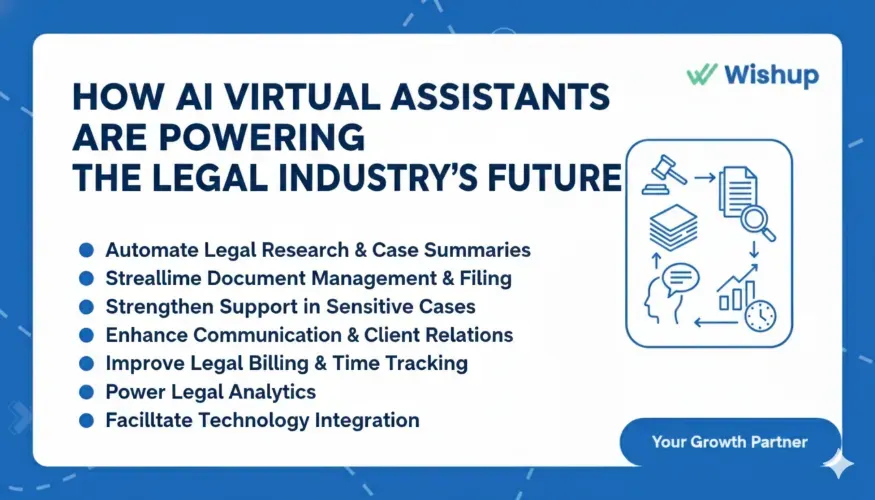
Enhance Communication and Client Relations
ResearchGate reports that gaining a new client can be 5-25 times more expensive than retaining an existing one. Even a modest 5 percent increase in client retention can raise profits by 25 to 95 percent. These numbers emphasize the vital role of maintaining strong client relationships and clear communication in law firms.
AI virtual assistants can help law firms achieve this by managing client correspondence, scheduling meetings, sending reminders, and providing timely case updates. They can also track follow-ups, prepare personalized messages, and maintain communication logs to ensure no client inquiry is missed. For intake and scheduling workflows, many teams also evaluate Chili Piper alternatives to route leads efficiently and reduce no-shows.
By keeping clients informed, engaged, and supported throughout their legal journey, automated VAs allow attorneys to focus on strategy. This approach also strengthens trust, client satisfaction, and long-term retention.
Improve Legal Billing and Time Tracking Accuracy
Precise billing and time management are crucial for law firms to ensure both profitability and client transparency. AI-powered virtual assistants contribute significantly by tracking billable hours, logging work activities, and producing accurate invoices efficiently. They can also reconcile client payments, flag discrepancies, and ensure that all work is properly accounted for.
By automating these tasks, they reduce errors, save administrative time, and allow attorneys to focus on legal work rather than back-office processes. This results in smoother financial operations, improved client trust, and a more efficient workflow for the entire firm.
Virtual Assistant for Lawyers: Cost Breakdown
Understanding the cost of a virtual assistant for lawyers is straightforward when you compare it to the alternative, a full-time in-house legal assistant.
Wishup legal industry virtual assistants are available on two primary plans:
- Basic VA: Starts from $1,299/month (4 hrs/day), suited for general legal admin, document management, and scheduling
- Elite VA: Starts from $1,999/month (4 hrs/day), for firms needing advanced support, strategic execution, and a VA with 5+ years of experience
Both plans include a free VA manager, instant replacement guarantee, and a 7-day money-back trial. See full pricing.
Most law firms save 30–40% compared to an in-house hire, with zero training, no long-term contracts, and a 7-day risk-free trial.
Get your free consultation →
Power Legal Analytics and Technology Integration
AI virtual assistants help law firms leverage legal analytics by organizing case data, tracking key performance metrics, and identifying patterns across past cases. They can generate reports on billable hours, case durations, and client outcomes, providing actionable insights for better decision-making.
Additionally, smart VAs assist in integrating new legal technologies, such as AI research tools, document management systems, and automated workflow software. They ensure these tools are implemented smoothly and efficiently. To maximize efficiency, it’s important to focus on refining enterprise search processes, ensuring data is well-structured and accessible for optimal retrieval accuracy.
By supporting both analytics and technology integration, AI-powered virtual assistants enable law firms to make data-driven decisions, streamline operations, and optimize resource allocation.
Frequently Asked Questions
How do intelligent virtual assistants maintain confidentiality in legal environments?
These AI assistants protect sensitive information through encrypted communication, secure cloud storage, and access-controlled systems. They follow strict privacy protocols and monitor file access, ensuring that all client data and legal documents are only accessible to authorized personnel.
Can automated legal assistants interact directly with clients, or do they only support lawyers?
While their primary function is to assist lawyers with administrative tasks, document management, and scheduling, AI assistants can also manage routine client interactions. This includes appointment reminders, status updates, and basic inquiries, always under attorney supervision to maintain professionalism and confidentiality.
What legal tasks are not suitable for delegation to AI virtual assistants?
AI or automated legal assistants should not handle tasks requiring professional legal judgment, such as providing legal advice or making strategic case decisions. They also should not finalize or authorize legal documents, which must be executed by a licensed attorney. Their role is limited to research, administrative support, and document handling under attorney guidance to ensure compliance and accuracy.
What tools should a virtual assistant for lawyers know?
Top legal VA tools include:
- Clio and MyCase (case management),
- NetDocuments or iManage (document management),
- QuickBooks or TimeSolv (billing and time tracking),
- Google Workspace or Microsoft 365 (communication and docs),
- Zoom or Microsoft Teams (client meetings), and
- Asana or Trello (task and deadline management).
Wishup legal VAs are trained in 150+ AI and no-code tools and can be matched to your firm's existing tech stack.
Legal Innovation Through AI-Powered Virtual Assistants
AI-powered virtual legal assistants are reshaping the legal sector by enhancing efficiency, accuracy, and client satisfaction. These intelligent tools automate research, organize case documents, and support sensitive matters, allowing attorneys to concentrate on high-value strategic work. They also streamline billing, monitor time, and integrate advanced analytics seamlessly.
By combining human expertise with AI capabilities, law firms can manage larger caseloads, ensure confidentiality, strengthen client relationships, and optimize daily operations. As AI technology continues to advance, these virtual assistants will become an essential component in driving innovation and shaping the future of legal practice.
If your attorneys are spending hours on tasks that don't require a law degree, document organization, client follow-ups, scheduling, billing entries, a Wishup virtual assistant for lawyers is the most cost-effective fix available.
✅ Pre-vetted, pre-trained legal VAs: no onboarding required
✅ Proficient in Clio, NetDocuments, MyCase, and 150+ tools
✅ Hire in 60 minutes, start the same day
✅ 7-day risk-free trial with money-back guarantee
✅ Instant replacement; no gaps in support
→ Book Your Free Consultation and Get $100 Off Your First Month
