
A medical virtual assistant for endocrinologists is a remote, HIPAA-trained professional who handles the scheduling, insurance verification, EHR documentation, and lab follow-up work of an endocrinology practice.
Hire a medical virtual assistant for endocrinologists via Wishup, starting at $1,299 per month.
Endocrinology also carries one of the higher no-show rates in outpatient care. It averages 14% nationally, largely because chronic-care patients need repeat labs and follow-ups that are easy to lose track of without dedicated coordination. A trained virtual assistant closes that gap without adding a full-time hire to payroll.
By the end of the blog, you will have learned:
- Who is a endocrinology VA is and how they differ from a general VA
- Common administrative challenges in endocrine practices and how the VAs solve it
- 10+ tasks a practice can delegate
- Tools and EHR platforms endocrinology VAs use
- Wishup's HIPAA training and vetting process
- Full cost breakdown vs. an in-house hire
Who is an endocrinology virtual assistant?
An endocrinology virtual assistant is a remote professional who supports the administrative and patient-coordination side of an endocrine practice, with working knowledge of chronic condition management: Type 1 and Type 2 diabetes, thyroid disorders, adrenal insufficiency, PCOS, and osteoporosis.
The role differs from a general VA in one core way: endocrine care is data-heavy and recurring. A general VA books an appointment. An endocrinology VA tracks A1C trends, coordinates CGM and insulin pump data uploads, and flags a missed thyroid panel before it becomes a missed diagnosis window.
General VA vs. Endocrinology VA: Capability Comparison
For a closer look at how specialty-specific vetting plays out elsewhere in healthcare, see how Wishup virtual assistants support rheumatologists with comparable EHR and prior authorization coordination.
What Are The Administrative Challenges Facing Endocrinology Practices?
Endocrinology practices lose time to five recurring problems: high no-show rates, lab follow-up backlogs, device-related prior authorizations, chronic-disease documentation load, and administrative staff turnover.
- No-show rates average 14% nationally, driven by the frequency of return visits chronic endocrine care requires.
- Lab follow-up backlogs build when TSH, A1C, and cortisol results arrive faster than staff can review and act on them.
- Prior authorization delays for CGMs, insulin pumps, and GLP-1 medications routinely stall treatment starts by weeks.
- Documentation load is heavier than general primary care, since chronic endocrine conditions require ongoing flowsheet updates, not single-visit notes.
- Staff turnover in administrative roles forces practices to retrain new hires on endocrine-specific terminology and workflows every time someone leaves.
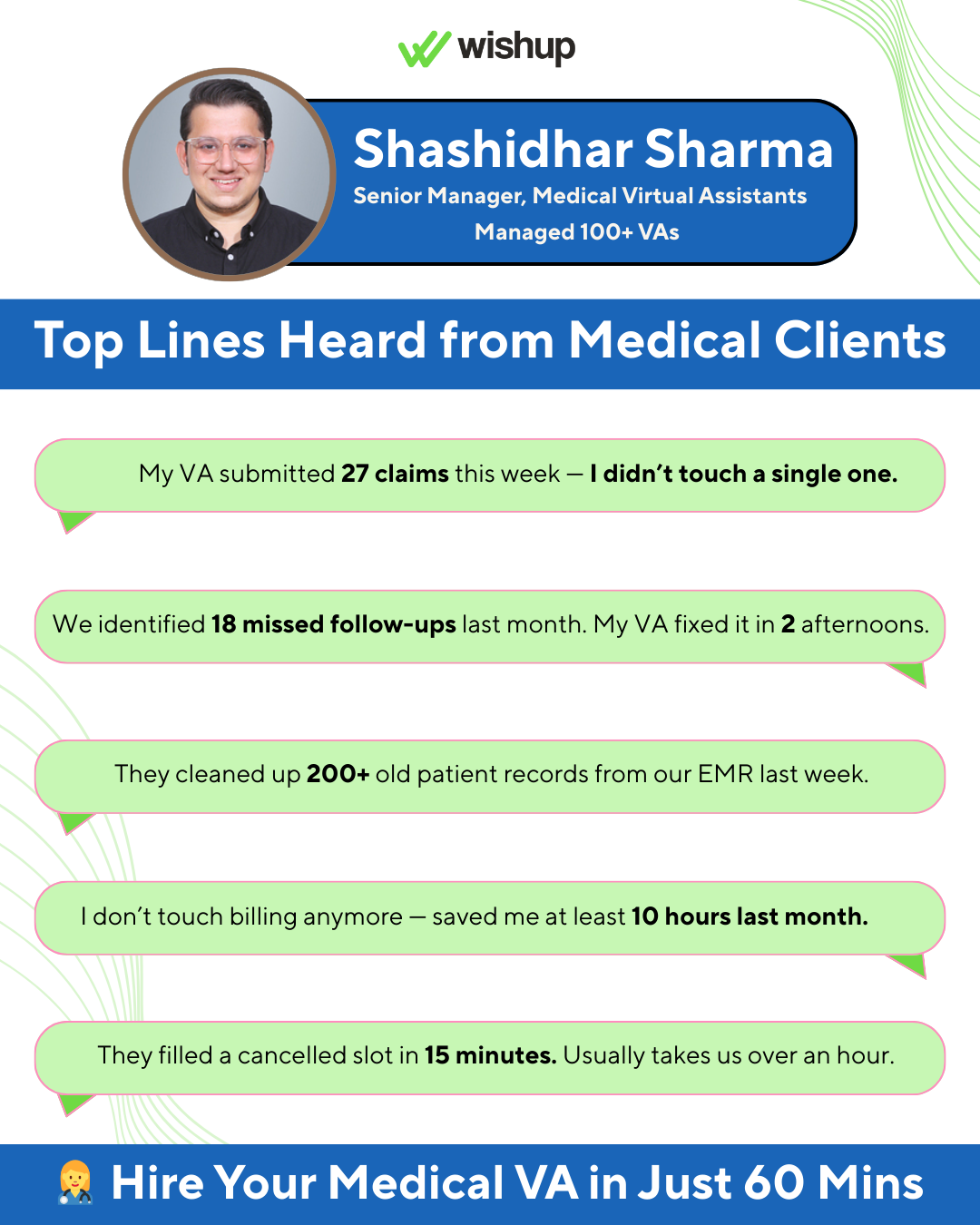
Case Studies of Wishup Healthcare Virtual Assistants

Why Does an Endocrinology Practice Need a Virtual Assistant?
Endocrine care runs on repeat visits, lab-dependent scheduling, and prescription refill cycles that outpace what front desk staff can track manually. One Wishup healthcare client, a New York-based multi-specialty clinic with a senior endocrinologist on staff, saw this firsthand: before a dedicated VA managed appointment intake, booking confirmations on the clinic's scheduling platform took two to three days, sometimes lapsing before anyone confirmed them.
After a Wishup VA took over that single task, confirmation time dropped to under an hour, a scheduling efficiency gain the practice measured at 80 to 85%.
Call handling told a similar story. Before Wishup VAs joined the front-line phone team, the clinic's call answer rate sat under 20%, with regular patient complaints about being unable to reach anyone. After onboarding, answer rates climbed into the consistent 80s, touching 90% on strong weeks, across roughly 700 to 800 patient calls per week.
The pattern holds across specialties: administrative volume in endocrinology doesn't shrink on its own, and the tasks that go untracked (refill requests, eligibility checks, unconfirmed appointments) are the ones that cost a practice patients and revenue.
What Tasks Can You Offload to an Endocrinology Virtual Assistant?
An endocrinology virtual assistant handles the recurring administrative and coordination work that builds up around chronic-care scheduling, without taking on clinical duties like triage, which stays with a licensed medical assistant or nurse.
1. Appointment scheduling and EHR entry
The VA moves bookings from third-party platforms like ZocDoc into the practice's EHR daily, confirming and updating records in real time rather than in batches.
2. Prescription refill coordination
The VA filters incoming refill requests from patients and pharmacies, flags which ones require a provider visit (controlled medications) versus a direct refill, and routes the rest to the provider's assistant for same-day processing.
3. Insurance eligibility checks
Before each day's appointments, the VA verifies active coverage, calculates co-pay amounts, and confirms self-pay status for every patient on the schedule.
4. PCP referral tracking
Many insurance plans, Medicaid in particular, require a primary care referral for a specialist visit. The VA identifies patients missing one and follows up by call, text, or email before the appointment date.
5. Pre-visit lab confirmation
For patients who need bloodwork before their visit, the VA confirms the labs were completed and reschedules the appointment if they weren't.
6. Appointment confirmation calls
On a set weekly cadence, the VA calls patients on the next day's schedule to confirm attendance and catch cancellations early enough to fill the slot.
7. Real-time no-show outreach
When a patient doesn't join a telehealth visit within minutes of the scheduled time, the VA can call immediately to reschedule same-day or next-day, a step the same client credits with a 10 to 15% improvement in no-show rates once introduced.
8. Patient phone and message coverage
The VA answers inbound calls and portal messages using platforms like RingCentral, handling routine scheduling and billing questions.
9. Remote patient monitoring coordination
For practices using RPM devices to track blood pressure or glucose readings between visits, the VA helps manage the intake and organization of that data for provider review.
10. Telehealth link coordination
For virtual visits, the VA (or the automated system the VA manages) sends patients a secure Doxy.me link ahead of time, the HIPAA-compliant platform this practice uses for endocrinologist video visits instead of Zoom or Google Meet, and confirms the patient is ready to connect before the appointment starts.
Automation Workflows Our Healthcare VAs Have Built
Wishup VAs don't just work inside your tools, they automate the repetitive parts. Two examples from live healthcare deployments:
Healthcare · Customer Support & Admin
The headache it removed: Staff retyped the same details from a spreadsheet into a document by hand, then created a folder, found the order, renamed it, and filed it, every single time.
Built with: Excel · VBA · Python
Healthcare · Operations
The headache it removed: Staff built the same five folders by hand for every new patient, over and over. Nothing gets forgotten or misnamed now.
Built with: Google Apps Script · Google Drive
With the full task list covered, the next question most practices ask is how these tasks show up in the numbers, starting with no-shows, since that's where delegation tends to pay off fastest.
How Does a Wishup Virtual Assistant Reduce No-Shows in Endocrinology?
The tactic that actually moved the number for the NY-based endocrinologist was switching from end-of-day outreach to real-time outreach. If a patient hasn't joined their 9 a.m. appointment by 9:05, front desk calls immediately, leaves a voicemail, and offers same-day or next-day rescheduling only, no open-ended rebooking.
Most patients who are reached this way simply forgot and reschedule on the spot. The practice measured a 10 to 15% improvement in no-show recovery after adopting this real-time model.
Real-time calling is currently handled by front desk staff rather than the VA, mainly because it requires being aware of what's happening in the clinic moment to moment, something a VA juggling other tasks can't always do live.
That said, VAs at the same practice already do a version of this for other specialties: end-of-day follow-up calls to patients who no-showed booking-platform appointments, offering to reschedule. It's a workflow Wishup VAs can take on directly for endocrinology if a practice wants that coverage shifted off front desk.
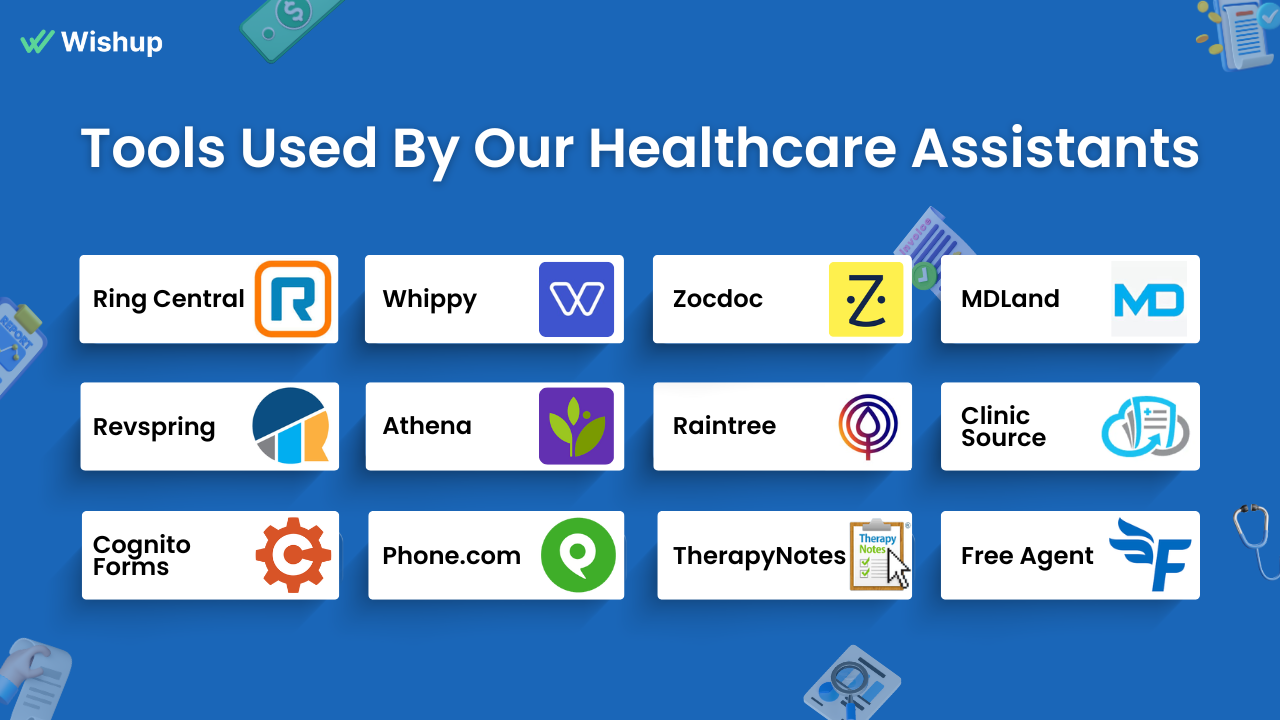
No-show recovery is one piece of the picture. The tools an endocrinology VA works inside daily are what make tasks like this, and the ten-plus others above, possible at the volume a busy practice needs.
What Tools Does an Endocrinology Virtual Assistant Use?
Not every tool this practice tried made the cut. An AI-driven patient messaging tool and a second booking platform were both tested and discontinued after they didn't integrate cleanly with MDLand, which is why the VA still transfers some bookings manually today.
It's a useful reminder that tool stacks in specialty practices are rarely plug-and-play, and a trained VA's value includes knowing which workaround to build when automation doesn't hold. Wishup’s VAs for the healthcare industry are trained in 120+ AI & automation tools and 200+ business skillsets.
Hire a HIPAA-Trained Virtual Assistant for Endocrinology from Wishup
Wishup is where endocrinology practices go to hire a virtual assistant who already understands chronic-care scheduling, HIPAA compliance, and specialty EHR workflows, without the practice absorbing months of training cost.
- Experienced professionals. Every Wishup VA has a minimum of 3 years of professional experience, selected from the top 0.1% of applicants through a 6-step hiring process.
- HIPAA-compliant. All medical virtual assistants complete HIPAA training specific to healthcare practice workflows before deployment.
- Fast turnaround. VAs respond within 5 minutes during working hours, and a dedicated client success manager responds within 60 minutes.
- 36-month average retention rate. Wishup VAs stay with clients significantly longer than the industry norm for outsourced admin support.
- Direct interviews. Practices interview VAs directly at no cost, with a 90%+ interview success rate among shortlisted candidates.
- A dedicated team, not a single hire. Every engagement includes a VA, a VA manager, and a customer success manager, at the price of one hire.
- $1,000 welcome offer. New clients get $500 worth of productivity tools and $500 worth of bookkeeping services free.
- Free VA management app. Clients track productivity and task completion through Wishup's built-in workforce management platform at no added cost.
- Trusted at scale. Wishup supported 1,200+ founders in 2026, with 1,500+ VAs managing 5,000+ tasks monthly.
- Tool expertise. VAs train on 120+ AI and automation tools and 70+ no-code tools across an intensive 8-week program.
- Zero risk. No cancellation fees, no interview fees, and no 30-day notice requirement to end an engagement.
- Proven reliability. 98.8% client satisfaction, with a 4.7 rating on Trustpilot and a perfect 5 on Clutch.
- Fastest onboarding. Practices match with a pre-vetted VA in 60 minutes through a 3-step process.
For a side-by-side look at how Wishup compares to other providers on exactly these criteria, see the full breakdown of the best medical virtual assistant companies, which covers vetting depth, HIPAA compliance, and pricing across the market.
Trust and compliance answer the "who is doing this work" question. The next question most practices ask is how fast they can actually get someone started.
How Does Onboarding Work at Wishup?
Onboarding at Wishup follows a fixed 4-step process, designed to move a practice from first call to a working VA without the multi-week hiring cycle a direct hire requires
Step 1: Submit requirements on a discovery call
The practice books a quick discovery call to walk through business needs, task priorities, and preferred skill sets, endocrinology-specific EHR experience included, if relevant.
Step 2: Get matched with a VA the same day
Wishup's team follows up the same day, often within a few hours, to confirm requirements in detail and recommend candidates suited to the role.
Step 3: Interview candidates for free
Practices can interview as many shortlisted assistants as needed, at no cost. Most finalize a VA at this stage, since candidates are already pre-vetted for the specific role type.
Step 4: Onboard instantly and delegate from day one
Once a practice finds the right fit, the VA deploys immediately, and the practice gets $100 off the first hire as a welcome credit.
For a closer comparison of how this timeline stacks up against traditional hiring, see the full breakdown of how long it actually takes to hire a virtual assistant, which covers Wishup's 60-minute onboarding against the 4-to-12-week cycle typical of a direct hire.
Speed of onboarding only matters if the cost makes sense against what a practice would otherwise spend on staff. That's the last piece to cover.
How Much Does a Medical Virtual Assistant for Endocrinologists Cost?
A Wishup medical virtual assistant for an endocrinology practice starts at $1,299 per month, compared to $75,060 per year for an in-house medical admin hire once salary, benefits, payroll taxes, and office overhead are factored in.
A full-time Wishup endocrinology VA saves a practice roughly $51,000 a year against an in-house hire, a 68% cost reduction, with no benefits, payroll tax, office space, or recruitment cost added on.
Specialization is built into the match, not billed as an add-on. A therapy practice gets a VA experienced in mental health clinic operations. An optometry clinic gets an optometry-specific VA. A dental office gets a VA trained on dental software and billing codes. That level of specialty matching is difficult to get consistently on general freelance platforms, where the practice absorbs the training cost itself.
Whether a practice builds this in-house using the workflows in this guide or brings in a concierge service like Wishup, the roadmap for avoiding the common admin mistakes in endocrinology is the same either way.
Before wrapping up, here are answers to the questions healthcare professionals ask most often when evaluating a medical virtual assistant for their practice.

Frequently Asked Questions on Endocrinology Virtual Assistants
What does a medical assistant do in endocrinology?
A medical assistant in endocrinology handles patient triage, records vitals and medication history before provider visits, and updates the patient's chart ahead of each appointment. This clinical intake work requires a medical or nursing background and stays separate from the administrative and scheduling work a virtual assistant handles.
How much does a virtual medical assistant cost?
A Wishup virtual medical assistant for endocrinology starts at $1,299 per month for 80 hours, or $1,999 per month for a full-time, 160-hour engagement. Both plans include HIPAA training, a dedicated VA manager, and a customer success manager at no added cost.
Can medical assistants work virtually?
Clinical medical assistants who perform in-person tasks like triage, vitals, and injections cannot work virtually. Administrative and coordination work, scheduling, insurance verification, EHR documentation, and prescription refill coordination, can be handled entirely by a remote, HIPAA-trained virtual assistant.
How is an endocrinology virtual assistant different from a medical scribe?
A medical scribe documents clinical encounters in real time during patient visits. An endocrinology virtual assistant handles the administrative and coordination work around those visits: scheduling, refill requests, eligibility checks, and lab follow-up. Some practices use both.
Does a virtual assistant reduce no-shows in an endocrinology practice
Yes. Real-time outreach when a patient misses their scheduled time, rather than waiting until end of day, has shown measurable improvement in no-show recovery for endocrinology practices, with same-day or next-day rescheduling offered instead of open-ended rebooking.
How fast can a practice onboard an endocrinology virtual assistant
Most practices go from discovery call to a working VA within the same week. Wishup matches candidates the same day as the discovery call, interviews are free, and the VA deploys immediately once selected.
Delegate Your Endocrinology Practice's Admin Work to Wishup’s MVA
Every task in this guide, scheduling, refills, eligibility checks, no-show recovery, is already running inside real endocrinology practices with a Wishup VA behind it. A HIPAA-trained assistant is matched, interviewed, and deployed in as little as 60 minutes, starting at $1,299 per month.
Spend More Time with Patients. We'll Handle the Admin.
Get matched with a HIPAA-trained endocrinology VA in as little as 60 minutes. Get $100 OFF your first month.
Book a Free Consultation →