
Businesses outsource bookkeeping services to get accurate, up-to-date books without the cost of a full-time hire. Outsourced bookkeeping services come at a fraction of what a fully loaded in-house bookkeeper costs once salary, taxes, and benefits are factored in. This guide covers:
- What outsourced bookkeeping services actually include, and where they end (tax filing usually isn't part of it)
- What outsourced bookkeeping costs at different transaction volumes, and how that compares to a full-time hire
- Part-time vs. full-time engagement models, and how to tell which one fits your business
- What tasks automation can handle vs. what still needs a human bookkeeper
- A checklist for vetting a provider, plus the most common mistakes businesses make when outsourcing
Outsource Bookkeeping Services: Quick Answer
- What is it? Outsourcing bookkeeping services means hiring a third-party bookkeeper or firm to handle transaction recording, reconciliations, accounts payable/receivable, and month-end close instead of hiring an in-house bookkeeper.
- How much does it cost? Outsourced bookkeeping services typically cost $200–$500/month for a freelance bookkeeper, $500–$2,500/month for a bookkeeping firm, and $2,500+/month for virtual CFO-level services (Mercury).
- What's not included? Outsourced bookkeeping services usually don't include tax filing; that's typically a separate engagement with a CPA or tax partner.
- When does it make sense? Outsourcing bookkeeping makes sense once your books need to be audit-ready for a loan, investor, or compliance review, and manual tracking can no longer keep up.

What Outsourcing Bookkeeping Services Actually Means
Outsourcing bookkeeping services means hiring a third-party bookkeeper or firm to handle your company's day-to-day financial record-keeping, instead of doing it yourself or bringing someone on as an employee.
Where businesses actually get tripped up is in assuming that "bookkeeping" and "accounting" cover the same ground; however, they don't, and signing a contract without knowing the difference is how expectations go sideways in a short span.
Bookkeeping is the operational, recurring work: recording transactions, categorizing expenses, reconciling bank and credit card accounts, tracking accounts payable and accounts receivable, and closing the books each month so the numbers stay current.
Accounting sits a level above that. Bookkeeping is the very first step in the accounting process. It captures the raw data, and accounting interprets and presents that data as something a business owner can actually act on, such as financial statements, tax return preparation, and forecasting.
In an outsourced bookkeeping services engagement, you are typically buying the first layer. How much of the second layer (interpretation, financial statements, audit support) you need depends on your business's operational complexity and its size.
For a closer look at why consistent bookkeeping matters regardless of business size, see Wishup's guide on 10 reasons bookkeeping is important for your business.
Why Businesses Outsource Bookkeeping Services
Businesses land on outsourcing for a handful of concrete, recurring reasons:
- Lower cost than a full-time hire: Outsourced bookkeeping costs scale with the work performed. An in-house bookkeeper costs a fixed salary plus benefits, payroll taxes, and equipment, regardless of how busy that month is.
- Immediate access to trained expertise: There is no recruiting cycle and no time spent training someone on bookkeeping fundamentals. The bookkeeper already knows the work on day one.
- Capacity that scales with transaction volume: A growing SaaS company with rising transaction volume doesn't need to rehire or renegotiate. Outsourced bookkeeping capacity adjusts automatically as volume changes.
- Fixes accuracy problems: Many businesses turn to outsourcing because their existing bookkeeping is inconsistent. Common issues include missed reconciliations, categorization errors, and books that run weeks behind.
- Keeps records ready for loans, audits, and investors: Clean, current books make loan applications, investor due diligence, tax season, and audits faster. Reconstructing records under deadline pressure is slower and more error-prone.
- Removes single-person dependency: An in-house bookkeeper who is sick, on leave, or leaves the company creates a coverage gap. A provider backed by a team doesn't have that gap.
- Frees up the founder's time. Bookkeeping is detailed, time-consuming work. Outsourcing it lets founders and operators focus on tasks only they can do.
The reasons behind the numbers are consistent across company sizes: outsourcing gives businesses access to trained bookkeeping expertise without the fixed cost of a full-time hire, it scales up or down with transaction volume, and it removes bookkeeping from the founder's or operator's task list entirely.
What this looks like in practice: One Wishup client cut month-end reconciliation time from a full week down to three days, with more accurate budget reports and fewer late payment issues. Another client, the founder of Dryden Labs, LLC, credits Wishup's bookkeeping support with delivering organized, accurate financial reports that let them pitch confidently to an investor, including catching billing errors that had gone unnoticed internally. Read the full review here →

How Much Does It Cost to Outsource Bookkeeping Services?
The cost to outsource bookkeeping services typically ranges from $200 to $2,500+ per month, depending on transaction volume and the level of service required. A freelance bookkeeper starts around $200–$500/month, a bookkeeping firm runs $500–$2,500/month, and virtual CFO-level support starts at $2,500+/month (Mercury).
Is $300 a month reasonable for outsourced bookkeeping? $300/month can be reasonable for a small business with low transaction volume and minimal complexity. That sits within the freelance bookkeeper tier ($200–$500/month). For a business processing hundreds of monthly transactions, running multi-channel revenue, or needing regular reconciliations and reporting, $300/month is below the $500–$2,500/month range a bookkeeping firm typically charges for that scope. Ask exactly what's included at that price before assuming it's a deal.
How much does an in-house bookkeeper cost compared to outsourced bookkeeping services? The U.S. Bureau of Labor Statistics reports a median bookkeeper salary of $49,210 a year, or $23.66/hour (BLS). Salary is never the full cost of an in-house hire. The U.S. Small Business Administration and Vena Solutions both use a 1.25x to 1.4x salary multiplier as a rule-of-thumb estimate for a full-time employee's total cost, covering payroll taxes, benefits, equipment, and overhead (SBA).
Applying that multiplier to the BLS salary figure puts the fully loaded cost of one in-house bookkeeper at roughly $61,500–$69,000 a year. This is a calculation based on the two figures above, not a number either source publishes directly, and it doesn't yet account for recruiting time, onboarding, sick days, or the risk of the role sitting vacant during a search.
Is outsourcing bookkeeping cheaper than hiring in-house? Usually, yes. At the upper end of the outsourced pricing tiers above, a bookkeeping firm retainer runs about $30,000 a year, still notably below the $61,500–$69,000 in-house estimate. Actual outsourced costs vary with scope and complexity, so this comparison holds directionally rather than as a guarantee for every business.
What Does an Outsourced Bookkeeper Actually Do?
The day-to-day scope is fairly consistent across providers, though the depth depends on business complexity:
- Recording and categorizing transactions
- Bank and credit card reconciliations
- Accounts payable and accounts receivable tracking
- Revenue and expense entries
- Month-end close and financial reporting support
- Keeping historical records organized and retrievable
For businesses with specific operational models, the work looks a little different. Take an e-commerce business as an example: the bookkeeping layer typically covers revenue entries, order reconciliation, payout tracking across payment processors, inventory-related accounting, and month-end close support, while a CFO (if the company has one) handles the strategic layer: cash flow forecasting, planning, and higher-level financial strategy. Outsourced accounting services fills the operational layer; it is not a replacement for strategic finance leadership, and a good provider will be upfront about that boundary rather than blur it in a sales pitch.
One more thing worth being clear-eyed about: AI tools alone don't reliably deliver consistent bookkeeping accuracy. Automated categorization and matching help, but human review - actual reconciliation, exception handling, and financial oversight are still what keeps the books accurate. Any provider claiming a fully automated, hands-off bookkeeping service is worth a closer look.
Read more: Ecommerce Bookkeeping Guide for DTC & Shopify Businesses
Part-Time vs. Full-Time Outsourced Bookkeeping: Which Model Fits?
There is not a single right answer here. It comes down to transaction volume and the range of responsibilities involved.
Part-time bookkeeping support tends to fit businesses with lower, more predictable transaction volume, a service business with a handful of monthly invoices, for example, or an early-stage company still building out its financial processes.
Full-time bookkeeping support becomes the better fit once transaction volume climbs and the workload extends beyond transaction entry into reporting, documentation, reconciliations, and compliance preparation. Businesses running continuous, high-volume transactions (subscription SaaS, multi-channel e-commerce, service businesses with dozens of active clients) generally need ongoing monthly support rather than a few hours a week.
The mistake to avoid is picking the engagement model based on budget alone rather than actual workload. Under-resourcing a high-transaction-volume business with part-time support is one of the most common reasons "cheap" bookkeeping ends up costing more in cleanup fees later.
Bookkeeping Automation: What It Can and Can't Replace
Automation has genuinely changed what a bookkeeping engagement can look like, and it's worth understanding the split between what software should handle and what still needs a person.
Tasks that automate well:
- Invoice generation
- Expense categorization
- Transaction matching
- Payment reminders
- Scheduled financial reports
- Receipt and invoice data extraction
What still requires human oversight:
- Accuracy checks and quality review
- Reconciliations
- Exception handling (the transactions that don't fit a pattern)
- Compliance support
- Financial review before numbers go external
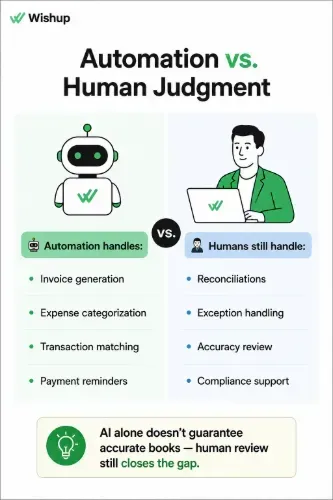
The practical implication for a business evaluating providers: a bookkeeping partner that has built real automation into their process should be cutting down on repetitive manual work and turnaround time, not cutting out the human review that catches errors before they compound. Providers now building dedicated "bookkeeping automation" support are essentially formalizing this split: automation for the repetitive layer, a trained bookkeeper for everything that requires judgment.
In-House vs. Outsourced Bookkeeping: A Side-by-Side Look
Neither model is universally "better" - a business with very high transaction complexity and a need for daily, in-person financial decision-making may still want an in-house hire eventually. But for most growing businesses, especially in the first several years, outsourcing closes the cost and expertise gap without the commitment of a full-time hire.
How to Outsource Bookkeeping Services: A Step-by-Step Process
- Audit your current bookkeeping situation: Are your books currently unstructured and in need of organization, or do you already have support but are dealing with accuracy issues and inconsistent reconciliations? The starting point changes what "success" looks like with a new provider.
- Decide on an engagement model: Part-time, full-time, or task-based; based on transaction volume and the breadth of responsibilities (reporting, documentation, compliance prep) you need covered.
- Vet providers against a real checklist: A lower monthly rate means nothing if the provider can't produce clean records on demand or has no backup when your bookkeeper is unavailable.
- Plan for onboarding and handoff: A provider should be able to work with your existing historical records, not require you to start from scratch.
- Set an oversight and reporting cadence: Weekly updates, monthly close timelines, and a clear point of contact for questions.
What to Look For in an Outsourced Bookkeeping Provider
Based on what actually goes wrong in these engagements are inconsistent quality, slow response times, and providers that can't scale with you. Here's what's worth screening for:
- How are bookkeepers vetted and trained? Ask about the screening process and what ongoing quality checks look like after onboarding, not just at hiring.
- Is there a backup if something isn't working? A single point of failure (one bookkeeper, no oversight layer) is a risk if that person is unavailable or turns out to be a poor fit.
- What's the actual response time during business hours? Vague answers here usually mean there isn't a real SLA.
- Can they produce historical records and reports on demand? For loan applications, investor reporting, or audits, you need a provider who can pull organized financial records quickly, not scramble to reconstruct them.
- What happens if it doesn't work out? Ask directly about replacement or guarantee policies before signing.
This is also where it's worth being direct: Wishup builds its bookkeeping VA service around exactly this checklist.
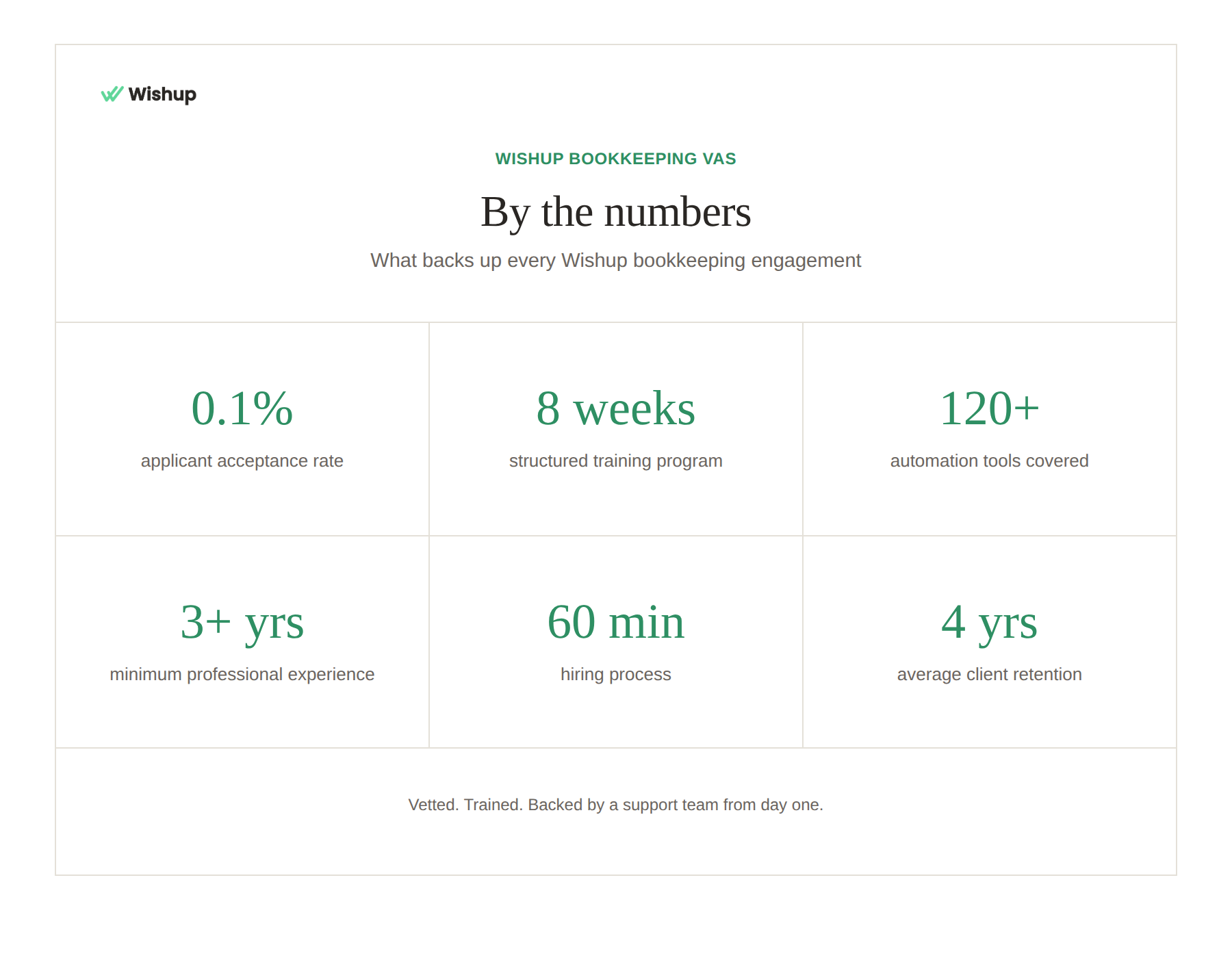
- 6-step vetting process: Only about 0.1% of applicants are accepted.
- 8-week structured training program: Covers 120+ automation tools, so you're not the one training your bookkeeper on your tech stack.
- 3-layer support model: The VA, a VA manager, and a dedicated Customer Success Manager work together, so quality doesn't depend on one person having a good week.
- 5-minute response time commitment during business hours.
- 60-minute hiring process.
- Money-back and replacement guarantee if the fit isn't right.
- Minimum 3+ years of professional experience for every bookkeeping VA.
- 4-year average client retention across Wishup's VA base. Continuity is what actually keeps books accurate over time, so this matters more than almost any other stat here.
Common Mistakes When Outsourcing Bookkeeping
- Choosing the cheapest option without checking actual scope: A $300/month retainer that doesn't cover your real transaction volume just delays the cost.
- Not clarifying what's excluded: Tax filing, payroll processing, and advisory work are often separate from core bookkeeping; confirm this before you assume it's covered.
- Skipping the vetting conversation: Asking about training, oversight, and backup coverage upfront avoids a mid-engagement scramble later.
- Assuming automation removes the need for review: Automated tools reduce manual work; they don't replace the accuracy check a trained person provides.
- Underestimating onboarding: A provider should be able to work with your historical books, if they can't, cleanup costs can exceed months of regular service fees.
FAQs
What does an outsourced bookkeeper do? An outsourced bookkeeper handles recurring financial tasks such as recording transactions, reconciling accounts, tracking accounts payable and receivable, and supporting month-end close and reporting. Hence, your books stay accurate and current without an in-house hire.
How much should you pay someone to do your bookkeeping?
It depends on transaction volume and complexity. A freelance bookkeeper typically runs $200–$500/month for basic needs, a bookkeeping firm runs $500–$2,500/month for more involved work, and virtual CFO-level services start at $2,500+/month (Mercury).
Is small business bookkeeping worth outsourcing?
For most small businesses, yes. A full-time in-house bookkeeper comes with a fixed salary plus benefits, payroll taxes, and equipment costs whether the workload is heavy that month or light. Outsourcing scales with actual need, and it adds coverage and quality oversight that a single in-house hire can't provide alone, since a provider isn't a single point of failure if someone is out sick or leaves the company.
Can I outsource bookkeeping services to an offshore provider? Yes, offshore and remote bookkeeping support (including providers based in or operating out of India) is common and can offer meaningful cost savings, provided the provider has a structured vetting and training process and a clear communication/response-time standard for your business hours.
If your books need structure, consistency, or just someone dependable running them week to week, Wishup's bookkeeping VAs are vetted, trained, and backed by a full support team from day one — with a 60-minute hiring process and a replacement guarantee if it's not the right fit.
