
What Is a Technical Virtual Assistant?
A technical virtual assistant is a remote professional who configures software, integrates platforms, and automates repeatable work so a business runs faster with fewer hands. They set up and manage CRMs, build automations across tools like Zapier and Make, maintain websites, and connect software integrations.
A general assistant uses your tools. A technical VA builds with them. One enters the data into the CRM. The other connects the CRM to your phone system so every call logs itself, gets transcribed, and turns into action items without anyone touching a keyboard. We have a technical VA running exactly that pipeline for a robotics client today, wiring OpenPhone into NetHunt through a transcription step and an AI summary so calls and texts update the right contact automatically.
The role also sits at a useful distance from full AI replacement. Plenty of work can be automated, yet someone still has to design the automation, watch it, and fix it when an API changes. That judgment layer is the job. If you are weighing where the line falls, our breakdown of a VA versus an AI assistant is a good companion read.
What Does a Technical Virtual Assistant Do in 2026?
A technical virtual assistant owns the complex operational tasks like help desk support, software setup, website upkeep, product QA, documentation, monitoring, ticketing, and tool integration. Here's a detailed overview of the tasks performed by a technical virtual assistant.
Help desk, onboarding, and access management
The technical VA is the first responder for everyday tech friction and the keeper of who can touch what. They answer first line IT requests, troubleshoot the frozen inbox and the broken login, and escalate the genuinely hard cases. They provision accounts when someone joins and revoke them cleanly when someone leaves. One small but telling example from our books: a VA built a Dialpad to Zapier to Slack flow that captures a client login two factor code and pushes it to both the client and the team at once, so a missing 2FA code stops blocking work.
Software setup, integration, and tool stack management
Connecting platforms is the heart of the job. A technical VA links Gmail, CRMs, spreadsheets, helpdesks, and phone systems so data flows once and lands everywhere it should. This is where Zapier, Make.com, and n8n earn their keep. A few live builds from our team:
- Order to cash for an e commerce seller: an incoming purchase order email is parsed by AI, SKUs are validated against price, minimum order quantity, and unit of measure, stock is checked, a Shopify order is created, a QuickBooks purchase order is generated per supplier, and every step is logged. It replaced roughly 90 minutes of manual checking per order.
- Invoice filing for a contractor: invoices arriving in Gmail are extracted and uploaded into the matching ServiceTitan purchase order, with the final amount updated automatically.
- Outreach tracking: LinkedIn connection activity logged in a sheet syncs into HubSpot, creates the contact if it does not exist, and spins up a 48 hour follow up task so warm leads stop slipping through.
Website, CMS, and content operations
Technical VAs keep sites current and publish at scale. That means CMS updates, plugin checks, uptime monitoring, content uploads, and making sure your WordPress hosting can handle traffic spikes without breaking a sweat. The depth here surprises people. One of our VAs built a WordPress publishing pipeline that takes an approved draft, generates the block HTML, creates the recipe card through a custom REST API endpoint, places images, and configures the SEO metadata, turning a 60 to 90 minute manual publish into a sub minute job. That is CMS work, API work, and content operations folded into one automation.
Documentation, QA, and product support
A technical VA writes the manuals, tests the features, and keeps the knowledge base honest. They create SOPs and how to guides, log bugs against new releases, and maintain the documentation that lets the next person move fast. We treat clear documented SOPs as a deliverable in its own right, because an automation nobody can maintain is a liability waiting to happen.
Monitoring, ticketing, and reporting
Keeping systems healthy and visible is constant background work. Technical VAs track uptime, flag anomalies, run routine checks, and manage internal and customer ticket queues. They also turn raw data into something a leader can act on. One VA built a Zapier Agent that watches an Asana board every day and sends a Slack digest of pending and changed tasks, so deadlines stop getting missed. Another runs a quote generator inside a CRM that collapsed 14 template combinations and a 12 hour turnaround into an instant, error free PDF.
Workflow automation and AI orchestration
This is the category that defines the modern role. A 2026 technical VA does not just use AI tools, they orchestrate them. They chain Claude, ChatGPT, and code steps together to extract, decide, and act. The standout in our portfolio is a compliance system one VA built in Google Apps Script for an education client. It manages fingerprinting and certificate tracking for more than 540 teaching fellows across six districts, sends confirmations, builds personal Drive folders, scans the inbox every ten minutes for receipts, validates data, and syncs cleared records to a master tracker. A run that used to take about 1,200 minutes by hand now runs itself, saving north of 100 hours a month. For industry specific versions of this, see our work on healthcare workflow automation and the real estate workflow automation VA.
How Does a Technical Virtual Assistant Differ From a General Virtual Assistant?
The difference comes down to ownership and depth: a general VA executes inside your tools, while a technical VA builds and maintains the systems those tools live in. Both are valuable, and many businesses need both. The table below maps where they diverge.
|
Dimension |
General VA |
Technical VA |
|
Core focus |
Executes recurring admin and coordination tasks |
Configures, integrates, and automates systems |
|
Tools relationship |
Operates inside existing tools |
Connects and extends tools with code and APIs |
|
Typical output |
Cleared inbox, booked calendar, updated records |
Working automations, dashboards, integrations |
|
Skills |
Organisation, communication, scheduling |
Automation platforms, scripting, data, APIs |
|
Handles APIs and code |
Rarely |
Routinely (Apps Script, Python, webhooks, REST) |
|
When it breaks |
Escalates the issue |
Diagnoses and fixes the issue |
|
Best for |
Daily operational load and coordination |
Scaling, reducing manual work, system reliability |
A simple way to decide: if your problem is I do not have enough hours, a general VA helps. If your problem is the same work keeps eating hours and breaking, you want a technical VA, often an automation expert VA who can remove the work entirely.
Who Actually Needs a Technical Virtual Assistant?
If your team copies data between apps, uses lot of software, rebuilds the same report monthly, or loses leads because a follow up did not fire, you need a technical virtual assistant.
The role of a tech VA fits:
- SaaS and tech startups scaling a tool stack faster than they can hire engineers, who need CRM, billing, and support systems wired together.
- E commerce operators juggling Shopify, marketplaces, inventory, and accounting, where order to cash and catalog work multiply with volume.
- Agencies and consultancies managing many client platforms at once, where reporting and onboarding are the bottleneck.
- Regulated and document heavy firms in healthcare, real estate, legal, and finance, where compliance tracking and filing eat real hours.
- Solo founders and lean teams who are the bottleneck themselves and need systems built once so the business stops depending on their attention.
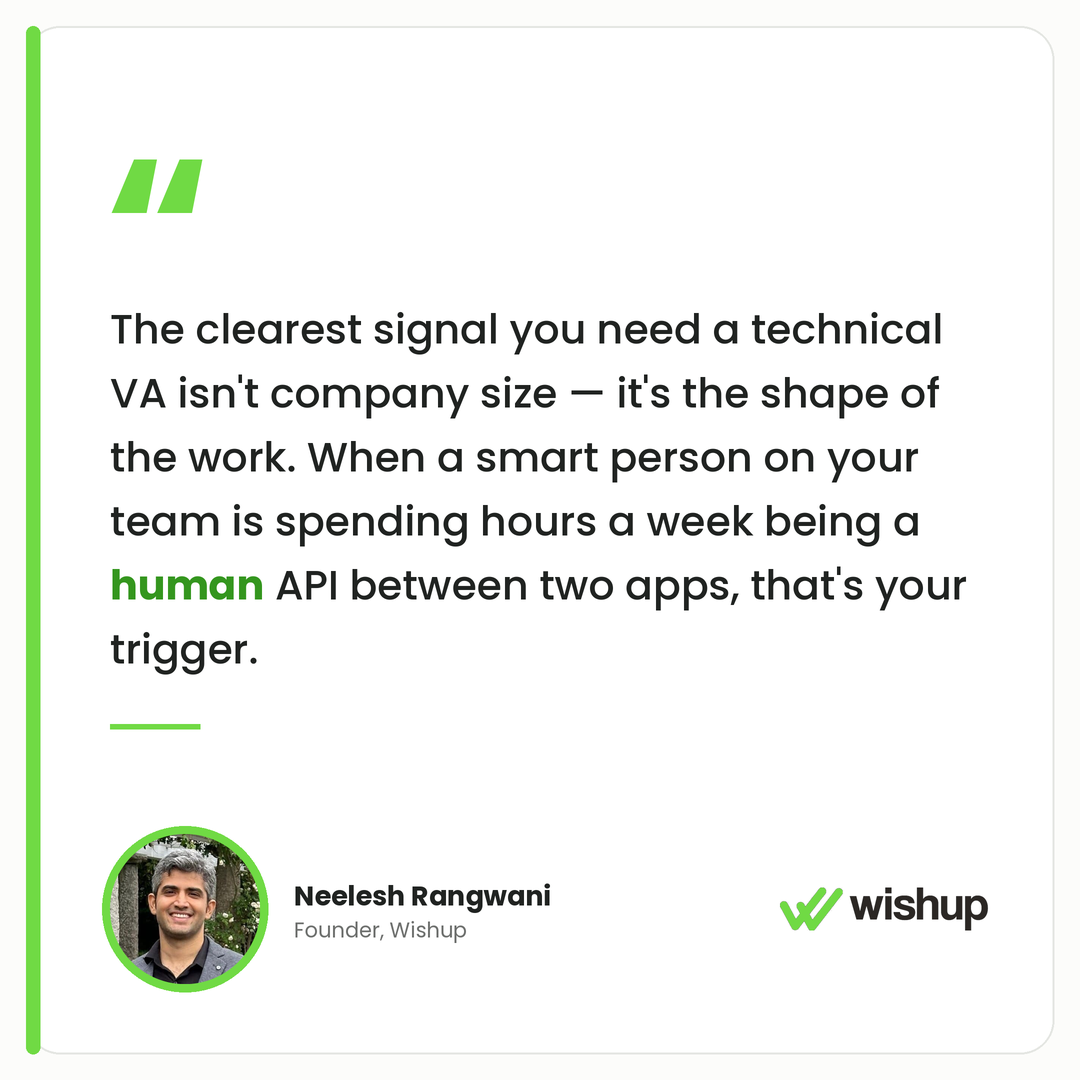
Neelesh's point of view: "The clearest buying signal is not company size, it is the shape of the work. A two person startup with three disconnected SaaS tools needs a technical VA more than a 50 person company with one clean platform. If a smart person on your team is spending several hours a week being a human API between two apps, that's when you need to hire a tech VA. Before you hire, it also helps to delegate the right way so the engagement starts on solid footing."
What Tools and Skills Define a Capable Technical VA?
A strong technical VA pairs fluency in client facing software with command of the automation engines that connect it. Tool lists go stale fast, so judge the categories more than the brand names. Here is the stack our technical VAs actually work in.
Automation and AI engines (the build layer)
- No code and low code platforms: Zapier, Make.com, n8n, Pipedream, and Google Apps Script for connecting apps and scheduling logic.
- Code where no code stops: Python, JavaScript, Node.js, VBA macros, SQL, plus webhooks and REST API calls for the cases off the shelf connectors cannot handle.
- AI and agents: Claude, ChatGPT and the OpenAI API, Gemini, Google AI Studio, custom GPTs, and agentic builders like Zapier Agents for extraction, decisioning, and drafting.
Client side software (the operate layer)
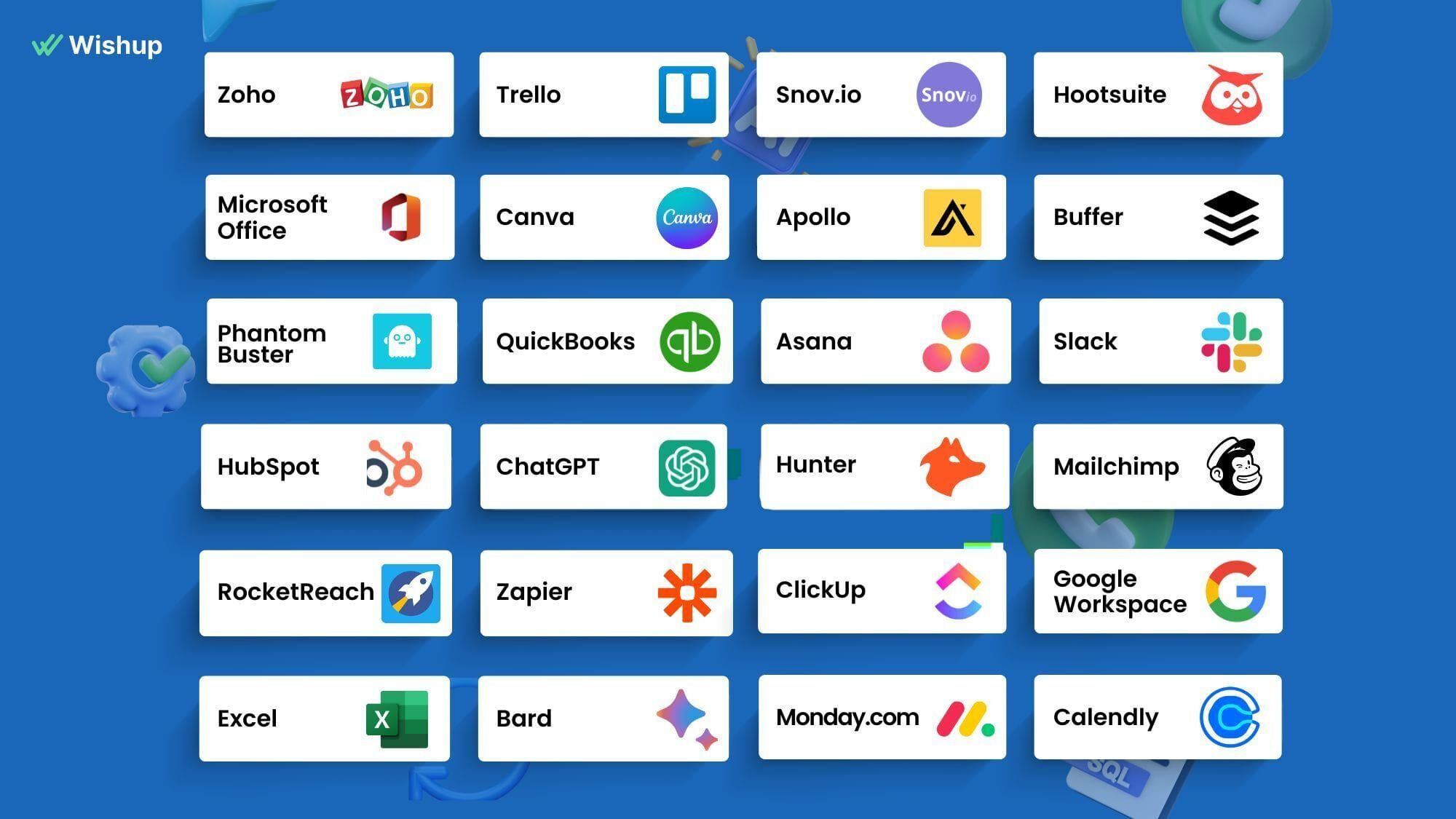
- CRM and sales: HubSpot, Zoho, Salesforce, GoHighLevel, NetHunt, Pipedrive.
- Productivity and comms: Google Workspace, Microsoft 365, Slack, Discord, Zoom, Notion, Asana, ClickUp, Trello.
- Commerce, finance, and ops: Shopify, QuickBooks, Stripe, ServiceTitan, AppFolio, Calendly, Mailchimp.
Skill wise, the non negotiables are clear thinking about data flow, the discipline to document, basic security hygiene around tokens and access, and the prompting skill to make AI reliable rather than impressive. For context on the training we put behind this, see how we train our VAs.
How Much Does a Technical Virtual Assistant Cost in 2026?
The cost of a technical virtual assistant starts from $1299 at Wishup. Pricing depends on where the talent sits, how much technical depth you need, and whether you buy through a marketplace, an agency, or a managed provider.
As a benchmark, virtual assistants run around 78 percent cheaper than a full time on site hire according to INSIDEA, and a senior in house automation engineer in a Western market can cost six figures fully loaded.
Wishup offers three technical virtual assistant plans: Prime VA, Elite VA, and US-based VA.
* The Prime VA plan costs $1,999 per month for full-time and $1,299 per month for part-time.
* The Elite VA plan costs $2,999 per month for full-time and $1,999 per month for part-time.
* The US-based VA plan costs $5,400 per month for full-time and $3,000 per month for part-time.
Note: In every plan, full-time means 8 hours of work per day, and part-time means 4 hours of work per day. All prices are in US dollars and billed monthly.
For a fuller breakdown of pricing models across the market, our guide to what a virtual assistant costs goes deeper.
Why Can't a Freelancer Usually Handle Technical VA Work?
Most freelancers can build a single automation, but they cannot own your operations, and that gap is where technical VA work actually lives. The job is not a one off project. It is an ongoing relationship with your systems. Here is where the typical gig hire breaks down.
- Automations rot, and nobody is watching. APIs change, tokens expire, a tool ships an update, and the Zap silently stops firing. A freelancer who delivered and moved on is not monitoring your 401 errors at 9am. A technical VA is.
- No accountability and no continuity. When a freelancer disappears mid build, you inherit half finished logic with no documentation. We have rebuilt exactly these messes for clients who lost weeks to a vanished contractor.
- Single skill, single tool. Real workflows cross five systems. A Zapier specialist who cannot drop into Apps Script, read an API doc, or debug a webhook will hit a wall on the problems that matter most.
- No security or access discipline. Handing CRM, inbox, and payment access to an unvetted gig worker is a risk most founders underestimate until something leaks.
Our blunt take: a marketplace freelancer is fine for a contained, throwaway task. For anything your business will depend on next quarter, you need a vetted operator who learns your stack, documents what they build, and is still there when it breaks. That is the difference between buying a deliverable and gaining a teammate.
How Do You Assess a Technical Virtual Assistant Before Hiring?
Assess a technical VA on proof of shipped work, breadth across tools, and how they think when something breaks, not on a resume keyword list. A clean interview answer is easy to fake. A working automation with a Loom walkthrough is not. Use this checklist.
- Ask for live builds with proof. Request two or three automations they have shipped, ideally with a short video walkthrough and the before and after time saved. Vague descriptions are a red flag.
- Probe tool breadth, not just one platform. Can they move between a no code tool and actual code when the connector runs out? The best ones reach for Apps Script or Python without flinching.
- Give a small real test. Hand them a messy, realistic task, such as a spreadsheet that needs to trigger an email through an approval step. Watch how they scope it.
- Ask how they handle failure. What do they do when a Zap halts at a find contact step, or when an API has no trigger available? Strong VAs answer with monitoring, fallbacks, and logging by instinct.
- Check documentation and communication. An automation nobody can maintain is debt. Look for someone who writes clear SOPs and explains tradeoffs plainly.
- Confirm security awareness. They should never paste secrets into screenshots, and they should talk about least privilege access without being prompted. For US businesses, hiring a security-aware technical VA should be complemented by specialist testing when custom applications or integrations handle sensitive data. DeepStrike’s comparison of penetration testing companies in the US can help teams shortlist providers and compare testing scope, reporting, and retesting support.
How and Where Do You Hire a Technical Virtual Assistant?
You can hire a technical VA through freelance marketplaces, niche job boards, or a managed virtual assistant service, and the channel you pick shapes the risk you carry. Each route trades off speed, cost, and reliability differently.
- Freelance marketplaces. Fastest to browse and cheapest on paper. The cost shows up later in vetting, continuity, and the single skill problem covered above. Workable for tiny tasks, risky for core systems.
- Specialised job boards and direct hire. Better quality control, but you absorb the full burden of sourcing, testing, training, and replacement if it does not work out.
- Managed VA services. You get a pre vetted, pre trained operator with a manager behind them and a replacement guarantee if fit is wrong. Slightly higher rate, far lower risk, and the option to start in days rather than weeks.
Whichever route you take, set the engagement up well: write down the workflows that hurt most, agree on a first automation to prove value, and put a clean onboarding playbook in place. If you want to skip the sourcing grind entirely, you can hire a vetted virtual assistant who is ready to start.

What Does a Technical VA Engagement Look Like in Practice?
The best way to understand the role is to watch one rebuild a function from the ground up. Sound Commerce, a global payment consultancy run by founder Matthew Steinbrecher, had data everywhere and insight nowhere. Manual data processing was burning 5 to 6 hours a week, monthly report generation took another 1.5 hours, and complex calculations were repeated by hand with no automation in sight. Decisions were slow because the infrastructure to support them did not exist.
Wishup placed an Elite VA, Shailja Tiwari, to fix the symptom and ended up rebuilding the engine. She automated the data pipelines in Python and SQL, built Excel and Power BI dashboards with DAX driven calculations, and cleaned and migrated more than 70 unstandardised columns in 24 working hours with zero downtime. She also supported machine learning data inputs, helped monitor Azure flows, and streamlined payment gateway onboarding for 15 plus businesses.
The measured results:
- Report generation cut by 80 percent, from 1.5 hours to 15 minutes a month.
- Manual reporting and data prep reduced by more than 70 percent.
- Decision making speed improved by roughly 40 percent, with complex calculations fully automated.
- Data migration of 70 plus columns completed in 24 hours with 0 percent downtime, and a 5 star satisfaction rating.
She is not afraid to speak her mind when she believes a process is inefficient or could be maximised. Even with a light task load, she proactively works on adjacent improvements without needing micromanagement.
That last line is the whole role in one sentence. Read the full fintech operations case study for the complete breakdown.
Why Hire a Technical Virtual Assistant From Wishup?
Wishup gives you a technical VA who is already vetted, already trained on the modern tool stack, and backed by a manager and a replacement guarantee. The role only works when the operator is genuinely capable and genuinely accountable, and that is what we are built to deliver.
- Top 0.1 percent, rigorously vetted. A 5 step screening process with aptitude, personality, and cognitive testing, drawing from a pool of 1,500 plus VAs.
- Trained on 120 plus AI and no-code tools and 200 plus skillsets. Plus an 8 week mandatory AI and communications program.
- Onboarded in 60 minutes. Match with a pre vetted, pre trained VA, often hired and trained by ex entrepreneurs, within the hour.
- Backed, not left alone. A dedicated VA manager and client success manager support every engagement, with free VA replacement within 24 hours if fit is wrong.
- Low risk commercials. Pricing from $1299 per month, monthly flexibility, and no long-term commitments.
- Proven and trusted. More than 1,500 businesses served, 4 plus years average VA retention, and a Net Promoter Score above 85.
If your problem is repeatable work that keeps eating hours and breaking, that is precisely the problem a Wishup technical VA is trained to remove. You can hire a vetted virtual assistant today, or start with a focused automation expert VA if automation is your first priority.


Frequently Asked Questions About Technical Virtual Assistants
Is a technical virtual assistant the same as an IT support person?
No. IT support is reactive and fixes what breaks. A technical VA does first line support too, but the larger value is proactive: building automations, integrating tools, and removing the manual work before it becomes a recurring problem.
Can a technical VA replace a developer?
Not for building software products. A technical VA excels at operational engineering, which means connecting existing tools, scripting automations, and managing data flow. For complex custom application development you still want a developer. For workflow automation specialists and CRM automation, a technical VA is often the better and cheaper fit.
Do technical VAs work in my time zone?
Wishup VAs work in your time zone, including a same day, fast turnaround in US hours, so support and monitoring line up with your business day rather than fighting it.
How quickly will I see value from a technical VA?
Often within the first few weeks. A good first move is to automate one painful, high frequency workflow, prove the time saved, then expand. Several of our automations paid back the engagement inside a single month.
