

🟢 Recently updated: June 2026 — Reviewed by the Wishup editorial team.
Most people don't fail at hiring a virtual assistant because they pick the wrong person. They fail because they hire before they know what they actually need — and then spend three weeks frustrated that their new VA "isn't proactive," when really, nobody ever told them what the job was.
This guide fixes that. It walks through hiring a virtual assistant the way it actually works in practice: start by figuring out what to hand off, then decide where to find someone, then budget, then test, then onboard. By the end you'll know exactly what to do on Monday morning — whether you hire a freelancer yourself or use a managed service.
Let's start with the part almost everyone skips.
What is a virtual assistant, really?
A virtual assistant is a remote professional who handles ongoing tasks for you — administrative, operational, or specialized — without being a full-time employee on your payroll. That's the textbook definition. Here's the more useful one: a VA is the person who does the work that's necessary but isn't you-shaped work.
Think about your week. Some of it genuinely needs you — your judgment, your relationships, your expertise. The rest is execution: booking the travel, chasing the invoice, formatting the deck, replying to the fifth "what are your hours?" email. A virtual assistant takes the second pile.
There are two broad types, and knowing which you need changes everything downstream:
- A generalist (administrative) VA handles the wide, shallow stuff: inbox, calendar, data entry, research, scheduling, travel. Most first-time hirers need this.
- A specialist VA goes deep in one area: bookkeeping, social media, e-commerce operations, legal intake, or medical scheduling. You hire these when a specific function — not your whole week — is the bottleneck.
The mistake is hiring a generalist and expecting specialist depth, or hiring a specialist for work a generalist could do at half the cost. You can only avoid that by getting specific first — which is Step 1.
When is it actually time to hire a VA?
The honest answer: when the cost of not hiring is higher than the cost of hiring. That sounds obvious, but most people wait far too long because they're stuck doing $15/hour work while their time is worth ten times that.
Here are the real signals, the ones that show up before you consciously notice them:
- You've started letting small things slip — a follow-up here, an invoice there — not because you forgot, but because there genuinely isn't time.
- You're doing admin at 9 PM that could've been done by someone else at 11 AM.
- You've said "I'll get to it" about the same task three weeks running.
- You're turning down opportunities because you have no capacity, not because they're bad.
- The thought of going on holiday makes you anxious about what'll pile up.
If two or more of those feel familiar, you're past the point where a VA makes sense — you're into the territory where not having one is actively costing you money.
There's also a quieter shift worth naming: in 2026, hiring a VA is no longer a "big company" move. Solo founders, freelancers, real estate agents, clinic owners, and two-person startups all run lean by delegating operational work instead of drowning in it or hiring expensive full-time staff too early. A VA is often the very first "hire" a business makes.
The delegation audit: figure out what to hand off (before you hire anyone)
This is the step that separates VA hires that work from the ones that quietly fizzle out. Before you look at a single candidate or service, you need to know what you're actually hiring for. Not "general help" — a real, written list.
Here's a 20-minute exercise that works better than any job description template:
1. Track your tasks for three days. Just jot down everything you do, in a notes app or on paper. Don't filter — "replied to client email," "booked flight," "made the invoice," "researched venues," all of it.
2. Mark each task with one of three letters:
- M — only Me can do this (your expertise, your relationships, your call to make)
- D — someone else could Do this if I showed them how
- A — this could be Automated or eliminated entirely
3. Look at your D pile. That's your VA's job description, written by your actual life instead of guesswork. Most people are genuinely surprised to find 40–60% of their week sitting in the D column.
The reason this matters so much: when you hire from a real D-list, you can tell the VA exactly what success looks like in week one. When you hire from a vague feeling of "I need help," you and the VA spend the first month discovering the job together — expensive, slow, and the number-one reason VA relationships fail early.
Group your D-list into themes (inbox & calendar, research, bookkeeping, social, customer replies). Those themes tell you two things at once: how many hours a week you'll need, and whether you need a generalist or a specialist. You've now done the hardest part of hiring, and you haven't even looked at a candidate yet.
Step-by-step: how to hire a virtual assistant
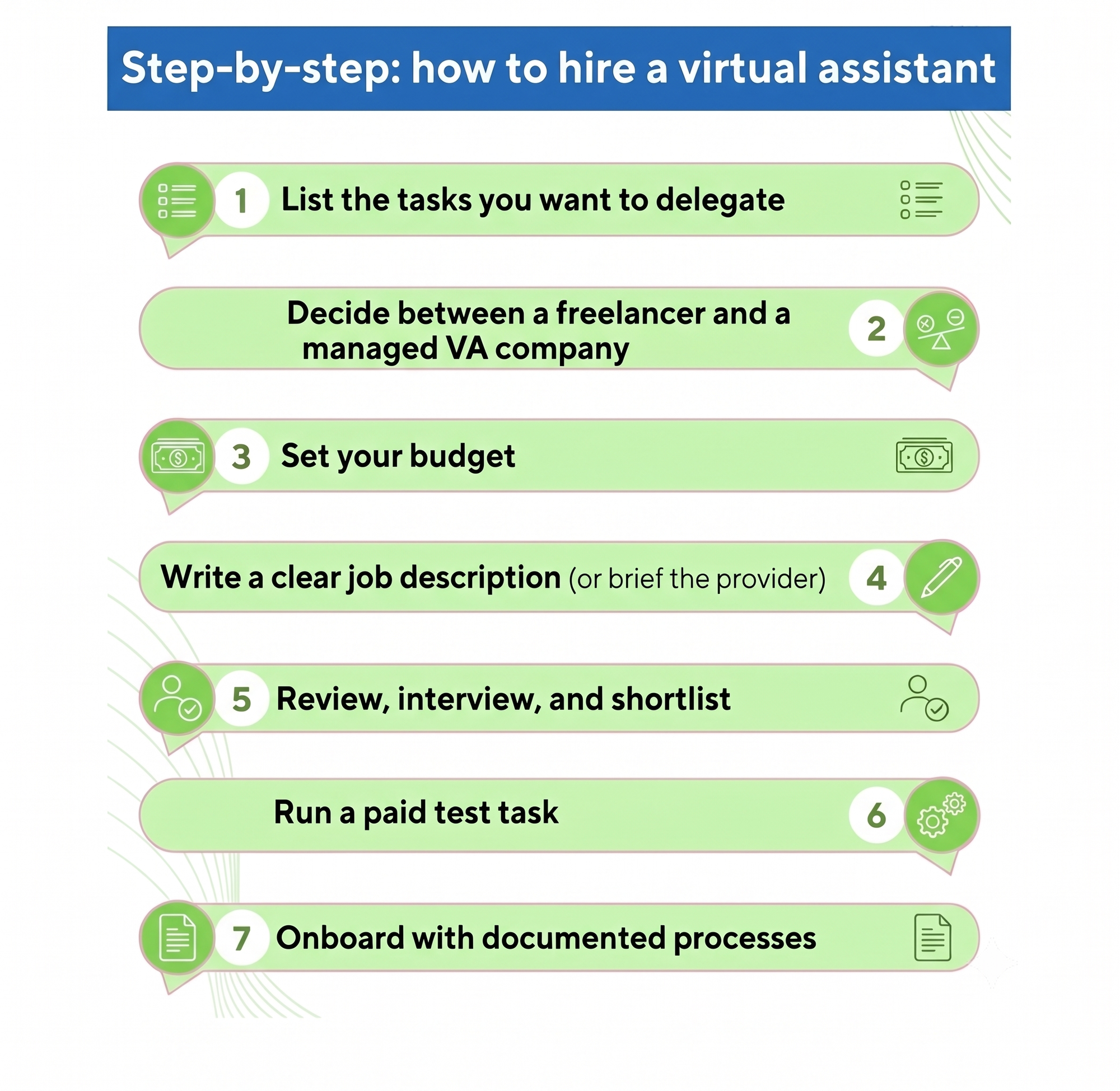
With your delegation audit done, the rest of the process is genuinely straightforward. Here are the seven steps in order.
Step 1: Turn your D-list into a one-page role
You already did the thinking. Now write it down plainly: the tasks, grouped by theme; the tools involved (Google Workspace, QuickBooks, Calendly, whatever you use); the hours you'll need; and the time-zone overlap that matters to you. One page is enough. This single document becomes your job post, your interview script, and your onboarding checklist all at once.
Step 2: Decide how you'll hire — freelancer or managed service
This is the real fork in the road, and it's less about cost than about who carries the risk. We'll go deep on this in the next section, but the short version: hiring a freelancer yourself means you own the vetting, contracts, payments, and the scramble if they vanish. Using a managed service means someone else owns all of that and hands you a pre-vetted person. Pick based on how much of that work you actually want to do.
Step 3: Set a realistic budget
Budget follows from three things — where the VA is based, how skilled they are, and how many hours you need. We've put real 2026 numbers in the cost section below. The one piece of advice that saves people money: start smaller than you think. Part-time first, then scale once you've seen the value. Almost nobody regrets starting at 20 hours a week; plenty of people regret committing to 40 before they'd built the working relationship.
Step 4: Source candidates (or brief your provider)
If you're hiring directly, post your one-page role on the platforms we list further down, and expect to screen a lot of applicants. If you're using a managed service, this step collapses into a single conversation — you describe the role once and they match someone who already fits. This is the biggest practical difference between the two routes: sourcing is where DIY hiring eats your week.
Step 5: Interview for communication, not credentials
When you do talk to candidates, resist the urge to grill them on tools. Tools can be learned in a week. What can't be taught quickly is clear communication and good judgment. A short video call tells you more than any CV: Do they ask sharp questions about your business? Do they explain things clearly? Do they follow up well? Those signals predict success far better than a list of software they've touched.
Step 6: Run a small paid test task (never skip this)
This is the highest-signal 30 minutes in the whole process. Give your top candidate a small, paid, real task that looks like the actual job. Not a hypothetical — a real thing.
Say you're hiring for inbox and scheduling. A great test: "Here are 10 sample emails. Draft a reply to each, flag the two you'd escalate to me, and propose a time for the meeting request in email 4." In half an hour you'll see their writing tone, their judgment about what to escalate, their attention to detail, and their scheduling logic — the exact muscles the real role uses. Pay them for it. Good candidates expect it, and it signals you're a serious client.
Step 7: Onboard like the first week decides everything (because it does)
Here's the rule that quietly determines whether this works: the quality of your onboarding sets the ceiling on the relationship. Spend the first week documenting your recurring processes — a two-minute Loom screen recording beats a page of written instructions every time — and set clear norms: where you communicate, how often you check in, how they flag a blocker. Front-load a few hours here and a good VA operates almost independently within two to three weeks. Skip it, and you'll be answering the same questions for months.
Where to hire a virtual assistant: freelancer vs managed service
This is the decision people agonize over, so let's make it simple. There are really three routes, and they trade off cost against effort and risk.
Freelance marketplaces (Upwork, Fiverr, OnlineJobs.ph) give you the widest pool and the lowest hourly rates. The catch is that you become the HR department: you write the post, sift through dozens of applicants, run the interviews, handle contracts and payments, manage quality, and — if it doesn't work out — start the whole thing over. For people with time and a clear sense of what they want, this works and it's cheap. For busy founders, the hidden cost is the hours it eats and the risk of a bad hire stalling you for weeks.
Managed VA services (like Wishup) flip that trade. You pay more per hour, but the vetting, training, replacement guarantee, and day-to-day management come included. You describe the role once and get matched with someone pre-vetted, usually within days. You're not buying a cheaper hour — you're buying the removal of hiring risk and management overhead.
Direct hiring through your network is the third route: ask around, hire someone referred. No platform fees, but your pool is limited to who you happen to know, and you still own all the management.
Here's the honest way to choose: if your time is worth more than the price difference, or a bad hire would genuinely hurt your business, go managed. If you have time to manage and want the lowest rate, go freelance. There's no universally right answer — there's only the right answer for how much of the work you want to own.
Where people hire from, by region
A quick practical note, since this comes up constantly: a lot of the world's VA talent is concentrated in the Philippines (strong English, Western time-zone overlap, deep VA culture) and India (large skilled talent pool, strong in technical and finance work, very competitive rates). US-based VAs cost considerably more but offer same-time-zone availability and are sometimes preferred for client-facing or compliance-sensitive work. Where you hire from is mostly a cost-versus-overlap decision — there's quality talent in all three.
How much does it cost to hire a virtual assistant in 2026?
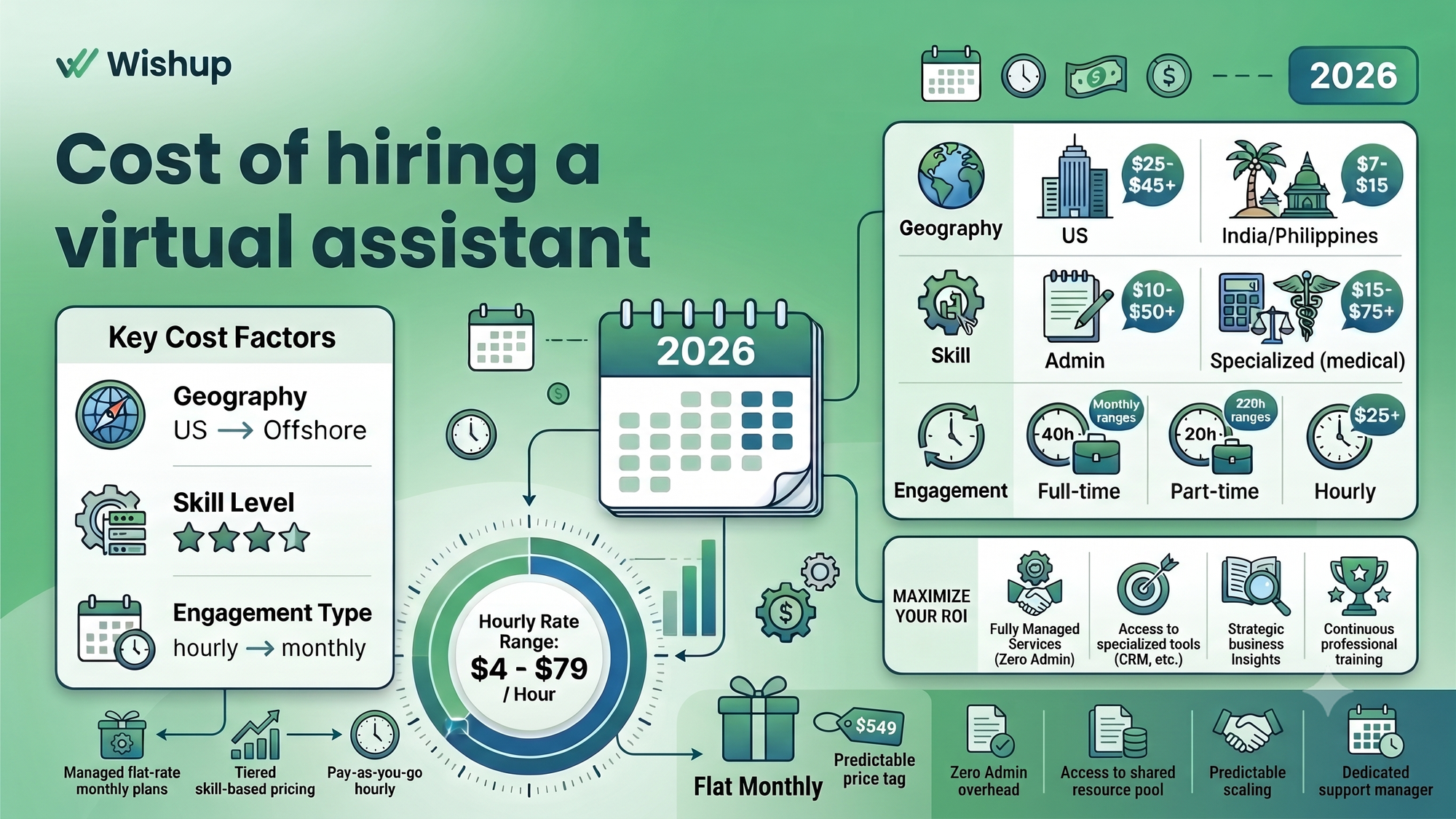
Costs vary more than most "average rate" articles admit, because three different levers move the price. Here's the real 2026 picture.
| What moves the price | Option | Typical 2026 cost |
|---|---|---|
| Where they're based | US-based VA | $25–$45+ / hour |
| Offshore VA (India, Philippines) | $7–$15 / hour | |
| How specialized | Generalist / admin VA | $10–$50+ / hour |
| Specialist (bookkeeping, legal, medical) | $15–$75+ / hour | |
| How you engage | Full-time (40+ hrs/week) | $1,000–$5,000+ / month |
| Part-time (~20 hrs/week) | $500–$3,000+ / month | |
| Hourly / on-demand | $25+ / hour |
The biggest single lever is geography. According to Indeed, the average US virtual assistant earns around $27/hour — while a pre-vetted offshore VA can deliver comparable output for a fraction of that. That gap is exactly why so many US businesses hire offshore or use managed providers that pair offshore cost with built-in quality control.
One thing the hourly numbers hide: a freelance rate isn't your real cost. Add the hours you spend vetting, the payment fees, and the risk of redoing work after a bad hire, and the "cheap" option often isn't. That's the actual math behind choosing managed over marketplace — you're pricing in the things that don't show up on the invoice. For a full company-by-company breakdown, see our guide on how much a virtual assistant costs.
What can you actually delegate to a VA?
If you did the delegation audit, you already have your personal answer. But here's the broader map of what VAs handle in 2026 — useful for spotting things you didn't realize you could hand off. Modern VAs do far more than basic admin; many are trained in AI and no-code tools, which means they can run repeatable systems, not just one-off tasks.
- Administrative & personal: inbox and calendar, travel, data entry, CRM updates, research, personal scheduling.
- Customer-facing: phone answering, virtual reception, email/chat support, appointment setting and follow-ups.
- Marketing & content: social media scheduling, content formatting and publishing, email marketing support.
- Finance & operations: bookkeeping, invoicing, expense tracking, order processing, inventory updates.
- Industry-specific: real estate transaction coordination, HIPAA-compliant medical scheduling, legal intake, e-commerce store management.
The rule of thumb is simple: if a task is repeatable and you can describe how it's done, it can be delegated. Keep only the work that needs your judgment, your relationships, or your legal sign-off.
Hiring for a specific role or industry
General VAs cover general work well. But if your bottleneck is one specialized function, hiring someone who already knows that domain saves weeks of ramp-up. The most common specialized hires:
- A real estate virtual assistant for transaction coordination, listings, and lead follow-up.
- A HIPAA-compliant medical VA for scheduling and patient admin under compliance rules.
- A virtual legal assistant for intake and document management.
- A social media manager to plan, schedule, and report on content.
- A VA for e-commerce store owners handling listings, orders, and customer queries.
- A virtual bookkeeper for reconciliations and invoicing.
Still deciding between an executive assistant and a general admin VA? Our guide on executive vs administrative assistants breaks down which fits.
The mistakes that quietly kill VA relationships
Most VA hires that don't work out fail for the same handful of reasons — and every one of them is avoidable.
The first and biggest is hiring before defining the work. "I need help" isn't a brief; it's a feeling. Without a real task list, you get mismatched skills and a frustrating first month. (This is exactly what the delegation audit prevents.)
The second is skipping the paid test task. An interview shows you how someone communicates; only a real task shows you the quality of their actual output. The two are not the same, and the gap between them is where bad hires hide.
Third is under-investing in onboarding. A VA without documented processes will interrupt you constantly — not because they're weak, but because you never gave them what they needed to work independently.
Fourth is choosing on price alone. The cheapest hourly rate routinely turns out to be the most expensive once you count redone work and turnover.
Fifth is dumping everything at once. Start with a few clear tasks, build trust, then expand. Overloading a new VA in week one overwhelms both of you.
And the sixth, especially for solo freelance hires: no backup plan. If your one freelancer disappears, your operations stall. This is the single biggest argument for a managed service — the replacement guarantee means one person quitting isn't your emergency.
A quick way to know if the math works (the ROI check)
Before you commit, it helps to sanity-check the numbers. The ROI of a VA comes down to one comparison: what they cost versus what your reclaimed time is worth.
Do this in three lines:
- Your effective hourly value — roughly, what an hour of your focused, high-value work is worth. Say it's $100.
- Delegable hours — from your audit, how many hours a week sit in the D column. Say it's 15, or about 60 a month.
- Compare. If a VA costs, say, $1,299 a month and frees 60 hours you value at $100 each, you've reclaimed $6,000 of capacity for $1,299 — before you even count the revenue you create with those reclaimed hours.
The break-even point arrives the moment your effective hourly value is higher than the VA's hourly cost — which, for almost any business owner, it already is. The numbers almost always favor delegating; the thing holding most people back is the audit and the onboarding, not the economics.
What changed in 2026: AI-trained VAs
The biggest shift in the last two years is that strong VAs are now fluent in AI and no-code automation, not just manual execution. This matters when you hire, because it changes what one person can deliver.
A traditional VA enters your leads into the CRM one by one. An AI-trained VA sets up an automation that captures the form, enriches the data, routes it, and then monitors the whole thing — turning a recurring task into a system that mostly runs itself. Instead of writing every social caption from scratch, they run an AI-assisted draft and edit for quality and brand voice.
So when you evaluate candidates or providers in 2026, ask what tools they actually use. The strongest VAs are comfortable with tools like ChatGPT, Zapier or Make, and the core stack for their specialty — QuickBooks for bookkeeping, HubSpot for sales, Canva for content. This is also why the old "offshore equals lower quality" assumption no longer holds: a pre-vetted, AI-trained offshore VA often delivers more leverage than an untrained local hire at three times the price.
Setting up the working relationship
Hiring is the start; the relationship is what delivers the value. Three things make it run smoothly.
One channel for communication. Pick a primary tool — Slack is common — and set norms: response-time expectations, a regular check-in rhythm, and how to flag something urgent. Scattering communication across email, text, and calls is how tasks get dropped.
One shared place to see the work. A simple tracker (Trello, Asana, ClickUp, or even a shared doc) lets both of you see what's in progress, done, and blocked — which removes the need for constant status updates.
Documented processes. For anything recurring, a short SOP — ideally a screen recording plus a checklist — is the highest-leverage thing you can create. It's what turns a VA from someone who needs direction into someone who just handles it.
With a managed service, a lot of this scaffolding comes built in: a dedicated manager helps coordinate, and the VA arrives already trained on common tools, so your onboarding time goes to your specific processes rather than the basics.
Scaling from one VA to a team
Plenty of businesses start with one part-time VA and grow from there. The signal to scale is simple: your VA is consistently at capacity and you still have work in the D column.
When you scale, you've got two moves. Add a second generalist to handle more volume, or add a specialist (a bookkeeper, a social media manager) to take an entire function off your plate. Most growing businesses end up doing both — a generalist for daily operations, specialists for finance and marketing. The advantage of a managed provider here is that adding a role doesn't mean re-running a whole hiring process; you request the skill set and a coordinator helps you slot the new person in.
If you'd rather skip the legwork
Everything above is the DIY path, and it works. But if reading "screen a lot of applicants" and "own the replacement scramble" made you tired, that's exactly the gap managed services fill.
Wishup is one such option: it matches you with a pre-vetted, AI-trained VA — drawn from the top 0.1% of applicants through a six-step vetting process — and handles the training, management, and replacement so you don't. Onboarding takes about 60 minutes instead of weeks, plans start at $1,299/month with no long-term contract, and there's a 7-day money-back window if the fit isn't right. It's rated 4.9 on Clutch and 4.7 on Trustpilot. If the managed route is where you landed in Step 2, that's the kind of thing to look for — vetting, a replacement guarantee, and a real person managing the relationship.
👉 Hire a pre-vetted VA in 60 minutes →
Final thoughts
Hiring a virtual assistant is one of the highest-leverage moves a busy founder or professional can make — but the leverage comes from the parts everyone rushes past. Do the delegation audit before you look at anyone. Choose the freelancer-or-managed route honestly, based on how much work you want to own. Always run the paid test task. And treat the first week of onboarding like it sets the ceiling, because it does.
Get those four right and the hire almost always works — whether you find the person yourself or have a service find them for you. The economics were never the hard part. The clarity is.
Frequently asked questions
How do I hire a virtual assistant for the first time?
Start with a delegation audit: track your tasks for three days and mark which ones someone else could do. That list becomes your role. Then decide between hiring a freelancer yourself or using a managed service, set a part-time budget to start, run a small paid test task with your top candidate, and invest a week in onboarding. First-timers usually have the smoothest experience starting part-time through a managed service, since vetting and replacement are handled for them.
Where is the best place to hire a virtual assistant?
It depends on how much work you want to own. Freelance marketplaces (Upwork, Fiverr, OnlineJobs.ph) offer the lowest rates but you handle all vetting and management. Managed services match you with a pre-vetted VA and handle the risk. Direct referrals avoid fees but limit your pool. For talent, the Philippines and India have the deepest VA talent pools at competitive rates; US-based VAs cost more but offer same-time-zone availability.
How much does it cost to hire a virtual assistant in 2026?
In the general market, VAs cost roughly $7–$15/hour offshore and $25–$45+/hour for US-based, or about $549–$5,190+/month depending on hours and specialization. Managed services typically use flat monthly plans starting around $1,299/month for part-time support, which include vetting, training, and management.
Should I hire a freelancer or use a managed VA service?
Choose a freelancer if you want the lowest rate and have time to vet, contract, and manage the relationship yourself. Choose a managed service if you'd rather not own the hiring risk — they handle vetting, training, replacement, and management, and match you with someone pre-qualified in days.
What tasks can I delegate to a virtual assistant?
Almost anything repeatable that doesn't require your specific judgment or legal sign-off: inbox and calendar management, data entry, research, bookkeeping, social media, customer support, phone answering, and specialized work like real estate coordination or medical scheduling. The test is simple — if you can describe how it's done, it can be delegated.
What should I look for in a good virtual assistant?
Prioritize communication and judgment over tool knowledge — tools can be learned in a week, clear communication can't. Look for someone who asks sharp questions about your business, explains things clearly, follows up reliably, and is comfortable with AI and automation tools. A short paid test task reveals all of this faster than any interview.
How long does it take to hire a virtual assistant?
Hiring directly takes days to weeks once you account for posting, screening, interviewing, and testing. A managed service can match and onboard a pre-vetted VA in as little as 60 minutes, because the vetting is already done before you ever talk to them.
How do I make sure the hire actually works out?
Three things matter most: run a paid test task before committing, document your processes during the first week (screen recordings work best), and start with a few tasks before expanding scope. With a managed service, a risk-free trial window and a dedicated manager further reduce the chance of a poor fit.
