

The thought of an executive staffing agency never comes out of the blue. Executives go looking because their inbox has 400 unread messages, three meetings got double-booked last week, and it's been four days since they last looked at their own calendar on purpose.
That's the actual starting point for this search for an executive assistant, so the comparison below is built around it: what each agency costs, how the employment relationship is structured, how fast you're actually working with someone, and where it genuinely falls short. Pricing below reflects the most consistent publicly available figures as of mid-2026. Several agencies quote custom pricing on a sales call, so treat these as directional ranges rather than a locked quote.
What Does an Executive Assistant Staffing Agency Actually Do?
An executive assistant staffing agency sits between two extremes: posting a job yourself and hoping for the best, or hiring a full-time employee with HR, payroll, and benefits attached.
It does two things:
- Sources and screens candidates for the judgment and discretion an EA role demands
- Hands off in one of two ways - gives you a shortlist to interview and hire executive assistant talent directly, or manages the entire employment relationship on your behalf
That second distinction is the one buyers underestimate. A pure recruiter finds you a candidate, collects a placement fee, and steps back; then you become the employer of record, responsible for payroll, compliance, and performance management going forward. A fully managed model works differently. The agency employs the assistant and stays involved after placement through a manager layer, quality checks, and replacement support if the match doesn't hold up.
A recruiter makes sense if you want a permanent direct hire and don't mind owning the HR side. A managed model makes sense if you want execution support without adding headcount to your own HR function.
One thing rarely mentioned in this kind of comparison: the role itself rarely stays where it started. An EA hired to manage a manufacturing company's inbox and marketing flyers ended up becoming the single point of contact for an entire field-agent network's tech and marketing requests within months; this is the story of Wishup and the scope our EAs have expanded that nobody wrote into the original job description. If you hire for a checklist, you may get exactly that, but if you hire for adaptability, the ceiling on what the role becomes is usually higher than the initial ask.
Hiring an Executive Assistant
Traditional hiring involves multiple steps before work begins. A staffing agency removes most of the hiring and HR overhead.
How We Selected the Best Executive Assistant Staffing Agencies
Every agency on this list was weighed against the same four questions, the ones that actually separate solid executive assistant staffing from a name on a directory page.
What does the vetting process actually test, and what's the acceptance rate? Several agencies publish acceptance percentages. Where they don't, we noted that gap rather than filling it in with an assumption.
How fast can you actually get someone working, and what happens to that timeline in practice? Onboarding estimates on a sales page and the real timeline reported by clients aren't always the same number.
What happens if the first match doesn't work? A replacement guarantee only matters if you know the terms such as how many days, how many attempts, and what it costs the second time around.
What does it cost, and what's the model behind that cost? Flat monthly fee, hourly billing, or a one-time placement fee change what you're actually buying, so pricing is broken out by model, not just a single number.
The 7 Best Executive Assistant Staffing Agencies in 2026
1. Wishup
Model & pricing: Fully managed EA/VA staffing, starting at $1,299/month for a part-time dedicated assistant (20 hours/week, roughly $16/hour), scaling to $2,849/month for full-time coverage (40 hours/week, roughly $17.80/hour) - billed monthly with no annual lock-in, and no separate setup or hidden fees on top.
Vetting & onboarding: Six-step screening covering aptitude, English proficiency, communication, and cultural fit, with roughly 0.1% of applicants accepted. Every assistant carries a minimum of 3 years of professional experience before an 8-week structured training program covering 120+ AI and automation tools. Matches typically start within 60 minutes of a scoped request.
Support structure: Three layers - the assistant, an EA manager, and a customer success manager along with a free replacement if the match doesn't hold.
What it looks like in practice: An EA named Tirthdeep, supporting John Tiso at JMT Consulting Group, started on inbox and calendar work and ended up rebuilding a broken Salesforce operation — cleaning years of bad data, building real-time reporting, and earning a seat on the client's Salesforce Steering Committee. Another, Kate, supporting Dr. Rikin Mehta, a founder running two companies (Lactiga and Licentiam) at once, built an investor-communication tracking system from scratch; Lactiga publicly credited her as a "strategic business partner" on LinkedIn. A third, Athira, clawed back over $20,000 for her client by auditing unused subscriptions and renegotiating travel bookings, alongside daily triage of 120+ inbound emails.
Where it doesn't fit: The model is offshore-first, so if an in-person, same-city assistant is a non-negotiable, this isn't it. Time zone isn't a constraint since Wishup EAs work within your business hours, not their own.
2. Athena
Model & pricing: Fully managed, single-executive-focused EA partnerships. Publicly cited pricing sits at $3,000/month on a 12-month commitment (about $36,000/year), or $3,600/month billed monthly with no annual lock-in. A buyout clause reportedly applies if a client wants to hire the assistant away from Athena directly. For a full side-by-side, see our Athena vs Wishup executive assistant comparison. However, Athena doesn't publish these terms on its own site, so it's worth asking directly during the sales call rather than assuming a number.
Vetting & onboarding: Athena states it accepts under 1% of applicants from a large monthly pool, with English proficiency testing, live project assessments, and a roughly four-week bootcamp before an assistant is assigned. Matching itself takes about 2–3 weeks, and reviewers commonly describe a 100-day-plus structured integration period before the relationship reaches full stride.
What it looks like in practice: Every account gets a dedicated "Executive Partner" plus an executive coach, and the service leans as much into coaching the client on delegation as it does into the assistant's task execution; it is a genuinely different value proposition than a pure task-taker model.
Where it doesn't fit: The 12-month commitment and buyout fee are the two terms worth reading closely before signing. They are worth weighing carefully if there is real uncertainty about whether the arrangement will work out in month one or two. Athena also doesn't offer bookkeeping, marketing, or technical specialist roles; it's EA support only.
3. Wing Assistant
Model & pricing: Managed VA and EA staffing with published tiers. General VAs from $699/month part-time and $999–$1,299/month full-time depending on experience; the Executive Assistant tier starts around $1,299/month and scales with experience level and hours.
Vetting & onboarding: A Customer Success Manager is assigned to every account, and if your assistant resigns, underperforms, or takes time off, Wing replaces them or provides a trained backup at any point during your active monthly subscription. Clients are typically matched with a single candidate rather than given a shortlist to choose from.
What it looks like in practice: Wing's pricing is genuinely lower than most names on this list, and the flat monthly fee model makes budgeting simple.
Where it doesn't fit: Clients are typically matched with a single candidate rather than a shortlist to choose from, so there's limited room to compare before committing.
4. BELAY Solutions
Model & pricing: Fully managed, with only the US-based assistants. BELAY doesn't publish pricing anywhere on its site; however, you get a number after booking a call. What's floating around online comes from unverified customer reports: figures around $3,800/month for under 90 hours of work (roughly $42/hour), and at least one account of a $20,000 buyout fee to hire an assistant away directly. None of this is confirmed by BELAY, so treat it as a starting point for a conversation, not a quote.
Vetting & onboarding: Every assistant is US-based, matched through a dedicated Client Success Consultant who manages the relationship going forward. The roster covers everything from general admin support to bookkeeping.
What it looks like in practice: If the priority is US-based talent specifically with native-level English, full overlap with U.S. business hours, no offshore conversation to have with stakeholders, then this model is built for that. It's a real, deliberate positioning, not a default.
Where it doesn't fit: No published pricing means every deal starts from zero; you're negotiating blind on the first call instead of comparing a number against your budget. If cost predictability matters as much as the US-based talent pool, that's worth weighing before you get on the call.
5. Boldly
Model & pricing: Subscription-based staffing built around US-based, W-2 executive assistants. Plans start at $2,600/month for a 40-hour minimum per assistant; that floor isn't negotiable, so there's no lighter entry tier if you only need occasional support. Anything outside core EA work- project management, web development, design, blog writing will get billed separately at $79/hour on top of the subscription.
Vetting & onboarding: Boldly's official minimum is 7 years of experience as an executive or senior administrative assistant, though in practice, many of their EAs carry 10 to 15+ years of corporate background. Every assistant is a W-2 employee rather than a contractor, which the company points to as its answer to the turnover and inconsistency that comes with a freelance-marketplace model.
What it looks like in practice: The experience floor is real, and the W-2 structure is a genuine differentiator most VA companies don't touch. If the actual need is one senior person handling EA work plus adjacent projects without managing a patchwork of freelancers, this is built for exactly that.
Where it doesn't fit: Cancelling the subscription reportedly requires 30 days' notice (Boldly's own site has confirmed this). Combine the $2,600 floor with the $79/hour rate on anything outside core EA scope, and the real monthly number can climb fast past what the plan page advertises.
6. C-Suite Assistants
Model & pricing: Direct-hire recruitment, not a managed staffing model. Placement fees run around a 25% contingency on the candidate's first-year compensation, and clients don't pay unless the search closes with a hire.
Vetting & onboarding: Founded in 1999/2003 in New York, C-Suite Assistants recruits exclusively for executive and personal assistant roles, sourcing heavily through referral networks rather than job boards. Typical placement timelines run 3–4 weeks from intake to offer acceptance, with some searches closing in as little as 10 days. A 90-day guarantee period covers a free replacement search if the initial placement doesn't work out.
What it looks like in practice: The specialization is real, just broader than "EAs only,” the firm covers executive assistants, personal assistants, chiefs of staff, and office managers, all under one recruiting focus on senior-level support roles rather than general staffing. That range shows up in their placements: family offices, private equity, law, and healthcare clients all use them for different flavors of the same core role.
Where it doesn't fit: C-Suite Assistants operates on a direct-hire, permanent-placement model. The company states this is intentional; they believe it's how they source the best candidates for clients. If what you actually want is an ongoing managed relationship rather than a one-time hire, this isn't that model.
7. Pearl Talent
Model & pricing: Managed offshore staffing (Philippines, Latin America, South Africa) for EAs and operations roles, rebranded from Catena in 2025. Pricing for baseline roles including executive assistants starts around $3,000/month under the managed-services model, which includes compliance, payroll, and ongoing training.
Vetting & onboarding: Pearl Talent states it places the top 0.8–1% of applicants it evaluates, with some clients reporting a full hire in under 10 days. A free replacement applies if a placement doesn't work out.
What it looks like in practice: Client testimonials repeatedly mention offshore hires outperforming comparable onshore staff on cost-adjusted output, and Pearl leans into pairing offshore hires with an existing onshore team rather than replacing one with the other.
Where it doesn't fit: At $3,000/month, an offshore-sourced EA through Pearl costs roughly the same as Athena's premium onshore-adjacent model, the offshore sourcing doesn't translate into offshore pricing here. The company also rebranded fairly recently, which means less of a long-run public track record to evaluate against firms that have operated under one name for a decade or more.
What Working With Wishup Actually Looks Like
Three real engagements, worth reading if you want to know what scope looks like in a good way.
JMT Consulting Group: Tirthdeep started the way most EAs do, inbox, calendar, the basics, rebuilding JMT Consulting Group's entire Salesforce operation. Then he noticed the client's Salesforce setup was a mess: years of bad data, reports that took hours to pull, no automation anywhere. He fixed it. Now he's got a seat on their Salesforce Steering Committee, two years of 5-star reviews behind him, and a sales leader at the firm calling him "the differentiator."
Lactiga & Licentiam: Dr. Rikin Mehta was running two companies at the same time with basically no system for either. Slowly, investor updates, follow-ups, documents, all scattered. Kate built the structure for both from nothing. Both companies nominated her for a Client Choice Award, and Lactiga did something you don't see often: called Wishup a "strategic business partner" on LinkedIn. Not the usual language for a vendor.
John Windsor (C-level advisor and AI/remote-work speaker): Athira wades through 120+ emails a day across his personal and business inboxes. She didn't get anywhere near his finances for the first couple of months; that trust had to be earned first, screen-share by screen-share. Once it was, she started managing his cards directly and has since saved him over $20,000 by killing unused subscriptions and re-booking travel smarter.
Read the full case study here.
Executive Assistant Staffing Agency vs Executive Assistant Recruiter vs Headhunter - What's the Difference?
These three terms get used interchangeably in search results, but they describe different commercial relationships, and mixing them up leads to the wrong contract structure.
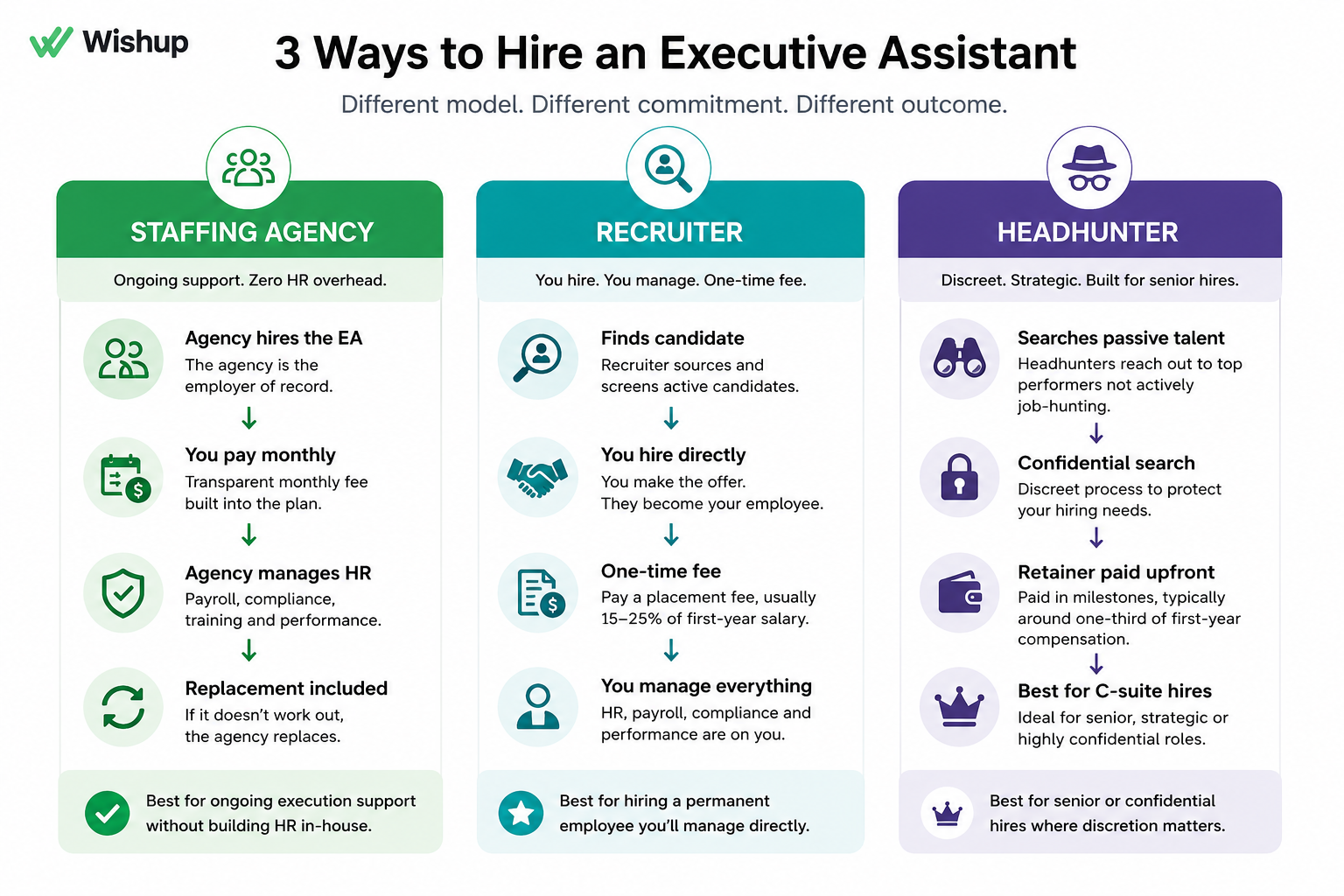
A staffing agency, in the fully managed sense, employs the assistant directly and places them with you on an ongoing basis; it can be full-time, part-time, or task-based. The agency stays on the hook for payroll, compliance, and replacement if the fit doesn't work. Wishup, Athena, Wing, BELAY, and Boldly all operate roughly in this category, though the pricing and support structure behind each varies substantially, as demonstrated above.
While a recruiter finds and screens candidates for a role you are hiring directly. Once you make the offer, the candidate becomes your employee, and the recruiter is done aside from a guarantee window. Fees run as a percentage of first-year salary; C-Suite Assistants charge around 25%, and general staffing firms typically land in the same range, typically presented within 1 to 2 weeks for common roles
An executive assistant headhunter runs retained searches for senior or confidential roles, actively approaching passive candidates rather than sourcing from an applicant pool. Retained fees are usually paid upfront in milestones, often around a third of first-year compensation, regardless of whether the search closes, which is the tradeoff for reaching candidates who aren't actively job-hunting.
The practical question: do you want someone else to own the ongoing employment relationship (staffing agency), a one-time introduction to your future direct employee (recruiter), or a confidential, high-touch search for a very senior seat (headhunter)? Most growing companies land on the first option because they don't want to build an HR function around one hire.
What to Ask Before You Hire an Executive Assistant Through an Agency
What's the replacement policy if the match doesn't work in month one, in specific terms? Get the number of days, the number of replacement attempts, and whether a second replacement carries a fee. A 90-day guarantee and a 7-day guarantee are not the same commitment.
Who do I escalate to if there's a problem, besides the assistant themselves? If the answer is "just message your EA directly," there's no real escalation path. A manager layered above the assistant turns a rough patch into something fixable instead of a full restart.
What does the screening process actually test, not just how many years of experience is required? Ask for the method: a written test, a live scenario interview, an English-proficiency assessment; ask what percentage of applicants pass. "We screen candidates" without a described method usually means a light resume filter.
What happens when the role's scope changes six months in? Real EA relationships shift. Ask whether scope changes require a contract renegotiation or fold naturally into the existing arrangement.
What's the actual response-time commitment during my business hours, in writing? Not "fast,” a number, and what recourse exists if it isn't met.
Read more: Outsourced Executive Assistant Guide (2026)
Executive Assistant vs Personal Assistant - Which Role Do You Actually Need?
An executive assistant is scoped around business function: calendar, inbox, meeting prep, stakeholder communication, project follow-through. When trust builds, sometimes systems ownership too. The work is professional-context by design.
A personal assistant handles life logistics, appointments, personal errands, household coordination, and non-business travel. If that's the actual need, look for a personal assistant staffing agency specifically, rather than assuming a standard EA hire will absorb personal tasks by default. Hybrid EA/PA arrangements are common for founders and family offices where the line between business and personal blurs, and it's worth naming that explicitly in the role scope rather than assuming an EA will absorb personal tasks by default.
An administrative assistant sits below both task execution within an existing process, usually with less independent judgment expected. If the actual need is someone following a defined checklist rather than someone making calls when priorities shift without you in the room, an administrative assistant staffing agency is the more appropriate and cheaper route.
The practical test: does the person need to make judgment calls when you're unavailable, or execute a known process? The former is EA territory. The latter is administrative support.
If you're still deciding between business support and personal assistance, explore our guide on Personal Assistant vs. Executive Assistant before making a hiring decision.
Frequently Asked Questions
How much does an executive assistant staffing agency actually cost? Fully managed offshore models run roughly $1,300–$3,000/month depending on the agency and experience tier. U.S.-based managed models (BELAY, Boldly) run $1,900–$3,000+/month, sometimes billed hourly at $40–$50/hour. Direct-hire recruiters like C-Suite Assistants charge a one-time placement fee, typically around 25% of first-year salary, rather than an ongoing monthly rate.
How fast can I actually have someone working? Wishup within 60 minutes of a scoped request, and Wing similarly, same-day, though exact timelines depend on role and availability. C-Suite Assistants reports 3–4 weeks typically, as fast as 10 days for urgent searches. Pearl Talent's own EA page cites 13–21 days from requirements to start. Athena's public timeline runs 2–3 weeks to match, plus a 100-day-plus integration period before the relationship is running at full capacity.
Do I pay if the agency doesn't find anyone? Under a contingency recruiting model (C-Suite Assistants, most traditional recruiters), no, the fee is only owed on a successful placement. Under a managed staffing model, you're generally paying a monthly fee from the start, with a replacement guarantee if the initial match doesn't work rather than a refund for a failed search.
What's a reasonable replacement guarantee to expect? 30–90 days is the common range across the agencies covered here. Ask specifically what happens on a second mismatch, since most public guarantee language only addresses the first one.
Ready to Find Your Executive Assistant? Here's Where to Start
If the comparison above narrowed things down, the next step is a scoped conversation rather than another sales page. Wishup runs a six-step screening process, an 8-week training program across 120+ AI and automation tools, and a three-layer support structure: the assistant, a VA manager, and a customer success manager, so there's no single point of failure if something needs to change. Matches start within about an hour of a scoped request, monthly plans start at $1,299 with no annual lock-in, and the engagement carries a replacement guarantee if the first match isn't right.
Book a call to get matched with a pre-vetted executive assistant.
