Summary: What Does a Virtual Executive Assistant Do?
- A virtual executive assistant is a remote professional who provides dedicated executive support to founders, CEOs, and senior leaders.
- They manage calendars, inboxes, travel, meetings, documents, research, and day-to-day operational workflows.
- Unlike a traditional virtual assistant, a virtual executive assistant works with a deeper context of an executive’s priorities, communication style, and recurring responsibilities.
- While an in-house EA provides similar support in person, a virtual executive assistant delivers executive assistance remotely using digital tools and structured workflows.
What Is a Virtual Executive Assistant?
A virtual executive assistant is a remote administrative professional dedicated entirely to one executive or a small leadership team. By managing the recurring administrative tasks, a virtual EA understands your unique working style, handles the recurring workflow, handles the stakeholder communication and makes decisions by understanding the clear boundaries. Executives spend an average of 16 hours per week on administrative tasks. A virtual executive assistant can take most of that back.
What Does a Virtual Executive Assistant Actually Do? (Core Responsibilities)
Every executive needs a real breakdown of the virtual executive assistant tasks.
Calendar & Schedule Management
CEOs lose time on small things such as meetings without a clear agenda, a 30-minute call that should have been an email, or back-to-back calls with zero buffer. A virtual executive assistant for a CEO reviews upcoming meetings, sends reminders, confirms availability, handles reschedule requests, and ensures every meeting has the right links, documents, and background information attached - so scheduling stops being something the CEO has to think about at all.
Email & Communication Management
The average professional spends 28% of their workday managing email, which is over 2 hours daily on a 9-to-5.
A virtual executive assistant creates a system around your inbox. One of our Virtual EAs manages multiple inboxes with over 120 emails on a daily basis. She reviews these messages daily, sorts them by urgency, drafts responses, and follows up on past conversations when action items remain unresolved.
A virtual EA brings effective email management by learning your communication style, relationships and boundaries. A trusted virtual executive assistant can often respond independently. The level of independence depends on the executive’s preference. For example, some founders need to review the investor communication or the top client’s communication at the same time the virtual executive assistant can take care of the routine conversations and stakeholder communications.
John Tiso, JMT Consulting Group - Financial Management
John was managing multiple client calendars, stakeholder touchpoints, and a broken Salesforce CRM that made reporting a nightmare. His Wishup virtual EA started with the standard playbook - inbox, calendar, communications. Then evolved into something nobody expected.
Within months, his virtual EA had cleaned the entire CRM database , built real-time automated reports, redesigned workflows, and earned a seat on the company's Salesforce Steering Committee. A senior sales leader called him "the differentiator."
“Critical reports that once took hours? Now pull instantly.”
Travel Planning & Coordination
A virtual executive assistant handles all the details around the travel. They take care of flight booking, accommodation, local transportation, meeting schedules, restaurant reservations, and a complete itinerary with all relevant confirmations and documents in one place.
Over time, the virtual executive assistant learns the travel preferences of the executives, such as airlines, seating choices, hotel requirements, and travel timings. This ensures a seamless travel with better customization. Your virtual executive assistant plans for unexpected events during travel. When a plan changes, a flight is delayed, or a reservation is cancelled, the virtual EA handles it and makes the necessary adjustments, and keeps the stakeholders informed.
Event & Trade Show Planning
Conferences, trade shows, and speaking engagements come with a level of
logistics that goes well beyond a normal business trip. A virtual executive
assistant isn't a dedicated event manager, but they can own the moving
pieces so nothing falls through the cracks — from venue coordination to
making sure your materials actually arrive before you do.
For external events, a virtual executive assistant can:
- Reserve venues and confirm event logistics with organizers
- Send and track invitations to your contacts and clients
- Order and arrange shipping for display materials and collateral
- Book flights, hotels, and any on-site meetings around the event
- Handle event registration and submit speaking-opportunity applications
- Keep a checklist of deadlines - abstract submissions, badge pickup,
material shipping cutoffs - so nothing is a last-minute scramble
For internal events (team offsites, leadership meetings, board sessions),
they handle the same coordination - venue, catering, materials, and
attendee logistics - so you can focus on what happens in the room, not how
it got set up.
Meeting Preparation & Follow-Up
Busy executives have back-to-back meetings scheduled. This stops them from preparing for the discussion and verifying the documents. A virtual executive assistant creates a workflow and brings structure to the process.
Before every meeting, they ensure the agenda is clear, documents on previous discussions are verified, the participant’s details are error-free and clear directions for the discussion. Post-meeting, the virtual EA collects all the key takeaways, updates the trackers, follows up with the task owners or team members, and sends reminders of deadlines.
This workflow streamlines all the communications, ensures nothing is missed, and records all the important decisions by aligning the stakeholders.
Document & Report Preparation
Your virtual executive assistant prepares, formats and organizes documents so they are ready when you need them. This includes board decks to weekly reports, executive memos and vendor contracts. They manage version history, handle shared drives, and make sure the sensitive materials are stored and shared securely.
Over time, they learn the way the executive wants the data to be presented. If you need a detailed document, a concise summary, or a quick briefing, the virtual EA adapts and delivers it.
Project Coordination & Task Management
A virtual executive assistant brings structure to the ongoing projects. They create a workflow by maintaining task trackers, updating project management tools, following up with stakeholders, and keeping an eye on the deadlines and the visibility of remaining action items.
For instance, after each meeting, the virtual executive assistant converts the discussion points into assigned tasks. They update platforms like Asana or ClickUp, follow up with team members on pending deliverables, and provide the executive with regular progress updates.
Research & Competitive Intelligence
A virtual executive assistant takes care of research and delivers a comprehensive and actionable summary, not a basic list. Executives make decisions based on information, case studies, statistics and internal documents. Finding these materials requires aggressive research and hours of work. A virtual EA conducts market research, monitors industry updates, prepares competitor analysis, brief documents for meetings, partnerships or strategic initiatives. The insight sourced by the virtual executive assistant helps the executives to make informed decisions by saving hours of time.
Vendor & Stakeholder Management
From chasing down a late invoice to coordinating with your IT provider, your virtual EA manages vendor relationships on your behalf. They follow up, escalate when needed, and maintain the ongoing communication that keeps operations running.
Executives maintain a wide network of external partners, service providers, clients and internal stakeholders. Maintaining these relationships seamlessly often involves small and significant touchpoints. Following up on pending requests, gathering updates and collating them, confirming timelines, and communicating them clearly with others keeps these relationships stable. A virtual EA handles this with precision.
One of our virtual executive assistants became a core pillar of the marketing department. Instead of the stakeholders reaching out to various departments and people, she became a single point of contact and streamlined the communication.
Professional Networking & Relationship Management
Staying connected with your professional network consistently pays off — but
it's usually the first thing to slip when things get busy. Nearly 80% of
professionals consider networking important to career success, and 70% of
people were hired somewhere they already had a connection. Yet nearly half
say they simply don't have time to keep it up.
A virtual executive assistant keeps your network active without it becoming
one more thing on your plate. They can:
- Log and segment new contacts in your CRM after meetings and events
- Research relevant industry events and conferences worth attending
- Build a follow-up cadence so warm connections don't go cold
- Draft personalized outreach for reconnecting with dormant contacts
- Track notes on each relationship — where you met, what matters to them,
what you last discussed — so every conversation picks up where it left off
Over time, your virtual EA becomes the person who remembers who you haven't
spoken to in three months and quietly puts a follow-up on your calendar
before that relationship goes cold.
Expense Tracking & Basic Financial Admin
Expense management is more than collecting the receipts. It involves collecting receipts, reimbursements, expense reports, corporate reconciliations, managing corporate records and coordination between the finance team and the vendors.
For example, after a business trip, the virtual EA collects all travel receipts, categorize expenses, submits reimbursement requests, follows up on the missing details, keeps the tracker clean and updated to share it with the finance team.
Financial responsibility and trust grow gradually. One of Wishup’s virtual executive assistants initially performed payment-related tasks by sharing the screen, and the executive completes the transaction. Trust developed over a period of time, and a more secure transaction process came into place.
Personal & Lifestyle Support
A virtual executive assistant takes care of the executive's personal appointments, family commitments, travel arrangements, and plans for important events or occasions. As the virtual EA gains experience, the understanding of the executive assistant’s routine, preferences, and priorities grows, and this allows the virtual executive assistant to provide the right support with minimal dependency.
What Does a Virtual Executive Assistant Handle Daily?
| Task | Time Spent Without Virtual EA | Time Spent With Virtual EA |
|---|---|---|
| Email management | 2+ hours/day | 15-minute review |
| Calendar coordination | 1 hour/day | 0 – fully owned by Virtual EA |
| Travel planning | 3–4 hours/trip | 10 min approval |
| Meeting prep & follow-up | 45 min/meeting | 5-minute review |
| Research tasks | 1–2 hours | Delivered as briefings |
| Expense reports | 1–2 hours/month | $0 of your time |
| Total recoverable hours/week | ~16 hours | ~2 hours (oversight only) |
Virtual Executive Assistant vs In-Office Executive Assistant
| Factor | Virtual Executive Assistant | In-Office Executive Assistant |
|---|---|---|
| Average Cost | Starts from $1,299 | $60,000–$90,000+/year salary plus benefits |
| Overhead Costs | No office space, equipment, or in-house employee costs | Additional costs for workspace, equipment, benefits, and taxes |
| Hiring Pool | Access to global talent | Limited to local or relocation candidates |
| Availability | Can provide support across multiple time zones | Typically available during office hours |
| Communication | Email, chat, and video calls | In-person and digital communication |
| Onboarding Time | Often days to a few weeks | Typically several weeks to months |
| Core Responsibilities | Calendar management, travel, meetings, communication, and research | Similar executive support responsibilities |
| Best For | Businesses seeking flexible, cost-efficient support | Organizations needing physical, on-site assistance |
While both roles provide remote support. A regular VA is more focused on the general task completions. However, a virtual executive assistant typically works with a deeper business context and handles more sensitive responsibilities by creating a strong workflow.
Read our detailed comparison of executive assistant vs administrative assistant → breaks down roles, salaries, and which hire makes sense for your stage of growth.
Virtual Executive Assistant vs. In-House Executive Assistant
Both in-house executive assistants and virtual executive assistants fulfill the same tasks. It includes managing the calendar, handling communication, and coordinating the meetings and travel schedules.
An in-house EA sits in your office, is on your payroll with full benefits, and costs you, on average, $60,000–$80,000 per year in salary alone. This is before taxes, benefits, or overhead.
A virtual executive assistant works remotely, and virtual executive assistant services - whether agency-managed or direct-hire. Studies show businesses can save up to 78% on operational expenses by shifting to virtual support. An in-house executive is the right fit for CEOs who need the executives in their office and accompany them to the on-site meeting, or business travels. A virtual EA is a right fit for remote leaders, consultants, and growing businesses that need high-level executive support. Choosing the right option is majorly dependent on the business model.
Virtual Executive Assistant vs. In-House EA: Real Cost Breakdown
What Tools Does a Virtual Executive Assistant Use?
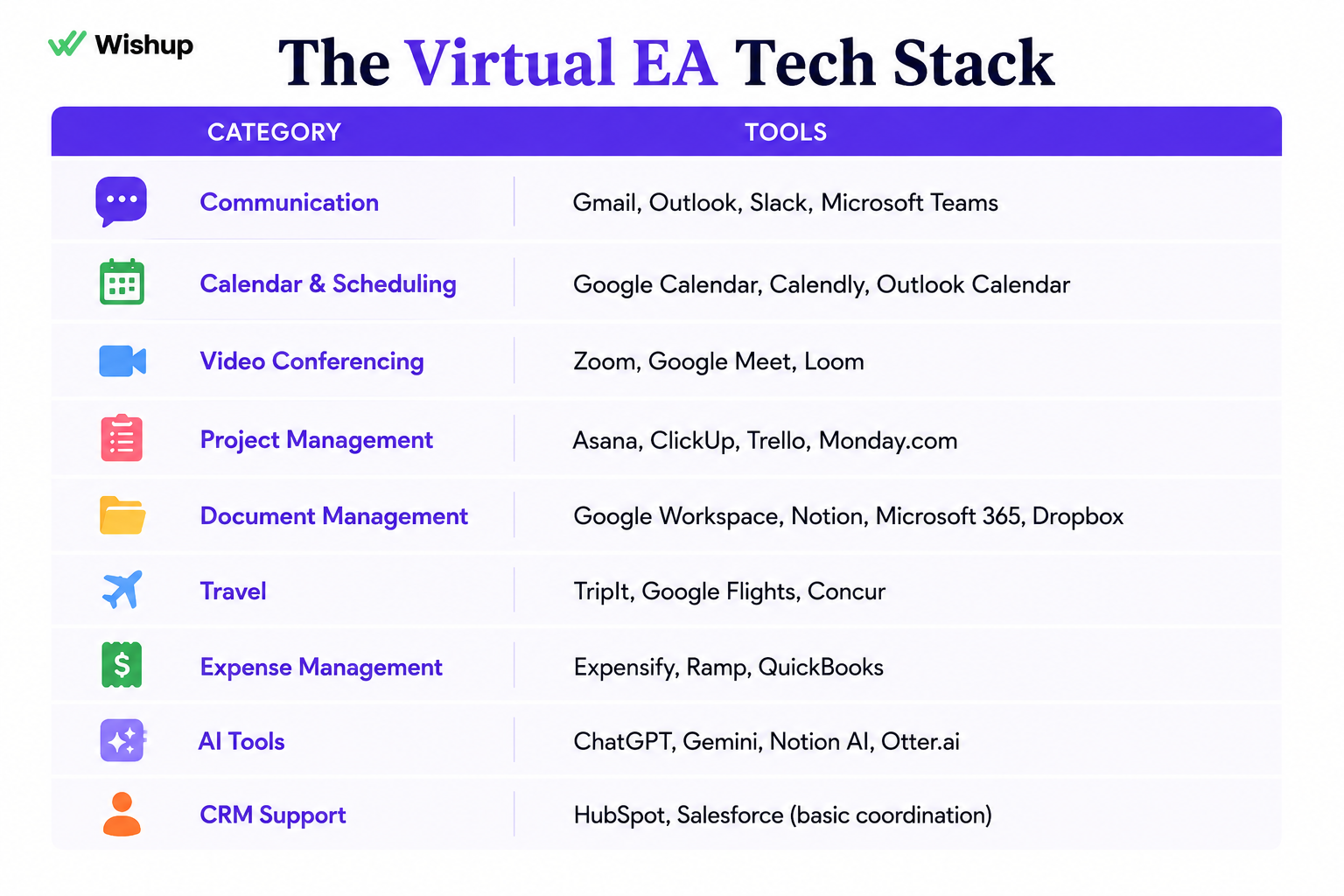
A virtual executive assistant’s tool knowledge directly impacts on how they build a workflow and process in your business. Tool-ready virtual EAs comfortably work around your tech-stack and make communication, project planning, scheduling and documentation seamless.
Virtual Executive Assistant vs. AI Assistant - Can AI Replace Them?
This is the question everyone is asking when AI is taking roles in business. The honest answer: no - but the nuance matters.
AI tools like ChatGPT, Gemini, and Notion AI are genuinely powerful for drafting emails, generating summaries, and automating repetitive workflows. Your virtual executive assistant should be using them. The best ones already do.
But here's what AI cannot do:
- Understand the subtext of a tense stakeholder relationship
- Know when not to send that email
- Make a judgment call about a calendar conflict based on six months of context
- Represent yourself with warmth and credibility to a key client
- Notice that something feels off and flag it before it becomes a problem
AI is a force multiplier for a great virtual executive assistant. It is not a replacement for one.
AI + Virtual EA: The Winning Combination
The best virtual executive assistants in 2026 use AI tools to handle the volume - drafting, summarizing, organizing - so they can focus their human judgment on the complexity: relationships, priorities, tone, and timing.
Read more: Chief of Staff vs Executive Assistant: Key Differences, Costs & When to Hire Each
Do You Actually Need a Virtual Executive Assistant?
The decision of hiring a virtual executive assistant depends on how much time you spend on the administrative tasks and coordination versus the time you spend on the work that needs your expertise and attention. If the administration work takes more time, it is a clear sign you need a virtual EA.
✅ You need a virtual executive assistant if:
- You spend more than 2 hours a day in your inbox
- You're still booking your own travel and making your own dinner reservations
- You miss follow-ups because things fall through the cracks
- Your calendar controls you - not the other way around
- You're doing work that feels below your pay grade, but nobody else is doing it
- You say "I need to get organized" more than once a week
- You've had a near-miss on a deadline or relationship because of admin overwhelm
43% of managers say virtual assistants helped reduce their weekly workload by 10+ hours. For executives, that number is even higher.
The question isn't whether you can afford a virtual EA. It's whether you can afford not to have one.
What to Look for When Hiring a Virtual Executive Assistant
It is important to evaluate the candidate before selecting one, and technical and soft skills are non-negotiable. The effective relationship between an executive and the assistant is built over a period of time. However, the best virtual executive assistant should understand the working style and personal preferences of the executive to build a strong foundation for the workflow.
Must-Have Skills and Qualities
Hard skills:
- Fluency in Google Workspace and/or Microsoft 365
- Calendar and inbox management experience with senior-level executives
- Proficiency in at least one project management tool (Asana, ClickUp, Notion)
- Strong written communication - they'll be writing in your voice
- Working knowledge of expense management tools
- Basic research and reporting ability
Soft skills (non-negotiable):
- Discretion: They will handle confidential information daily
- Proactive, not reactive: They should anticipate, not just respond
- Clear communicator: They can push back professionally when needed
- High ownership: They follow through without being chased
How to Manage a Virtual Executive Assistant
Hiring the right person is only half the equation; how you onboard and
manage them determines how fast they become genuinely useful. Most of the
friction in the first few weeks is about missing context.
What to document before you hand anything off
Your virtual EA can't read your mind, but they can absorb your preferences
quickly if you write them down once instead of explaining them every time:
- How you like meetings scheduled, buffer time between calls, preferred
times of day for different meeting types, how long you actually want
meetings to run versus what gets booked by default - Priority contacts, who gets a same-day response no matter what, and who
can wait - Your communication tone and style, especially for emails they'll draft
on your behalf - Travel preferences, airlines, seating, hotel chains, the small things
that make trips smoother - What you want flagged immediately versus handled without you
The first two weeks
Start with recurring, lower-risk tasks: inbox triage, calendar management,
meeting prep, rather than handing off your most sensitive work on day one.
Give specific feedback quickly, not just "good" or "not quite right," but
the reasoning behind it. That's what compresses the learning curve.
Managing it yourself vs. a managed service
If you hire independently, all of this documentation, training, and
ongoing quality control is on you. With a managed service like Wishup,
this groundwork happens before your VA starts; every Wishup virtual EA is
trained in 120+ tools and matched to your working style before Day 1, so
you're not starting from zero.
Either path can work. The difference is whether you're building the
onboarding process yourself or stepping into one that's already built.
How Much Does a Virtual Executive Assistant Cost?
Looking for a broader cost breakdown beyond virtual support? See our full guide on how much an executive assistant costs in 2026 →
Ready to Get Your Time Back?
Your time is your most valuable resource. Stop spending it on work that can be delegated.
Wishup's virtual executive assistants are pre-trained, pre-vetted, and ready to take over in 60 minutes . Whether you need 10 hours a week or full-time executive support, we have a plan for you.
Hire Your Wishup Virtual Executive Assistant Today →Frequently Asked Questions
What is the role of an executive virtual assistant?
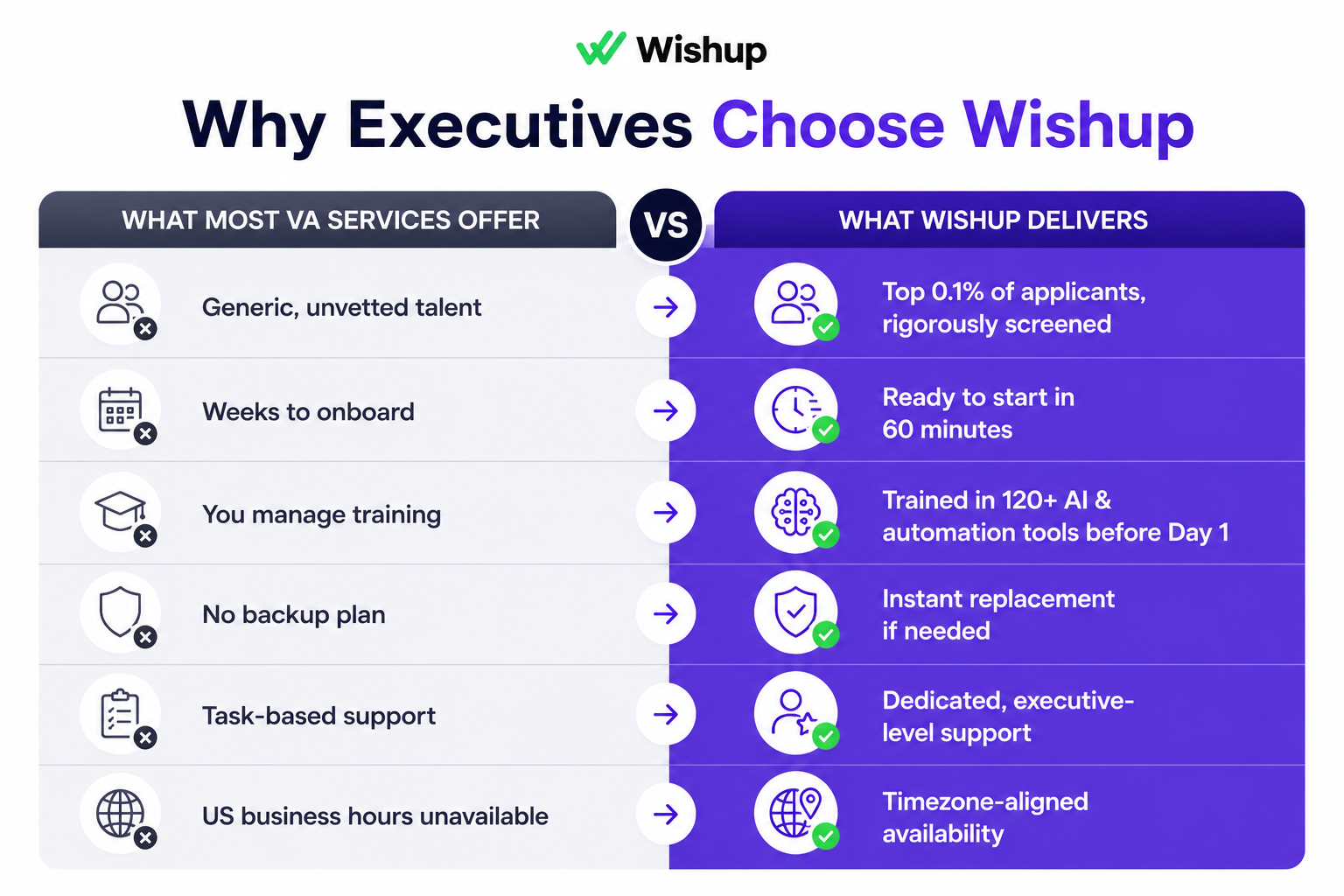
A virtual executive assistant manages the operational and administrative responsibilities of a senior leader, including calendar, communications, travel, research, document preparation, and project coordination, so the executive can focus entirely on growth-driving work. At Wishup, every virtual EA is dedicated exclusively to one executive, trained in 120+ tools before Day 1, pre-vetted profiles and ready to start 60 minutes.
What is the difference between a virtual assistant and an executive assistant?
A regular virtual assistant handles task-based, repetitive work across multiple clients. A virtual executive assistant is dedicated to one executive, handles complex and confidential work, and operates as a strategic partner, not just a task executor. Wishup's virtual EAs are specifically matched to executive profiles, not randomly assigned.
What does a virtual executive assistant do on a daily basis?
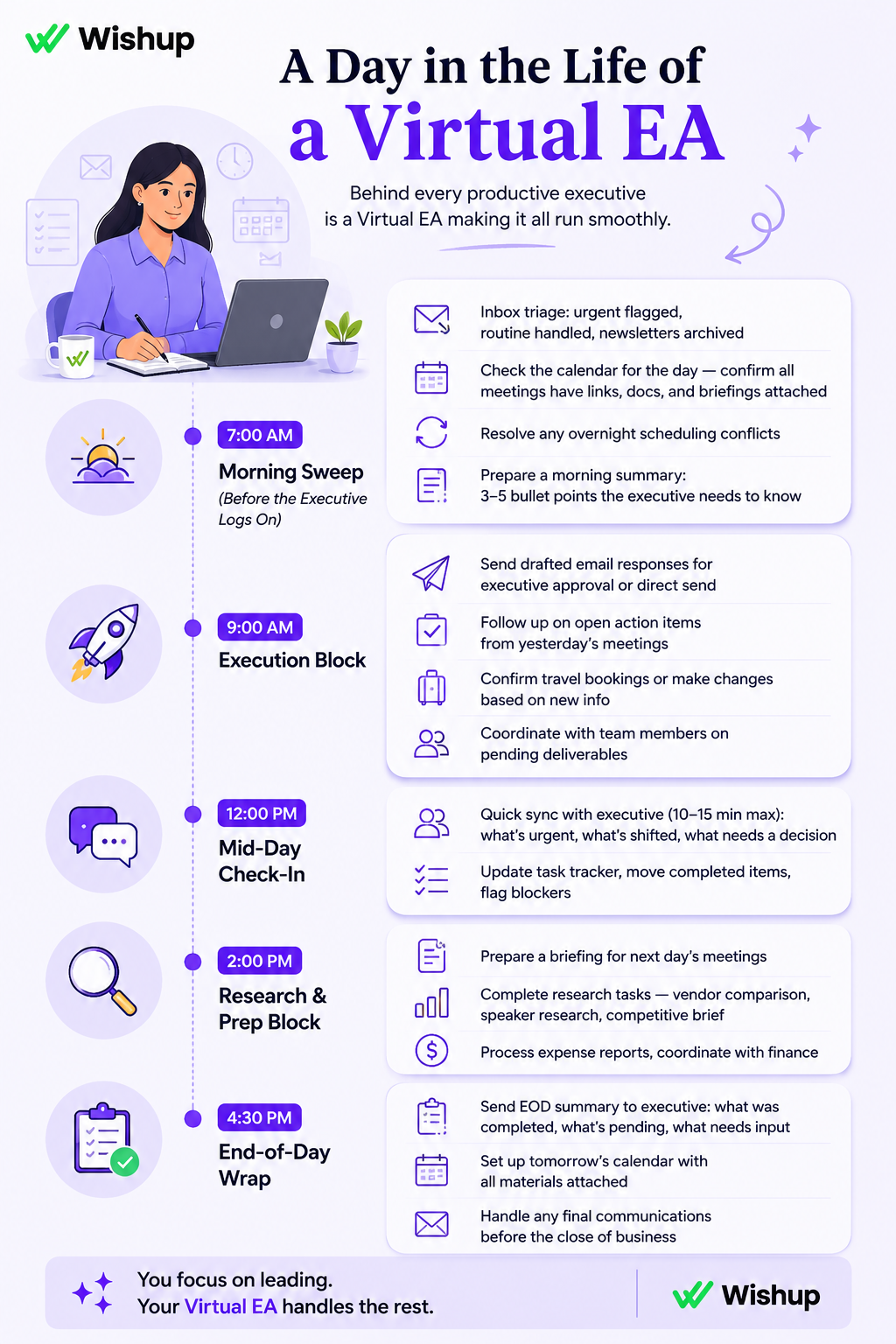
On any given day, a virtual EA triages email, manages the calendar, prepares meeting briefings, follows up on action items, coordinates travel, handles vendor communication, and sends an end-of-day summary. No two days are identical, but the executive never has to think about any of it.
How much does it cost to hire a virtual executive assistant?
Rates range from $20/hr for freelance talent to $60/hr for fully managed professionals. Executives spend between $1,500 and $3,500/month for part-time to full-time dedicated support. Wishup offers $1299/month for 4 hours and $1999/month for 8 hours.
Can a virtual executive assistant work in a different time zone?
Yes, and for many executives, it's an advantage. A virtual executive assistant in an earlier time zone can clear your inbox and prep your calendar before your workday begins. Wishup matches every executive with a virtual EA aligned to their working hours, so overlap is built into the model, not an afterthought.
What industries benefit most from a virtual executive assistant?
Tech, consulting, real estate, finance, healthcare, e-commerce, and professional services see the highest ROI. Any industry where a founder or senior leader is the primary revenue driver benefits enormously from having their time protected. Wishup has active virtual executive assistants across all of these verticals, with matched experience rather than generalist support.
Is a virtual executive assistant the same as a personal assistant?
Not exactly. A personal assistant focuses on personal life management. A virtual executive assistant focuses on professional and business operations, though many experienced virtual EAs handle both comfortably. Wishup virtual executive assistants are trained for executive-level business support first, with the flexibility to extend into personal admin where needed.
