
24%1 of pest control business owners have opted for help with marketing and customer engagement tasks. Although the number seems slight, in the era of automation, what these businesses need is pest control virtual assistant.
A pest control virtual assistant is the one who works remotely and looks after operations such as appointment scheduling, technician dispatch coordination, CRM updates, customer follow-ups, invoicing, and recurring service plan management across pest control management platforms.
These platforms may include PestRoutes, FieldRoutes, ServiceTitan, and Briostack. All these operational and back-office tasks are absorbed by the pest control VA.
Hire a pest control virtual assistant from Wishup and get matched with a trained, pre-vetted VA in 60 minutes, starting at $1,299/month.

Wishup is a virtual assistant company in the United States. Wishup's pest control virtual assistant is pre-vetted from the top 0.1 percent of applicants, trained on 120 plus tools, and onboarded in 60 minutes, with pricing from $1299 a month.
This guide covers:
- Every task a pest control VA handles,
- How much one costs,
- Which pest control businesses benefit most, and
- Why Wishup's trained VAs outperform other options.
Who is a pest control virtual assistant?
A pest control virtual assistant is a remote administrative professional trained in the operational workflows specific to pest management companies. It may include dispatching, service plan management, chemical record documentation support, and CRM management inside platforms like PestRoutes, FieldRoutes, and Briostack.
The role is distinct from a general VA. A general virtual assistant manages inboxes, calendars, and basic research tasks across industries. A pest control VA understands the seasonal nature of pest control demand. They have in-depth knowledge of the pest-control industry and are trained in tools specifically useful for the industry.
Key Difference Between General Virtual Assistant vs Pest Control Virtual Assistant
Wishup pest control VAs are pre-vetted and pre-trained before deployment. Every VA passes a 6-step hiring process with a 0.1% acceptance rate across 179,011 applicants over 6 months. Minimum corporate experience required is 2 years, and the average Wishup VA brings 5 to 10 years of prior work experience to the role.
What Key Skills Should a Pest Control Virtual Assistant Have?
A pest control virtual assistant needs five core skills: scheduling and dispatch coordination, customer call handling, estimate and invoice follow-up, review and reputation management, and CRM fluency in pest control software. Each maps to a specific pain point pest control companies face:
- Scheduling and dispatch: booking recurring and one-off treatments, routing technicians efficiently, and filling cancellations, so no route runs half-empty.
- Customer communication: answering inbound calls, triaging an emergency infestation from a routine quarterly visit, and returning every message the same day.
- Estimates and invoicing: preparing quotes, following up on outstanding estimates, and chasing unpaid invoices.
- Review management: requesting reviews after a completed service and flagging negative feedback for the owner, because pest control is won on reputation.
- CRM fluency: working inside PestPac, FieldRoutes, Briostack, or GorillaDesk from day one.
Can a Virtual Assistant Work as a Receptionist for a Pest Control Company?
Yes, a pest control virtual assistant works as a virtual receptionist, answering inbound customer calls, screening emergency infestations from routine requests, booking service calls, and following up on quotes while technicians are on routes. A pest control company that sends calls to voicemail loses jobs to the competitor who answered first.
Unlike an answering service that only takes a message, the pest control virtual receptionist works inside the company's CRM and scheduling software, so a call becomes a booked treatment, not a callback list. The virtual assistant handles the front desk, the follow-up, and the dispatch as one connected job.
Why Do Pest Control Companies Need a Specialized VA Instead of a General VA?
A specialized pest control virtual assistant understands how the industry works, while a general VA mainly handles administrative tasks. This industry knowledge helps improve response times, protect revenue, and reduce the need for supervision.
Here are the key differences:
- Prioritizes urgent calls: Knows that termite, bed bug, or active infestation calls require immediate action, while routine maintenance can be scheduled later.
- Supports seasonal growth: Manages renewal reminders, seasonal outreach, and recurring service plans during peak pest seasons.
- Works with pest control software: Has experience using platforms like PestRoutes, FieldRoutes, and Briostack, reducing training time.
- Requires less supervision: Understands pest control workflows and can make informed decisions instead of waiting for instructions.
A general VA completes assigned tasks. A specialized pest control VA applies industry knowledge to help you book more jobs, respond faster, and keep operations running smoothly.

Challenges Pest Control Companies Face Without Administrative Support
Pest control is a high-volume, time-sensitive business. The operational bottlenecks below cost owners' revenue every week.
1. Infestation calls go unanswered
Homeowners with active rodent, bed bug, or termite problems call the first company that picks up. When technicians are on routes, and no one is answering the phone, those high-value emergency jobs go to competitors.
2. Recurring service plans lapse
Quarterly and monthly plan holders drift away when renewal windows pass without a follow-up. Each lapsed plan is annualized recurring revenue lost with no retention system in place.
3. Seasonal campaigns never launch
Mosquito season, termite swarming season, and rodent season are predictable revenue windows. Without proactive outreach to the existing customer base before each season, those jobs go to whoever advertises first.
4. Lead response is too slow
Pest control leads from Google Ads and local directories expect a callback within the hour. Leads that sit uncontacted for more than 60 minutes convert at a fraction of the rate of leads contacted immediately.
5. Technician scheduling is inefficient
Emergency same-day additions, route changes, and callout management require dedicated dispatch attention that field technicians cannot handle from the road.
6. Back-office admin eats the day
Invoice generation, payment follow-ups, customer complaint handling, and CRM updates collectively consume 3 to 4 hours daily for a 5-to-10 technician operation, none of it billable.
How Pest Control Companies Use a Virtual Assistant: Real Use Cases
Pest control companies use a virtual assistant across three recurring situations: front-desk overflow, seasonal surge coverage, and recurring-service management.
Front-desk overflow
A solo owner or small pest control company cannot answer the phone while treating a property. The pest control virtual assistant covers the phones, books the service call, and dispatches the technician, so a missed call does not become a lost customer.
Seasonal surge coverage
Termite swarming and mosquito season compress months of demand into weeks. The virtual assistant runs pre-season outreach, books the surge, and manages the schedule, without the company hiring a permanent seat that sits idle in winter.
Recurring-service management
Quarterly plans are the revenue base of a pest control company. The virtual assistant tracks who is due, sends reminders, rebooks, and keeps recurring accounts on schedule inside the CRM.
Wishup's pest control virtual assistant runs these workflows inside the company's own scheduling and CRM software.
30+ Tasks a Pest Control Virtual Assistant Handles Across Operations
Pest control VA tasks fall across 5 operational categories, with more than 30 tasks:
Appointment Scheduling and Dispatch Coordination
- Answer inbound service calls and book appointments inside PestRoutes, FieldRoutes, or ServiceTitan
- Schedule technician routes by location, service type, and availability
- Send appointment confirmation messages and 24-hour reminders via SMS and email using automation.
- Manage same-day schedule changes and emergency dispatch additions
- Coordinate multi-stop routes to reduce technician travel time between jobs
- Follow up on no-show appointments and reschedule within the same day using automation.
Customer Communication and Lead Follow-Up
- Respond to inbound inquiries from Google, Yelp, and the company website within 60 minutes
- Qualify inbound leads against service area, property type, and pest type before routing to the owner
- Follow up on uncontacted leads from the previous business day each morning
- Handle customer complaints, escalate unresolved issues, and log outcomes in the CRM
Invoicing and Payment Administration
- Generate invoices after each completed service job using the company's billing platform
- Send payment reminders for invoices overdue by 7, 14, and 30 days
- Record payments received and reconcile against open invoices weekly
- Flag accounts with 2 or more consecutive missed payments for owner review
Seasonal Campaign Outreach
- Build outreach lists from the existing customer database, segmented by service history and property type
- Send pre-season email or SMS campaigns for mosquito, termite, rodent, and bed bug treatment windows
- Track campaign response rates and log interested customers as qualified leads in the CRM
CRM and Back-Office Administration
- Update customer records after every service interaction, including technician notes, treatment details, and follow-up dates
- Manage chemical application record documentation by organizing technician-submitted reports
- Monitor and respond to Google Business Profile reviews within 24 hours
- Compile weekly operations reports covering jobs completed, revenue invoiced, leads contacted, and plans renewed
Pest Control Operations Automated by Wishup VAs Using ServiceTitan and Zapier
Each automation below is active inside a live field service operation. The workflows are directly applicable to pest control companies running ServiceTitan, PestRoutes, or FieldRoutes.

Why Wishup Pest Control VAs Outperform Other VA Services
Wishup pest control VAs are pre-trained, pre-vetted professionals selected through a 6-step process with a 0.1% acceptance rate, not matched from a freelancer pool after you sign up.
The 5 operational differences that matter for pest control businesses:
- 0.1% acceptance rate: 179 VAs were hired from 179,119 applicants over 6 months. Every VA cleared written English tests, aptitude assessments, real-world scenario assignments, structured interviews, and reference checks before entering an 8-week training program.
- Pre-trained on field service workflows: Wishup VAs are trained on ServiceTitan, Zapier, Google Workspace, HubSpot, Asana, Mailchimp, and 70+ additional tools before deployment. No onboarding lag, no tool tutorials on your time.
- 60-minute onboarding: From consultation to a working VA takes 60 minutes, compared to 2 to 4 weeks on freelance platforms.
- Dedicated account manager included: Every Wishup engagement includes a dedicated account manager who monitors performance, handles issues, and coordinates replacements. Freelance VA providers give none of that.
- Instant replacement guarantee: If a VA is unavailable, Wishup provides a trained replacement without restarting the hiring process. Active service schedules and open invoices keep moving.
How Does Pest Control VA Onboarding Work at Wishup?
Wishup onboards a pest control VA in three steps, taking you from consultation to a live first task in under 60 minutes. The process ensures your VA is aligned with your workflows and platform before handling live dispatch or billing.
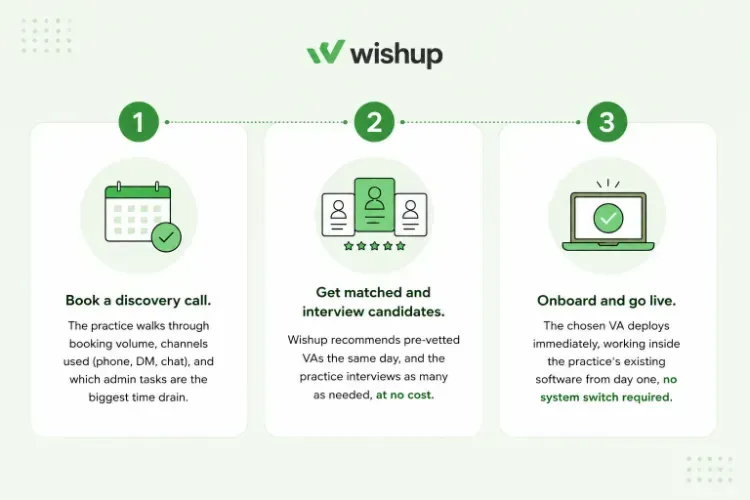
Step 1: Discovery and Workflow Match (Day 0)
Share your operational challenges, software stack (PestRoutes, FieldRoutes, ServiceTitan, or Briostack), and service workflows. Wishup matches you with a VA already trained on your tools and processes.
Step 2: Access and Platform Setup (First 60 Minutes)
Your VA is added to your CRM, scheduling software, and communication tools with the appropriate permissions. A quick alignment session establishes dispatch priorities, billing workflows, and emergency handling procedures.
Step 3: Live Work with Ongoing Support
Your VA begins with real operational tasks such as CRM updates or route management instead of spending days in training. For the first 90 days, a dedicated account manager oversees performance to ensure a smooth transition and consistent quality.
How Much Does A Pest Control Virtual Assistant Cost?
A Wishup pest control VA starts at $1,299/month for a 4-hour daily engagement. A full-time in-house admin hire costs $35,000 to $50,000 per year in base salary, plus benefits, payroll taxes, and office overhead, totaling $55,000 to $70,000 annually.
When Is The Pest Control Virtual Assistant Service an Ideal Fit for You?
This service works best for:
- Pest control companies with 3 or more technicians losing calls during active route hours
- Operations running recurring quarterly or monthly service plans with no renewal follow-up system
- Businesses spending 3 or more hours daily on scheduling, invoicing, and CRM updates in-house
- Owners scaling to new service territories without adding full-time office headcount
- Companies running seasonal mosquito, termite, or rodent campaigns reactively instead of proactively
- HVAC virtual assistant,
- Roofing Virtual Assistant,
- Trucking Virtual Assistant,
- Virtual Assistant for Electrical Contractor,
- Landscaping virtual assistants.

Frequently Asked Questions: Pest Control Virtual Assistant
Can AI replace a pest control virtual assistant?
AI tools handle specific automated tasks like invoice alerts, appointment reminders, and CRM data entry triggers.
A pest control virtual assistant handles the judgment-dependent work that AI cannot: qualifying infestation calls, managing upset customers, coordinating same-day dispatch changes, following up on lapsed service plans, and adapting to the unexpected situations that arise daily in field service operations. AI and a trained VA work together, not as substitutes for each other.
How much does a pest control virtual assistant charge per hour?
Pest control VA hourly rates range from $9 to $38 per hour depending on the engagement model. Freelance VAs on platforms charge $15 to $25 per hour with no vetting guarantee and no backup coverage.
A managed Wishup pest control VA starts at $1,299/month for 4 hours daily, which works out to approximately $16 per hour with pre-training, account management, and an instant replacement guarantee included.
What pest control software does a Wishup VA know?
Wishup VAs are pre-trained on ServiceTitan, Zapier, Google Workspace, Asana, HubSpot, Mailchimp, and 70+ additional tools before deployment. Familiarity with PestRoutes, FieldRoutes, and Briostack is built through client-specific onboarding completed within the first 60 minutes of engagement. See the full tools list for a complete breakdown.
What is the difference between a pest control VA and an in-house dispatcher?
An in-house dispatcher costs $35,000 to $50,000 per year in base salary plus benefits, occupies desk space, and covers one operational function. A pest control VA handles dispatch coordination alongside 30+ other tasks including invoicing, customer follow-ups, CRM management, and seasonal campaign outreach, at 60 to 70% lower cost and with no office overhead.
Can a pest control VA manage recurring service plan renewals?
A pest control VA tracks quarterly and monthly plan renewal dates, flags expiring plans 30 days in advance, conducts outbound re-engagement calls or emails, and updates service records in the CRM after each renewal.
Recurring service plan retention is one of the highest-ROI tasks pest control companies delegate to a VA because the revenue protected per retained plan consistently exceeds the VA's hourly cost.
Is it common for pest control companies to use virtual assistants?
Virtual assistants have become a standard back-office layer for pest control companies, especially seasonal operations that scale call volume fast during termite and mosquito season. Owners delegate scheduling, dispatch, and customer communication to recover hours without a permanent hire.
Source:
- PCOs Turn to AI for Task Automation and Marketing Help, Poll Finds. Pest Control Technology. Published 2025. Accessed June 12, 2026. https://www.pctonline.com/news/pcos-turn-to-ai-for-task-automation-and-marketing-help-poll-finds/
