

You need a virtual assistant when recurring tasks like inbox management, scheduling, follow-ups, research, and reporting take more than 3 hours of your workday or start affecting response time, growth, and focus.
The clearest signs include 9+ hour workdays, missed follow-ups, slow client replies, admin-heavy mornings, and turning down work because you are already at capacity.
This post covers 15 specific signs across 3 categories: burnout and overwhelm, time management breakdown, and business growth strain.
If you've been mentally drained before noon, unable to carve out a single block of focused work, or simply thinking about hiring a VA for months without acting on it, the answer to "do I need a virtual assistant?" is likely yes. The signs below will confirm it.
Hire a pre-vetted Wishup VA in 60 minutes, plans from $1,299/month, top 0.1% talent, instant replacement guarantee.
Do I Need a Virtual Assistant?
You need a virtual assistant if recurring admin, scheduling, inbox, follow-up, research, or coordination work takes more than 15 hours per week or delays revenue-generating work.
If your workday regularly crosses 9 hours, your inbox takes more than 1 hour a day, or client response times have slipped, you have already crossed the point where VA support makes sense.

Statistically speaking, the reason why you need a VA is because…
A virtual assistant reduces operational overhead, recovers founder time, and executes tasks across administrative, financial, and support functions.
The data across industries confirms the pattern. 41% of U.S. small businesses now work with at least one virtual assistant, and the top reason isn't cost, it's capacity.
The same study revealed 37.7% of business owners outsource to VAs specifically to increase operational efficiency, while another 20.5% do it to free up in-house employees so they can focus on higher-value work.
The financial case is equally direct. The expense of hiring a VA runs 78% lower than that of a full-time, in-person employee, a gap that widens further when you account for benefits, equipment, and onboarding costs.
For a founder spending 3 to 5 hours daily on administrative tasks, that translates to 15 to 25 recoverable hours per week that can be redirected to revenue-generating work.
Administrative support remains the most outsourced VA task category, accounting for 34% of all delegated assignments in 2025. Other high-volume categories include marketing coordination, sales and outreach support, operations, and financial and bookkeeping tasks, in that order.
35% of well-paid executives already use a virtual assistant as a standard operating practice, not an experiment.
The pattern is consistent: business owners who identify the signs early recover time, reduce operational errors, and scale faster than those who delay the decision.
The 15 signs below are organized as a diagnostic, not a checklist. Read them as a mirror, not a menu.
15 Signs You Need a Virtual Assistant
The following are the 15 signs you need a virtual assistant, categorized into three aspects: burnout and overwhelm, time management breakdown, and business growth strain.
1. Your workday regularly runs past 9 hours
A standard workday shouldn't bleed into your evenings. When it does, it's a sign the volume of work on your plate has outgrown what one person can manage at a healthy pace.
Most of those extra hours aren't spent on strategy or growth. They're spent on scheduling, email, data entry, and follow-ups that could easily be handled by someone else.
2. You haven't had a real weekend in months
Working 7 days a week feels productive, but it's one of the fastest ways to burn out. Your best thinking happens when you're rested. Weekends spent catching up on tasks that piled up during the week are a sign your workload needs structural help, not just more hours.
3. You feel mentally drained before noon
Starting the day already tired is a reliable early sign of burnout. It usually means your mental energy is being used up on low-stakes decisions and repetitive tasks before you even get to work that actually matters.
Cognitive overload from task-switching, moving between email, scheduling, coordination, and deep work, reduces decision-making quality by up to 40%.
4. Small mistakes are slipping through more often
Typos in client emails. A meeting you forgot to reschedule. An invoice sent with the wrong amount.
These are signs your attention is spread too thin, not that you're careless. When one person manages operations, communications, scheduling, and delivery all at once, errors are inevitable.
5. Admin work fills more than half your day
Business owners spend an average of 68% of their workday on administrative tasks, leaving only 32% for growth-focused work. If your day is dominated by data entry, file organization, expense tracking, and inbox management, you're operating well below your actual capacity.
If you're not clear yet on the full scope of what a VA can take off your plate, the detailed breakdown of what does a virtual assistant do covers 100+ task types across 11 categories, from inbox management and bookkeeping to lead generation and content scheduling, with specific examples for each.
6. Your inbox is unmanageable
The average professional receives around 121 emails per day. Managing that volume alone consumes up to 28% of the workweek. If you spend the first hour of every morning just triaging your inbox and still miss things, your email has become a full-time job inside your job.
7. Scheduling eats up your mornings
Back-and-forth emails to confirm a meeting time. Rescheduling a call that conflicted with another. Finding a slot that works for 4 people across 3 time zones.
Each of these takes 10 to 15 minutes, and they add up fast. If your mornings disappear into calendar logistics, you're spending high-energy hours on zero-leverage work.
8. You can never find a block of uninterrupted focus time
Deep work, the kind that produces real output, requires 90-minute to 2-hour blocks of uninterrupted time. If your day is broken up by notifications, coordination messages, quick admin tasks, and rescheduling requests, those blocks never form. You end the day busy but not productive.
9. You're turning down new business because you're already stretched
Saying no to a good client or a solid project because you simply don't have the bandwidth is one of the clearest signs your operations need support. Revenue opportunities shouldn't be limited by administrative capacity.
The operational relief from delegation has a direct revenue side as well. The documented benefits of hiring a virtual assistant for sales and outreach include faster lead response times, higher pipeline conversion rates, and consistent follow-up execution, the 3 activities most founders deprioritise when capacity runs out.
10. Client response times are slipping
When your business was smaller, you replied to clients the same day. Now it takes 2 to 3 days, sometimes more. Slow response times damage client relationships and signal that your capacity hasn't scaled alongside your growth.
11. You're doing work that doesn't require your expertise
Formatting a report. Researching a vendor. Updating a spreadsheet. Building a slide deck. None of these tasks requires your specific knowledge or judgment, but they take the same hours out of your day as the ones that do. Every hour spent on work below your skill level is an hour not spent on work only you can do.
The root cause of this pattern is structural, not personal. Most executives have never been taught a system for deciding what to hand off.
The CEO delegation framework covers the exact decision tree for identifying which tasks to keep, which to delegate, and which to automate, based on whether they require your unique judgment, relationships, or creative vision.
- research and data collection,
- document creation and formatting,
- inbox and calendar management,
- CRM updates,
- outreach coordination, and
- administrative documentation.
12. Your to-do list keeps rolling over
Tasks that carry over from Monday to Tuesday, then Wednesday, then next week are a symptom of a backlog, not a motivation problem.
If the same 10 items sit on your list for more than 3 days, it's because there's genuinely more to do than one person can get through in a day.
A persistent backlog is not just a productivity problem; it carries a measurable financial cost. The cost of poor delegation breaks down how much recurring task accumulation costs founders in lost revenue, compounding operational errors, and opportunity costs per week.
- daily task categories that don't need your input but do need to get done consistently and on time.
13. You're too stretched to properly onboard or manage new hires
Scaling a team requires time and attention, writing job descriptions, screening candidates, scheduling interviews, onboarding new people, and setting up workflows. When you're already at capacity, hiring becomes another task that keeps getting delayed.
14. Your business is growing, but your systems aren't keeping up
New clients, new projects, and increased volume are good problems to have, until they start breaking processes that were built for a smaller operation. Spreadsheets that worked at 10 clients don't work at 50. A shared inbox that was fine for 2 people doesn't work for 6.
15. You've thought about hiring a VA more than once
If the idea has come up more than a couple of times, whether you've Googled it, mentioned it to someone, or bookmarked it to "look into later", that's not a coincidence. It means some part of your day is consistently generating the thought that you need help.
The onboarding process covers NDA signing, scope of work definition, tool access setup, and a dedicated account manager assignment, so you're not starting from scratch.
Once You've Identified the Signs, Here's What to Do Next
Recognizing the signs is the easy part. Most business owners sit with that recognition for weeks before acting on it, usually because the next step feels unclear. It doesn't have to be.
Step 1: Start by listing every task you did in the last 5 working days.
Go through that list and mark anything that didn't require your specific expertise, judgment, or relationships to complete. Be honest. Most people find that 50–60% of what they did falls into that category.
Step 2: That list becomes your delegation starting point.
Once you have it, group the tasks into 3 buckets:
- recurring daily tasks (inbox, scheduling, data entry),
- recurring weekly tasks (reports, follow-ups, research, CRM updates), and
- one-off tasks (formatting documents, vendor research, setting up tools).
This grouping tells you what kind of VA support you need, administrative, operational, or a combination of both.
The practical guide on how to manage a virtual assistant covers the 6-phase management framework, from onboarding and task delegation to feedback cadence and KPI tracking, so your VA delivers consistent output from week one without constant follow-up from you.
Step 3: Match the task list to a VA
The next step is matching that task list to a VA with the right skill set. A VA trained in project management tools like Asana or Notion handles operational coordination differently from one trained in financial tools like QuickBooks or Xero.
Knowing what you're delegating before you hire means you get the right person from day one, not after two weeks of trial and error.
This is where Wishup fits
Wishup virtual assistants are hired, trained, and onboarded through a structured 6-step process. Only the top 0.1% of applicants are selected from a pool of 20,000+ candidates, screened across skill assessments, communication standards, tool proficiency, and reliability track record.
Read how Wishup trains its virtual assistants to walk through the full process.
Every VA arrives pre-trained in 150+ no-code and productivity tools, including QuickBooks, Xero, HubSpot, Zapier, Notion, Asana, and Google Workspace.
This means you're not paying for a learning curve. The VA you're matched with already knows the tools your business runs on.
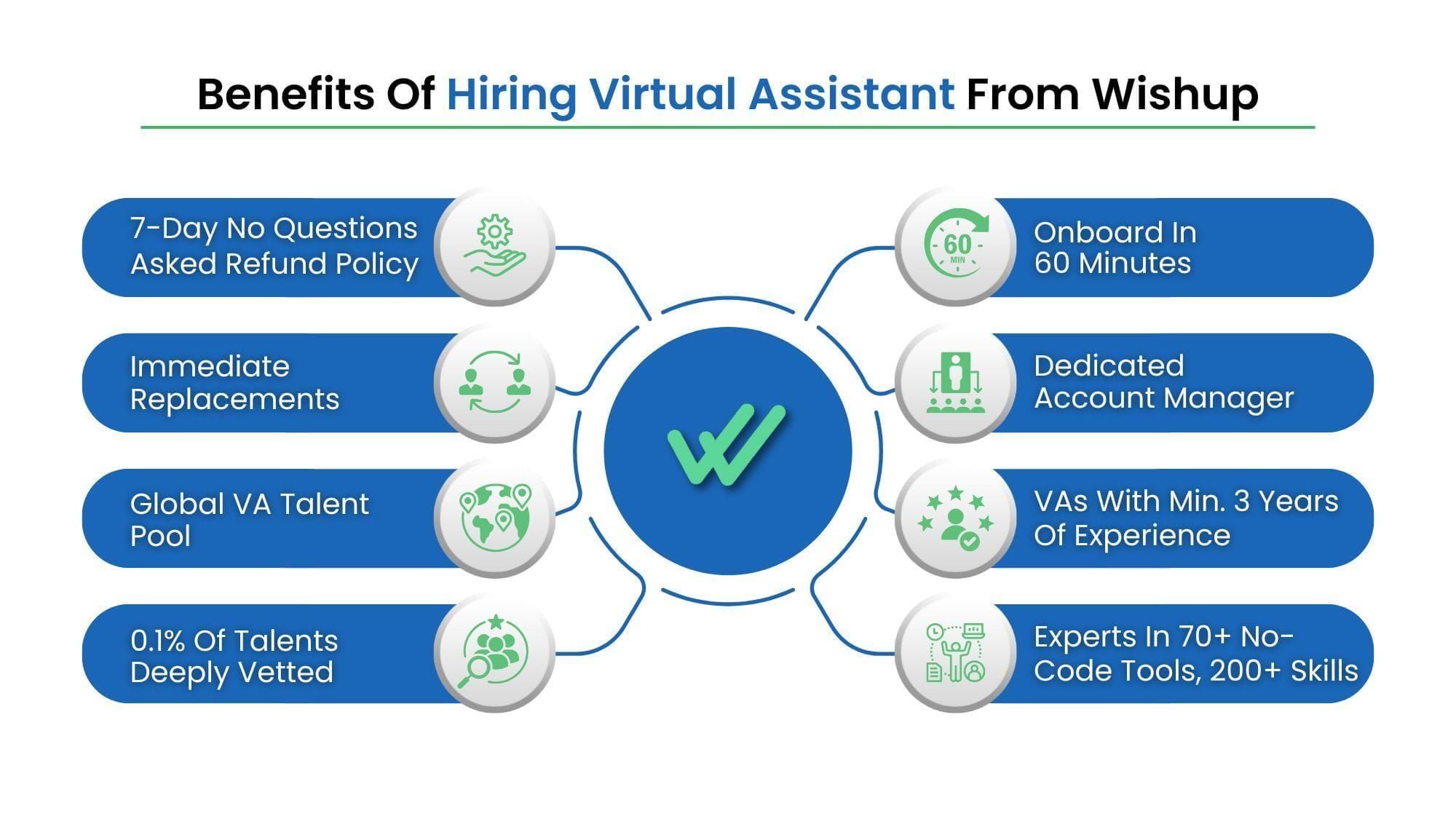
The onboarding process covers 4 steps: NDA signing, scope of work definition, tool access setup, and dedicated account manager assignment. From the moment you submit your requirements to the moment your VA starts working, the turnaround is 60 minutes.
If a match isn't right, Wishup replaces the VA at no extra cost, no contract renegotiation, no gap in coverage.
Wrapping Up
The 15 signs in this post aren't meant to overwhelm you. They're meant to make the decision clearer. If 5 or more of them describe your current workweek, the case for a VA isn't a maybe; it's a math problem.
Wishup virtual assistants are available within 60 minutes. The vetting is done. The training is done. You bring the task list.
Plans start at $1,299/month (Prime VA, 4 hrs/day) with no long-term contract and an instant replacement guarantee.
Hire a Wishup Virtual Assistant →
See full pricing →
FAQs
What is the average cost of a virtual assistant?
A Wishup virtual assistant starts at $1,299/month (Prime VA, 4 hrs/day, quarterly billing) up to $2,999/month (Elite VA, 4 hrs/day), depending on 3 factors: skill level, hours per day, and whether you need a US-based VA (from $3,000/month).
For a full breakdown by plan, hours, skill level, and comparison against in-house and freelance alternatives, read the complete guide on how much a virtual assistant costs. This compares to a full-time in-house hire, which typically costs 78% more when salary, benefits, equipment, and office costs are factored in. See full pricing.
What are the top skills that make a great virtual assistant?
The 5 skills that consistently define high-performing virtual assistants are
- clear written communication,
- time management,
- tool proficiency,
- attention to detail, and
- The ability to take ownership of tasks without constant follow-up.
Tool proficiency matters most at the operational level; a VA who already knows QuickBooks, HubSpot, Zapier, Notion, and Google Workspace requires no ramp-up time and delivers output from day one.
Who usually hires virtual assistants?
Founders, solopreneurs, small business owners, and executives across industries, including healthcare, real estate, e-commerce, SaaS, legal, and financial services, are the primary hirers of virtual assistants.
41% of U.S. small businesses now work with at least one VA, and 35% of well-paid executives use one as a standard part of their operations.
How do I know if I need a virtual assistant?
You need a virtual assistant when recurring, delegable tasks, such as inbox management, scheduling, data entry, research, and reporting, consume more than 3 hours of your workday consistently.
A practical way to confirm it: track everything you do over 5 working days, then identify every task that didn't require your specific expertise to complete. If that list is long, the decision is already made.
