
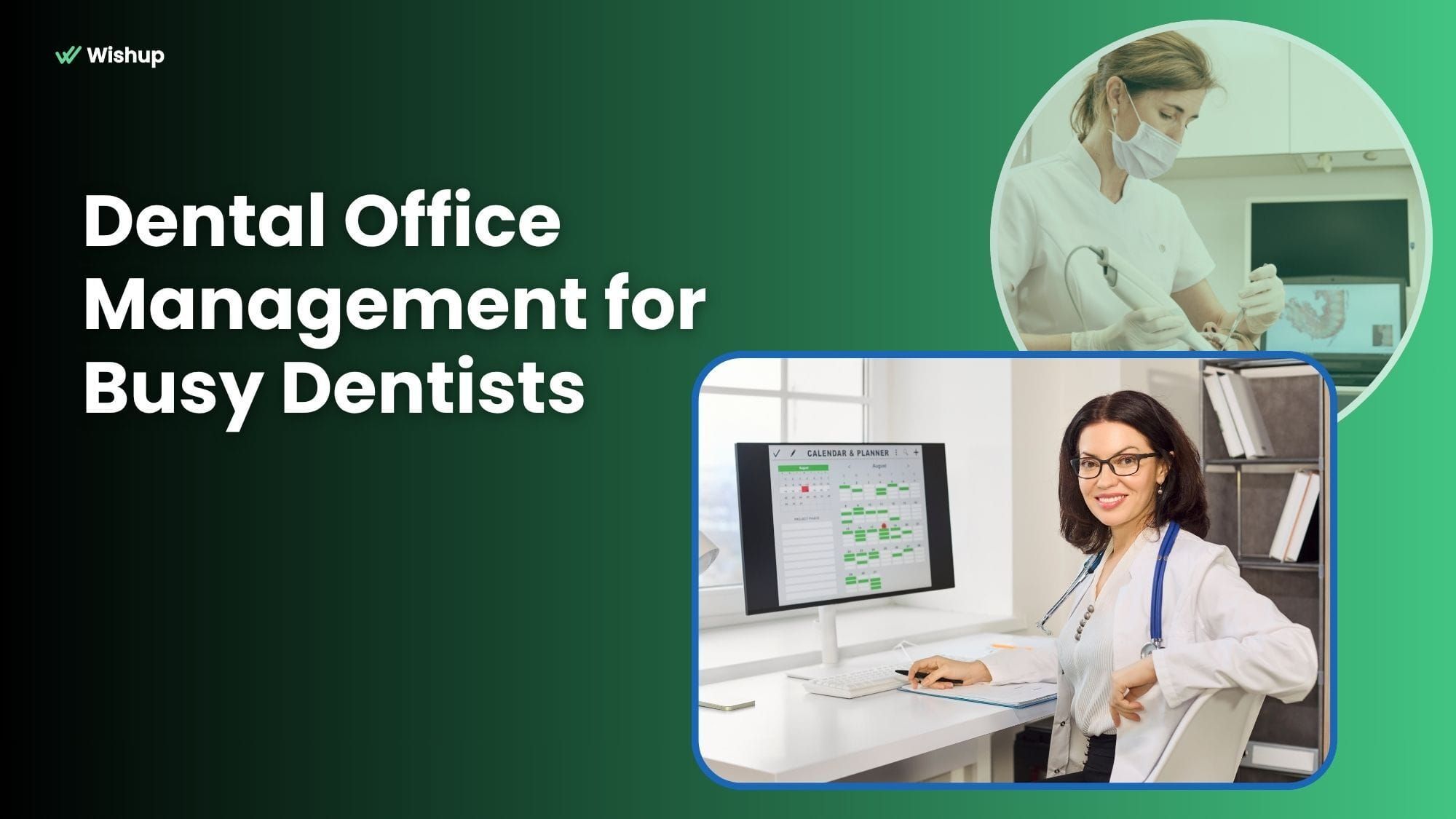
Virtual assistants now run the business side of dental practices end to end, from scheduling to billing to recall, so dentists can stay chairside.
I want to start with something I see in almost every dental practice I talk to. The dentist is excellent at dentistry, and the practice is quietly drowning in everything that is not dentistry. Phones ring out, insurance verifications pile up, claims sit unsubmitted, and recall lists go cold. None of that work is clinical, but all of it decides whether the practice grows or stalls.
This is the reason a virtual assistant has stopped being a nice extra and become a core member of the dental team. A modern dental office runs on several business functions at once, and a single front desk person cannot own all of them well.
In this guide I will walk through what dental office management actually involves, where a virtual assistant fits into each part of it, and how to think about hiring one for your practice.

What dental office management involves
A dental practice is a small business, and like any business it has to perform a set of core functions to survive.
When you organize the work by function rather than by task, two things become clear. You can see which functions are weak, and you can see exactly what kind of person should own each one.
Here are the six functions a dental practice runs every single day, and the dental office virtual assistant fits each one.
Patient access and scheduling
The goal here is simple. Get patients in the door and keep the chair full.
This covers answering calls, texts, and online inquiries, booking and confirming appointments, sending reminders to cut no-shows, and managing the waitlist so cancellations get filled fast.
An empty chair is lost revenue you never get back.
Intake and patient coordination
Once a patient is booked, someone has to prepare them for care.
That means sending and collecting intake forms, verifying insurance eligibility and benefits before the visit, and coordinating referrals, labs, and any pre-visit instructions. Accuracy matters most here, because an error at intake becomes a denied claim later.
Billing and the dental revenue cycle
This is where many practices quietly lose money.
The function covers insurance verification, reviewing CDT and ICD-10-CM codes before submission, sending clean claims, working denials, chasing accounts receivable, and posting payments.
In dentistry this is expert work, not a side task for a busy front desk, and it is one of the highest-value functions a dental virtual assistant can own.
Patient experience
This function covers follow-up calls, post-visit check-ins, review requests, and the single biggest revenue lever in dentistry, recall and hygiene reactivation.
A patient who falls off the recall list is a patient who stops generating revenue, and most practices have hundreds of them sitting dormant.
Marketing and patient acquisition
New patients do not appear on their own.
This covers social media, content, email and text campaigns, online reputation, and following up on website inquiries before they go cold.
For a practice trying to grow, especially with higher-value cash treatments, this function turns attention into booked appointments.
Back office and administration
Finally, the function that keeps everything else running.
Records management, electronic health record hygiene, document handling, inbox and calendar support for the dentist, supply ordering, and bookkeeping support.
Compliance work like HIPAA documentation sits across this layer and touches every other function.
When you map your practice against these six, you usually find that one or two functions are getting all the attention and the rest are neglected.
That is the gap a virtual assistant fills. You can hire a dedicated virtual assistant for each of the above mentioned areas.
The role of a virtual assistant in dental office management
A virtual assistant is not a single benefit you bolt on to fix one problem.
The right assistant becomes an integral part of how the practice operates, working across several of those six functions at once.
That is what separates a real team member from a task rabbit.
A dental virtual assistant is a remote professional who runs the non-clinical side of your practice.
If you are new to the idea, it helps to first understand what is a virtual medical assistant before you map the role to dentistry, because the foundations are the same and the specialty knowledge is what changes.
How the role maps to each function
In day-to-day terms, a dental office management virtual assistant takes ownership of work like this:
- Appointment scheduling and calendar handling. Booking, confirming, and rearranging the schedule so the dentist always has a full, sensible day.
- Patient follow-ups and reminders. Reducing no-shows and bringing lapsed patients back through recall.
- Insurance verification and claim support. Confirming eligibility and benefits before the visit so there are no surprises at checkout.
- Billing, invoicing, and payment tracking. Submitting clean claims, posting payments, and keeping accounts receivable under control.
- Front-desk support and call handling. Answering calls and messages with a warm, professional voice patients trust.
- Updating patient records and documentation. Keeping charts accurate inside your electronic health record so every appointment starts with complete information.
- Handling cancellation and rescheduling requests. Filling gaps quickly so a cancellation does not become an empty chair.
- Supporting treatment coordination. Following up on proposed treatment plans so accepted cases actually get scheduled.
- Managing reviews and patient communication. Protecting your reputation and keeping patients engaged between visits.
- Reducing admin load for dentists and clinic staff. Taking the repetitive work off your team so they can focus on patients in the building.
Notice that the front-desk work and the call handling overlap with the role of a virtual medical receptionist, while the eligibility and pre-authorization side connects to the work of a prior authorization virtual assistant.
A strong dental office management virtual assistant often blends these capabilities into one hire.
One important point. No two practices delegate the same way. A practice that lives or dies on hygiene recall will lean on the retention function, while a busy oral surgery office will lean on billing and authorizations. This is also why specialty matters.
The assistant supporting a therapist works very differently from one supporting a dentist, which is why Wishup matches you with an assistant who specializes in your field rather than a generalist.
The same logic applies whether you run a dental office or one of the other specialties Wishup supports, from virtual assistants for dentists to virtual assistants for therapists, optometrists, veterinarians, and chiropractors.
If you want to see how the same model plays out in a neighboring field, the breakdown of a chiropractic office management virtual assistant follows the exact six-function logic I described above.
How dental office management virtual assistant protects health information
This is the most important thing to understand before you hire anyone.
A dental office management virtual assistant handles protected health information every day. Patient names, conditions, insurance details, and full records. That raises the bar on trust, training, and process far above any ordinary administrative role.
It is also why patient-facing healthcare experience matters more than generic admin skill.
How access actually works
They never see your passwords
Passwords are stored in a manager that auto-fills on login. The assistant can use the system without ever seeing the password itself.
Access runs through your systems
Your IT sets up the login. Everything your assistant does shows up in your own audit logs. You can revoke access any time.
Only what they need, nothing more
Assistants get access only to the specific tools and records needed for their work. The moment the engagement ends, access is gone.
Their activity is tracked
Hours, tools used, tasks done, all visible to you through a tool called Time Doctor. You see a daily summary every evening.
When you hire for dental office management virtual assistant, you are not buying someone who can type fast.
You are buying someone you can trust with patients and with protected health information from day one, without a long ramp-up on how sensitive the work is.
What real compliance looks like
Compliance is more than a signed form.
For a remote assistant it should cover the whole environment in which patient data is handled.
At Wishup that means a Business Associate Agreement signed before anyone touches patient data, a strict non-disclosure agreement signed by every assistant from day one, and HIPAA training completed during onboarding.
If you want the full picture of what to demand from any provider, the guide to hire a HIPAA compliant virtual assistant lays out the checklist.
How access actually stays safe
The model that protects your practice is simple. Your virtual assistant works inside your systems, under your rules, and you can cut access instantly.
- They never see your passwords. Credentials live in a password manager that auto-fills on login, so the assistant uses the system without ever seeing the password.
- Access runs through your systems. Your IT sets up the login, every action shows in your own audit logs, and you can revoke access any time.
- Only what they need. The assistant gets access to the specific tools and records the work requires, and nothing more. The moment the engagement ends, access ends with it.
- Activity is visible. Hours, tools used, and tasks completed are tracked, and you receive a daily end-of-day summary.
- A clear incident protocol. If anything ever goes wrong with patient data, you hear within 24 hours, access is cut immediately, and you get a plain-language report of what happened and what changed.
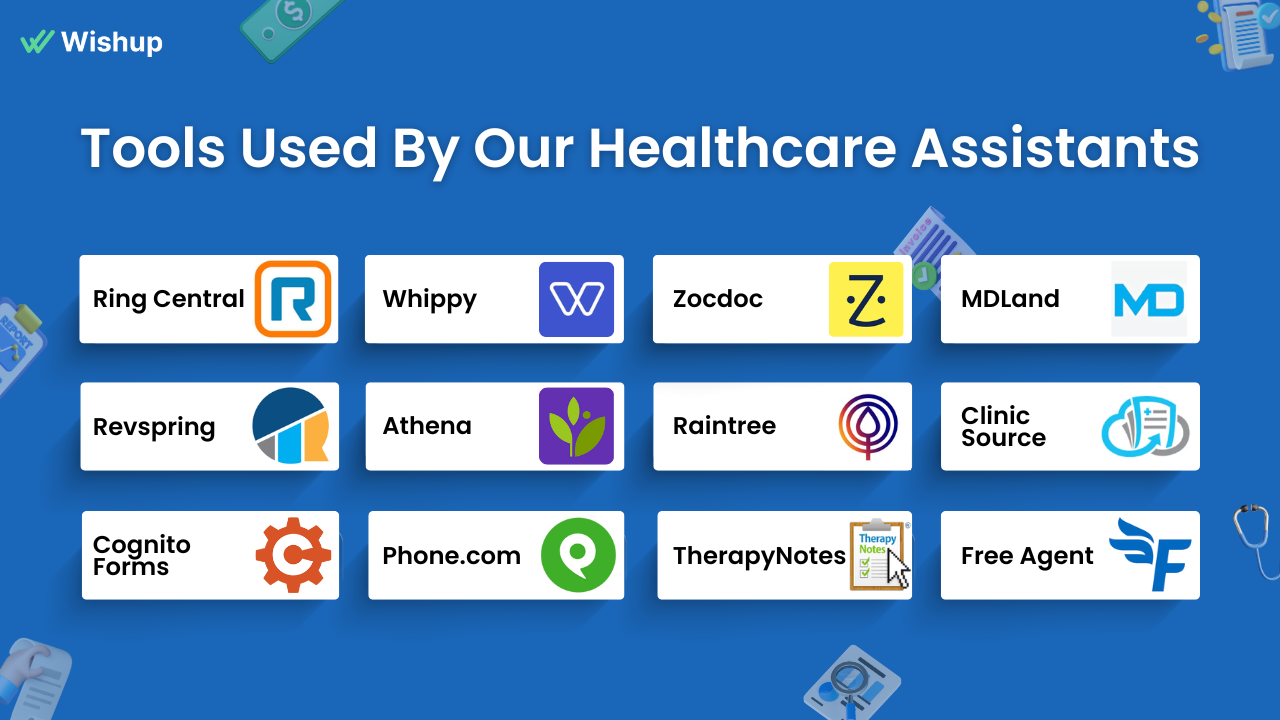
Because so much of this work happens inside your electronic health record, the assistant has to be fluent in your software.
Wishup assistants are pre-trained across the dental and medical platforms practices actually use, and the overview of EHR softwares used by healthcare virtual assistants shows how deep that coverage goes.
When practices should hire a dental office management virtual assistant
You do not need to wait for a crisis. There are clear signals that tell you the business side has outgrown your current team. If you recognize a few of these, it is time.
- The phone goes unanswered. Calls roll to voicemail during treatment hours, and missed calls become missed appointments.
- No-shows are climbing. Nobody has time to run consistent reminders and confirmations.
- Accounts receivable is aging. Claims sit past 30, 60, or 90 days because billing is squeezed between front-desk duties.
- Recall has gone quiet. Your hygiene schedule has gaps and lapsed patients are not being chased.
- You are doing admin after hours. The dentist is catching up on paperwork at night instead of resting.
- Front-desk turnover keeps resetting you. Every time someone leaves, you lose institutional knowledge and start training again.
- A second provider is joining. More chairs mean more verifications, more claims, and more scheduling than one person can absorb.
Any one of these is a productivity leak. Two or three together usually means the practice is leaving real revenue on the table every month.
How much does it cost to hire a dental office management virtual assistant
There are three realistic ways to get this work done, and they are not equal. Let me lay them out honestly so you can compare.
Option one: do it yourself in-house
You write the job description, post it, screen applicants, interview, run background checks, hire, and train. You also carry payroll, benefits, office space, equipment, and the cost of covering absences.
According to the U.S. Bureau of Labor Statistics, the median wage for a dental assistant was $47,300 in May 2024, and that is salary alone before you add the overhead. The harder cost is time.
A typical in-house hire takes weeks to recruit and weeks more to ramp, and when that person leaves you do it all again.
Option two: a freelance platform
Freelance marketplaces look cheap on the surface. The trade-off is that vetting, training, and reliability are on you.
There is usually no HIPAA assurance, no replacement guarantee, and no manager to call when something slips. For work that touches protected health information, that is real risk to carry alone.
Option three: a managed service
A managed service like Wishup sits in between in cost and ahead on everything else.
You get a pre-vetted, trained, dedicated assistant, plus a manager who owns the relationship and a guaranteed replacement if the fit is not right.
You skip recruitment, payroll, and HR overhead entirely.
Wishup dental office management virtual assistant pricing
Wishup offers three plans. In every plan, full-time means 8 hours a day and part-time means 4 hours a day, billed monthly in U.S. dollars.
- Prime VA. $1,299 per month part-time, $1,999 per month full-time.
- Elite VA. $1,999 per month part-time, $2,999 per month full-time.
- US-based VA. $3,000 per month part-time, $5,400 per month full-time.
Set against a single in-house salary plus overhead, a dedicated dental office management virtual assistant who covers several functions usually pays for itself through recovered claims and filled chairs alone.
How can you hire a dental office management virtual assistant from Wishup
The process is built to be fast and low-risk, because you should not have to gamble to get help. It comes down to three steps.
Share your requirements and workflow
Tell us your practice size, the software you run, your billing volume, your time zone, and the tasks you want covered. This is how we match for specialty and fit rather than just availability.
We match you with a pre-vetted top 0.1% assistant
From a pool of healthcare-trained professionals, we shortlist candidates who already know your kind of work and your tools, filtered to your working hours.
Six stages of hiring
285,000 → applied last year. 257 were hired across all six stages below.
Screening
Background, experience
Aptitude test
Problem-solving, thinking
English and empathy
Spoken and written, patient scenarios
Personality fit
Temperament for patient-facing work
References checked
Past employers, performance
Final interview
Our leadership meets them
Interview as many as you like, then onboard in 60 minutes
You get unlimited same-day interviews at no cost, and you only hire if you are satisfied. Once you choose, onboarding takes about an hour.
The matching works. Our first-match success rate is 90 percent, and the second-match success rate is 100 percent. You are not stuck with a single option and you are never charged to interview.
Why hire a dental office management virtual assistant from Wishup?
Plenty of companies will rent you an assistant. Here is what makes the Wishup model different, grouped the way we actually run it.
We hire elite talent
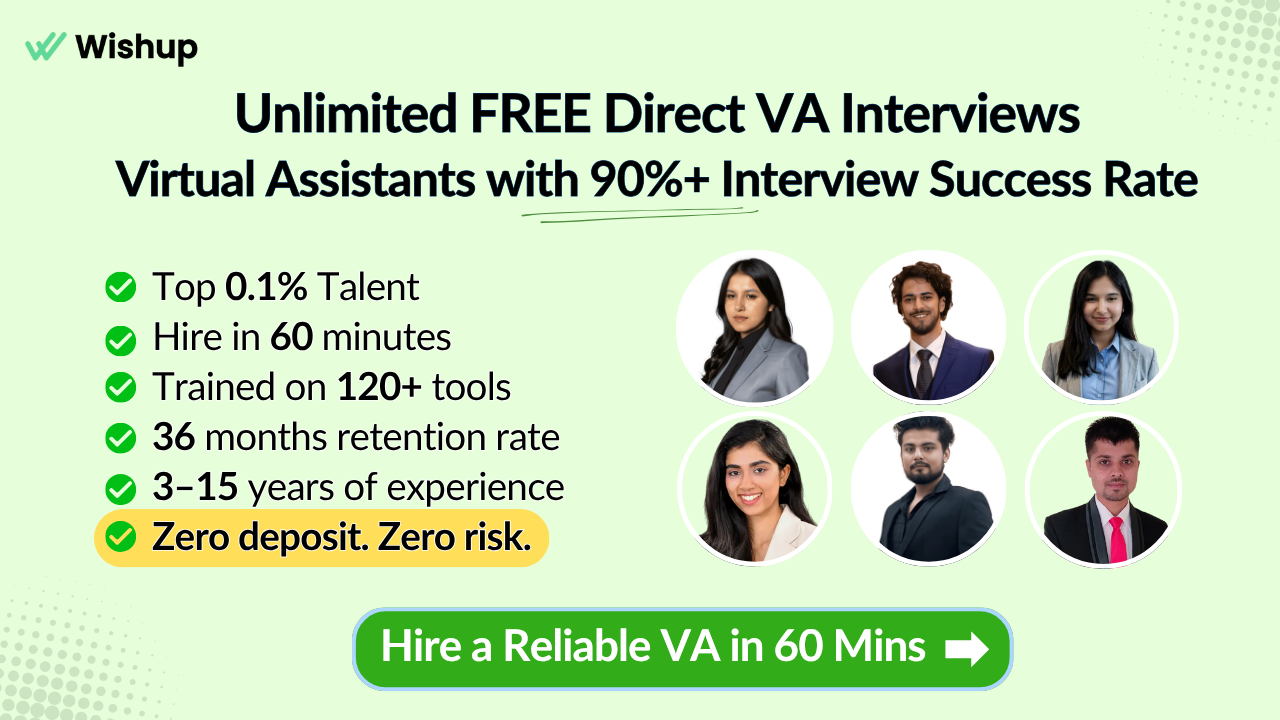
We take only the top 0.1 percent of applicants through a six-step, in-person vetting process.
Every assistant is a college graduate, aptitude-tested at the 99th percentile, with at least three years of professional experience before they ever meet a client.
Where our people come from
Our healthcare assistants are not general admins we retrain. Most come in with medical qualifications or real healthcare experience already.
Pharmacy degrees, so clinical terms are already familiar.
From prior healthcare clients, not classroom training.
Years of real practice work before joining us.
Direct healthcare
Medical scribing, UK healthcare admin, EMR work, and insurance claims. They have seen how a practice actually runs.
Patient-facing service
Years of customer service work, where warmth and consistency are the whole job. Matters when a patient calls upset.
Detail discipline
Backgrounds in banking operations and IT support, so they are good with documentation and careful with the small things that matter in billing.
Sales and hospitality polish
Time in sales, retail, and hospitality. Helpful for billing conversations and keeping referral relationships warm.
If the first assistant is not right
You interview candidates before anyone starts. If the fit is not right once they do start, we replace them at no cost, no questions asked. Only 4 percent of our clients ever request a replacement, and most issues resolve in the first week.
The result is stable, reliable talent, which is exactly what you do not get from freelancers.
We train them rigorously
Before an assistant is matched to your practice, they are trained across 120-plus AI and business tools, from automation platforms to scheduling and communication software, alongside professional communication, reporting, and task-management discipline.
That training is why a Wishup medical virtual assistant can step into your electronic health record and start contributing quickly instead of needing months of hand-holding.
The seven parts of healthcare training
HIPAA certification first
Every assistant earns HIPAA certification through Alison and hipaatraining.us before anything else. Covers patient data handling, treatment and billing rules, common mistakes to avoid, breach protocols, and how to work securely from home. Assistants must show proof of certification.
Healthcare terminology and insurance basics
The words and ideas used every day in your office. Clinical terms, EMR language, insurance types (HMO, PPO), copay, deductible, coinsurance, referral versus authorization. So when a patient asks a question or a payer calls, the assistant is not guessing.
The full patient journey, end to end
From the first phone call to the last payment. Registration, insurance verification, clinical documentation, basic medical coding, claims, payment posting, and patient billing. Your assistant sees how every step connects, so nothing falls through the cracks.
Billing and denials, where money gets lost
The top reasons claims get denied and how to prevent them. Front-end errors, coding mistakes, insurance issues. Focus is on accurate data entry, eligibility checks, and getting claims out on time, so you get paid faster with less back-and-forth.
What real practices actually deal with
A panel summary from our existing healthcare clients on how their days actually go, what they expect, and the sensitive areas where mistakes cost the most (billing, documentation, scheduling). So your assistant is not starting from theory.
The tools they will use in your office
Common EMRs, schedulers, phone systems, and payer portals, with enough familiarity to hit the ground running. Deep system training happens with you, on your specific setup.
A quiz they have to pass
Before an assistant can be shortlisted for you, they take a healthcare quiz covering HIPAA, workflows, and billing. We track their readiness on a scorecard. If they do not pass, they do not come near your practice.
We deploy them in 60 minutes
Industry-based matching means you are paired with someone who fits your specialty, and onboarding happens in about an hour.
There is no recruitment cycle, no payroll setup, and no HR overhead for you to absorb. Unlike many providers, we never charge you to interview candidates.
What we promise
We respond within 2 business hours and resolve within 24.
Handling your workflows on their own.
Calls queue or a backup assistant steps in, depending on how long.
No questions, no extra cost, any time.
Start month-to-month. Move to quarterly when you are ready.
We sit down and see how things are going.
We manage the talent for you
This is the part that protects your investment.
You get a dedicated assistant, a single point of contact who owns your account, and a manager who reviews the work, all built into the price.
Support includes weekly quality reviews, fortnightly checks that your standard procedures are being followed, and monthly check-ins with your customer success manager.
You also get an instant replacement guarantee, backup coverage when your assistant is on leave, end-of-day reports, time tracking, and enterprise-grade data security with strict non-disclosure agreements and monitored workflows.
Wishup is rated 4.9 on Clutch and 4.7 on Trustpilot, and across dental billing work our assistants achieve over 95 percent first-pass claim acceptance.
One more thing worth saying plainly. This model suits recurring operational work, the kind an in-house employee would own.
It is not built for one-off micro-gigs. If you want consistent, ongoing support that behaves like a real team member, that is exactly what it is designed for.
Healthcare automation expert virtual assistants for your dental office
A Wishup dental virtual assistant is not only a pair of hands.
Our full-time assistants are automation experts who can build workflows that remove repetitive steps from your practice entirely.
Using tools like n8n, Zapier, and similar platforms, they connect your scheduling, reminders, intake, and reporting so the routine work runs itself and your team only handles the exceptions.
This is already happening inside the practices we support. Across two healthcare clients in a recent quarter, automations built by Wishup assistants saved around 140 hours per month and roughly $5,600 per month in cost, benefiting six people across the teams. That is time handed straight back to patient care.
Saved per month
Through workflow automation across two healthcare clients.
Cost saved per month
From automating repetitive, manual operational steps.
People freed up
Team members who got hours back for higher-value work.
If you want to see how this is done step by step, we have walkthroughs for how to automate dental practice workflows with a virtual assistant, along with the broader how to automate healthcare workflows with a virtual assistant and a specialty example in how to automate therapy practice workflows with a virtual assistant.
How Wishup virtual assistants have helped healthcare professionals
The clearest way to understand the impact is through practices that have already done it.
Cutting accounts receivable by 60 percent
When the right person owned the right tasks, one healthcare brand brought its receivables down sharply and made scaling feel possible again. The full story is in how a healthcare brand cut AR by 60% with a virtual assistant.
Pulling a founder out of burnout
A single assistant helped a healthcare CEO streamline operations, hire faster, and reclaim her time. Read it in how a virtual assistant rescued a healthcare CEO from burnout.
Giving two startups time and control back
One assistant supported two fast-growing healthcare startups, bringing order and speed to overloaded schedules, as told in how a virtual assistant helped a healthcare startup regain time and control.
How to use medical virtual assistants in your office
If you have never delegated before, do not hand over everything at once. The practices that succeed start narrow and expand as trust builds.
- Start with one painful function. Usually scheduling and reminders or insurance verification, because the results show up fast.
- Write down your process once. A short standard operating procedure for your top tasks lets the assistant work to your standard from week one.
- Give system access the safe way. Through your password manager and your logins, with permissions limited to what the role needs.
- Set a daily rhythm. A quick morning priority list and an end-of-day report keep everyone aligned without constant check-ins.
- Expand by function. Once the first function is running smoothly, add the next one, whether that is billing follow-up, recall, or reviews.
Within a few weeks the dental management virtual assistant moves from following instructions to anticipating what the practice needs, which is the point where they become integral rather than optional.
Benefits of dental office management virtual assistants in a healthcare setting
Pulling it together, here is what a dental office management virtual assistant delivers when the role is set up well.
- Lower overhead. No office space, equipment, benefits, or HR cost attached to the role.
- More chairside time. The dentist and clinical team stop doing admin and get back to patients.
- Healthier revenue cycle. Cleaner claims, faster submission, and active follow-up on aging accounts.
- Fewer no-shows and a fuller schedule. Consistent reminders, confirmations, and recall keep the calendar working.
- Better patient experience. Calls answered, messages returned same day, and patients who feel looked after.
- Coverage you can rely on. Backup when your assistant is out and a replacement guarantee if the fit is wrong.
- Time-zone alignment. Support that works your hours, whether Eastern, Central, Mountain, or Pacific.
Learn how a healthcare virtual assistant works
It helps to picture the working model, because you are never left alone with a single remote hire. Three people support every engagement.
- Your assistant. A dedicated professional working with proficiency with your EHR/EMR tools, on your tasks, during your working hours.
- Your point of contact. One person at Wishup who owns your account and is always reachable. All our virtual assistants will respond you within 5 minutes during business hours and the POC within 60 minutes.
- A manager. Someone who checks your assistant's work and quality, built into the price rather than charged as an extra.
On top of that you get a clear set of service commitments.
Urgent issues get a response within a couple of business hours, your assistant is typically handling your workflows independently within four to eight weeks, backup steps in if they are unwell, and there is no long-term lock-in.
You can start month to month and move to quarterly when you are confident. Every evening you receive an end-of-day report, so you always know what was done.
If you want to compare providers before you decide, the rundown of the best medical virtual assistant companies is a fair place to start.
Hire a healthcare virtual assistant for your practice
Dental office management is not one job. It is six business functions running at once, and a busy clinical dentist cannot own all of them and still do great dentistry.
A dental office management virtual assistant lets you keep the chair full, the claims clean, the recall list warm, and the front desk calm, without adding a salaried hire and all the overhead that comes with it.
That is why a virtual assistant has become an integral part of the modern dental practice rather than an optional extra.
If your practice is showing the signals I described earlier, the next step is simple. Share your requirements, interview a few matched candidates at no cost, and onboard the one who fits in about an hour.
Ready to take the business side off your plate?
Get a pre-vetted, HIPAA-trained dental virtual assistant matched to your practice and onboarded in 60 minutes.
Hire a dental virtual assistant