
Immigration law firms operate in highly documentation-intensive environments where attorneys manage consultations, intake screening, client communication, compliance procedures, case documentation, and court-related timelines simultaneously. As the number of active cases grows, administrative workflows can quickly become overwhelming and begin affecting response times, organization, and client experience.
Immigration virtual legal assistant helps reduce this operational burden by supporting day-to-day workflows that keep the practice organized and responsive.
At Wishup, we support that kind of recurring work. We are a 100% remote outsourcing platform for SMBs, and our virtual assistants are pre-vetted for U.S. law firms and trained for legal work in tools like Clio, Westlaw, and QuickBooks.
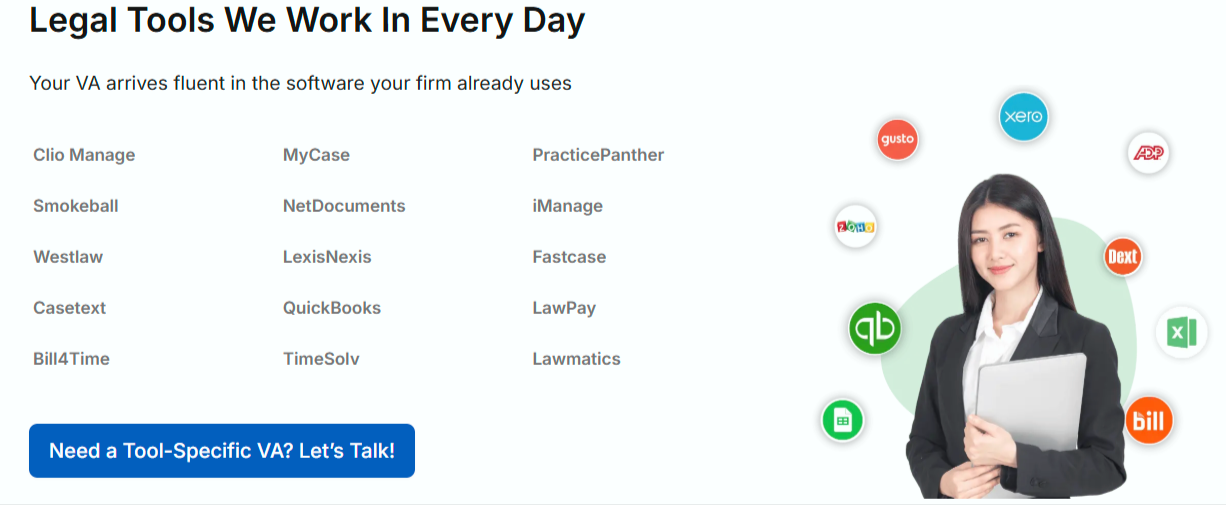
We also train our VAs across 120+ AI tools and 200+ skill areas, so they can support the systems and repeatable tasks that law firms use every day.


Why workflow management is a growing challenge for immigration law firms
Immigration law is document-heavy by nature. A single matter can involve intake forms, identity records, supporting evidence, deadline checks, follow-up emails, and repeated status updates across a case file.
Our virtual assistants for immigration support roles reflect that load clearly. They mention organizing and maintaining case files, assisting with preparation and filing of legal documents, managing immigration calendars, tracking case progress, and supporting document collection with clients.
That is why a virtual assistant for immigration law firms matters.
The work is not usually a single large project.
It is the same set of small, repeating tasks that keep a practice moving, and those tasks can stack up fast when the team is also handling legal review, strategy, and client-facing work. A virtual assistant gives the law firm a steady layer of support for the routine work that sits around the legal work.
What a virtual assistant for immigration law firms does in day-to-day operations
From intake coordination and consultation scheduling to documentation management and client follow-ups, legal virtual assistants help streamline repetitive processes so attorneys can focus more on legal strategy and case preparation.
Here are the top 13 tasks you can immediately delegate to your virtual assistant for immigration law firms.
Supporting Quality Control and Case Accuracy
Accuracy is critical in immigration law workflows, especially when firms are handling multiple versions of intake forms, screening documents, declarations, and supporting records simultaneously.
Virtual assistants help support quality control by reviewing documentation for inconsistencies, preparing discrepancy lists, organizing corrections, tracking pending edits, and maintaining updated versions of case-related files.
This additional layer of operational review helps firms improve documentation consistency while reducing administrative errors before attorney evaluation or filing preparation.
Maintaining Confidentiality and Compliance Standards
Immigration law firms manage highly sensitive personal and legal information, making confidentiality and compliance critical operational priorities. Legal virtual assistants working within immigration practices are often trained on confidentiality standards, secure communication practices, and attorney-client privilege requirements.
Their responsibilities may include handling sensitive documentation securely, maintaining restricted access to records, organizing confidential communications, and following structured internal workflows for case-related information management.
Strong operational processes around confidentiality help immigration firms maintain client trust while ensuring sensitive information is handled professionally and responsibly across all administrative workflows.
Managing Immigration Intake Workflows Efficiently
Client intake is one of the most time-sensitive and detail-oriented processes in immigration law. Every consultation requires accurate background information, supporting documentation, eligibility screening, and properly structured intake records before an attorney can begin evaluating the case.
A virtual assistant provides client intake support by organizing intake forms, reviewing submissions for missing information, updating questionnaires, formatting client responses, and coordinating document collection. In many immigration firms, intake workflows are continuously refined to improve clarity and reduce delays caused by incomplete submissions or inconsistent data collection.
Virtual assistants also assist with intake form maintenance by restructuring questions, improving readability, organizing checkbox-based responses, and helping standardize documentation formats across the firm. This creates a smoother experience for both attorneys and clients while reducing administrative inefficiencies during consultations.
Organizing Immigration Case Documentation
Immigration cases often involve large volumes of supporting documentation, including passports, travel history records, immigration notices, marriage certificates, tax returns, criminal dispositions, affidavits, and client declarations. Without structured organization systems, managing these files can become time-consuming and difficult for legal teams.
Virtual assistants help maintain organized documentation workflows by categorizing records, preparing consultation packets, updating digital folders, managing communication threads, and organizing client-submitted files before attorney review.
They may also assist with summarizing consultation notes, maintaining case-related spreadsheets, tracking pending documentation, and ensuring important records remain accessible throughout the case lifecycle.
Well-organized documentation systems not only improve operational efficiency but also help attorneys retrieve critical information more quickly during consultations, filings, and case preparation.
Supporting Family-Based and Adjustment of Status Cases
Family-based immigration remains one of the most common practice areas for
immigration firms — petitions for spouses, parents, and children require
extensive documentation and careful timeline tracking from filing through
adjustment of status.
A virtual assistant can support these cases by organizing supporting
evidence (marriage certificates, joint financial records, photos, and
affidavits), preparing petition packets for attorney review, tracking
priority dates and NVC processing stages, and monitoring biometrics and
interview scheduling.
Because family-based cases often span months or years, consistent
tracking matters as much as the initial filing. A virtual assistant helps
keep each case moving by flagging upcoming deadlines, following up on
missing documentation, and keeping the file organized for whatever stage
the case is in.
Supporting Employment-Based Visas and Naturalization Filings
Employment-based immigration — H-1B petitions, PERM labor certifications,
and other employer-sponsored filings — involves strict deadlines tied to
visa bulletin movement and government processing windows. Naturalization
cases (Form N-400) carry their own document checklists and interview
preparation requirements.
A virtual assistant can support these workflows by tracking LCA and PERM
filing deadlines, organizing supporting employer documentation, preparing
RFE (Request for Evidence) response packets for attorney review, and
maintaining naturalization document checklists ahead of biometrics and
interview appointments.
For firms that also handle humanitarian cases — including T-visa,
U-visa, or TVAP-related matters — the same organizational support
applies: structured documentation, consultation notes, and referral
tracking, handled with the confidentiality these cases require.
Client Intake and Initial Case Coordination
Intake is where a case begins, and it's also where small delays add up
fastest. Your VA can collect client details, sort incoming case
information, and organize the first batch of documents so nothing sits
untouched between the initial call and the first attorney review.
Document Collection and File Organization
Immigration matters depend on clean, organized records. Your VA gathers
documents, labels files consistently, and keeps both physical and digital
case folders in order — the same file handling that shows up constantly
in immigration support job descriptions, because it's genuinely central
to how these cases move forward.
Case Tracker and Status Sheet Updates
Most firms run on internal spreadsheets, shared trackers, or case
management software to monitor progress. Someone needs to keep those
updated as documents arrive, deadlines shift, or a case moves to its next
stage — that's a natural fit for a dedicated VA, freeing attorneys from
manually maintaining status sheets between client-facing work.
Deadline Monitoring and Follow-up Coordination
Immigration cases run on dates — filing windows, biometrics appointments,
interview scheduling, response deadlines. A VA can track what's
approaching, flag what's missing, and follow up with clients before a
deadline becomes a problem instead of a checklist item.
Data Entry and Record Verification
A large share of case management is straightforward data handling —
entering details, cross-checking fields, and keeping information
consistent across forms, trackers, and internal files. It's repetitive
work by nature, which makes it easy to delegate without sacrificing
accuracy, as long as the person doing it is trained and consistent.
Secure File Sharing and Document Handling
Day-to-day legal operations also involve moving files across shared
drives, password-protecting sensitive packets, and sending finalized
documents to the right recipients. It's routine admin work, but it still
requires care — the kind of task a trained VA handles as a normal part of
supporting immigration casework.
Streamlining Scheduling and Consultation Coordination
Immigration law firms frequently manage consultations across multiple platforms, including Outlook, Microsoft Teams, Zoom, RingCentral, and email communication systems. Coordinating consultations manually can create scheduling conflicts, missed follow-ups, and delayed communication with clients.
An immigration law firm virtual assistant helps streamline scheduling workflows by managing attorney calendars, coordinating virtual meetings, sending appointment reminders, organizing consultation timelines, and tracking follow-up tasks after client interactions.
For firms handling high consultation volumes, this level of coordination becomes critical for maintaining operational consistency. Legal virtual assistants also help organize recurring meetings, training sessions, referral calls, and internal workflow discussions that support ongoing case management activities.
By centralizing scheduling and communication workflows, immigration firms can improve responsiveness and maintain more organized day-to-day operations.
How immigration law firms use virtual assistants to support administrative work
When a firm hires a virtual assistant for immigration law firms support, the goal is not to hand off legal judgment. The goal is to move routine work away from attorneys and paralegals so the legal team can stay focused on the parts that need their expertise. That can include intake logs, folder clean-up, client reminders, spreadsheet updates, and document prep support. Immigration scope of work that we get from our legal clients support this picture because they combine legal support with administrative handling, client follow-ups, and file maintenance.
That is also where our legal training helps.
Wishup helps U.S. law firms with virtual assistants trained for legal work, including 120+ tools such as Clio, Westlaw, and QuickBooks.
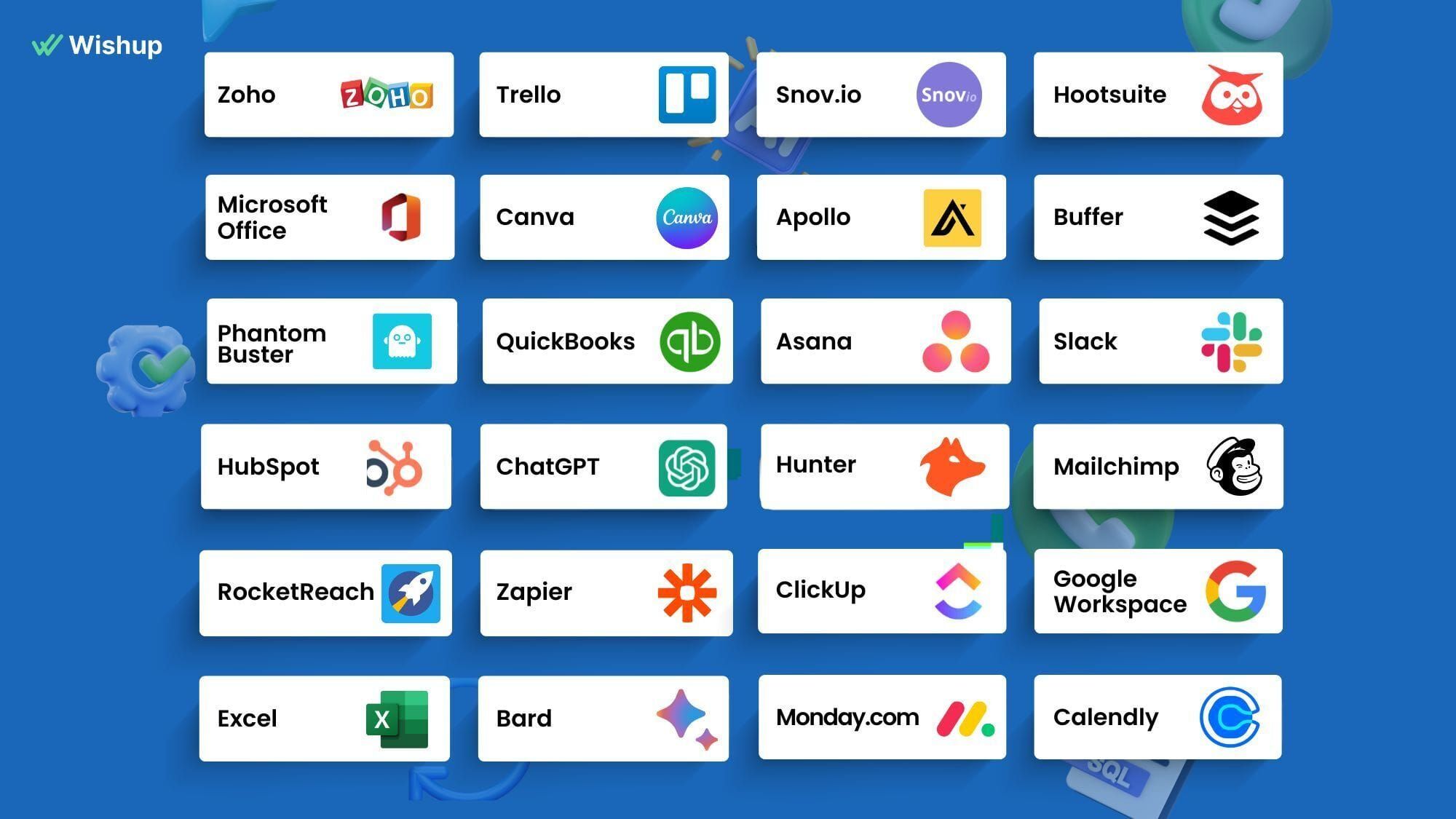

We also train our VAs in legal-specific work, which helps them step into recurring law-firm operations with less ramp-up.
Common workflow bottlenecks inside immigration law firms
The biggest bottlenecks are not always dramatic. They are small delays that compound. A missing document can hold up a packet. A late follow-up can slow an intake. A messy tracker can leave the team guessing about case status. A virtual assistant for immigration law firms can help reduce that friction by keeping the routine work visible and moving.
Another common bottleneck is fragmented communication. Clients ask for updates, attorneys need status information, and staff need to know what is pending. A virtual assistant can help keep these messages organized, which gives the firm a cleaner rhythm across the day.
How a virtual assistant for immigration law firms supports better internal coordination
A good virtual assistant for immigration law firms acts like an operational layer between the client, the attorneys, and the back office. That support can include status updates, document follow-ups, case file maintenance, and communication logs. It is a practical way to keep recurring work from sitting on a senior team member’s desk.
At Wishup, our Elite VA supported a U.S.-based property tax law firm for 11 months by helping streamline intake workflows, organize recurring operational tasks, and reduce the administrative load on the internal team. The engagement also helped bring more structure to SOP-driven processes across the firm.
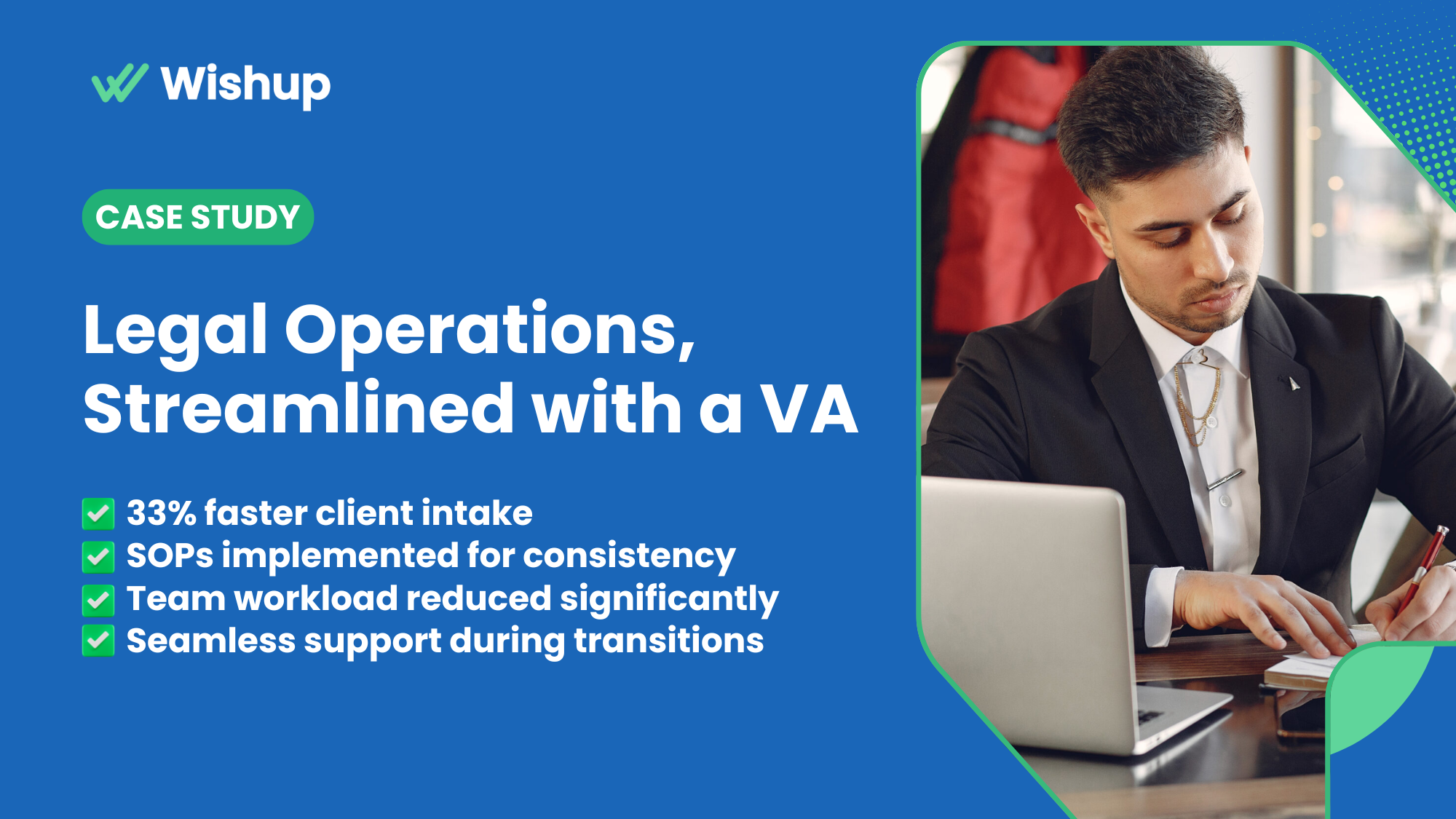

One of our legal clients also reported a 25% reduction in client intake time after working with a Wishup-trained VA using Clio. For immigration law firms handling large volumes of documents, follow-ups, and case coordination, this kind of operational support can help create a more organized and responsive workflow system.
How managed virtual assistant support fits immigration law firm operations
Immigration firms get the best results from support that is recurring, structured, and supervised. That is where a managed virtual assistant for immigration law firms fits well.
Rather than handing off random one-off jobs, the firm can assign ongoing admin work, build SOPs, and keep the same support rhythm week after week. Our managed service model is built for that kind of work, with dedicated support and review layers around the assistant.
That matters because law firms care about continuity.
Our virtual assistants are recruited by ex-entrepreneurs, go through a 6-step vetting process, and receive training built around U.S. business workflows and communication standards.
We also maintain strong client satisfaction ratings, including 4.9 on Clutch and 4.7 on Trustpilot, which reflects the consistency and support structure behind our managed service model.
How Wishup supports immigration law firms with managed virtual assistant services
A virtual assistant for immigration law firms from Wishup works as recurring operational support, not disconnected one-off task help. We train our virtual assistants across 120+ business and AI tools so they can support the day-to-day administrative workflows that keep legal teams organized and responsive.
Our matching process helps immigration law firms onboard support quickly without spending weeks in hiring cycles.
Law firms can conduct unlimited same-day interviews at no additional cost, and many of our clients find the right match in the first round itself.
We also provide onboarding support, replacement coverage within 24 hours, weekly QA reviews, SOP adherence checks, and a dedicated support structure after onboarding.
Other benefits of onboarding a legal virtual assistant from Wishup includes:
- 99% on-time delivery rate tracked across all legal workflows
- 5 minute response time from your virtual assistant
- 60 minute response time from any POC from Wishup during working hours
- 8-week mandatory AI & communications training
- 98.8% client satisfaction rate across 1,200+ active engagements
- SOC 2 aligned, GDPR compliant, legal NDA signed on day 1
- 6-step vetting process (aptitude, cognitive, English, and more) + unlimited free interviews
- 36 month average VA retention rate with 99.9 percentile aptitude test score
- Automation specialist VA trained in trigger-action workflow design, multi-app workflow builds, and conditional logic
- Quality analysis (weekly manager reviews, SOP checks, CSM cadence)
- In-house hire vs. Wishup immigration VA (no payroll tax headaches, no ATS/HR overheads, no surprise charges)
For firms managing intake, document-heavy workflows, follow-ups, and recurring administrative coordination, this model helps create consistency without adding internal hiring overhead.
What a virtual assistant for immigration law firms should not handle
A virtual assistant for immigration law firms should support operations, not replace legal judgment. The virtual assistant will handle intake, records, follow-ups, trackers, and admin work, but legal advice, case strategy, and final attorney review should stay with the legal team. That line keeps the workflow clean and the work properly divided.
How much does it cost to hire virtual assistant for immigration law firms
At Wishup we have a monthly pricing plan starting at $14.99/hr only. You can hire an immigration law firm virtual assistant without any long term contract. The cost to hire a VA are listed below:
Conclusion: Hire a Virtual Assistant in 60 Minutes
A virtual assistant for immigration law firms helps the practice move through its daily workload with less drag. The value is not in flashy work. It is in the steady pieces that keep cases organized: intake, files, trackers, client updates, calendar work, and document handling. That kind of support fits what immigration law firms already ask of administrative and paralegal support roles, which is why the model works so well.
At Wishup, we bring that support through a managed model, trained talent, legal workflow familiarity, and a hiring process that moves fast. For immigration law firms that want recurring support without building a larger in-house admin layer, that makes Wishup a practical fit.
Your next step is simple: Schedule a free consultation with Wishup. No commitment. No sales pressure. Just clarity on whether this model fits your practice.
