
If you have ever hired a new provider and then watched weeks pass before they could bill a single insurance claim, you already understand why medical credentialing decides whether a practice grows or stalls.
I work alongside the Wishup healthcare team, and credentialing is one of the most common reasons practice owners reach out to us. The work is detailed, it never really stops, and a small slip can hold up revenue for months.
This guide walks through what medical credentialing actually involves, what it costs, how long it takes, and how to outsource medical credentialing without losing control of your data.
Whether you are a solo clinician adding your second provider or an operations lead managing dozens of physicians across a large group, the same principles apply, and the same kind of specialist can carry the load.
If you want a sense of the full picture first, a healthcare virtual assistant can carry much of this load from day one.
What is medical credentialing?
Medical credentialing is the formal process of verifying that a provider has the education, training, licenses, and standing to treat patients and to be paid for it.
Doctors, dentists, therapists, and other clinicians have to show proof of their qualifications, and hospitals and health plans confirm that proof before listing them as in-network. Federal programs require it too.
A provider has to clear credentialing before they can be eligible for Medicare or Medicaid reimbursement.
In plain terms, credentialing is the gate between hiring a provider and getting paid for their work.
Until a provider is credentialed with a given insurance plan, claims for that provider cannot be submitted to that plan.
That single fact is why credentialing sits at the center of practice revenue, and why so many owners ask us for help managing it.
A trained virtual medical credentialing specialist keeps that gate moving.
Virtual medical credentialing services handle provider enrollment, CAQH management, primary source verification, and recredentialing remotely, inside your own systems, so your team stops spending clinical and admin hours on payer applications and follow-up calls.
A virtual medical credentialing specialist runs the same workflow an in-house credentialer would, with the paperwork, the payer follow-up, and the effective-date tracking all handled for you.
Why this matters for your revenue
When credentialing stalls, the provider can still see patients, but the practice often cannot bill for those visits yet.
In many cases patients are pushed to pay out of pocket, which strains the relationship and rarely recovers the full fee. Strong medical credentialing services exist precisely to stop that gap from opening.
What is a medical credentialing specialist?
A medical credentialing specialist is the person who owns this verification work end to end.
Their core job is to confirm that a provider's credentials are accurate and current, and to keep them that way. The role usually splits into two halves. The first is primary source verification, where the specialist contacts schools, licensing boards, and former employers directly to confirm a provider's education, license, and history rather than taking the CV at face value.
The second is ongoing maintenance, where the specialist tracks expiration dates and renews or updates credentials before they lapse.
Day to day, a credentialing specialist handles credential verification, compliance checks against payer and regulatory standards, background screening, and database management inside medical credentialing software.
In larger organizations they often sit within a medical staff services team. The most experienced specialists hold certifications from the National Association of Medical Staff Services, such as the Certified Provider Credentialing Specialist credential, which signals proficiency in the credentialing process, provider enrollment, and privileging.
Every Wishup virtual medical credentialing specialist is HIPAA trained before touching any provider data, and works inside your systems rather than pulling records out of them. That combination of credentialing skill and data discipline is the heart of what we offer.
How to outsource medical credentialing?
To outsource medical credentialing well, you hand the process to a trained specialist while keeping ownership of your data and your decisions.
The goal is not to lose visibility. It is to stop spending your own clinical and administrative hours on payer applications and follow-up calls.
Here is the sequence I recommend to practices of any size.
- Map your current state. List every provider, every payer they need, and every renewal date you can find. This becomes the working backlog.
- Choose your model. Decide between an in-house hire, a freelancer, or a managed partner. The next section breaks down the real cost of each.
- Set up secure access. Your specialist works inside your systems through your logins, with activity logged in your own audit trail.
- Hand over the backlog and the calendar. A good specialist takes both the new applications and the recredentialing schedule, so nothing lapses.
- Review weekly. You get a clear status on every application and every effective date, without chasing it yourself.
Practices that handle virtual assistants for therapists will delegate credentialing differently from a group working with a virtual assistant for dentists. No two practices run the same way, so the right medical insurance credentialing services flex to your specialty rather than forcing a single template on you.
How much does medical credentialing cost?
The honest answer is that price matters less than the total cost, because credentialing mistakes are expensive in ways that do not show up on an invoice.
To compare your options fairly, look at three routes: an in-house hire, a freelancer, and a managed partner like Wishup.
In-house hire
Salary + benefits + overhead
- You carry recruiting, payroll, and HR cost.
- You fund the training and certification yourself.
- One person means no backup when they take leave.
- Turnover restarts the whole cycle.
Freelancer
Lower rate, higher risk
- Little visibility into vetting or training.
- Data handling is often unclear, with no signed BAA.
- They may juggle many clients at once.
- If they vanish, the work stops cold.
Wishup managed partner
From $1,999 / month
- HIPAA trained, pre-vetted specialist.
- Signed BAA and NDA before any data is touched.
- Backup coverage and free replacement built in.
- A dedicated manager reviews the work.
The difference is trust and continuity.
A freelancer may quote the lowest number, but the medical credentialing companies worth choosing protect you on training, security, and reliability.
With Wishup you hire once and keep the same specialist for years.
Our virtual assistants stay with us for an average of close to four years, so you are not rehiring and retraining every season.
What we promise
What you'll see every day
A short summary at the end of each day: calls answered, appointments booked, follow-ups done, anything needing your attention. You can also check in on live activity any time through a shared dashboard.
What we promise
If something's urgent
We respond within 2 business hours, resolve within 24.
Fully up to speed
Handling your workflows on their own.
If they're sick
Calls queue or a backup virtual assistant steps in, depending on how long.
If it's not working
No questions, no extra cost, any time.
No lock-in
Start month-to-month. Move to quarterly when you're ready.
Quarterly check-in
We sit down and see how things are going.
Hire once, delegate for the long run, and keep the same specialist who already knows your payers.
Prime virtual assistant
Elite virtual assistant
US-based virtual assistant
Can a remote service handle medical credentialing, and how do you compare providers?
Yes, a remote credentialing service handles the full process, enrollment, verification, CAQH, and recredentialing, working inside your systems through your logins, so your data never leaves your control.
Digital medical credentialing is now standard, because the work is portal-based: CAQH, Availity, and NPPES are all online, so a remote specialist does exactly what an on-site one would.
When you compare virtual provider credentialing services, weigh four things: whether they sign a BAA before touching provider data, whether the specialist is HIPAA-trained and vetted, whether there is backup coverage and a replacement guarantee, and whether you keep a visible audit trail of every action.
A service that quotes the lowest rate but cannot show you those four is the one that costs you later in delays and compliance risk.
How long does medical credentialing take?
Credentialing usually takes anywhere from about 30 days to six months for a single payer, and complex cases run longer. Some payers turn an application around in 30 to 45 days. Others take 120 days or more. There is no fixed timeline in how many days the credentialing gets verified.
The spread is wide because each health plan moves at its own pace and each application has to be complete and accurate before the clock even starts.
Verification specialists often advise planning for at least 120 to 150 days when bringing on a new physician, so the work should begin the moment a hire is confirmed.
The approval timeline sits largely with the payer, not with you, because each plan runs the application through its own credentialing committee, and those committees meet on their own calendars.
When a committee meeting is postponed or cancelled, a file that is otherwise complete simply waits for the next session. Several other factors stretch the timeline too:
- Provider delays. A busy clinician may be slow to supply a document the payer has requested, which pauses the whole file.
- Committee scheduling. Credentialing is finished, but final approval waits on the next committee meeting, which can be a month or two out.
- Rate negotiations. If the practice and the payer have not agreed on the provider's reimbursement rate, credentialing can stall until they do.
- Incomplete applications. Outdated or missing information on the provider's side is the most common self-inflicted delay.
This is exactly where consistent follow-up earns its keep, and where a dedicated medical credentialing specialist shortens the timeline by chasing every effective date instead of letting applications sit.
A good medical credentialing specialist keeps a point of contact for each payer, logs every submission, and sets reminders to call and email on a set cadence rather than waiting to be chased.
The cash-flow workaround that keeps revenue moving
Here is a tactic our specialists use in real practices.
If a new provider is not credentialed by their start date, the billing team temporarily assign the patient to another provider who is already credentialed with that plan.
Claims keep flowing while the new provider's credentialing is finalized. It is a careful, compliant way to protect cash flow during the gap, and it reflects the kind of operational judgment that separates trained medical credentialing solutions from simple form-filling.
What is provider credentialing in medical billing
Provider credentialing in medical billing is the link between a clinician's verified qualifications and the practice's ability to get paid.
Before a provider can submit claims to a payer, they must be credentialed and enrolled with that payer.
Credentialing in medical billing therefore sits upstream of every claim. If the credentialing is wrong or incomplete, the claim is denied or delayed, no matter how clean the coding is.
This is why we treat credentialing in medical billing as a revenue function, not a paperwork chore.
When you understand what is credentialing in medical billing, you see why front-end accuracy protects the entire downstream process.
Our specialists also support eligibility checks and clean claim submission, and across our healthcare clients we see a very high share of claims accepted on first submission.
What could happen without medical credentialing
Skipping or mishandling credentialing creates risk on every front. Without proper credentialing, providers cannot bill for services or receive reimbursement from Medicare and other payers.
The consequences stack up quickly:
- Denied or delayed claims. Services delivered by an uncredentialed provider often cannot be billed to that plan.
- Stalled revenue. Cash flow halts while the practice waits on effective dates.
- Compliance and liability exposure. Credentialing reduces malpractice and fraud risk by confirming every provider is qualified.
- Patient friction. Patients may be forced to pay out of pocket, which damages trust.
These are not edge cases. They are the predictable result of letting credentialing slip, and they are the reason medical credentialing compliance has to be treated as a standing responsibility rather than a one-time task.
What does a medical credentialing specialist do
I covered the definition earlier, so here I want to show the work itself.
A Wishup medical credentialing specialist runs a clear, repeatable workflow for every new provider, and a separate cadence for renewals.
This is the same eleven-step process our virtual credentialing assistant follows.
Add malpractice coverage
Add the provider to the group's malpractice policy so coverage is in place before any application goes out.
Collect documents and credentials
Gather every license, registration, board certification, and the logins the provider needs for the systems they will use.
Create the provider file
Build a single record where everything about the provider is logged and kept on file from day one.
Update internal logs
Record the provider's join date and details in the internal logs, so the whole team is working from the same source.
Update provider profiles in credentialing portals
Set up and complete the provider's profiles in the credentialing portals the practice uses.
Keep CAQH, Zocdoc, and the payment portal current, since insurers and patients pull provider information from them.
Complete and submit payer applications
Fill out and submit each payer's unique application, which can run to 60 or more for a large multi-specialty group.
Follow up with the insurers
Track every application on a set cadence, calling and emailing each payer's point of contact until it moves.
Secure the effective dates
Confirm the effective date from each insurer, since billing depends on that date.
Inform the billing team
Tell the billers the moment a provider is active with a plan so claims can start going out.
Notify the provider
Update internal logs again and let the provider know they are credentialed and live with the plan.
Board verification versus board certification
One detail trips up newcomers and shows why an experienced medical credentialing expert matters.
Payers do not all accept proof in the same form.
Some will accept a board certification document from the provider.
Others insist on board verification sent directly from the certifying board itself, which means the specialist has to request that the board send the verification straight to the insurer.
Sending the wrong form to the wrong payer restarts the clock.
Knowing which payer wants which is the kind of detail that comes from doing the work, not reading about it.
Re-credentialing and hospital privileges
Re-credentialing is a recurring requirement that each payer sets on its own schedule, often every six months, one year, or two years.
There is no single automation that handles it, so it has to be tracked deliberately.
Hospital privileges follow a separate but similar process when a provider needs to admit or treat patients at a given facility, which means reaching out to the hospital to secure those privileges.
A healthcare automation specialist who owns the medical provider credentialing process keeps all three running in parallel.
Tools a virtual medical credentialing specialist works in
Our medical credentialing virtual assistants are fluent in the platforms credentialing runs on, including CAQH, NPPES, Availity, TriZetto, eClinicalWorks, the Health Commerce System, the Workers Compensation Board portals, the Office of the Workers Compensation, and Medallion.
Tools like Availity, TriZetto, and Medallion also sit at the center of healthcare revenue cycle management, of which credentialing is the first stage.
That fluency is part of why our medical credentialing training produces specialists who are productive early rather than learning the tools on your time.
What Is Medical Provider Credentialing
Medical provider credentialing is the broader term for verifying and enrolling any licensed provider, not only physicians. It covers nurse practitioners, therapists, dentists, and allied health professionals.
The medical provider credentialing process is the same in spirit across all of them: verify qualifications at the primary source, enroll with payers, and maintain the credentials over time.
What changes is the specialty detail. A virtual assistant for veterinarians deals with different requirements than a virtual assistant for a chiropractor or an virtual assistant for optometrists.
Because Wishup is not locked to one specialty, you get medical provider credentialing services from a specialist matched to your field.
Credentialing for medical providers in behavioral health, for instance, is well served by our virtual assistants for psychiatrists and our virtual assistant for a mental health practice.
Why Is Medical Credentialing Important
Medical credentialing is important because it protects patients, the practice, and your revenue at the same time. It confirms that every clinician treating patients is genuinely qualified, which is the foundation of patient safety and a major defense against malpractice and fraud risk.
It is also the precondition for insurance enrollment, since providers must be credentialed to participate in networks and submit claims. Beyond that baseline, credentialing delivers four practical benefits I see in every practice we support:
- Billing accuracy. When provider data is verified and on file with the payer, claims are processed against correct information, which means fewer errors.
- Time saved. A credentialed provider can see a patient right away, instead of the patient having to search for someone in network.
- Lower patient cost. In-network status is what turns a $100 consultation into a $15 to $20 copay, with the plan covering the rest.
- Fewer discrepancies. With a specialist as the point of contact, payers can resolve a provider question directly rather than waiting on a busy clinician.
For specialties with heavy procedural volume, such as our virtual assistant for oncology and virtual assistant for cardiology clients, accurate credentialing directly affects how quickly the practice can bill for complex care.
Getting it right is not optional, and it is why healthcare medical credentialing deserves a dedicated owner.
How to Do Medical Credentialing
If you want to do medical credentialing in-house, the process follows a clear path. Submit complete applications with the provider's education, work history, privileges, and malpractice coverage.
Complete primary source verification with schools, licensing boards, and past employers. Review clinical experience where the payer requires it. Secure approval and enrollment in each payer network.
Then move into ongoing monitoring and recredentialing so nothing lapses.
Doing it well takes time, attention, and the right medical credentialing software, and many practices find that the medical credentialing process is faster with a dedicated specialist chasing every step.
Whether you keep it in-house or outsource it, the principle is the same: accuracy up front, relentless follow-up after.
How CAQH fits into the process
CAQH deserves its own explanation because almost every US practice relies on it. It is the central portal where a provider's information lives, and most insurers pull provider data straight from it.
Each provider has their own CAQH account, and the credentialing specialist completes that profile with the provider's locations, hours, specialty, patient age range, certifications, and degrees.
From there, the specialist grants view-only access to a payer when it requests information, and can limit which fields a payer sees so that sensitive items are not shared.
Common Medical Credentialing Mistakes to Avoid
Most credentialing problems are not exotic. They are a handful of avoidable mistakes that a trained medical credentialing specialist is trained to prevent. These are the ones I see most often, and the reason careful, experienced people matter on this work.
Sharing information with the wrong person
Credentialing email chains loop in many parties. Sending confidential provider information to someone who was not meant to receive it is the single most common rookie error.
Copying the wrong party on email
When a provider flags that a payer concern is already resolved, the provider should not be looped into the reply to the insurer. Watching who is CC'd protects everyone.
Listing services a provider does not perform
A provider profile must list only what the provider actually does. Anything extra creates a compliance problem and can delay or void credentialing.
Working without a standard operating procedure
No checklist, no point-of-contact list, no follow-up reminders. Without a documented process, applications stall and renewals get missed.
Letting profiles and certifications lapse
Out-of-date CAQH profiles or expired certifications quietly break credentialing. Keeping everything current is a standing job, not a one-time setup.
No follow-up cadence
Applications do not move on their own. Without scheduled calls and emails to each payer, files sit in a queue for weeks longer than they need to.
Avoiding these is mostly about discipline and attention to detail, backed by a written process. That is exactly what our medical credentialing training builds into every specialist before they reach your practice, and it is reinforced by a quality assurance layer that checks the work.
How to hire a virtual medical credentialing assistant from Wishup
Hiring a virtual medical credentialing specialist from Wishup takes three steps and can be done in less than a day.
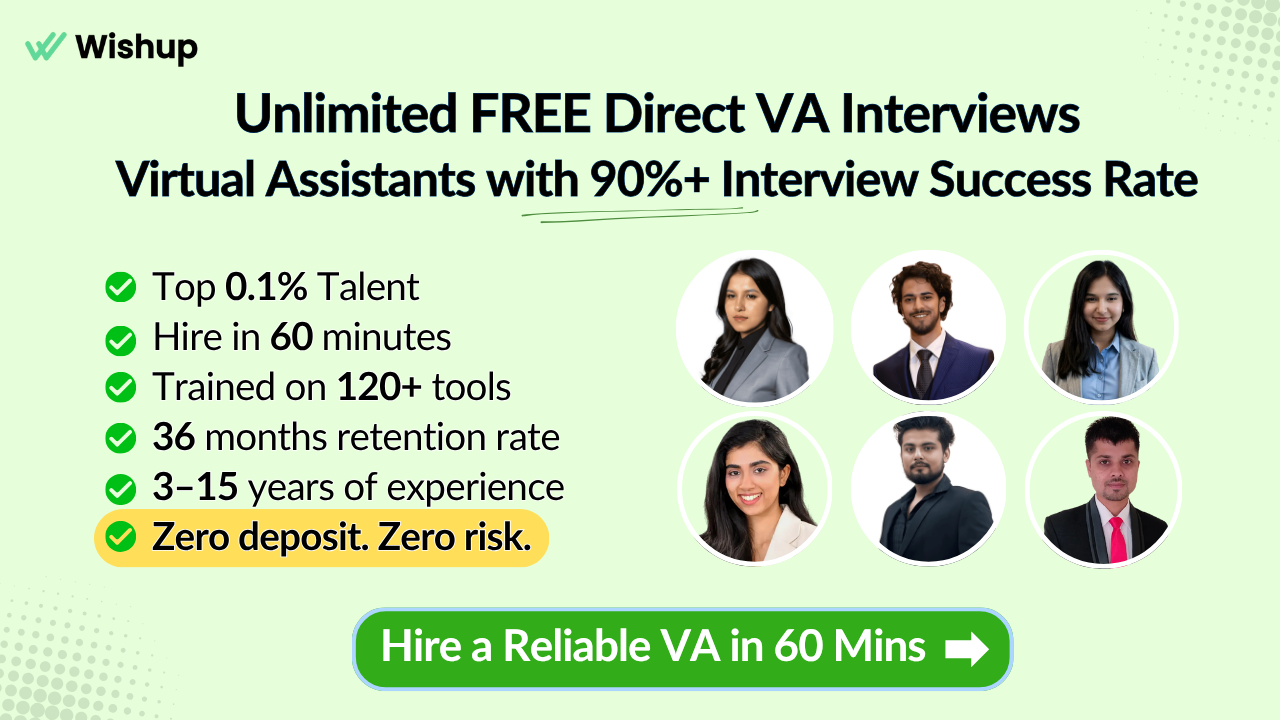
You interview as many pre-vetted candidates as you like at no cost, and you only commit when you are satisfied.
Our first match success rate is 90 percent and our second match success rate is 100 percent.
Share your requirements
Tell us your specialty, your payers, your tools, and your workflow. A customer success manager scopes the role with you.
Interview and select
We match you with top 0.1 percent specialists. Interview unlimited candidates the same day and pick the one who fits.
Onboard in 60 minutes
Your specialist is set up inside your systems and ready to work within the hour. Hire a healthcare virtual assistant to get started.
The managed service layer is what makes this work over the long run.
You get a dedicated account manager as your single point of contact, backup coverage if your specialist is ever unavailable, built-in quality assurance, training in your specific tools, and the ability to scale support up or down without a new recruitment cycle.
There are a few things worth sorting out before you hire a medical virtual assistant, and we walk you through all of them.
How a HIPAA compliant virtual assistant keeps your data safe
This is the question every practice owner should ask, so I want to answer it directly. Your patient data never leaves your systems.
Your medical credentialing virtual assistant works inside your electronic medical record, with your logins and your rules, and we sign the legal paperwork before anyone starts.
A HIPAA compliant virtual assistant is the baseline, not an upgrade.
They never see your passwords
Credentials are stored in a password manager that auto-fills on login, so the specialist uses the system without ever seeing the password.
Access runs through your systems
Your IT sets up the login. Everything the specialist does appears in your own audit logs, and you can revoke access at any time.
Only what they need
The specialist gets access only to the specific tools and records the work requires. The moment the engagement ends, access is gone.
Their activity is tracked
Hours, tools, and tasks are visible to you through Time Doctor, with a daily summary every evening.
Paperwork we sign
A Business Associate Agreement is signed before any patient data is touched, as the law requires. Each specialist also signs a strict NDA from day one.
If something goes wrong
You hear from us within 24 hours, access is cut immediately, and you get a plain-language report of what happened and what we are changing.
Two practical safeguards matter for credentialing in particular. Masked password sharing means the specialist can log into a provider's CAQH or payer account without ever seeing the raw password.
And inside CAQH itself, the healthcare virtual assistant can limit which fields a payer sees, so a provider's personally identifiable information stays hidden when it is not needed.
Handling protected health information and personally identifiable data with this level of care is non-negotiable, and it is the core reason practices trust a Wishup medical credentialing specialist with their providers' records.
For more on how we build this into every placement, see our guide to working with a HIPAA compliant virtual assistant. One honest note on expectations: even a strong specialist does best with 30 to 45 days of guided onboarding on your specific setup, which is when accuracy climbs toward the high marks you want from credentialing for medical providers.
Healthcare Automation Experts: Virtual Assistants Who Build Workflows
Our medical credentialing specialist virtual assistants are not only careful with paperwork.
They are automation experts who build and streamline workflows for US healthcare practices using tools like n8n, Zapier, and more.
Where a process is manual and repetitive, they look for a way to remove the friction, which is exactly the mindset credentialing rewards.
NEOLIGHT · HEALTHCARE · LIVE
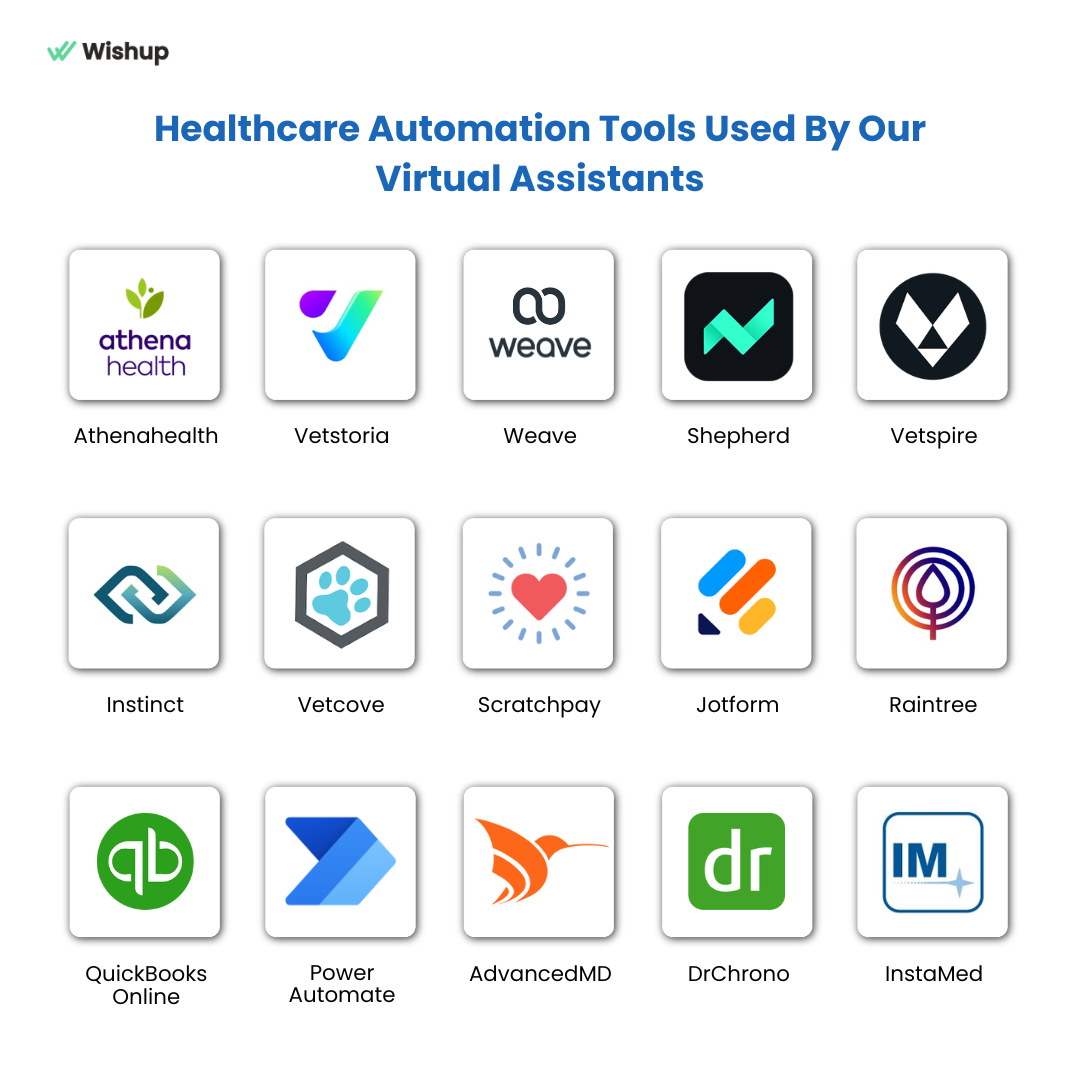
Our specialists also work across 70 or more EHR and EMR systems and the tools that surround them, including
- RingCentral for calling,
- Whippy for texts,
- Zocdoc for scheduling,
- MDLand for patient records and schedules,
- RevSpring and Athena for billing,
- Raintree for database and accounting needs,
- ClinicSource for patient records and visits,
- Cognito Forms for internal records,
- Phone.com for calling,
- TherapyNotes for the patient portal, and
- FreeAgent for CRM.
If you want to see how this applies to your field, we have detailed playbooks on how to automate healthcare workflows with a virtual assistant, how to automate therapy practice workflows, and how to automate dental practice workflows.
Why hire a medical credentialing virtual assistant from Wishup
Plenty of medical credentialing companies will sell you a seat.
What sets Wishup apart is how we hire, train, deploy, and then manage the specialist for the long run.
Here is what that looks like in practice.
We hire elite talent
Top 0.1 percent of applicants through a rigorous six-step vetting process, college graduates, aptitude tested in the 99th percentile, with at least three years of experience and a 36-month average retention.
We train them rigorously
Eight weeks of mandatory training across 120-plus AI and EHR tools, professional communication, and task management for accuracy and speed.
We deploy in 60 minutes
Industry-based matching, no charge for client interviews, and no recruitment, payroll, or HR overhead on your side.
We manage the talent
A dedicated customer success manager, instant replacement guarantee, enterprise-grade data security, EOD reports, time tracking, and a consistent feedback cycle.
Reliable, not a revolving door
Stable talent unlike freelancers, peer-trained for US businesses, with backup coverage when your specialist is on leave and replacement within 24 hours at no extra cost.
Trusted and proven
Rated 4.9 on Clutch and 4.8 on Trustpilot, recruited by ex-entrepreneurs, with over 95 percent of claims accepted on first submission across our healthcare work.
Our service suits recurring operations and admin work, the kind of consistent support that feels like an in-house employee, rather than one-off micro-gigs. You get loyalty without the long lock-in.
How Wishup virtual medical credentialing assistants have helped Healthcare Professionals
The clearest case for this work is what it does for real practices. One healthcare brand cut its accounts receivable by 60 percent with a virtual assistant, which is exactly the kind of revenue impact clean credentialing and billing support produce.
In another case, a virtual assistant pulled a healthcare CEO back from burnout by absorbing the operational load.
And a healthcare startup regained time and control once a specialist took over the repetitive work.
If you want the wider view, our complete guide to medical virtual assistants for healthcare practices ties it all together.
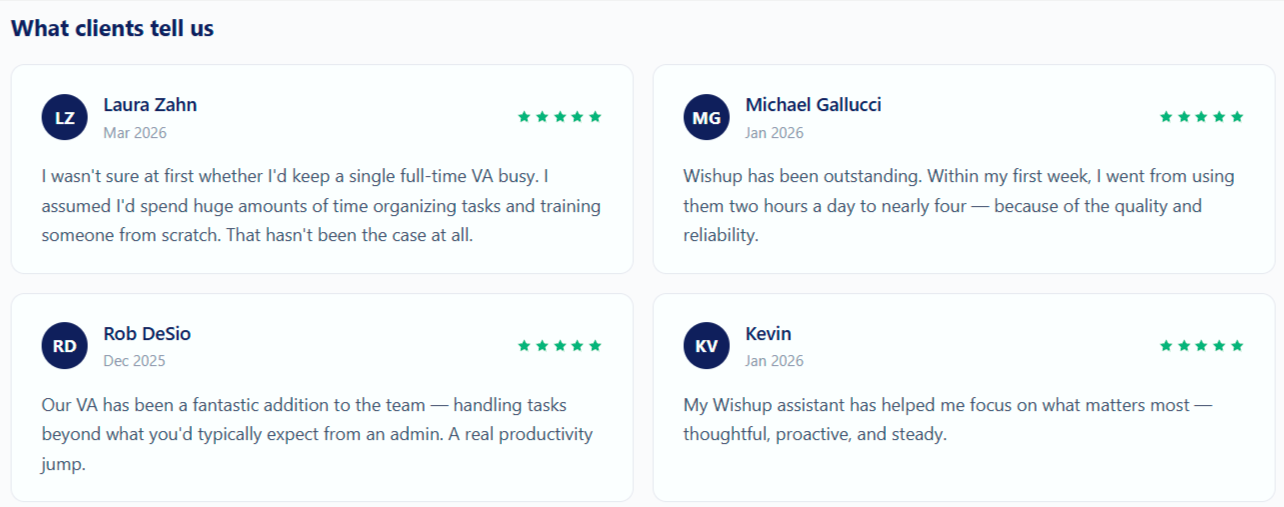
"I wasn't sure at first whether I'd keep a single full-time virtual assistant busy. I assumed I'd spend huge amounts of time organizing tasks and training someone from scratch. That hasn't been the case at all."
"Wishup has been outstanding. Within my first week, I went from using them two hours a day to nearly four, because of the quality and reliability."
"Our virtual assistant has been a fantastic addition to the team, handling tasks beyond what you'd typically expect from an admin. A real productivity jump."
"My Wishup assistant has helped me focus on what matters most. Thoughtful, proactive, and steady."
Keep your revenue moving with a credentialing specialist
Get a HIPAA-trained medical credentialing specialist who works inside your systems and chases every effective date, so your providers get paid on time.
Hire a healthcare virtual assistantFAQ about medical credentialing
Do you sign a BAA before touching patient data?
Yes, always. It's legally required whenever an outside party handles patient data, and we treat it that way. Your legal team can adjust our standard BAA to add any state-specific wording you need.
What if a patient is in crisis on the phone?
Every healthcare virtual assistant is trained to recognize a crisis call, stay warm on the line, and route it to emergency resources. We'll write the exact script with you during onboarding.
Can your virtual medical credentialing specialist work with our EMR?
Almost certainly. Our virtual medical credentialing specialist work daily across the major EMRs. If yours is one they haven't used, they're up to speed within the first week.
What if patient data is ever exposed?
You hear from us within 24 hours. Virtual assistant access is cut immediately. You get a written report you can hand to your compliance team. If regulators need to be told, we help you through it.
How long do your virtual assistants usually stay?
On average, 3.7 years. That matters because your patients get to know one voice instead of a rotating cast.
What if the first person isn't right for our patients?
You interview candidates before anyone starts, specifically listening for warmth. If the fit still isn't right once they begin, we replace them at no cost.
What if our virtual assistant is sick or on leave?
Short absences: calls queue, urgent things get covered by your point of contact. Longer absences: a backup virtual assistant steps in. Your patients shouldn't feel a gap.
What hours will they cover?
Your practice hours. For example if your practice runs in Ohio, that's typically 8am–5pm Eastern. We'll match their schedule to yours.
What won't a virtual assistant do?
Anything clinical like diagnosing, treatment decisions, crisis response. Everything else like patient admin, scheduling, EMR, billing, credentialing, they will be taken care by the virtual assistant.
Can we grow into this as we add providers?
Yes. One virtual assistant comfortably covers two providers plus admin. As you grow, we can add a second VA or a medical billing and coding specialist.
Can the virtual assistant help with credentialing for our new provider?
Yes, directly. CAQH updates, payer applications, follow-up calls. Often this moves faster than doing it in-house, because someone's chasing every step.
What if we want to stop?
Monthly engagements end at the end of the billing month. Access is cut, documentation is handed over, and patient data stays with you — it was never on our servers anyway.
