

Running a restaurant in the U.S. is as much about managing numbers as it is about crafting great dining experiences. Thin profit margins and intense competition mean financial missteps can quickly sink a business.
That is why you need to hire virtual assistant for restaurant bookkeeping from Wishup, starting at just $300/month.

Restaurant bookkeeping is the process of recording and reconciling a restaurant's daily sales, food and beverage costs, labor, and operating expenses to track profitability on thin (3–5%) margins.
It differs from standard bookkeeping because of high transaction volume, multi-channel revenue (dine-in, takeout, delivery), inventory tracking, and tip and sales-tax compliance.
According to the National Restaurant Association, around 30% of new restaurants fail within their first year.
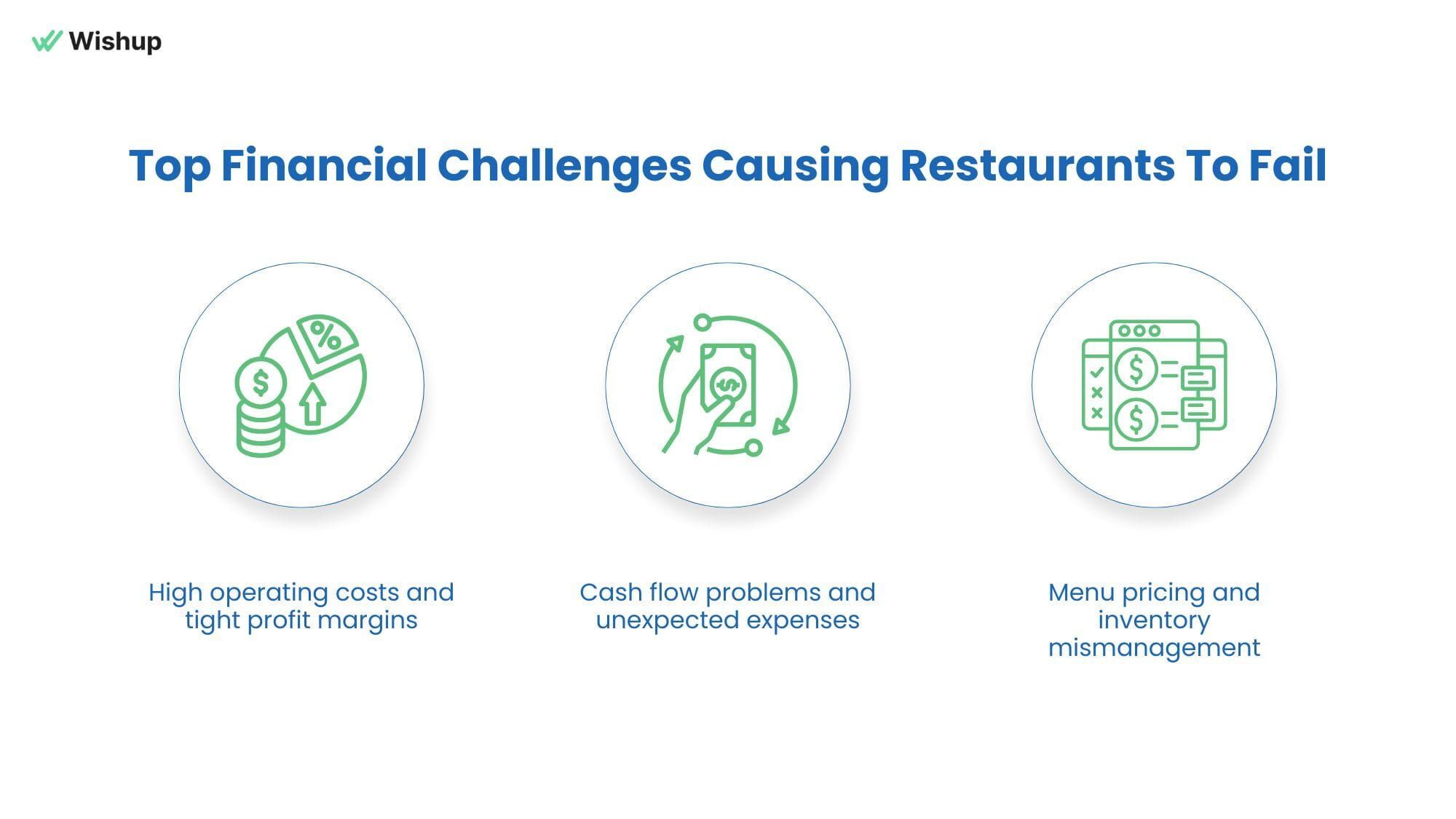
One major reason is poor financial planning – when operating costs, cash flow, and pricing aren’t closely monitored, a restaurant’s slim profits can evaporate.
In fact, high operating costs, cash flow problems, and mismanaged pricing/inventory are among the top financial challenges causing restaurants to fail. These are exactly the issues that diligent bookkeeping and financial management aim to control.
What Does a Bookkeeper Do at a Restaurant?
A restaurant bookkeeper records daily sales by revenue channel, reconciles cash against card and delivery-app deposits, enters supplier invoices, processes payroll including tips, tracks food and beverage cost against sales, and closes the books each month. The job is different from general bookkeeping because of transaction volume, tip compliance, and inventory.
Daily
Pull the POS report and record sales split by dine-in, takeaway and delivery. Reconcile the cash drawer against the digital payment batches. Log supplier invoices as they arrive rather than at month end. Flag any variance between what the POS says was sold and what the bank received, because that gap is where card processing fees, comps and voids hide.
Weekly
Calculate prime cost, which is food and beverage cost plus total labour, and compare it against sales. Reconcile delivery platform statements, since commissions, promotions and adjustments rarely match what the POS recorded. Review accounts payable and schedule supplier payments against expected cash.
Monthly
Reconcile every bank and card account. Complete inventory valuation. Produce the P&L, balance sheet and cash flow statement. File sales tax. Reconcile tip reporting against payroll records.
A bookkeeper records and reconciles.
An accountant interprets the resulting reports and advises.
A CPA files your returns and represents you if the IRS asks questions.
Most independent restaurants need a bookkeeper year-round and a CPA once a year. Paying CPA rates for daily transaction entry is the most common way small restaurants overspend on finance.
How tips are handled in restaurant bookkeeping
Tips are where restaurant books most often go wrong, because a tip
is not revenue but it is taxable wages, and the two get confused.
Cash tips kept by the server never enter your revenue. The
employee reports them to you, you report them on their W-2, and you
pay the employer share of FICA on them. They are a payroll item, not
a sales item.
Card tips land in your bank account as part of the batch, then
go out again on payroll. They pass through your books rather than
belonging to them. Recording them as sales inflates your revenue and
your sales tax liability.
Service charges are not tips. An automatic gratuity on large
parties, a delivery fee, a banquet service charge — the IRS treats
these as revenue, not tips. They are subject to sales tax where your
state taxes them, and when distributed to staff they are wages, not
tip income. Getting this wrong is one of the more common audit
findings in food service.
Tip pooling needs its own record. Whatever the arrangement,
your books need to show what came in, how it was split, and what
each employee received.
The compliance pieces that carry penalties
-
Form 8027: Restaurants that normally employ more than 10
people on a typical business day and where tipping is customary
must file an annual return reporting receipts and tips. Missing it
carries penalties. -
Tip allocation: If reported tips fall below 8% of gross
receipts, the shortfall may need allocating across tipped
employees. -
The FICA tip credit (Form 8846): This is the one owners most
often leave on the table. You pay employer FICA on tips your staff
report, and you can claim a credit against income tax for a
substantial portion of it. It is a real cash benefit and it needs
your tip records to be accurate to claim.
What this means for your books
Tip reporting has to reconcile three ways: what the POS recorded,
what payroll paid out, and what was reported to the IRS. If those
three do not match at month end, fix it that month. Reconstructing
a year of tip records during an audit is the single most expensive
bookkeeping cleanup in this industry.
Why Accurate Bookkeeping Matters in the Restaurant Industry
For restaurant owners, bookkeeping isn’t just an administrative chore – it’s the backbone of a healthy business.
Accurate, up-to-date books give you a clear view of your profit margins, cash flow, and expenses, which is critical in an industry where the average net profit margin is only 3–5%.
With margins that tight, minor errors or unnoticed losses (like waste, theft, or overspending) can mean the difference between profit and loss.
Good bookkeeping provides several key benefits for restaurants:
Real-Time Financial Visibility
You can see how profitable your menu items are, track food and labor costs (which often consume over 65% of revenue combined, and identify trends (like seasonal slumps or rising ingredient costs) early.
Clear visibility into profitability also helps restaurants compare their margins to industry averages and understand whether their financial performance is healthy or lagging behind peers.

Cash Flow Management
Restaurants deal with daily sales and expenses, from supplier bills to payroll. Keeping books current helps ensure you have enough cash on hand to pay vendors and staff on time, avoiding the common cash crunches in this business. Consistent money tracking also makes it easier to predict tight weeks, plan supplier payments, and avoid last-minute scrambling.
Regulatory Compliance
Accurate books make tax time far less stressful. All income and expenses are properly recorded, so you can file sales taxes, payroll taxes, and annual returns correctly. This helps avoid costly IRS penalties that can accrue up to 5% of unpaid taxes per month (up to 25% total) for late filings.
Fraud and Error Prevention
With professional oversight of your finances, there’s a reduced risk of fraud and mistakes. Outsourced bookkeeping services implement controls to catch irregularities – an important safeguard in cash-heavy businesses.
Better Decision-Making
When your financial reports (income statements, balance sheets, etc.) are accurate, you can make informed decisions about expanding your menu, adjusting pricing, or opening a new location. You’ll know if you can afford that new chef or whether to renegotiate with a supplier based on real data.
In short, disciplined bookkeeping is essential for a restaurant’s survival and growth. However, maintaining accurate books is easier said than done when you’re also juggling the day-to-day demands of restaurant operations.
Restaurant Bookkeeping Checklist (What Most Owners Miss)
Restaurant bookkeeping is more complex than standard business accounting because of inventory, cash flow, and multi-channel revenue. Here’s a simple checklist most restaurant owners follow to stay on top of their books.
- Track daily sales by POS system
- Separate dine-in, takeaway, delivery revenue
- Record platform commissions (GrubHub, DoorDash, Uber Eats, etc.)
- Monitor food cost and inventory usage
- Reconcile cash vs digital payments daily
- Track staff wages, tips, and payroll taxes
- Categorize kitchen, rent, and utility expenses
- Maintain vendor and supplier payment records
- Review weekly profit margins per location
- Prepare monthly financial statements
Small Margins and Real Expenses in a Restaurant– Every Penny Counts
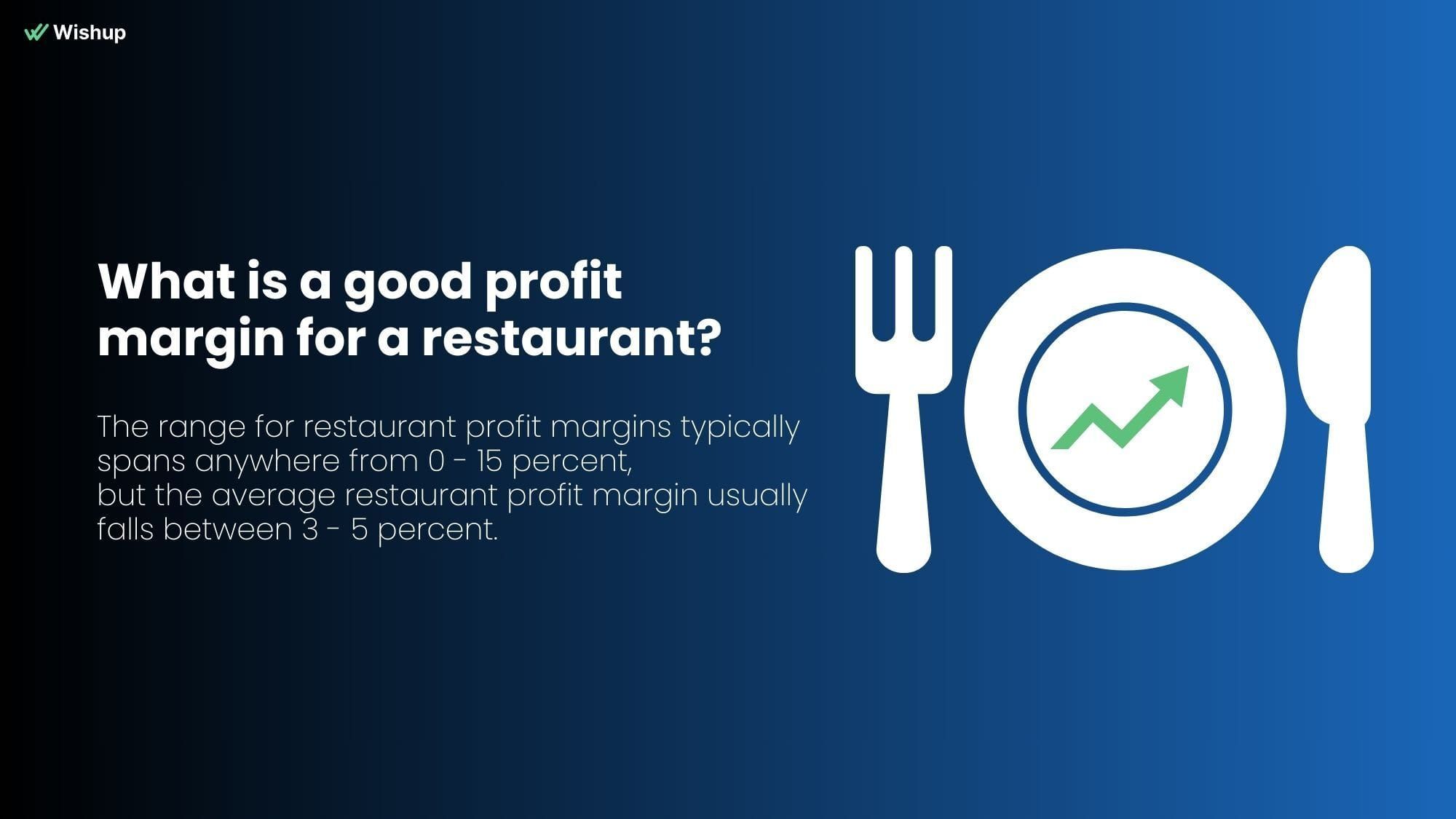
Restaurant ownership isn’t a get-rich-quick venture; it’s more like a labor of love with razor-thin margins. On average, U.S. restaurants only see 3–5% profit margins in good times (some years as low as 1.8%!).
Where does the money go? Let’s talk about real expenses:
- Food & Beverage Costs (COGS): You’re spending a big chunk of revenue on fresh ingredients, beverages, and supplies, and those costs fluctuate constantly. Waste or spoilage directly eats into your profits.
- Labor: From chefs and servers to cleaners, labor typically gobbles up 25–35% (or more) of revenue. Overtime, turnover, and training all add to this hefty expense.
- Rent & Utilities: That cozy location with good foot traffic isn’t cheap. Rent, electricity for all those refrigerators, gas for the stoves – they add up quickly each month.
- Equipment & Maintenance: Kitchens are rough on equipment. Repairs, replacements, and regular maintenance (broken ice machine, anyone?) are ongoing drains on cash. A Restaurant Management System can help track maintenance schedules and costs efficiently. To control costs long term, invest in preventive maintenance and energy-efficient walk-in refrigerators and freezers, which help cut utility bills, improve temperature control, reduce spoilage, and support lower COGS with steadier cash flow.
- Licenses, Insurance, Misc.: Health inspections, liquor licenses, insurance premiums, point-of-sale systems, marketing – the list goes on. All are must-haves that increase the cost of doing business.
When you tally it up, it’s obvious that every dollar counts. A surprise expense or a slow month can mean the difference between breaking even or falling behind.
There’s little room for error, which is why keeping a tight grip on finances is critical. In fact, poor cash flow management is cited in 82% of small business failures, according to Jessie Hagen, U.S. Bank.
For restaurant owners, that means that not having clear, up-to-date books and a handle on expenses can literally sink the business. Yet, maintaining that financial clarity is no easy task when you’re busy managing the daily chaos.
Restaurant Bookkeeping: The Hidden Burden After a 14-Hour Shift
After a marathon day, the last thing you want is to play the role of an accountant, but you have to. Tracking sales, tallying credit card fees and cash tips, paying vendor bills, recording payroll, reconciling yesterday’s receipts with the POS reports – bookkeeping for restaurants is uniquely tedious.
One bookkeeper on a restaurant forum summed it up: “I do the books for several restaurants… It’s a different kind of world; I can see why a restaurant dude wouldn’t want to do accounting”.
The volume of small transactions in food service is huge – every burger, every coffee, every refill is a line in the ledger. Add complexities like managing inventory (and accounting for waste or theft), handling sales tax, tip reporting, and compliance with health and labor regulations, and it’s clear why bookkeeping feels so burdensome to restaurant owners.
How Much Time Is Admin Stealing?
For restaurant owners, bookkeeping and taxes can quietly eat into the time meant for growth.
For restaurant owners, this “worst part” often comes after long shifts when you’re tired and prone to mistakes.
The result?
Many owners either procrastinate (letting receipts pile up in a shoebox) or sacrifice what little personal time they have to keep up with the books. It’s a classic lose-lose: you either risk your sanity or risk your financial clarity.

Financial Templates for a Small Restaurant
Running a restaurant isn’t just about great food – it also requires keeping meticulous financial records. Two key tools for this are a Profit and Loss (P&L) statement and a Chart of Accounts (CoA). These templates, customized for a small independent restaurant and aligned with U.S. GAAP standards, will help you organize finances, track performance, and ensure compliance.
We’ll explain each and provide copy-and-paste examples.
Restaurant Profit and Loss (P&L) Statement Format (US GAAP Aligned)
A Profit and Loss statement (also called an Income Statement or “profit and loss account”) summarizes your restaurant’s sales, costs, and expenses over a period.
It shows whether you made a profit or loss and exactly where you’re making or losing money in your operation. For effective monitoring, many restaurants prepare P&L statements monthly or even weekly to catch trends early.
A typical restaurant P&L is organized into five main sections: Sales, Cost of Goods Sold (COGS), Labor, Operating Expenses, and Net Profit.
This format aligns with GAAP-based income statement presentation (revenue minus expenses) while using restaurant-specific categories.
Key Components of a Restaurant P&L
Follow the money from sales to the bottom line.
Sales / Revenue
Food, beverages, catering, merchandise, and other income earned during the period.
COGS
The direct cost of ingredients, drinks, and other items sold. Sales − COGS = Gross Profit.
Labor Costs
Wages, salaries, payroll taxes, benefits, and other employee-related costs.
Operating Expenses
Rent, utilities, marketing, supplies, repairs, insurance, and other daily operating costs.
Net Profit / Loss
What remains after all costs are deducted from sales. Positive = profit. Negative = loss.
Below is an example P&L template for a small independent restaurant. You can use this format to plug in your numbers. It’s structured to highlight gross profit, operating profit, and net profit in a GAAP-consistent way (revenues minus various expenses), while also reflecting restaurant-specific needs (like distinguishing food vs. beverage sales and costs):
Restaurant P&L Statement
Use this worksheet to track revenue, costs, expenses, and profitability.
This format can be adjusted based on your needs. For example, you might break “Beverage Sales” into alcohol vs. non-alcohol, or add more expense categories (like “Kitchen Supplies” or “Insurance”) if they are significant for you.
The goal is to ensure the P&L is detailed enough to be useful but not overly complicated. If the main sections (Sales, COGS, Labor, Operating Expenses, Other) are in line, you can quickly gauge your restaurant’s health.
Finally, use the P&L to calculate important performance metrics. For instance, you can compute your gross profit margin (Gross Profit as a percentage of Sales) and net profit margin, or specific ratios like food cost percentage (Food Cost divided by Food Sales).
These figures help identify problems (e.g., if food cost % is too high, you may have waste or pricing issues) and track progress over time. By updating your P&L regularly (monthly or even weekly), you’ll be able to spot trends and react quickly, for example, taking action to lower rising costs or to boost sagging sales.
Restaurant Chart of Accounts (US GAAP Aligned)
A Chart of Accounts (CoA) is a complete list of all accounts your restaurant uses to record financial transactions. It acts as the organizing backbone of your accounting system – think of it as the master list of “buckets” where every transaction will go.
A well-structured CoA tailored for restaurants ensures that nothing falls through the cracks and that all your income and expenses are categorized logically. This makes it much easier to produce useful financial reports (like the P&L above, as well as balance sheets and cash flow statements) and to make informed decisions.
Why a Customized Restaurant CoA Matters:
Many off-the-shelf accounting software packages (e.g. QuickBooks) come with a default chart of accounts, but these defaults are not well-suited to the complexities of a restaurant.
Important categories unique to restaurants – like food cost, beverage cost, or even modern expenses like POS system subscriptions and delivery app fees – may be missing or lumped into generic accounts.
On the other hand, some generic charts include hundreds of unnecessary accounts. For a small independent restaurant, it’s better to keep the CoA lean and relevant, typically on the order of 100 accounts or so, not hundreds.
In practice, that means including all the key accounts you need for GAAP-compliant financial reporting, but not overloading it with extraneous detail. Organizing the accounts into logical groups (assets, liabilities, equity, revenues, COGS, expenses) will also improve clarity.
Below is a sample Restaurant Chart of Accounts organized by category, with suggested account numbers. (Account numbering isn’t required, but using a numeric code for each account helps keep them sorted by category – e.g. assets in the 1000s, liabilities in 2000s, etc., which is a common GAAP practice.)
Restaurant Chart of Accounts
A complete sample chart of accounts for an independent restaurant, with account numbers, descriptions, and restaurant-specific notes.
What the restaurant owns
| Code | Account | What it tracks |
|---|---|---|
| 1000 | Cash on Hand | Cash available in registers, petty cash drawers, or the safe. |
| 1010 | Business Checking Account | Funds held in the primary business checking account. |
| 1020 | Business Savings Account | Funds set aside in a business savings or reserve account. |
| 1100 | Accounts Receivable | Money owed to the restaurant by customers, such as catering clients or house accounts. |
| 1200 | Inventory – Food | Cost value of food ingredients on hand for preparation. |
| 1210 | Inventory – Beverages | Cost value of alcoholic and non-alcoholic beverages in stock. |
| 1300 | Prepaid Expenses | Expenses paid in advance, such as prepaid rent or insurance premiums. |
| 1400 | Equipment | Value of major kitchen equipment and appliances owned by the restaurant. |
| 1500 | Furniture & Fixtures | Value of furniture, fixtures, tables, chairs, bar fixtures, and décor owned. |
| 1600 | Leasehold Improvements | Cost of improvements made to a leased building or restaurant space. |
What the restaurant owes
| Code | Account | What it tracks |
|---|---|---|
| 2000 | Accounts Payable (A/P) | Amounts owed to suppliers and vendors for purchases made on credit. |
| 2100 | Accrued Expenses Payable | Expenses incurred but not yet paid at period end, such as wages or utilities. |
| 2200 | Short-Term Loans Payable | Notes or loans due within one year. |
| 2300 | Long-Term Debt | Loans or notes payable with a maturity beyond one year. |
| 2400 | Sales Tax Payable | Sales taxes collected from customers that are payable to the government. |
The owner's stake in the business
| Code | Account | What it tracks |
|---|---|---|
| 3000 | Owner's Equity / Capital | The owner's investment in the business, including initial capital and additional contributions. |
| 3010 | Retained Earnings | Cumulative net income retained in the restaurant rather than distributed to the owner. |
Income streams
| Code | Account | What it tracks |
|---|---|---|
| 4000 | Food Sales | Revenue from the sale of food items such as entrees and appetizers. |
| 4010 | Beverage Sales | Revenue from alcoholic and non-alcoholic beverages. |
| 4020 | Catering Sales | Income from catering services or private events. |
| 4030 | Merchandise & Other Revenue | Income from merchandise, delivery fees, rental income, gift cards, or other non-core sources. |
Direct costs of sales
| Code | Account | What it tracks |
|---|---|---|
| 5000 | Food Cost (COGS) | Cost of food ingredients used to produce menu items sold, including meat, dairy, produce, and other ingredients. |
| 5100 | Beverage Cost (COGS) | Cost of beverages sold, including beer, wine, liquor, coffee, and soft drinks. |
Other costs to run the restaurant
| Code | Account | What it tracks |
|---|---|---|
| 5300 | Labor – Salaries & Wages | All staff wages, including kitchen and service staff wages and salaries. |
| 5400 | Payroll Taxes & Benefits | Employer-paid payroll taxes and employee benefits. |
| 5500 | Occupancy – Rent & Utilities | Rent, property taxes, electricity, gas, water, and trash. |
| 5600 | Marketing & Advertising | Advertising, promotions, and marketing campaigns. |
| 5700 | Repairs & Maintenance | Equipment repairs, routine maintenance, and restaurant facility upkeep. |
| 5800 | Supplies & Miscellaneous | Office supplies, dishware, cleaning supplies, smallwares, business insurance, licensing fees, and similar costs. |
| 5900 | Professional Fees | Accounting, legal, consulting, and other professional services. |
| 6000 | Depreciation & Amortization | Periodic expense recorded for depreciation of equipment and furniture and amortization of applicable assets. |
| 6100 | Interest Expense | Interest on loans or credit lines. |
Example: Filled P&L for a Small Restaurant (Monthly)
Sample: independent café, ~$90,000 monthly sales
| Line item | Amount | % of sales |
|---|---|---|
| Food Sales | $68,000 | 75.6% |
| Beverage Sales | $20,000 | 22.2% |
| Other Income (catering) | $2,000 | 2.2% |
| Total Sales | $90,000 | 100% |
| Food Cost (COGS) | $20,400 | 30.0% of food sales |
| Beverage Cost (COGS) | $5,000 | 25.0% of bev sales |
| Total COGS | $25,400 | 28.2% |
| Gross Profit | $64,600 | 71.8% |
| Salaries & Wages | $27,000 | 30.0% |
| Payroll Taxes & Benefits | $4,500 | 5.0% |
| Total Labor | $31,500 | 35.0% |
| Prime Cost (COGS + Labor) | $56,900 | 63.2% |
| Rent & Occupancy | $7,200 | 8.0% |
| Utilities | $2,700 | 3.0% |
| Marketing | $1,800 | 2.0% |
| Repairs & Maintenance | $1,350 | 1.5% |
| Supplies & Misc. | $2,250 | 2.5% |
| Total Operating Expenses | $15,300 | 17.0% |
| Operating Profit | $10,500 | 11.7% |
| Depreciation | $1,800 | 2.0% |
| Interest | $900 | 1.0% |
| Net Profit (Pre-Tax) | $7,800 | 8.7% |
Best Accounting Software for Restaurants
Most restaurants need two systems, not one: a POS that captures sales and an accounting platform that receives them. The choice that matters is how cleanly the first talks to the second.
| Software | Best for | Why |
|---|---|---|
| QuickBooks Online | Most independent restaurants | Widest POS integration support, and almost every bookkeeper and CPA already knows it, which keeps your labour cost down |
| Xero | Owners who want a cleaner interface | Strong bank reconciliation and unlimited users, so managers can be given access without extra cost |
| Restaurant365 | Multi-location groups | Purpose-built for restaurants, combining accounting with inventory and scheduling. Priced accordingly |
| Toast + QuickBooks | Restaurants already on Toast POS | The native sync means daily sales land categorised rather than as one lump deposit |
| Wave | Very small cafés and food trucks | The genuinely free option, though with no inventory function and limited POS integration |
Why the integration matters more than the software
A restaurant generates hundreds of transactions a day. If your POS pushes a single daily total into your accounting system, your bookkeeper has to break that figure back out by hand into food sales, beverage sales, sales tax, tips and card fees. That is the work that makes restaurant bookkeeping expensive.
Who handles bookkeeping for restaurants?
Four options, and most restaurants move through them in order as they grow.
The owner, which costs nothing in cash and roughly 10 hours a week, and is where errors from fatigue tend to appear.
A restaurant manager, which works until the manager's operational load makes the books the thing that slips.
An in-house bookkeeper, averaging around $3,900 a month fully loaded, which most independent restaurants cannot justify.
A virtual or outsourced bookkeeper, which is the common answer for single-location restaurants, starting at $300 a month for managed bookkeeping.
Whichever you choose, the person needs restaurant-specific experience. Tip reporting, delivery-platform reconciliation and inventory valuation are where general bookkeepers most often get restaurant books wrong.
The True Cost of DIY Bookkeeping vs Outsourcing
If you’re handling all the bookkeeping yourself to save money, it’s important to recognize the hidden cost. Your time is valuable.
Every hour you spend updating spreadsheets or wrestling with QuickBooks is an hour not spent improving operations, engaging customers, or just getting some rest.
Let’s break down your options for managing the financial side:
As the table shows, doing it yourself isn’t “free” at all – it’s paid for with your invaluable time (and potentially in costly mistakes). On the other hand, hiring staff or a local CPA firm could ensure accuracy but might cost more than you can comfortably afford each month.
This is exactly where outsourcing to a virtual bookkeeping service shines: it hits a sweet spot of professional quality at an affordable cost.
Small businesses that outsource bookkeeping see an average savings of 40% compared to hiring an in-house bookkeeper, when you factor in wages, taxes, and lost productivity.
For a restaurant owner, that could mean thousands of dollars saved annually and hours of time given back to them.
What Is a Virtual Bookkeeper (and How Does it Work)?
A virtual bookkeeper is a professional bookkeeper who works remotely (usually off-site) to handle your financial record-keeping. Thanks to today’s cloud accounting software and secure file-sharing, virtual bookkeepers can do everything an in-person bookkeeper would do, without needing a physical presence at your restaurant.
Here’s how a virtual bookkeeping arrangement typically works for a restaurant:
Remote Access to Financial Data
You grant the bookkeeper secure access to your financial accounts and systems. For instance, you might add them as a user on your QuickBooks Online account (or Xero, FreshBooks, etc.), share view-only access to bank statements, and provide digital copies of bills, receipts, and daily sales reports from your POS system.
Regular Transaction Management
The virtual bookkeeper enters and categorizes your daily transactions – recording sales, depositing credit card batches, logging invoices from food suppliers, updating payroll entries, etc. They reconcile bank statements to make sure every dollar is accounted for correctly.
Software and Tools
Virtual bookkeepers are proficient with digital tools. (For example, our team of certified bookkeepers is versed in 15+ accounting platforms – they “meet you where you are,” whether it’s QuickBooks, Xero, Zoho, or a spreadsheet system.) They can also set up integrations or use expense management apps and receipt scanners to streamline data collection.

Communication
You stay in touch via email, phone, or video calls. A good virtual bookkeeper will send you questions if something looks off (e.g., “Was this $250 purchase on 5/10 a new oven part or an expense for catering?”) and will provide updates. Many operate almost like an extension of your team. For instance, they might message you weekly with a summary (“Your weekly books are all set!”) and flag any issues needing your attention.
Reporting and Advice
Typically, the bookkeeper will deliver monthly financial statements – profit & loss (P&L), balance sheet, cash flow statement – and can walk you through them. You get insights without doing the number-crunching yourself. If they notice trends (like food cost percentage creeping up or unexplained revenue gaps), they’ll alert you. Essentially, you gain a financial partner who helps interpret the numbers, not just record them.
The key is that you get professional bookkeeping done consistently and correctly in the background, while you focus on running the restaurant. And because it’s remote, you have flexibility – the service can scale with you and often costs far less than an in-house hire, as we’ll see next.
6 Benefits of Outsourcing Your Restaurant’s Bookkeeping
Outsourced virtual bookkeeping offers multiple advantages tailored to small restaurant businesses. It’s not just about saving time (though that’s a big win); it’s also about improving the quality of your financial management at a fraction of the cost.
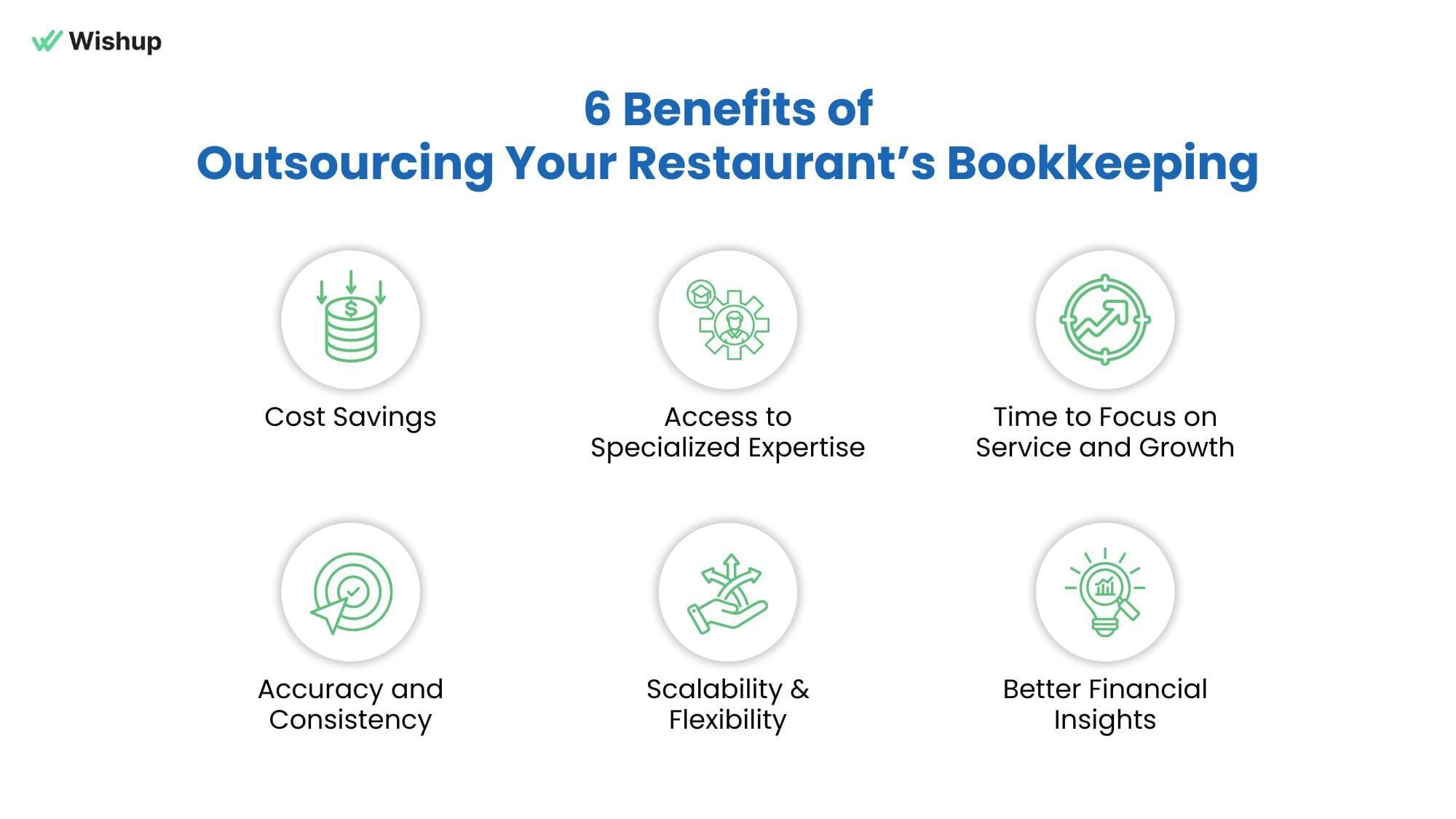
Here are the top benefits that U.S. restaurant owners are seeing:
Significant Cost Savings
By outsourcing, you only pay for the bookkeeping help you need. You might engage a virtual bookkeeper for, say, 10 hours a week rather than a 40-hour employee with full salary and benefits. Many outsourced services offer flat monthly packages that are far cheaper than a staff hire.
For example, compare that to the ~$3,900/month cost of an average in-house bookkeeper. Wishup’s virtual bookkeeper plans start as low as $300 per month for a micro plan, and go up to $1,799 per month for a dedicated full-time (8 hours/day) bookkeeper, still less than half the cost of a full-time employee. This kind of budget-friendly scalability means even the smallest independent diner or café can afford expert bookkeeping help.
Access to Specialized Expertise
When you outsource, you’re tapping into professionals who understand restaurant accounting specifically. They know about tracking cost of goods sold (COGS) for food and beverage, handling tipping and payroll intricacies, managing sales tax on restaurant meals, and the seasonality of the business. A specialized service ensures your books adhere to industry best practices.
Instead of a jack-of-all-trades (or an overworked owner) keeping the books, you get someone who’s up-to-date on the latest accounting rules and technology.
For instance, our bookkeeping team includes 500+ certified experts with 3–10 years of experience in U.S. bookkeeping, meaning we’ve seen the books of many restaurants and know how to handle your unique needs. This expertise leads to greater accuracy and insights.

Outsourcing to pros helps “reduce the risk of costly errors” and missed compliance steps.
Time to Focus on Service and Growth
With bookkeeping off your plate, you and your managers reclaim hours each week. You can invest that time in improving kitchen operations, training your staff, marketing your restaurant, or simply interacting with customers to boost satisfaction.
It’s the classic benefit of outsourcing: you free up internal resources for core operations.
Improved Accuracy and Consistency
A professional bookkeeper will maintain a regular schedule, reconciling accounts, paying bills, and closing books each month on time. This consistency means your financial data is always up to date and error-free.
You’ll get reliable monthly reports without last-minute scrambling. And because outsourced bookkeepers use the latest software and processes, they often catch and prevent mistakes that an untrained person might overlook.
The result is audit-ready books and peace of mind that everything “adds up.”
As Altametrics (a restaurant tech company) highlighted, outsourcing brings in processes and technology that ensure accuracy and efficiency in financial records. No more shoeboxes of receipts or spreadsheets full of typos – your virtual bookkeeper keeps things organized and precise.
Scalability & Flexibility
Whether you run a single food truck or a growing multi-location restaurant group, outsourced bookkeeping can scale with you.
Need more hours of support during the busy holiday season? It’s usually easy to add on. Slower in the winter? Scale back the hours. You’re not locked into a fixed cost or dealing with the HR headache of hiring/firing staff as your needs change.
Wishup, for example, offers flexible plans where you can choose a package of 40, 80, or 160 hours of bookkeeping a month and adjust as needed.
This flexibility ensures you always have the right level of support. Plus, if your bookkeeper goes on leave, the service can provide a backup – you’re not left stranded like you might be with a single in-house bookkeeper.
Better Financial Insights & Decision Support
Beyond just crunching numbers, good virtual bookkeepers often act as advisors. They can generate custom reports – maybe food cost percentage analyses, weekly prime cost reports, or cash flow forecasts – to help you run the restaurant more profitably.
Outsourcing to a firm means you might also get access to a team that includes senior accountants or CFO-level insight when you need it.
For example, Wishup will loop in an accounting manager to review your books or offer strategic advice on request. This level of insight can be game-changing for a small restaurant. It’s like having a financial controller on call, without paying a six-figure salary.
In summary, outsourcing your restaurant’s bookkeeping can lead to lower costs, better accuracy, and more time to grow the business. It turns bookkeeping from a headache into a strength – you get clean books and useful analysis that help your restaurant thrive.
Virtual Bookkeeping with Wishup – Built for Busy Restaurant Owners
One popular solution worth highlighting is Wishup’s virtual bookkeeping service, which has been a game-changer for many small business owners, including restaurateurs. Wishup provides trained virtual bookkeepers who act as an extension of your team, minus the overhead.

Here’s what makes it stand out for restaurant owners:
Restaurant-Savvy Bookkeepers
Wishup’s virtual bookkeepers are experienced with the restaurant industry. We know about POS systems, inventory management, invoice juggling, and seasonal fluctuations.
We even pre-train our assistants in 120+ business tools, from QuickBooks and Xero to restaurant POS software. That means minimal hand-holding for you – they already “get” your world.
Fast Onboarding
Need help ASAP? Wishup can match you with a bookkeeper in as little as 60 minutes. No weeks of waiting. Most clients are up and running in under a day. This is crucial when you’re underwater with tasks and need to catch up on your books from yesterday.
Affordable, Transparent Pricing
Unlike hiring a local accountant with unpredictable fees, Wishup offers simple pricing plans. For instance, you can start with a managed bookkeeping service at just $300/month for basic needs.
As your needs grow, you can transition to a dedicated virtual bookkeeper for $999/month (around 80 hours) or full-time at $1799/month (160 hours), still far less than a typical salary. Or, if you prefer hourly flexibility, the rate is flat $9.99/hour, no matter where you’re located. That pricing predictability is a relief on tight budgets.
All-in-One Support
Wishup’s bookkeepers handle everything from daily transaction recording, accounts payable/receivable, payroll assistance, to monthly financial reports.
They even support tax preparation and filings as needed (yes, including sales tax or 1099s for contractors. It’s like having a full finance department packaged for a small business. You won’t need separate services for bookkeeping vs. tax – it’s integrated.
Seamless Communication & Tools
Working with a remote bookkeeper is made easy. Wishup provides a free management app and a dedicated account manager to ensure things go smoothly. Your virtual bookkeeper will work with the tools you already use (whether it’s QuickBooks Online, Xero, or your POS exports). There’s no forcing you into a new system; they adapt to your workflow. Updates and reports can be shared via email or the dashboard, and you can reach out anytime with questions.
Reliability and Trust
All Wishup bookkeepers are certified and pre-vetted top 0.1% talent, and we have a 98% client satisfaction rate and 99% on-time delivery rate. Plus, there’s a 7-day money-back guarantee if you’re not happy.
In practice, that means you can trust that your books will be done accurately and on schedule. Many owners also appreciate having that dedicated contact watching over their finances – it’s like a safety net.
No Strings Attached
It’s worth noting there are no long-term contracts with Wishup. It’s month-to-month. If you ever feel you’ve got it handled (or want to pause for any reason), you can cancel anytime without penalties. This flexibility removes the worry of “What if it doesn’t work out?” or committing to a year-long expense.
Having outsourced bookkeeping. Now, instead of spending Sunday night crunching numbers, you can review last week’s sales summary prepared by your virtual bookkeeper and instantly glean which menu items are hits or which days are slow. You might even discover you have time to plan a new marketing promo or simply take a well-deserved evening off, knowing the financial side is under control.
Conclusion: Focus on Food, Not Files (Take Back Your Time)
You opened your restaurant to share your love of food and hospitality, not to spend nights pouring over ledgers. The reality, however, is that solid bookkeeping is the backbone of a sustainable restaurant, and ignoring it isn’t an option. The good news is you don’t have to tackle it alone or let it swallow your time.
By leveraging Wishup’s virtual bookkeeping services, you can offload the tedious financial work to experts who do it faster and more accurately, and for a cost that makes sense for a small business.
Imagine what reclaiming those hours and mental energy would mean: more time to craft menus, train your staff, engage with customers, or simply get some rest so you’re recharged for the next day’s hustle. Many successful restaurant owners will tell you that delegating and outsourcing is how they grew their business and kept their sanity. It’s time to join that club.
Ready to reclaim your time and streamline your restaurant’s finances? Take the next step by exploring how Wishup can tailor its bookkeeping support to your restaurant’s needs. Don’t let bookkeeping chaos hold you back from growing your business. Focus on what you do best – delighting customers – and let a trusted virtual bookkeeper handle the number-crunching. Your future self (and your bottom line) will thank you for it.
FAQs on Restaurant Bookkeeping
How do you do bookkeeping for a restaurant?
Restaurant bookkeeping follows a daily, weekly, and monthly rhythm. Daily: record POS sales by category, reconcile cash against digital payments, and log supplier invoices. Weekly: calculate prime cost (food + beverage + labor) and review it against sales. Monthly: reconcile all bank and card accounts and prepare a P&L, balance sheet, and cash-flow statement.
What is prime cost in a restaurant?
Prime cost is the sum of a restaurant's cost of goods sold (food and beverage) plus total labor cost. It typically represents 60–65% of sales in a healthy restaurant and is the single most important number to control, because it covers the largest expenses an owner can directly influence.
What is the best chart of accounts for a small restaurant?
A small restaurant's chart of accounts should stay lean, around 100 accounts, grouped into assets, liabilities, equity, revenue, COGS, and operating expenses. It should separate food and beverage sales and costs so you can track each category's cost percentage, and include restaurant-specific accounts like delivery-app fees and POS subscriptions that default software charts often omit.
How much does restaurant bookkeeping cost?
DIY bookkeeping costs nothing out of pocket but 10+ hours a week of an owner's time. A full-time in-house bookkeeper averages around $3,900 a month with taxes and benefits. A virtual bookkeeping service is the middle path, Wishup's managed bookkeeping starts at $300/month, with dedicated plans scaling up from there.
Should a restaurant outsource its bookkeeping?
Outsourcing makes sense when an owner is spending nights on the books, missing reconciliations, or making errors from fatigue. Small businesses that outsource save roughly 40% versus an in-house hire and reclaim hours weekly, while gaining specialist accuracy on tip reporting, sales tax, and COGS tracking.
What does restaurant bookkeeping include?
Restaurant bookkeeping includes six things: recording daily sales split by revenue channel, reconciling cash against card and delivery-app deposits, entering and paying supplier invoices, processing payroll with tip allocation, tracking inventory and food cost against sales, and producing monthly financial statements.
It also covers sales tax filing and tip reporting compliance, both of which carry penalties if handled incorrectly. What it does not include is tax strategy or year-end filing, which is a CPA's job.
How to account for food waste in restaurant bookkeeping?
Food waste is accounted for through your inventory valuation rather than as a separate expense line. The mechanism is simple: beginning inventory plus purchases minus ending inventory equals cost of goods sold. Anything wasted, spoiled or comped stays inside COGS because it never became a sale.
That means waste is invisible in your books unless you track it separately. To see it, log a daily waste sheet recording item, quantity and reason (spoilage, over-prep, cooking error, comp), then compare theoretical food cost, which is what your recipes say you should have used, against actual food cost from inventory. The gap is your waste, theft and portioning variance combined.
Most restaurants running above a 3% variance have a controllable problem rather than a pricing one. Comped meals should be tracked separately from spoilage, because one is a marketing cost and the other is an operational loss, and they need different fixes.
Do restaurants hire bookkeepers?
Yes, though most independent restaurants outsource rather than employ. A full-time in-house bookkeeper costs around $3,900 a month once payroll taxes and benefits are counted, which is difficult to justify against a 3 to 5% net margin.
The common pattern for a single-location restaurant is a virtual bookkeeper handling daily and monthly work from $300 a month, with a local CPA engaged once a year for filing. Multi-location groups above roughly $5 million in combined revenue are usually the point where an in-house hire starts to make sense.
How do you record tips in restaurant bookkeeping?
Cash tips kept by employees are not revenue, they are reported for
payroll tax purposes only. Card tips pass through your bank account
and out through payroll, so they should not be recorded as sales.
Service charges and automatic gratuities are different: the IRS
treats them as revenue and as wages when distributed, not as tips.
What is the FICA tip credit?
The FICA tip credit lets restaurant employers claim a credit against
income tax for the employer share of Social Security and Medicare
tax paid on employee tips above the minimum wage threshold. It is
claimed on Form 8846 and requires accurate tip reporting records to
support. Many small restaurants never claim it.
