
A virtual assistant for wedding planners is a remote professional who manages the administrative and coordination work behind every wedding like inquiry responses, vendor outreach, timelines, budgets, guest tracking, and post-event follow-up, so the planner can focus on design, client relationships, and booking more events. For a solo planner or a small studio, a trained virtual assistant is the difference between capping out at a handful of weddings a year and scaling without hiring full-time staff.
This guide is written for working wedding planners. It covers exactly what to delegate, the AI-powered workflows mastered by VAs that now cut hours off routine tasks, costs involved, and how to hire a VA who actually understands the pace of wedding industry.
What does a virtual assistant for wedding planners do?
A wedding planning virtual assistant takes over the time-consuming, repeatable work that fills a planner's calendar but doesn't require the planner personally. That includes responding to and qualifying inquiries, coordinating with vendors, building and updating wedding-day timelines, tracking RSVPs and seating, managing budgets and vendor payments, scheduling consultations, preparing client proposals, and handling social media and review requests.
The core categories a wedding virtual assistant owns:
- Inquiry and lead management - answering new inquiries fast, qualifying couples by date, budget, and guest count, and booking discovery calls before the lead goes cold.
- Vendor coordination - sourcing vendors, sending requests for quotes, chasing contracts and certificates of insurance, and maintaining a master vendor list.
- Timeline and logistics - building the run-of-show, syncing it across every vendor, and updating it whenever a detail changes.
- Guest management - RSVP tracking, dietary restrictions, seating charts, and hotel room blocks.
- Budget and payments - maintaining the budget tracker, reconciling deposits, and sending payment reminders.
- Marketing and admin - social media scheduling, email follow-ups, proposal decks, invoicing, and post-wedding review and referral requests.
If you're new to delegation, our breakdown of what a virtual assistant does and our event-planning VA guide map closely to a wedding planner's workflow.
Why do wedding planners need a virtual assistant in 2026?
Wedding planners need a virtual assistant because the volume of coordination work has grown while margins and time have not. The U.S. wedding market is worth over $100 billion, with roughly 2 million weddings a year, and the average couple now hires around 13 wedding professionals and spends about $34,000, according to The Knot's 2026 Real Weddings Study. Every one of those 13 vendors is a contact your team has to source, brief, contract, schedule, and chase.
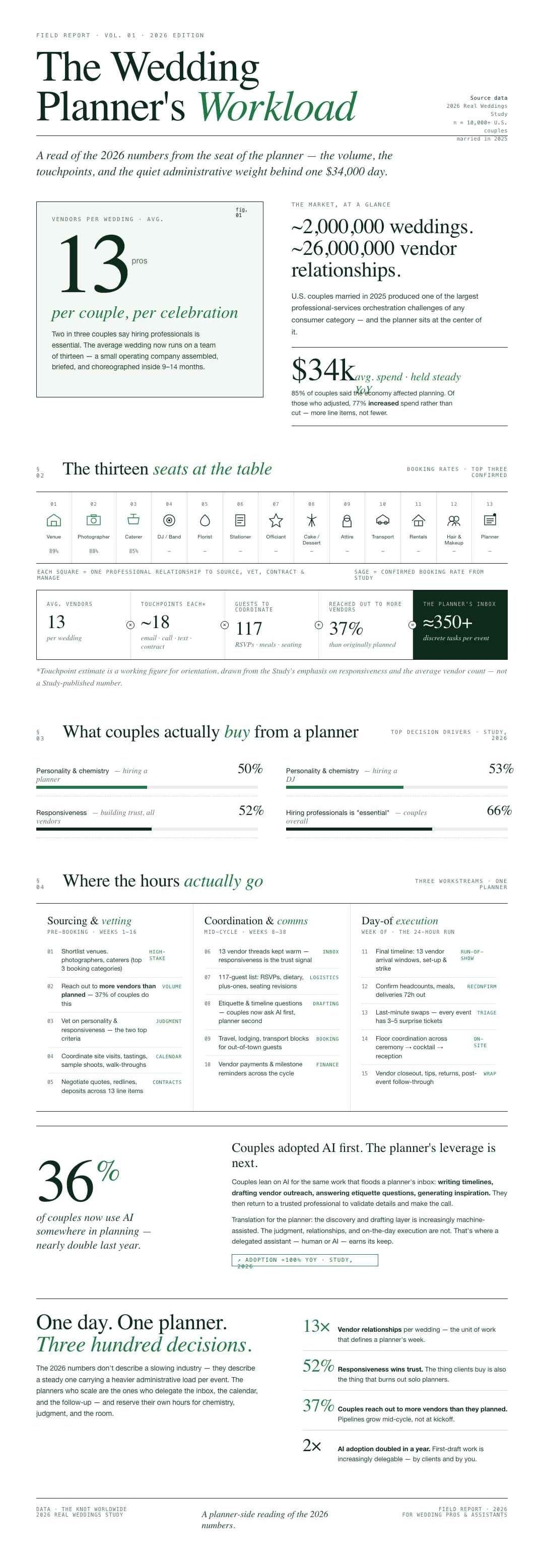
The workload is documented. Couples planning without professional help spend an estimated 200 to 300 hours organizing a single wedding, and one widely cited study put the figure at around 528 hours - about 12 hours a week across a typical engagement. As a planner, you absorb a large share of that load for every couple on your books, multiplied across your whole calendar.
The practical problems that follow are familiar:
- Slow inquiry response loses bookings. Couples often book the planner who replies first and most personally. Inquiries that sit in an inbox for a day go cold.
- Peak-season overload. Spring and fall compress most of the year's weddings into a few months, and admin work spikes exactly when you have the least time.
- Billable design time gets eaten by admin. Hours spent on data entry, email, and chasing COIs are hours not spent on the creative work clients actually pay for.
- Small coordination errors damage reputation. A missed certificate of insurance, a double-booked vendor, or a timeline error on the day is visible to the couple and every guest.
A virtual assistant absorbs the repeatable work so the planner protects both revenue and reputation. If you're weighing whether you've hit that point, these signs you need a virtual assistant apply directly to event professionals.
How can an AI-fluent virtual assistant help a wedding planner today?
An AI-fluent virtual assistant uses AI and automation tools to compress tasks that used to take hours into minutes, while still applying human judgment to client-facing work. The Knot's 2026 study confirms wedding planning has "entered the AI era" as couples and professionals alike now expect AI-assisted workflows. A VA trained in AI tools can easily turns that shift into a scalable advantage.
Concrete examples of AI workflows a wedding planner can put to work this week with the help of a virtual assistant:
- Inquiry triage in minutes. Your VA feeds a batch of inquiry emails into an AI tool that extracts wedding date, budget, guest count, and venue into your CRM, then drafts personalized first replies for your approval, so no lead waits hours for a response.
- Contract and proposal summaries. A 25-page venue or catering contract becomes a one-page plain-English summary flagging payment terms, cancellation clauses, and insurance requirements, so nothing important hides in fine print.
- Mood boards and design concepts on demand. Using tools like Canva and AI image generators, your VA produces three mood-board directions and a branded client proposal deck before your next consultation.
- Run-of-show generation. Feed the vendor list and ceremony details to your VA; an AI-assisted workflow drafts a minute-by-minute timeline that the VA refines and distributes to every vendor.
- RSVP and guest data parsing. Incoming RSVP emails and form responses are auto-sorted into a clean guest spreadsheet with meal choices and plus-ones, eliminating manual data entry.
- Social content at scale. Real-wedding photos get repurposed into Instagram, Reels, and Pinterest content, with AI-drafted captions scheduled out for weeks.
- Workflow automation. Using platforms like Zapier, Make, or n8n, your VA connects your inquiry form, CRM, calendar, and email so a new lead automatically creates a record, books a call slot, and triggers a follow-up sequence.
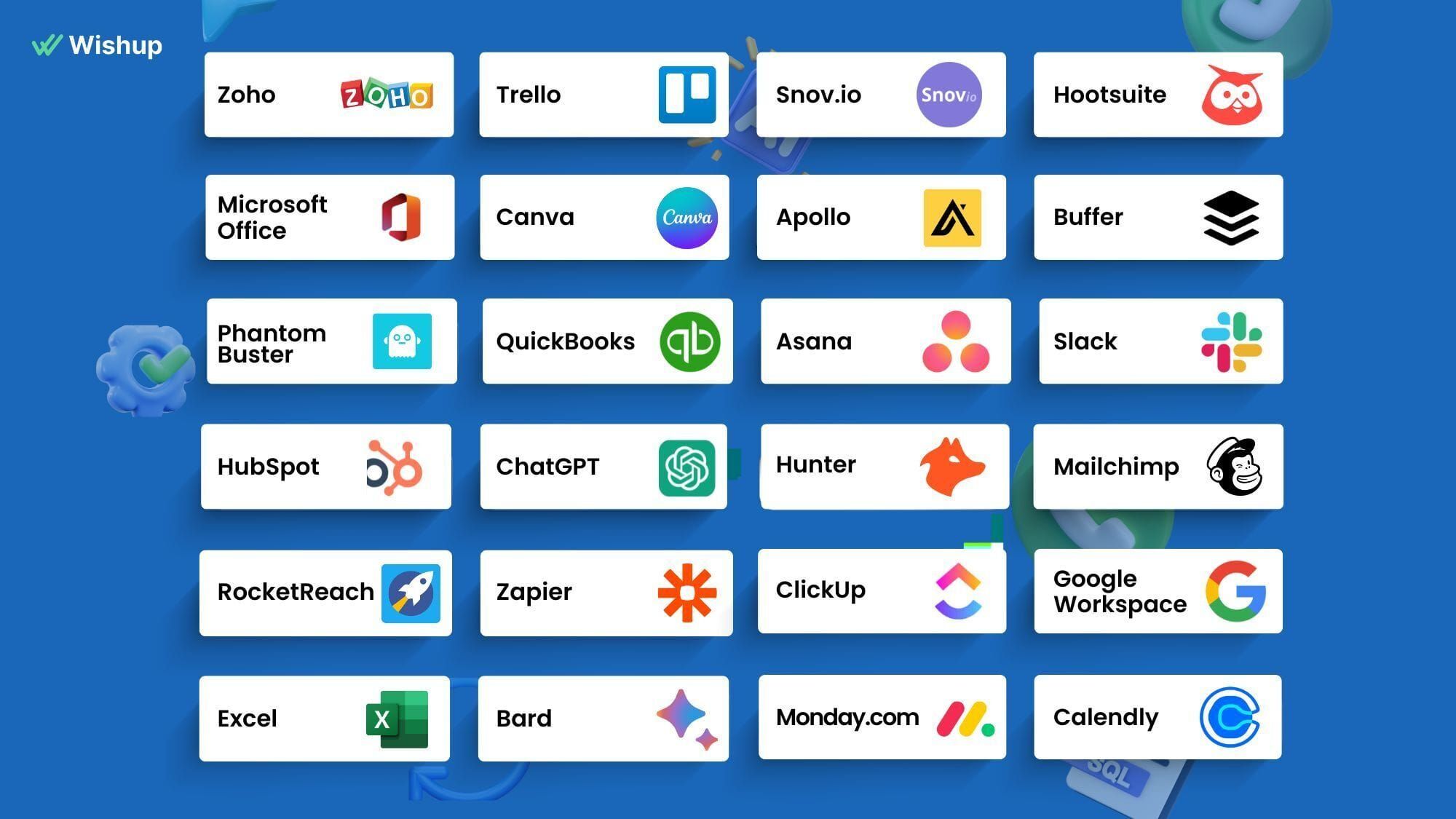
The point is leverage: AI handles the first draft and the data wrangling, your VA handles judgment and quality control, and you handle the couple. Planners who want a dedicated specialist for this can hire an automation expert VA or set up workflow automation as a standing service.
Which wedding planning tasks should you delegate to a virtual assistant first?
Delegate the high-volume, low-judgment tasks first - the ones that consume the most hours and carry the least risk if templated. These give you the fastest time back and let you build trust with your VA before handing over client-facing work.
Start here, in order:
- Inbox and inquiry response. Triage your inbox, apply templates, and reply to new inquiries fast. See inbox management for how this is run as a service.
- Calendar and consultation scheduling. Book discovery calls, venue walkthroughs, and vendor meetings without the back-and-forth. This is core calendar management.
- Vendor outreach and tracking. Send RFPs, collect quotes, and maintain a master vendor sheet with contacts, pricing, and contract status.
- CRM upkeep. Keep every couple's record current - stage, budget, next action - through CRM management.
- Budget and payment tracking. Maintain the spreadsheet, log deposits, and send payment reminders.
- Guest and RSVP management. Track responses, meals, and seating.
- Social media and lead generation. Schedule content and capture inbound leads; many planners pair this with a dedicated social media manager and ongoing lead generation.
Answer Pattern | Action | Reason |
No / Yes / Yes | Delegate immediately | Repeatable, teachable, time-consuming |
No / No / Anything | Automate instead | Simple enough for Zapier, Make, or a scheduling tool |
Yes to Q1 | Keep it yourself | Requires your unique judgment. No SOP can replace it. |
Hold back, at least at first: final design decisions, pricing strategy, sensitive client conversations, and on-the-day lead coordination. Our guide on how to delegate to a virtual assistant walks through deciding what to hand off and what to keep.
What does a typical week with a wedding planning VA look like?
A typical week has the VA clearing admin in the background while the planner runs consultations and design work. The arrangement removes the constant context-switching that makes planning feel like two jobs at once.
A realistic split during a busy stretch:
- Monday: VA clears the weekend's inquiries, qualifies leads, and books the week's discovery calls. Updates the CRM and flags the three couples closest to signing.
- Tuesday-Wednesday: VA chases outstanding vendor contracts and COIs for two upcoming weddings, builds a mood board for a new client, and reconciles last week's vendor payments.
- Thursday: VA finalizes the run-of-show for Saturday's wedding and distributes it to all vendors, confirms timings, and updates the seating chart after late RSVPs.
- Friday: VA schedules a week of social content from a recent wedding's photos, sends review requests to last weekend's couple, and preps your consultation notes for Monday.
Outcome-based sample task brief for wedding planner virtual assistants:
| Field | Details |
|---|---|
| Task | Shortlist wedding photographers for the Oct client - candid/documentary style. |
| Why | Presenting options on Friday's client call. I want to walk in with a strong, vetted shortlist. |
| What I need | A clear comparison I can show the couple: who they are, price, what's included, availability, portfolio. Format it however reads best. |
| Constraints | Candid style, within the photography budget (in the client sheet), available the wedding dates. |
| Deadline | Thursday 3 PM. Flag me earlier if you hit a wall or find something worth a second look. |
The planner spends those same hours meeting couples, walking venues, and designing, with full focus on the work that wins referrals and commands premium fees.

How much does a virtual assistant for wedding planners cost?
The cost of a virtual assistant for wedding planners starts from $1299 per month. It is far less than a full-time in-house hire, because you pay only for the support you need without payroll, benefits, or overhead. Pricing varies by provider, location, and whether you want part-time or full-time support.
The two main models:
- Freelance/hourly VAs are cheapest per hour but require you to source, vet, train, and manage them yourself, and you carry the risk if they disappear mid-season.
- Managed VA services cost more per hour but handle vetting, training, backup coverage, and replacement, so you get reliability instead of a gamble.
For a full breakdown of rates by region and model, see our guide on how much a virtual assistant costs. For most wedding planners, the relevant math is simple: if a VA frees up even a few hours a week that you reinvest into booking one additional wedding, the service pays for itself many times over given the average wedding's value.
How do you hire a virtual assistant for wedding planning?
You hire a wedding planning VA by choosing between a freelancer and a managed service, then matching the assistant's skills to the tasks you most need offloaded. A managed service is the lower-risk path for planners, because wedding season has no room for an assistant who vanishes or needs weeks of training during your busiest months.
Wishup is built for exactly this kind of fast, reliable support. It matches you with a pre-vetted, AI-fluent virtual assistant and is designed around speed and continuity:
- Hire in 60 minutes. You can onboard a vetted VA in about an hour instead of waiting days or weeks to start.
- You interview and choose your VA. Unlike services that assign you someone, Wishup lets you select your assistant yourself.
- AI- and tool-trained. Wishup VAs are trained across 50+ AI tools and 70+ no-code tools, directly relevant to the AI workflows above.
- Same-time-zone coverage. You're matched with a U.S.- or India-based assistant who works in your time zone, so inquiries and vendor messages get answered in real time.
- Free replacement within 24 hours. If a match isn't right, you're not stranded mid-season.
- Top 0.1% selection and month-to-month flexibility. Rigorously vetted talent with no long lock-in.
You can hire a virtual assistant from Wishup and brief them on your wedding workflow the same day. Planners running destination weddings or heavy guest travel can also lean on a virtual travel assistant for room blocks and itineraries.
What should you look for in a wedding planning virtual assistant?
Look for a VA who combines event-coordination instincts, strong written communication, tool fluency, and reliability under deadline pressure. Weddings are unforgiving. The date doesn't move. So, dependability matters as much as skill.
Prioritize these qualities:
- Communication polish. Your VA will email couples and vendors in your name, so their tone has to match your brand.
- Calendar and detail discipline. Timelines, deadlines, and seating charts leave no margin for sloppiness.
- Tool fluency. Comfort with CRMs, spreadsheets, design tools, and AI/automation platforms.
- Composure in peak season. The ability to juggle multiple weddings at once without dropping details.
- Discretion. Couples share budgets and family dynamics; your VA must handle sensitive information professionally.
When should a wedding planner hire a virtual assistant?
A wedding planner should hire a virtual assistant the moment admin work starts crowding out client time, booking, or design, usually well before it feels "affordable." Waiting until you're drowning in peak season means onboarding under maximum stress.
Clear signals it's time:
- You're answering inquiries late at night because there's no time during the day.
- You've turned down or lost bookings because you couldn't respond fast enough.
- Vendor coordination and data entry eat the hours you should spend designing or meeting couples.
- You dread peak season instead of capitalizing on it.
- You want to scale the number of weddings you take on but have no capacity left.
If two or more of these are true, a VA is overdue. Most wedding planners are effectively solo operators, and our guide for solopreneurs hiring a VA speaks to that reality.
How do you onboard and delegate to a wedding planning VA effectively?
You onboard a wedding planning VA effectively by documenting your repeatable processes once, then handing them over with clear examples and a single source of truth. The upfront effort pays back across every wedding the VA touches.
A simple onboarding sequence:
- Document your top workflows. Record short Loom videos or write quick SOPs for inquiry responses, vendor outreach, and timeline building.
- Share templates and brand voice. Give your VA your email templates, proposal format, and tone guidelines so client communication stays consistent.
- Centralize tools and access. Set up shared access to your CRM, calendar, design tools, and budget trackers.
- Start with one workflow. Hand over inquiry management first, confirm it's running well, then layer in the next task.
- Set a weekly check-in. A short weekly sync keeps priorities aligned and catches issues before they reach a couple.
For step-by-step help, see how to onboard a virtual assistant. A managed service like Wishup handles the vetting and training side, so your onboarding is mostly about sharing your processes.
Frequently asked questions
Can a virtual assistant talk to my wedding clients and vendors directly? Yes. Most planners have their VA handle inquiry responses, vendor coordination, and routine couple updates using approved templates and the planner's brand voice, while reserving sensitive or high-stakes conversations for the planner. You decide where that line sits.
Do wedding planning virtual assistants work on weekends, when most weddings happen? It depends on the arrangement. Some planners schedule their VA's hours to include event days for live coordination support; others use the VA purely for weekday admin and handle the day-of themselves. Confirm availability and scheduling flexibility before you hire.
Can a virtual assistant build my wedding-day timelines and seating charts? Yes. Timeline construction, run-of-show distribution, RSVP tracking, and seating charts are core, high-value tasks for a wedding VA, and AI-assisted workflows now make building and updating them much faster.
Will an AI-fluent VA replace my judgment as a planner? No. AI and an AI-fluent VA handle first drafts, data entry, and research; you keep design direction, pricing, and client relationships. The combination gives you more time for the creative and relational work that AI can't do.
How quickly can I get started? With a managed service like Wishup, you can interview and onboard a vetted VA in about 60 minutes, then begin delegating the same day.
Ready to plan more weddings without the burnout? Hire an AI-fluent virtual assistant from Wishup and hand off the admin that's holding your studio back.
