When should I hire in-house data annotators versus outsourcing to a vendor?
Choose in-house when you need tight iteration loops, high trust boundaries, or deep domain expertise that is hard to externalize into written guidelines. Choose external vendors when volume is high, labeling is repeatable, and speed-to-scale matters. A hybrid is common: internal experts define taxonomy, edge cases, and gold standards, while external teams execute high-volume labeling under review. Human-in-the-loop offerings support private workforces (employees or contracted teams), public crowd options, and specialist vendor workforces, which is a useful mental model even outside the Amazon Web Services ecosystem.
What vendor types exist, and what are their structural tradeoffs?
Most suppliers fall into four procurement types: freelancers, boutique agencies, large managed vendors, and crowdsourced platforms. They primarily differ in how they manage worker sourcing, training, redundancy, QA, security posture, and throughput. Crowdsourcing platforms commonly emphasize microtask design, automated QC, and flexible worker pools, while managed vendors like Wishup emphasize dedicated, stringently pre-vetted data annotation specialists, take full ownership of work, and provide the accessibility to scale up and down.
How should I decide between a freelancer, boutique agency, large vendor, and crowdsourced platform?
Treat this as a risk and control decision, not only cost. If you have sensitive data, start by eliminating options that cannot meet security and contractual requirements. Map your project against three axes:
- Label complexity and ambiguity
- Required scale and turnaround,
- Acceptable residual error after QA
Platforms can be cost-effective for simple, well-specified tasks; managed vendors are usually safer for complex or high-stakes tasks because they can implement reviewer workflows, training, and escalation. Public workforce models may require redundancy and stronger QC to manage variance.
What internal roles should I budget for, even if I outsource?
At minimum, budget for an annotation product owner (taxonomy and acceptance criteria), a data engineer (dataset packaging, exports, audits), and a QA lead (sampling plans, disagreement analysis, drift control). If you operate in regulated contexts, assign an information security and privacy reviewer to ensure contractual and technical controls match your data classification. Governance models that emphasize lifecycle risk management align well with this structure.
What does right-sizing an annotation team look like?
Team sizing is a throughput equation plus a QC penalty factor. If you need redundancy (multiple labelers per item) and review layers, your effective throughput is lower than raw labeler throughput. Systems that explicitly recommend multiple labelers per object to improve accuracy reflect the common trade: more votes increase reliability, but increase cost and cycle time.
What is the minimum technical spec I should provide before hiring or outsourcing?
Provide: label ontology (classes and definitions), annotation instructions with positive and negative examples, target output format, acceptance metrics, ambiguity policy, and a change-control process for guideline updates. If you skip any of these, you will pay later through rework and disagreement. Tooling that supports embedded guidelines inside the annotation UI helps operationalize the spec, which is supported by platforms that allow attaching annotator specifications directly in the tool.
What should be in an annotation guideline that actually reduces disagreement?
Write guidelines as a decision system: definitions, inclusion and exclusion criteria, prioritized rules for edge cases, and a “what to do when unsure” section. Include a small calibration set that covers common ambiguities. Vendor workflows that emphasize example-driven instructions and iterative testing on a small private set reflect a proven approach: test, observe errors, revise, then scale.
Which tooling features matter most for a buyer?
Prioritize: role-based access control, auditability, review workflows, consensus or inter-annotator agreement reporting, and robust import/export to your target ML formats. For computer vision work, format support across image and video is a practical requirement. For example, tools that support a wide range of image and video inputs and provide structured role models for organizations better support secure outsourcing.
Should I insist on on-prem or private-cloud deployment?
Require it when data classification or contractual obligations demand strict control. Some annotation platforms explicitly offer self-hosted community editions and enterprise on-prem deployment options, which can be important for regulated buyers and for minimizing data egress.
How should I structure my data exchange and deliverables format?
Define an input manifest contract and an output manifest contract: required fields, IDs, versioning, and annotation payload schema. Ensure the output includes provenance metadata (who labeled, when, tool version, guideline version) so you can audit and debug model failures. If using cloud-native human-in-the-loop systems, storing datasets in object storage with explicit input and output artifacts is a common operational pattern.
How do I use automation or pre-labeling without degrading quality?
Treat automation as a priority queue and a reviewer workload reducer, not as a quality substitute. Active learning and automated labeling approaches can reduce cost and time by focusing human effort on hard examples, but you must keep strong acceptance gates and monitoring to prevent systematic errors from being amplified.
Which quality metrics should I use for annotation work?
Use two layers of metrics.
Layer one measures label correctness against a gold standard: accuracy for classification, precision and recall for detection tasks, and F1 for many NLP tasks where class imbalance matters.
Layer two measures reliability and process health: inter-annotator agreement, reviewer overturn rate, defect density by label type, and drift over time. For object detection, correctness is typically defined by intersection-over-union overlap thresholds between predicted and ground-truth boxes.
What is an inter-annotator agreement, and when should I require it?
Inter-annotator agreement quantifies how consistently different annotators label the same items, and is most valuable when the task has ambiguity or subjective judgment (text sentiment, policy labeling, complex segmentation).
Tools that provide consensus workflows and agreement reporting can operationalize this by intentionally sending the same items to multiple labelers and reporting agreement statistics.
What pricing models should I expect, and when is each appropriate?
Common models include per-label or per-object, per-hour, per-task-duration, and platform subscription plus services. A per-object charge can be layered with workforce costs. Public pricing examples show per-object tiers and per-task charges that vary by task duration, which is a useful way to reason about complexity-based pricing.
Tool vendors often use subscription pricing for the platform and separate service add-ons.
What hidden costs should I budget for when outsourcing Data Annotator for AI Models?
Hidden costs usually come from rework and management overhead: guideline iteration, QA sampling and arbitration, vendor PM time, data engineering for format conversions, and security reviews. If you use a marketplace or crowd system, fees can add up: requester fees, platform fees, and QC fees can be separate line items.
Automated labeling can also introduce computational costs for training and inference, even if it reduces manual labeling volume.
At Wishup, we offer automation experts at a monthly pricing of $1999 for 160 hrs only.
How do I build a budgeting template that prevents surprises?
Build a bottom-up model with these line items:
- Labeling labor
- Redundancy multiplier
- Review labor and arbitration
- Rework allowance
- Tooling and storage
- PM and reporting
- Security and legal overhead
- Contingency
Use pilot data to estimate per-item time and defect rates, then scale. Public task-duration tables are useful priors for time-per-item estimates.
How should I think about ROI for annotation spend?
ROI is improved model performance per dollar and reduced iteration time. Label noise can reduce performance and increase the training sample complexity needed for a target accuracy, so spending on quality can be ROI-positive if it prevents systematic noise.
What baseline security controls should I require from any vendor?
Require least-privilege access, strong identity and access management, encryption in transit and at rest, logging and audit trails, and incident response obligations. Control catalogs like NIST SP 800-53 provide a structured way to translate these requirements into verifiable controls and assessments.
What compliance artifacts are meaningful for annotation vendors?
Ask for independent assurance or certification where feasible. A AICPA SOC 2 report addresses controls relevant to security, availability, processing integrity, confidentiality, and privacy, and is designed for users needing assurance about service-organization controls.
An ISO/IEC 27001 certification indicates an information security management system with defined requirements.
How should I structure GDPR obligations when outsourcing annotation?
If the dataset includes personal data subject to the GDPR, structure the relationship as controller-processor or processor-subprocessor as appropriate, and ensure the contract includes processor obligations (processing instructions, confidentiality, security measures, and sub-processing controls).
For transfers to third countries, consider standard contractual clauses and related transfer safeguards, and ensure they flow down to any sub-processors.
How do I handle sensitive data like PHI or PCI?
Classify data first, then choose a deployment and workforce model that matches the classification. Some managed services explicitly state they do not support PHI, PCI, or certain compliance regimes, so you must validate scope before onboarding.
What operational reporting should I require from a vendor?
Daily throughput, backlog, defect rate, reviewer overturn rate, IAA trends, and change log of guideline updates. Only accept percent complete when paired with quality evidence. Tooling that supports task agreement and review settings makes this measurable.






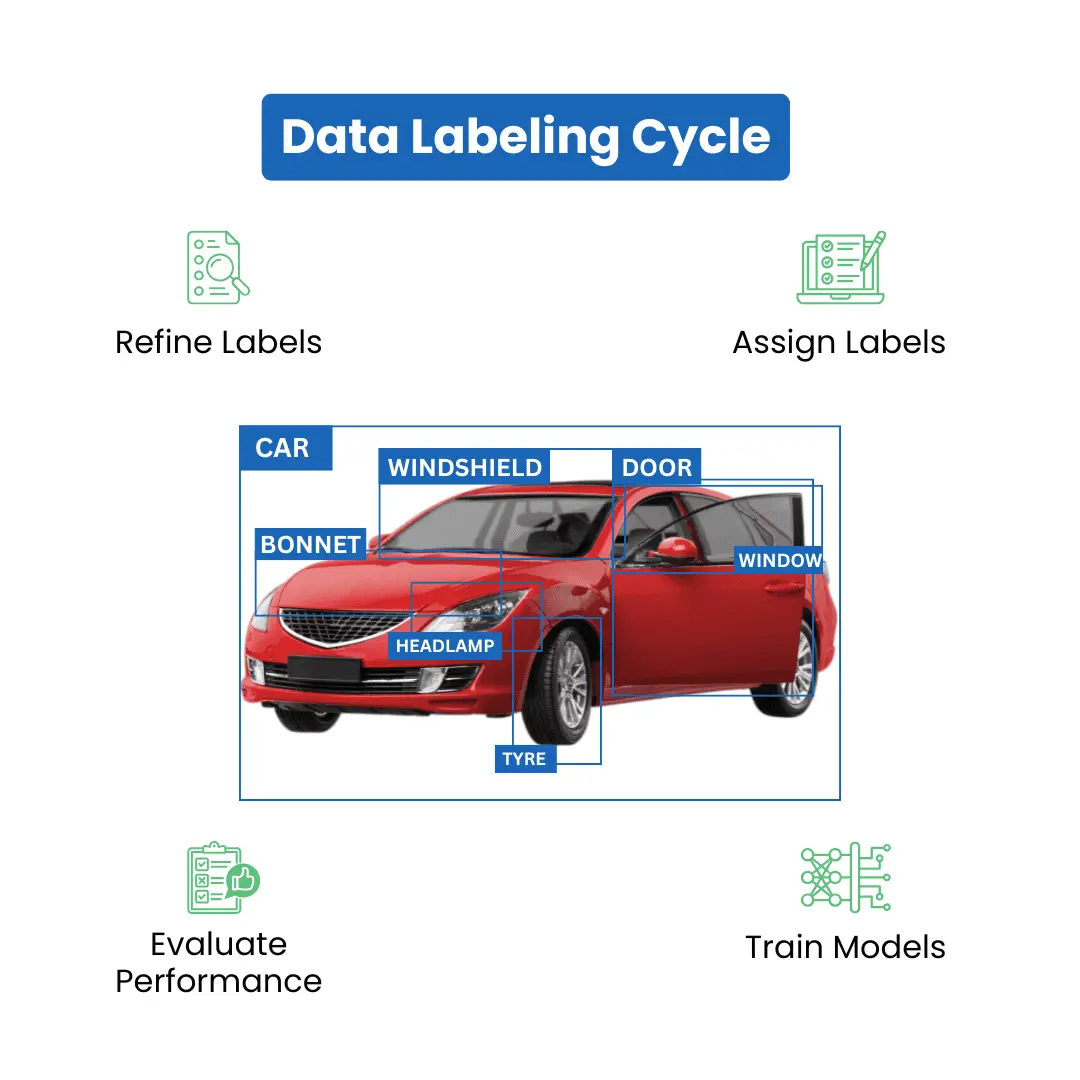
 Image classification











 ▶
▶